
A buyer can have the right sample and still lose control of the order when the quote lives in one chat, the payment terms in another file and the shipping documents in a forwarder’s inbox. Give the order one ID and one versioned control sheet. Each handoff then has a named owner, dated evidence and a clear release decision.
Put the eight stages on one sheet
Use this as the working map for a single purchase order. The actual brief, quote, destination and written terms supply the commercial values.
| Stage | Owner | Input | Evidence + release decision | Next handoff |
|---|---|---|---|---|
| Brief | Buyer | SKU and destination requirements | Dated brief; complete or hold | Candidate |
| Candidate | Verification owner | Supplier and booth/listing identity | Verification record; pass, hold or reject | Quote |
| Quote | Buyer or sourcing owner | Same brief for each candidate | Normalized quote; comparable or incomplete | Sample |
| Sample | Buyer or sample owner | Sample ID and check plan | Approval record; approve, revise or reject | Order |
| Order | Buyer and payee | Approved sample and written order | Order/payment record; release or hold | Production |
| Production | Supplier and follow-up owner | Frozen specification | Progress/deviation log; continue, correct or stop | Inspection |
| Inspection | Inspection owner | Linked inspection plan | Report and decision; pass, hold or reject | Warehouse/shipping |
| Shipping | Shipping owner and broker | Approved goods and route decision | Document handoff; release or hold | Destination |
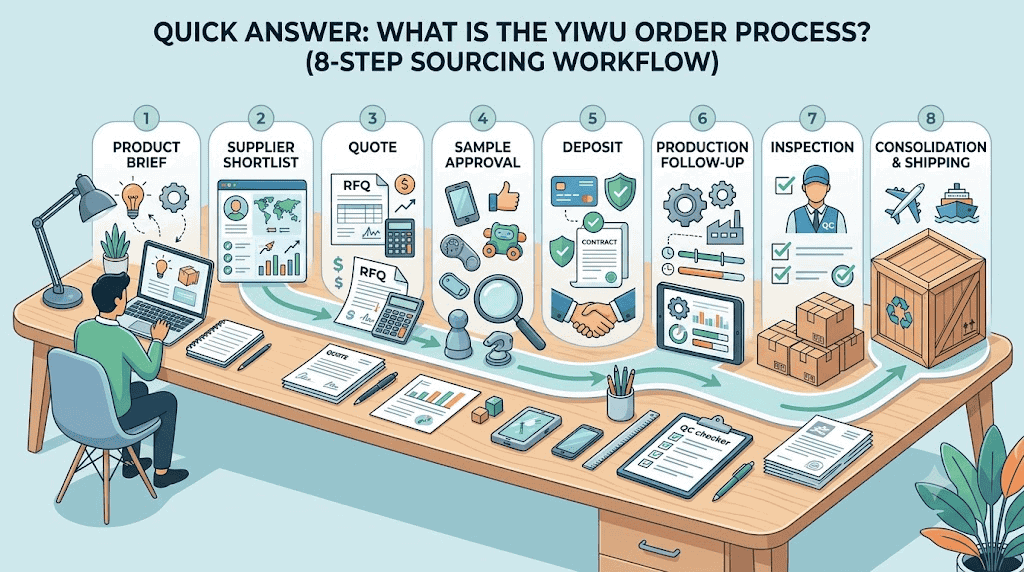
Eight stages in order; the sheet below each stage carries the evidence and release decision.
Freeze the brief before the first quote
Use one brief version for one SKU or one clearly defined set. A change to the product, packing or destination creates a new version and reopens the affected rows.
Capture the order ID, SKU, dimensions, material, colour, function, quantity basis, labels, barcodes, retail and inner packing, carton requirements, destination country, sales channel, required-by event and open safety, labelling, customs or product-document questions. Add the buyer who approves the brief and the date of approval.
For market navigation and product discovery, see How to Source From Yiwu Market. The control sheet begins when a product is specific enough to quote.
Identify the candidate before the verification handoff
Yiwugo’s buyer portal identifies market districts and buyer-service areas.[1] Save the district, floor, booth or online listing used for the candidate. A district page helps locate a category; the contracting entity and payee still need their own evidence.[2]
Yiwugo’s market guidance says suppliers may represent production elsewhere in China and advises buyers to confirm that delivered goods match the store sample.[10] Keep the booth identity, contracting entity, payee and production source in separate fields.
The candidate row needs the contact, product variant, verification owner, decision, evidence path and date. Send the row to the Yiwu supplier verification checklist before money moves. The broader reliable China supplier guide and 1688 verification checklist cover their own platform and verification questions.

Make every quotation answer the same brief
Send the same version to each candidate. A low unit price often changes meaning when material, packing, quantity basis or delivery responsibility changes with it.
| Quote row | Supplier A | Supplier B | Difference to resolve |
|---|---|---|---|
| Exact SKU and brief version | |||
| Unit and quantity basis | |||
| Material, finish and included parts | |||
| Sample and tooling scope | |||
| Retail, inner and carton packing | |||
| Lead-time definition and start point | |||
| Incoterm rule and named place | |||
| Quote validity and exclusions | |||
| Required product/order documents |
ICC describes Incoterms rules as a way to clarify the tasks, costs and risks in delivery from seller to buyer.[3] Write the rule with its named place; the three-letter rule alone leaves the handoff incomplete.
Use the separate Yiwu shipping quote guide for route, rate and transit comparison. Keep its result ID on this sheet.
Let the sample decide what gets ordered
Give the sample an ID that points back to the frozen brief and forward to the written order. Attach dated photos, measurements, material and colour references, included parts, label and packing version, known deviations, completed checks, decision owner and approval date.
A sample that differs from the brief needs a named correction or a new approval. When several suppliers’ samples travel together, the sample-consolidation guide handles that logistics; this sheet carries the approved sample ID and decision.
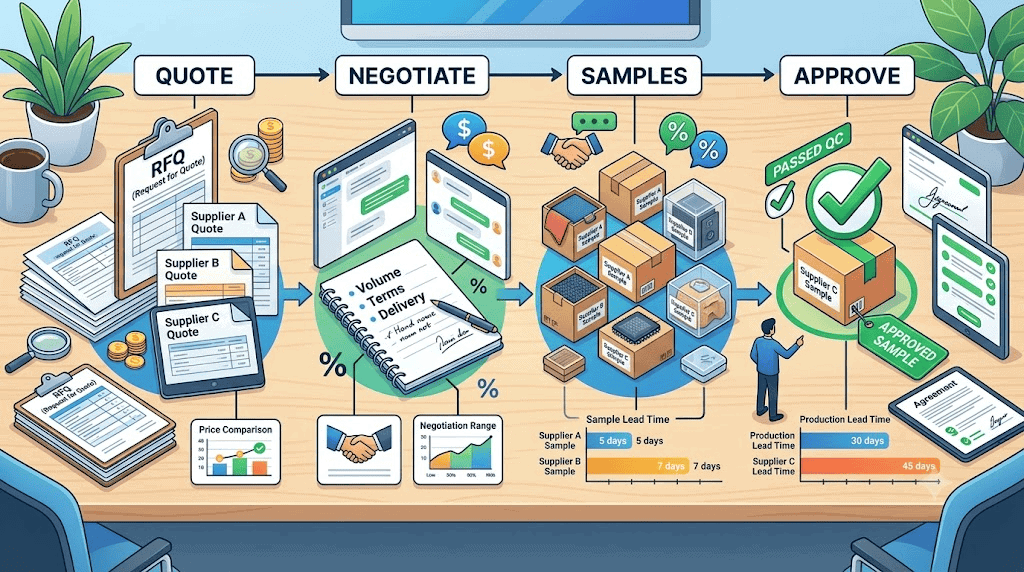
Release payment against the written order
Government trade guidance recommends a clear written contract stating the amount, currency and payment timing.[5] Tie those terms to the approved product version.
Before payment, connect the order ID, brief and sample IDs, cleared seller/payee identity, SKU and quantity basis, price basis, currency, packing, labels, carton marks, Incoterm and named place, production milestone, inspection condition, change-control rule, amount due, remaining amount, trigger for each payment, approver, date and evidence path.
The order determines the deposit arrangement. Fee models belong in Yiwu Sourcing Agent Fees, so the product sheet can stay focused on what releases money for this purchase.

Turn production updates into decisions
For every milestone, save the expected result, the evidence received, the deviation and the decision owner. A message saying “on schedule” becomes useful when it points to a dated progress photo, milestone sheet or inspection note.
If the supplier changes a material, colour, component, label, packing or delivery-date basis, mark the affected brief rows and reopen the relevant sample, quote, compliance, inspection or shipping decision.
| Check date | Expected milestone | Evidence received | Deviation | Decision | New owner/date |
|---|---|---|---|---|---|
Use the inspection result as the release gate
Send the inspection scope to the specialist pre-shipment inspection checklist, which defines the sampling method and decision criteria. ISO’s official metadata describes ISO 2859-1:2026 as a system of acceptance sampling plans for inspection by attributes.[7] The order file records the agreed method, report ID, result, owner and date.
For packaging, attach the package type, distribution route and test-report ID. ISTA distinguishes early screening from shipment-hazard simulation and says the correct procedure depends on the intended outcome.[8]
Warehouse receipt, counting and multi-supplier consolidation continue in the Yiwu cargo consolidation guide. The Quality Control Service page describes service scope.
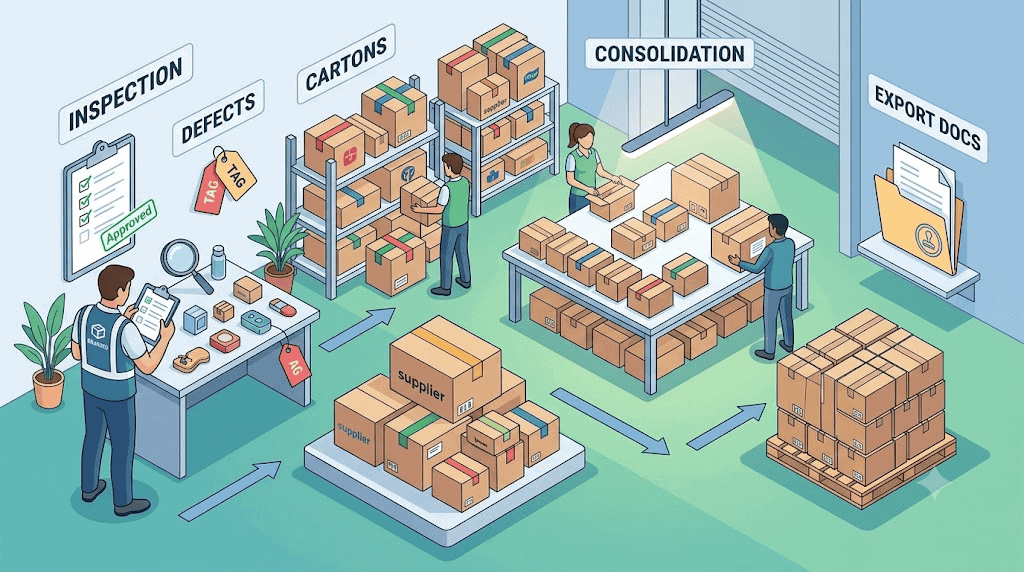
Close the shipping file with the broker
The shipping owner fills in the route and forwarder quote; the broker answers destination-specific questions. Keep the decision and document versions on the same order sheet.
Commercial invoices, packing lists and transport documents each support a different part of the handoff.[4][5] For EU-bound goods, Access2Markets points importers to EORI registration, entry information and documents originating with the exporter.[6]
Save the order and shipment IDs, route-owner evidence path, Incoterm and named place, document versions, broker questions and responses, declared shipper/consignee/goods description across the files, and the shipment release or hold decision.
For US-bound goods, a CBP factsheet records a change to duty-free de minimis treatment effective August 29, 2025 and describes filing requirements for non-postal shipments.[9] Ask a qualified broker which entry route applies to the actual product and shipment.

When an exception stops the handoff
Route the problem first, then keep the result ID in the control sheet.
| Exception | Hold point | Specialist handoff | Keep here |
|---|---|---|---|
| Supplier, payee or specification changed | Candidate/order | Supplier verification | Change, decision and date |
| Sample differs from order | Sample/order | Sample consolidation | Sample and order IDs |
| Inspection result needs action | Inspection | Inspection plan | Report path and next owner |
| Warehouse or carton receipt differs | Warehouse | Yiwu consolidation and carton handoff | Order ID and hold decision |
| Route or transport document changes | Shipping | Shipping quote | Evidence path and release decision |
| Supplier refund or dispute is needed | Recovery | Refund/dispute guide | Case ID, amount at risk and owner |
Keep the order auditable after handoff
The sheet is finished when each stage points to its evidence, decision and next owner. A coordinated China-side review can use the brief, latest quote, destination and current-stage record already attached to the order.
The China Sourcing Service page explains the service scope. Send those four items through the contact page when the handoff needs coordinated support.
Sources
[1] Yiwugo Buyer Entrance
[2] Yiwugo: International Trade Mart District 1
[3] ICC: Incoterms Rules
[4] Business.gov.uk: Understanding International Trade Terms
[5] Business.gov.uk: Understanding Export Documentation
[6] European Commission Access2Markets: Customs Clearance Documents and Procedures
[7] ISO 2859-1:2026: Sampling Procedures for Inspection by Attributes
[8] ISTA: Test Procedures
[9] U.S. CBP: Suspension of Duty-Free De Minimis Treatment Factsheet
[10] Yiwugo Editorial Guide: Source Product in Yiwu Wholesale Market


