
Yiwu Market Booth Checklist: Quote and Sample Tracking Workflow
You are walking Yiwu International Trade City for the first time. A booth sells the exact handbag you want. The price looks right. The seller is friendly. Should you place the deposit on the spot, or is there a minimum set of facts to capture before you walk to the next booth — or to the next district?
The booth card has a WeChat ID and a booth number. Is that enough to find the same seller next season, or do you need more?
You collect ten business cards by lunch. They all look the same. Which facts survive the trip, and which ones fade before you board the train?
A Yiwu market visit can generate more product photos, quotations, cards, and chat contacts than a buyer can compare from memory. Two visually similar products may still differ in material, finish, packaging, quote basis, or follow-up terms. The trap is that the visit feels productive while the post-trip record collapses to a few notes and a confused spreadsheet.
This article is the record system that survives the trip. It is not a district guide, trip logistics guide, route comparison, event article, or generic Yiwu introduction. It is a booth-level workflow: what to record, what to compare, what to hand to a warehouse or consolidation partner, and how to keep the shortlist traceable. The live fetches confirm only that the two Yiwugo URLs are titled for District 1 and District 2. They do not support floor allocations, current booth counts, event details, fees, or market-wide MOQ and lead-time norms.
Yiwu Market Booth Checklist: Record Card
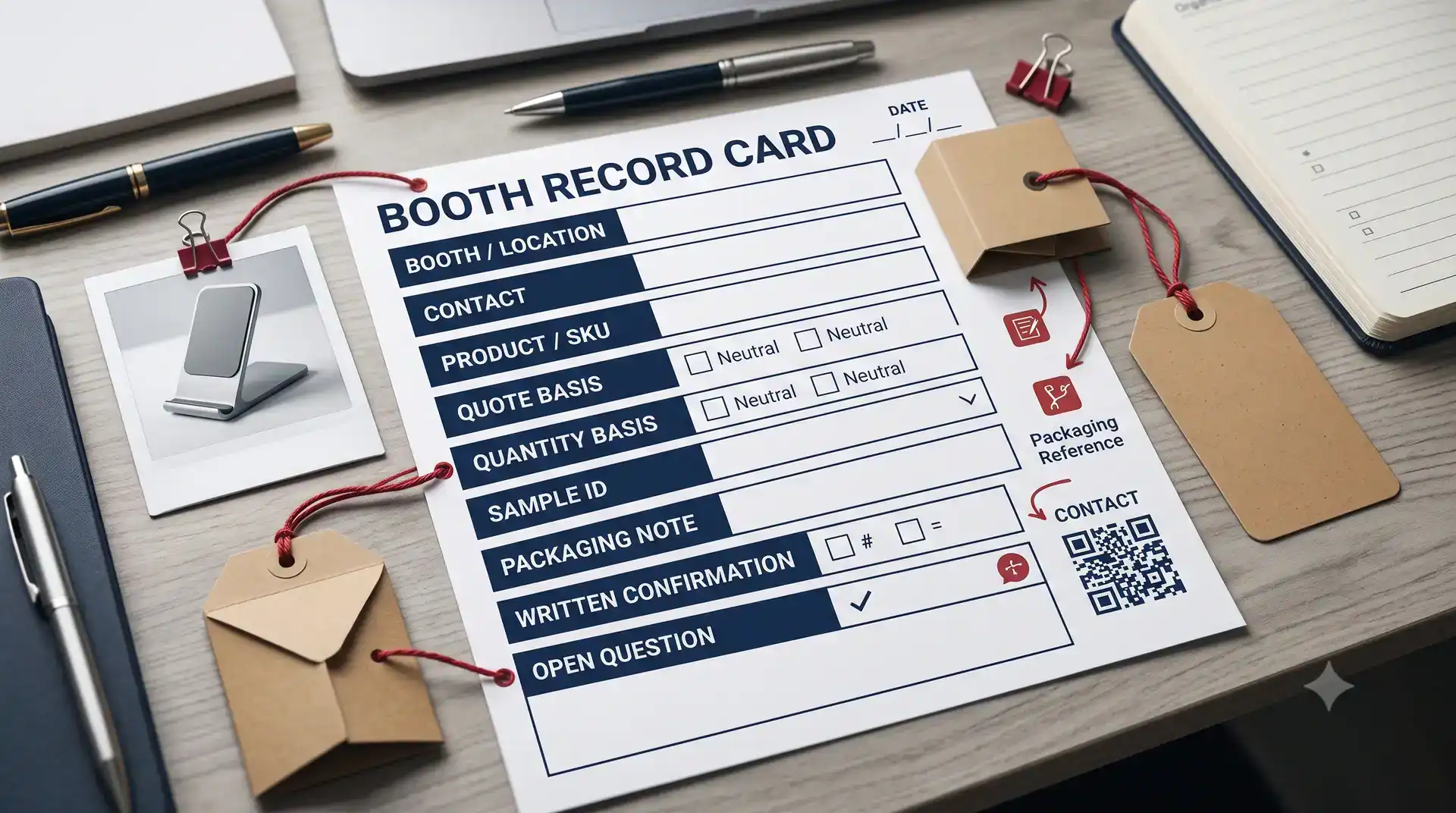
Use the table below as the field set for every booth you visit. If you cannot fill a field, leave it blank and treat the booth as a lower-confidence option in your shortlist. Do not invent numbers to fill the row.
| Layer | Field | Where it comes from | Why it matters |
|---|---|---|---|
| Booth / location | Floor number, district number, booth number, booth name | Booth card, on-site signage | Lets you and your agent return to the same booth next season |
| Booth / location | Photo of the booth card and the frontage | Phone camera | Independent evidence of identity if the booth name changes |
| Seller identity | Seller name (Chinese + pinyin if available), WeChat ID, phone, business card photo | Business card, WeChat QR scan | One reliable contact is the start of post-trip follow-up |
| Product | Booth’s product category, SKU, model number, photo of the item in the booth | Phone camera, booth card | Links the booth to a specific SKU, not just a category |
| Product | Photo of the reference sample you took away with you (if any) | Phone camera | Captures material, finish, and packaging at the visit moment |
| Spec | Material, dimensions, weight, colour/finish, components, accessories | Verbal confirmation + photo + sample | The basis of your quote comparison and your eventual order spec |
| Spec | Brand / trademark status, “no third-party brand” confirmation | Verbal confirmation | Avoids IP issues at customs or at the destination market |
| Quote basis | Unit price, currency, price basis (per piece / per dozen / per carton), price valid-until date, quote-includes list | WeChat follow-up message after the visit | The only way to compare booths fairly is to lock what the quote includes |
| Quote basis | What the quote excludes (packaging, accessories, freight, inspection) | WeChat follow-up message | Prevents surprises when the invoice arrives |
| Supplier-stated MOQ | Minimum order quantity per SKU, MOQ per colour, MOQ per size | Verbal confirmation + written follow-up | Defines whether the booth fits your order size |
| Supplier-stated sample | Sample fee per piece, stated refund condition, sample lead time | Verbal + written | Supports a provisional comparison; verify before payment |
| Supplier-stated packaging | Inner packing (polybag, individual box), master carton quantity, label position | Verbal + photo of the booth’s sample carton | Prevents re-packaging surprises before shipment |
| Supplier-stated production estimate | Lead time from deposit, claimed capacity, peak season note | Verbal + written | Supports planning only; verify before relying on it |
| Follow-up | Date and time of first follow-up message, response time, language used | Your own log | Tests whether the seller is reachable post-trip |
| Warehouse / consolidation handoff | Whether the booth can deliver to a Yiwu warehouse, packaging requirements for handover | Written confirmation | Defines whether the booth fits a multi-booth consolidation plan |
| Shortlist | Tier (A: lead candidate, B: backup, C: drop), reason for tier | Your own evaluation | The single output the rest of your sourcing workflow uses |
The rest of this article is the workflow around the table.
The Booth Visit Problem
A Yiwu visit can produce more information than the buyer’s working memory can hold. Each record may combine a location reference, contact, product photo, quote, and packaging discussion. A buyer who does not connect those records at the booth often has to reconstruct them during post-trip re-quoting.
The classic mistakes:
- Photos without context. A phone full of photos, no booth number, no date, no SKU. Sorting them after the trip is its own project.
- Quote in chat without a quote basis. A seller sends a number over WeChat without specifying whether it is per piece, per dozen, per colour, per size, with or without packaging, FOB Yiwu or EXW booth. The buyer ends up comparing two numbers that mean different things.
- Cards without back-up. The business card is the contact; the booth card is the identity; the WeChat QR is the follow-up channel. If only one of the three is captured, the next season’s reorder starts from scratch.
- Single-supplier mindset. The trip becomes “I found a bag”, not “I compared five booths for one bag category”. Without comparison, the quote you accept is the first quote you got, not the best quote available.
- No warehouse plan. The booth delivers its carton. The buyer’s other cartons are at other booths, on other floors, in other districts. Without a consolidation plan, the trip ends with ten cartons shipped separately from ten booths.
The record system below is the way out of each of these.
What the Live Yiwugo Directory Tells You (and What It Does Not)
The two live Yiwugo URLs used here return page titles for Yiwu International Trade City District 1 and District 2. That is enough to establish limited directory context, but the fetched content does not expose a floor-by-floor allocation, a current booth census, or the commercial terms of any supplier.
That context is useful, but it is not the same as a live, on-site record. Specifically:
- The fetched result exposes the page title, not a live booth count or floor allocation. We do not cite either from this source.
- The fetched result does not establish event dates, allocation rules, or seasonal layouts. We do not cite those.
- The fetched result does not establish MOQ norms, sample norms, lead times, or capability claims. Those must come from a named seller’s written quotation and still require verification.
What this means for your workflow:
- Use Yiwugo as one directory starting point, then confirm the current location through on-site signage or a named contact.
- Use the on-site booth record to capture the booth-level facts that Yiwugo does not show.
- Use the post-trip quote follow-up to lock the price basis, MOQ, sample, packaging, and production estimate that Yiwugo does not show.
If you want to cite Yiwugo in your own sourcing notes, link to the specific district page you used. Do not generalise from Yiwugo to the whole market.
The Booth Record Workflow: Five Steps
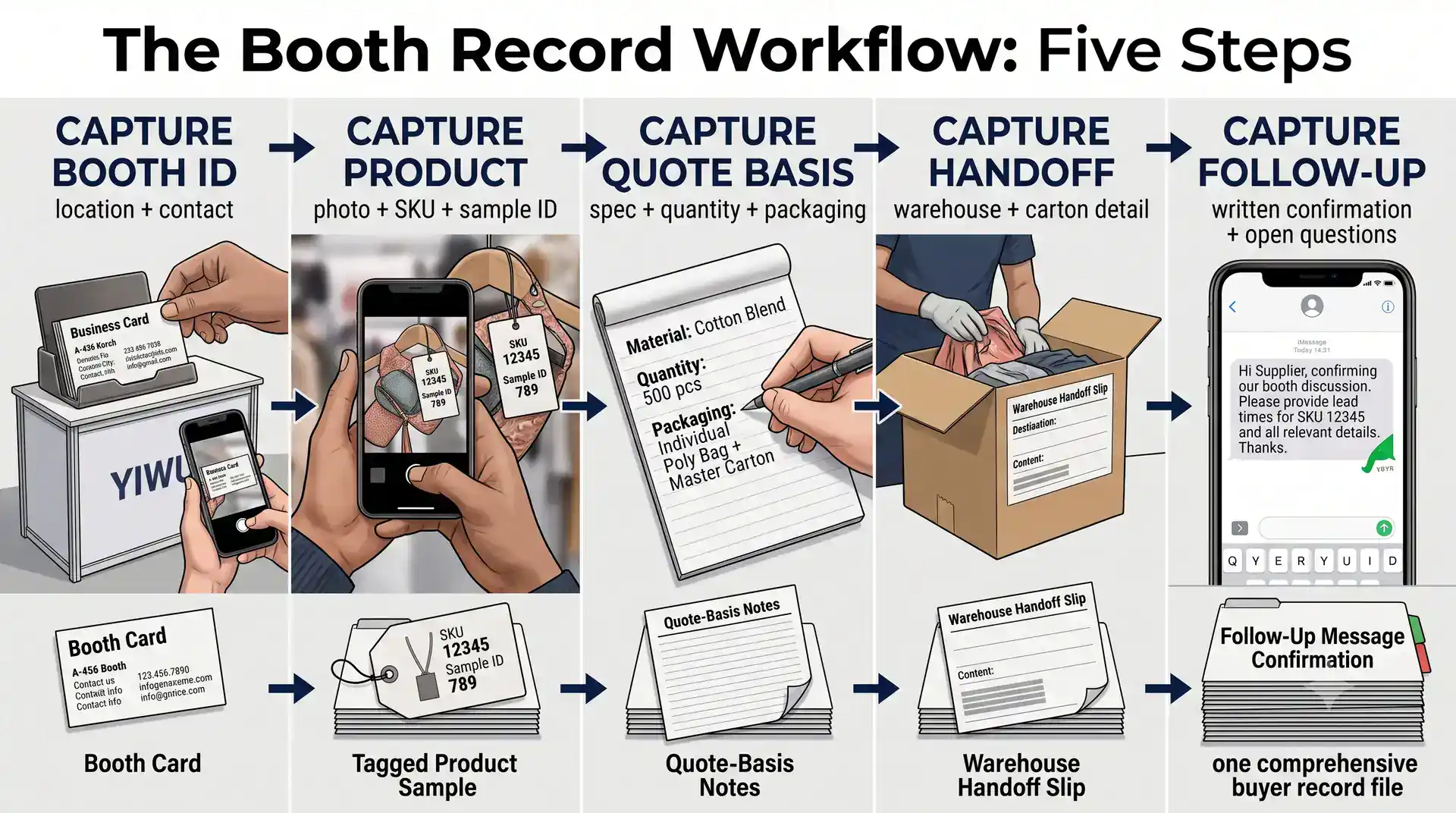
Use the five steps below at every booth. The steps are written for a buyer who is physically at the market; if you use a Yiwu agent to walk the market on your behalf, treat the agent as the “on-site” recorder and review the records the same day.
Step 1 — Capture the booth identity (60 seconds)
- Photograph the booth card (front and back if it has two sides).
- Photograph the frontage with the booth number visible.
- Photograph the business card.
- Scan the WeChat QR from the seller’s phone, not from a printed card if possible.
- Note the floor and the district.
This step is fast and does not depend on the seller speaking English. Photos of cards and frontage are the same evidence whether the seller is talkative or not.
Step 2 — Capture the product (2–3 minutes)
- Photograph the SKU you are interested in, with the booth’s product label or SKU card visible if there is one.
- If the seller offers a paid reference sample, photograph the sample alongside the booth card and a small item with a known size (a coin, your pen) for scale reference.
- Write down the seller’s verbal description of the material, dimensions, and components, even if you plan to confirm later in chat.
The scale reference matters. “About 30 cm wide” is less useful later than a photo of the bag next to your phone or a measuring tape.
Step 3 — Capture the quote basis (3–5 minutes)
Ask four questions, in writing if the seller’s English allows it, and confirm by WeChat after the visit:
- What is the unit price, and what is the price basis (per piece, per dozen, per carton)?
- What does the price include (packaging, accessories, label, hangtag)?
- What is the MOQ per SKU, per colour, and per size?
- What is the lead time from deposit, and what is the seller’s capacity per month?
Write the answers in your record card. Send a summary message after the visit using placeholders until the seller confirms them: “Location reference [ ], product reference [ ], quoted unit basis [ ], quantity basis [ ], packaging included [ ], supplier-stated production estimate [ ], quote date [ ].” Record whether and how the seller confirms or corrects the summary. Do not turn one response time into a universal reliability verdict.
Step 4 — Capture the handoff detail (2 minutes)
If you are using a Yiwu warehouse or a consolidation agent, ask the seller:
- Whether they can deliver to the warehouse, and on what terms (free local delivery, paid local delivery, courier).
- What packaging they use for warehouse handover (master carton quantity, polybag, individual box, label position).
- Whether the seller accepts the warehouse’s stated receiving protocol, including the evidence fields and exception-reporting window agreed for this order.
If the seller cannot deliver to a warehouse, you either accept supplier-arranged freight (which breaks your consolidation plan) or you move on. This is the moment to find out, not after the goods arrive.
Step 5 — Capture the follow-up signal (1 minute)
Before you leave the booth, send the summary message from step 3 and note the reply. A complete written confirmation and an ambiguous one are different evidence signals, but response speed alone does not prove capability or reliability. Record both the content and timing, then verify material terms again before payment.
Comparing Booths After the Trip
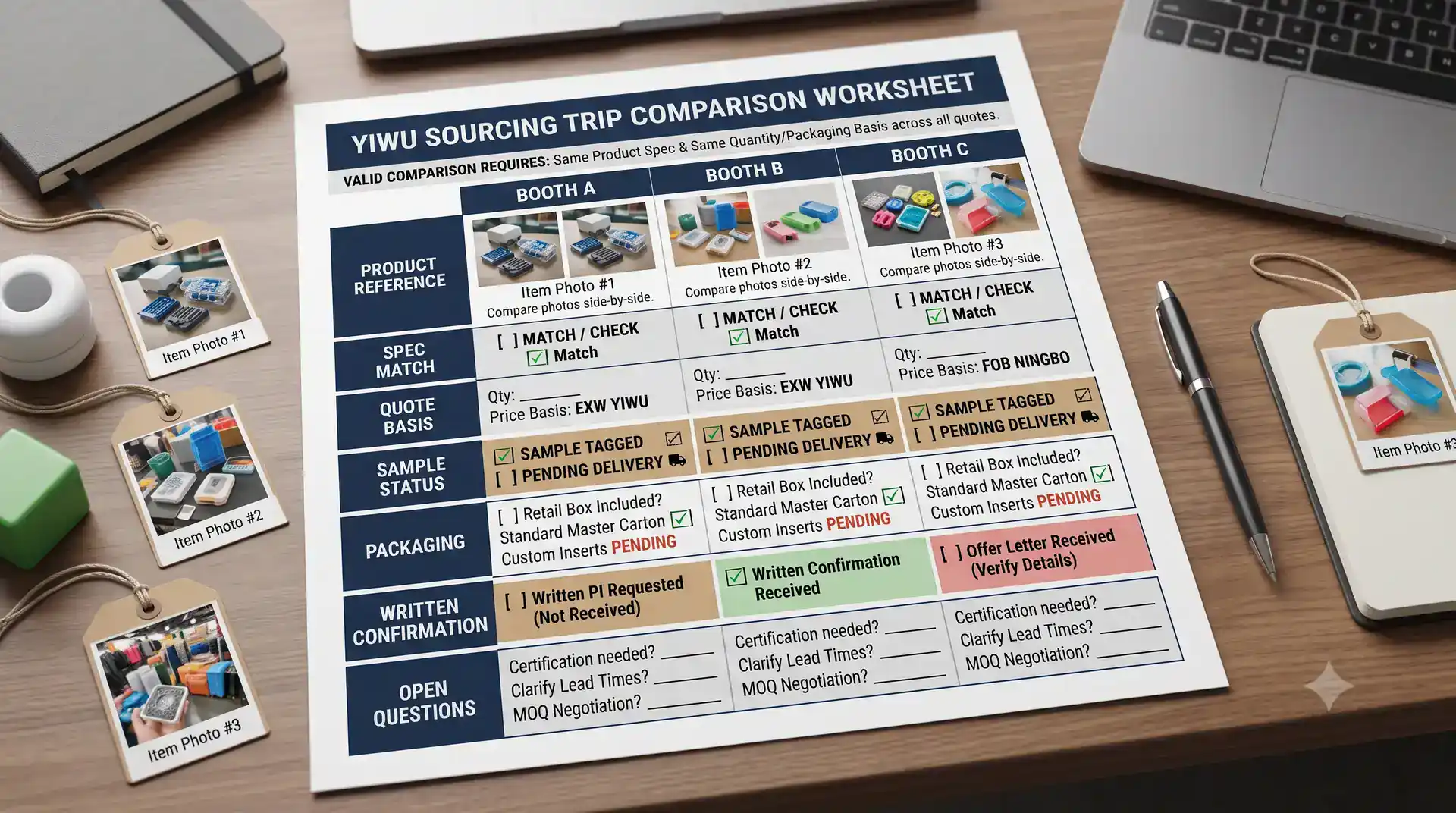
Once the trip is over, the question is which booth deserves the deposit. The comparison is the job of your shortlist, not of your memory. Three rules:
- Compare the same price basis. A ¥X per piece quote that includes packaging and a ¥X per piece quote that excludes packaging are not comparable. Convert both to the same basis before ranking.
- Compare the same MOQ shape. A booth that quotes 100 pieces per SKU and another that quotes 500 pieces per SKU are answering different questions. The booth that can split into smaller per-SKU runs is more flexible, even if its unit price is higher.
- Compare the same follow-up evidence. Record whether each seller confirmed the quote basis, specification, packaging, and next step in writing. Treat speed as context, not as proof of supplier quality.
A useful shortlist output is a one-page table with one row per booth, sorted by tier. Columns: booth ID, seller name, SKU category, unit price on a stated basis, MOQ, lead time, packaging, follow-up response time, tier, and reason for tier. The reason for tier is what you will refer back to when the seller asks why they did not win the order.
The Warehouse and Consolidation Handoff
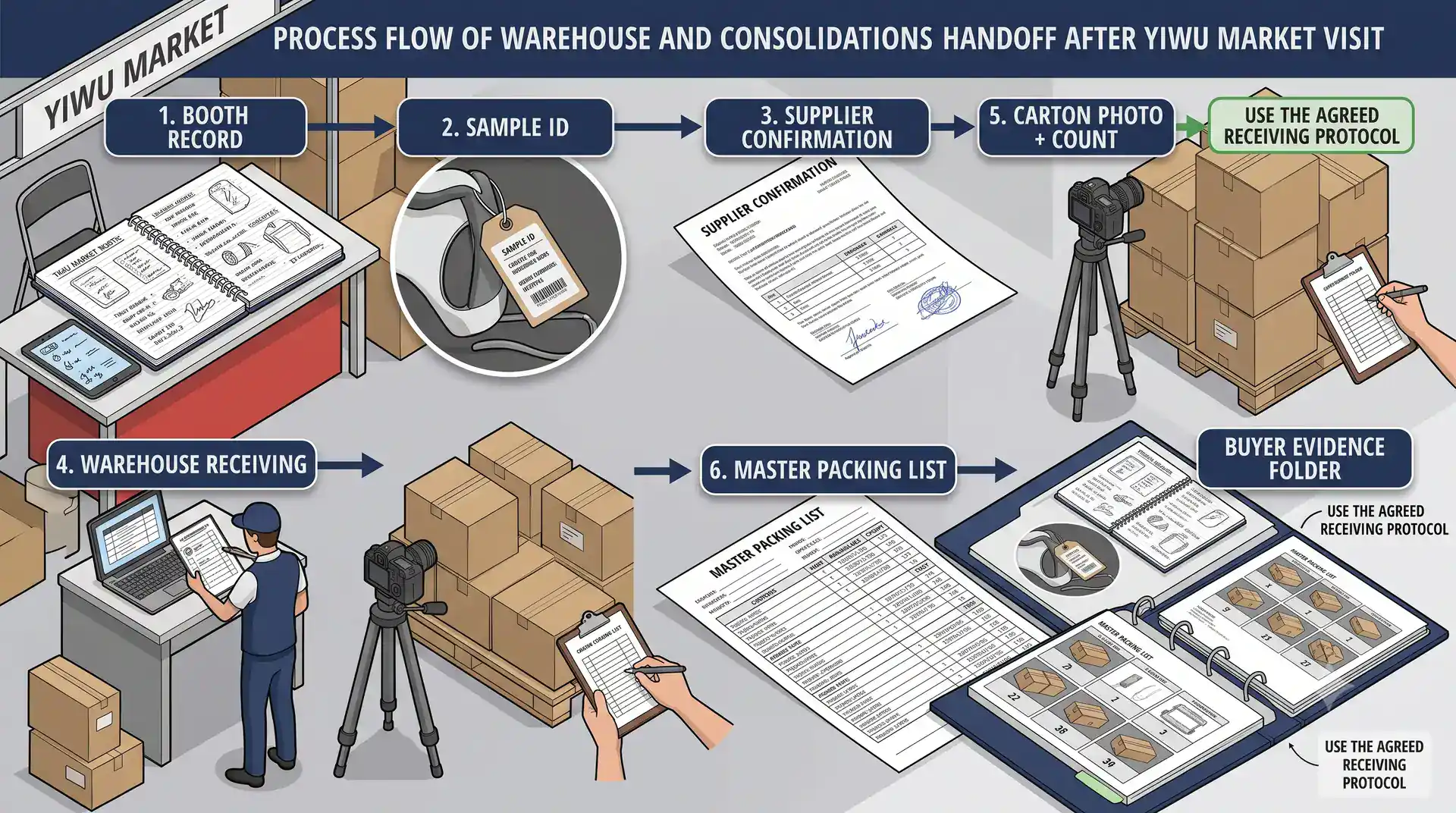
If orders from several booths may move into one export shipment, define the consolidation handoff before paying deposits. A Yiwu-side warehouse or consolidation partner may receive, photograph, count, and store cartons according to an agreed scope. Those services and evidence fields vary by provider and contract.
The four things to confirm before you commit to a booth:
- Delivery to warehouse. Ask the seller to quote the local-delivery basis and exclusions in writing; do not assume it is free or charged per carton.
- Packaging standard. Master carton quantity, polybag, label position, and any required export marking. If the booth’s standard does not match the warehouse’s receiving protocol, the warehouse will re-pack or reject the carton. Confirm the standard in writing.
- Carton marking. Each carton needs a unique mark that ties it to your order and to the booth. A simple scheme (e.g. “Order #2026-08-Y1, Booth D1-2F-A1234, carton 1 of 4”) is enough.
- Receiving protocol. Define photos, count verification, the agreed exception-reporting window, and an escalation route for shortage or visible damage. The warehouse’s scope should match what the seller and buyer agreed to.
These four items do not require a custom contract; they require a one-page written confirmation per booth, signed (in WeChat is fine) before the goods leave the booth.
Bounded Failure Scenarios
Scenario 1 — “The booth quotes a low unit price, but the carton does not include packaging.” A buyer compares ten booths on unit price alone. The cheapest quote omits the polybag and master carton, so it is not comparable with the next quote. Record the price basis and exclusions on the spot.
Scenario 2 — “The booth’s WeChat replies stop the day after the deposit.” A buyer ranks a booth from a friendly visit but never sends a written summary of the quote. Later, neither side can point to a confirmed packaging basis. Capture the follow-up evidence before the deposit; friendliness is not a record.
Scenario 3 — “The seller’s name on the card is the seller’s sister-in-law, who runs a different booth.” A buyer records only a contact name. On the next visit, the location has changed and the old card is ambiguous. Save the booth or location reference separately from the person’s name.
Scenario 4 — “The sample is perfect, but the bulk production is not.” A reference sample looks right, but its tag is not connected to the bulk-order SKU. When production starts, the buyer cannot prove which sample was approved. Link the physical sample, photo, SKU, and dated approval before ordering.
Scenario 5 — “The directory reference does not match the on-site location.” A buyer starts with an online district page, but the named contact or on-site signage points elsewhere. Treat the fetched Yiwugo titles as limited directory context, not a verified live floor plan. Record the current location at the booth and date the evidence.
FAQ
How many booths are there in Yiwu International Trade City?
We do not cite a current booth count from the live Yiwugo fetch because it exposed page titles only, not a live directory census. A current count should come from a source that explicitly publishes and dates that figure.
Does Yiwugo show event dates, allocation, or seasonal layout?
The Yiwugo pages we read show district-level category browsing. They do not show event dates, allocation rules, or seasonal layouts in the pages we used. We do not cite those.
Is the same booth listed on Yiwugo and on-site?
The Yiwugo listing tells you which floor and district carries a category. The on-site booth card tells you the booth’s name and number. Use both, but treat them as separate evidence. The on-site record is what survives the trip.
Do I need a Yiwu-side agent to use this checklist?
No. The checklist works whether you walk the market yourself or use a Yiwu-side agent. If you use an agent, the agent becomes the on-site recorder. The fields you capture do not change.
Is the sample fee refundable against a bulk order?
Some booths refund the sample fee against a confirmed bulk order; others do not. Capture the seller’s stated policy in writing on the day of the visit. We do not cite a market-wide sample-fee norm.
Is this checklist a Yiwu district guide?
No. The article’s unique intent is the booth-level record and comparison workflow. For a Yiwu district guide, see our existing Style Sourcing district guide and market guide content.
How Style Sourcing Can Help
If you are planning a Yiwu trip and want the record system to be set up before you fly, we can prepare the booth record card template for your product category, align the warehouse handoff protocol with the booths you plan to visit, and review the post-trip shortlist with you. We do not promise booth counts, fees, MOQ norms, lead times, quality outcomes, or capability assessments that the live source does not support. The starting point is your product, your order size, and the destination market.


