
Paid the 1688 supplier, got the tracking number, and now you are refreshing it every few hours?
Wondering what really happens after the supplier hands the cartons to the local Chinese courier?
And who actually checks the goods before they leave China — you, the supplier, or somebody else?
That is the stage many short 1688 guides do not explain in enough operational detail.
They focus on registration, search, messaging, payment, and “shipping from China.”
But the gap between supplier dispatch and international shipping is where an importer can lose visibility, time, money, and trust.
This guide walks you through what happens after a 1688 supplier ships your order, step by step, so you can decide what you want to handle yourself and what you want a Chinese-side team to handle for you.
Quick Answer: What Happens After a 1688 Supplier Ships?
After a 1688 supplier ships your order, the typical flow is:
- the supplier hands cartons to a domestic Chinese courier;
- the cartons travel to a China-side warehouse (yours, an agent’s, or a 3PL’s);
- someone receives the cartons, counts them, checks external condition, and ideally checks internal contents;
- any visible mismatch or defect is raised back to the supplier on 1688;
- cartons from multiple suppliers can be consolidated into one shipment;
- the consolidated goods are packed, labelled, and prepared for international shipping (air, sea, courier, or freight).
In other words: the supplier’s job ends at their warehouse door. Everything after that is your responsibility — or whoever you choose to take it on.
If nobody on the Chinese side is watching this stage for you, you are essentially flying blind until the goods arrive overseas.
Why This Stage Matters More Than Most 1688 Buyers Expect
1688 has very competitive prices.
But those prices usually assume you have someone in China to receive, check, and consolidate the goods before they leave.
If you do not, three things tend to go wrong:
- wrong quantities arrive;
- visible damage is discovered only when the cartons are opened at your overseas warehouse;
- consolidating multiple suppliers’ orders becomes expensive and chaotic — separate shipments, separate freight bookings, no packing list.
These are not exotic risks. They are common risks when buyers try to handle a first 1688 order remotely without a Chinese-side receiving process.
The post-shipment stage is also where:
- reporting, after-sales, or dispute windows may start running, while evidence becomes harder to reconstruct after a long delay;
- international freight costs are decided (carton size, weight, and stackability matter);
- export documentation (packing list, commercial invoice, HS codes if relevant) needs to be prepared;
- last-mile mistakes (wrong shipping mark, wrong consignee, missing cartons) become expensive to fix.
So this is the stage where the gap between “I saved money on 1688” and “I lost money on shipping + QC issues” is decided.
The Post-Shipment Workflow: 7 Stages After a 1688 Supplier Ships
Below is a practical workflow for 1688 importers using a Chinese-side receiving process.
You do not have to handle all seven yourself. The point is to know what each stage does, so you can decide who owns it.
Stage 1: Supplier Hands Cartons to a Domestic Chinese Courier
After production is finished, the 1688 supplier usually packs the goods into cartons and arranges a domestic courier pickup.
- For sample-size orders, this is often a small-package courier (SF, YTO, ZTO, Yunda, etc.).
- For bulk orders, this is usually a logistics company (德邦 / 安能 / 中铁 / a专线 carrier).
What to confirm with the supplier at this stage:
- How many cartons are in the shipment, and their sizes (L × W × H in cm).
- Total weight.
- Whether the supplier uses a master carton or single-product cartons.
- Domestic courier name and tracking number.
- Estimated arrival at the receiving warehouse.
Common mistake:
Asking the supplier to “ship it” without confirming the above. Then the receiving side has to guess how many cartons to expect, and what to do when the number is off.
Stage 2: China-Side Warehouse Receiving
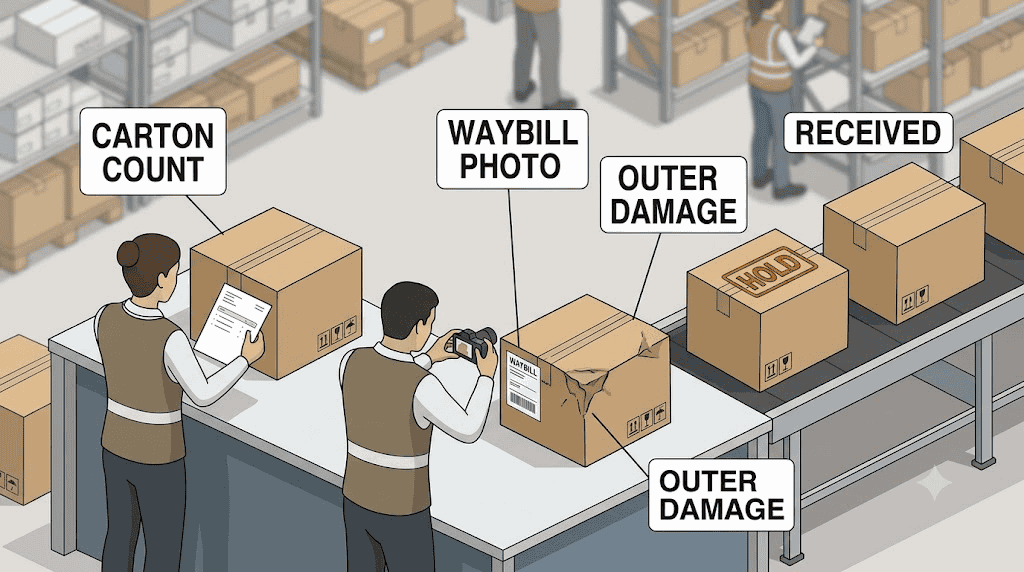
[Image placement — Body image 1: warehouse receiving checklist showing carton count, photo evidence, and visible-defect checks. Recommended alt: “warehouse receiving checklist showing carton count photo evidence and visible defect checks”]
When the cartons arrive at the warehouse, someone needs to physically receive them.
This is not just “signing for the delivery.” A real warehouse receiving process includes:
- Counting cartons against the supplier’s shipping note.
- Photographing the outside of each carton.
- Photographing the courier waybill (so the tracking chain is documented).
- Flagging any carton with visible damage (dent, crushed corner, wet carton, broken seal).
Why this matters:
- If a carton is already damaged on arrival, document it and notify the relevant supplier, platform, warehouse, or domestic carrier promptly. The available reporting window depends on the order and channel.
- If the carton count is wrong, you can raise an exception on 1688 while the dispute window is still open.
- If you skip this stage, you may not see the goods until they reach your overseas warehouse, when evidence collection and correction are usually more difficult.
Stage 3: Carton Condition and Photo Evidence
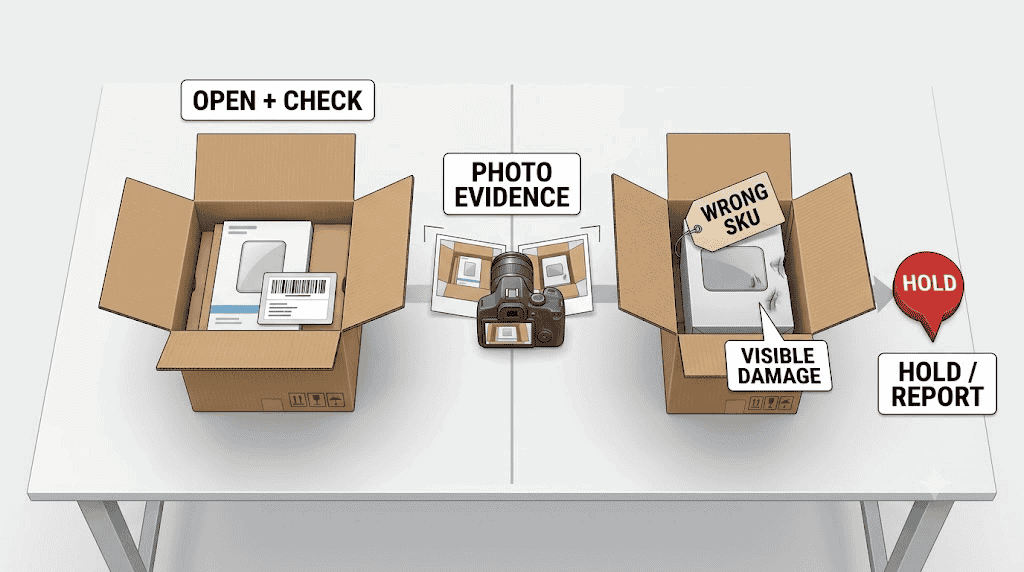
[Image placement — Body image 2: side-by-side intact carton and visibly damaged carton, with generic labels only. Recommended alt: “carton photo evidence comparing intact and visibly damaged 1688 supplier shipments”]
External condition alone is not enough.
Once cartons pass the outside check, the next step is opening them and confirming the contents, at least at sample level.
The opening scope should be agreed for the specific order. Options include:
- opening selected cartons under a buyer-agreed sampling plan;
- opening every carton when the order risk and agreed scope require it;
- checking each SKU or variant under an agreed coverage plan for mixed orders.
Photo evidence should capture:
- The product inside the carton.
- The way it is packed (foam, bubble wrap, dividers, polybag).
- Any visible defect (scratch, dent, wrong colour, wrong size, missing accessory).
- The label / barcode / shipping mark on the carton and on the product.
Common mistake:
Skipping internal checks because the outside of the cartons looks fine. Many quality issues are not visible until the carton is opened.
For a documented way to connect inspection evidence with payment, customs, and handoff decisions, see our China Sourcing Evidence Trail: Sample, Payment, Inspection and Customs Handoff.
Stage 4: Raising Exceptions on 1688
If receiving or internal checks find a problem, the buyer needs to raise it on 1688 quickly.
What can be raised:
- Wrong quantity (missing units, extra units, wrong SKU).
- Wrong product variant (size, colour, model).
- Visible damage documented by photo.
- Carton count mismatch.
1688 reporting and dispute windows are not unlimited. A stronger evidence package is usually:
- raised promptly and within the order/platform’s applicable window;
- backed by clear photo evidence;
- kept factual and specific (avoid emotional language).
Common mistake:
Quietly accepting the goods and hoping the issue resolves itself later. By the time the goods are on a ship or a plane, 1688 dispute leverage is essentially gone.
Stage 5: Consolidation (If Multiple Suppliers)
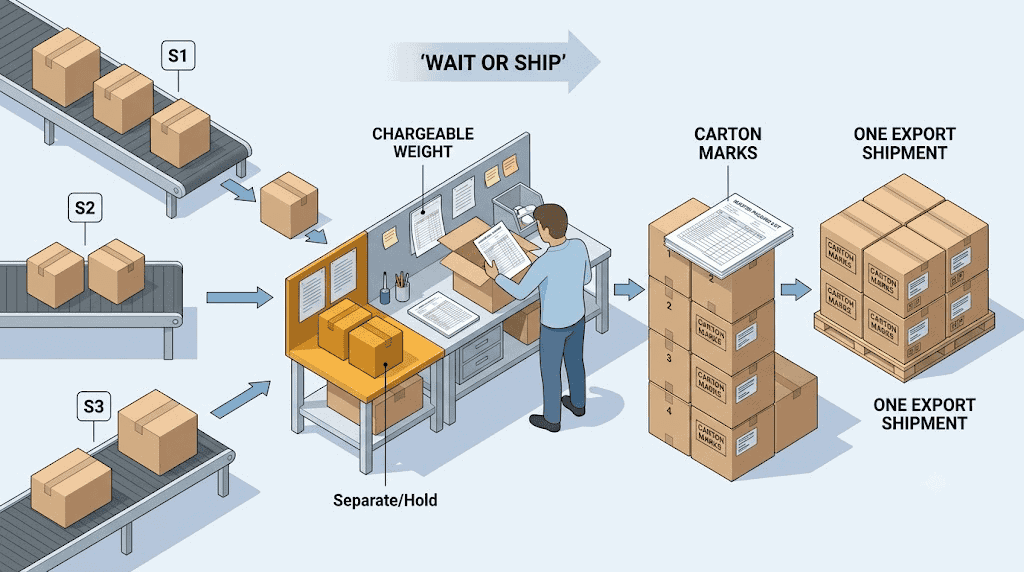
[Image placement — Body image 3: several supplier cartons moving through a consolidation bench into one numbered export shipment with a packing list. Recommended alt: “consolidation flow from multiple 1688 supplier cartons into one export shipment”]
If your order came from more than one 1688 supplier, cartons from different suppliers may arrive at different times.
Without consolidation, you would have to:
- ship each supplier’s cartons separately internationally;
- pay separate international freight;
- receive multiple shipments at your overseas warehouse;
- sort and merge them yourself.
With consolidation, all the cartons are gathered at one Chinese warehouse, repacked into export-ready cartons, and shipped as one international shipment.
Consolidation decisions to make:
- Which suppliers wait for each other, and which ship immediately?
- How to repack to reduce wasted space (carton size, filler, master carton).
- How to keep a packing list per supplier and a master packing list for the whole shipment.
- How to label each export carton so the receiving warehouse can match them to the master packing list.
Common mistake:
Accepting separate international dispatches without comparing chargeable weight, handling, timing, and compatibility against a consolidation option.
Stage 6: Export Documentation
Before the goods leave China, you need at minimum:
- A packing list (what is in each carton, by SKU and quantity).
- A commercial invoice (for customs clearance overseas).
- The shipping mark / consignee label on each carton.
- For certain product categories: certificates, test reports, or declarations (verify category-specific requirements).
For a buyer-ready document handoff checklist, see China Import Document Checklist for Overseas Buyers.
If you do not have a Chinese-side team, this stage often becomes a scramble: documents are typed up by the buyer, sent to the supplier, and reviewed at the last minute, with frequent errors.
Common mistake:
Treating export documentation as only “the freight forwarder’s job.” The party preparing the goods still needs to provide accurate product, quantity, packing, and destination information; responsibility should be agreed for the actual shipment.
Stage 7: International Shipping Handoff
The last step is handing the consolidated, documented cartons to the international freight provider:
- Air courier (DHL, FedEx, UPS) for small urgent shipments.
- Air freight for medium-volume urgent shipments.
- Sea freight (LCL or FCL) for larger or non-urgent shipments.
- Dedicated line / railway for specific corridors (e.g., China-Europe rail).
What to confirm at handoff:
- The booking references.
- The destination address and contact.
- The declared value (for customs).
- Any special handling (fragile, no-stack, temperature-controlled, etc.).
Common mistake:
Choosing shipping mode based on the cheapest quote, without checking cut-off times, customs requirements at destination, or warehouse receiving hours. The cheapest quote is not always the cheapest total cost.
Who Actually Handles All of This?
Realistically, there are three common models for foreign 1688 buyers:
| Model | Who handles the post-shipment stage? | Pros | Cons |
|---|---|---|---|
| Fully DIY | You handle receiving, photos, exceptions, consolidation, docs, and shipping yourself (or with a remote helper) | Lowest direct cost | High risk of missed issues, late exceptions, expensive fragmented shipping |
| Partial agent | A Chinese-side agent handles receiving + photos + exceptions; you handle shipping booking yourself | Balanced cost and risk | You still need to coordinate shipping and docs |
| Full-service sourcing agent | The agent handles receiving, photos, exceptions, consolidation, docs, and shipping | Lower buyer coordination load; one team can connect the stages | Higher direct service scope; need to vet the agent before paying |
The best model depends on your order value, supplier count, Chinese-language ability, warehouse setup, and the level of evidence or control you need.
What to Confirm Before You Pay the 1688 Supplier
To make the post-shipment stage run cleanly, these are the things you should agree with the supplier before paying the deposit:
- Final quantity per SKU.
- Carton plan: how many cartons, sizes, weight.
- Whether the supplier uses master cartons or single-product cartons.
- Inner packing (polybag, foam, dividers, silica gel, instruction sheet).
- Carton labels: SKU, quantity per carton, shipping mark.
- Domestic courier name and typical delivery time to the receiving warehouse.
- Who pays the domestic shipping fee to the receiving warehouse.
- Who is responsible if a carton is damaged in domestic transit.
These confirmations are not optional polish. They are the difference between a clean receiving process and a long email chain after the goods arrive.
Common Post-Shipment Problems and How to Prevent Them
Below is a quick reference table of the most common issues, what causes them, and what you can do at each stage to reduce the risk.
| Problem | Typical cause | Prevention stage |
|---|---|---|
| Wrong carton count | Supplier shipped short, or domestic courier lost cartons | Receiving stage (Stage 2) |
| Visible carton damage | Poor packing, rough domestic transit | Confirm packing before deposit; receiving stage (Stage 2) |
| Wrong SKU inside | Supplier mixed production batches; wrong label | Internal check (Stage 3) |
| Wrong colour / size | Supplier substituted material or production run | Sample approval before bulk; Stage 3 |
| Mixed supplier shipments arrive at different times | Different suppliers’ lead times | Consolidation planning (Stage 5) |
| 1688 dispute rejected as “too late” | Buyer waited too long to raise | Report promptly and check the applicable order/platform window (Stage 4) |
| International shipping cost higher than expected | No consolidation, oversized cartons, wrong mode | Consolidation (Stage 5) + shipping mode choice (Stage 7) |
| Wrong shipping mark / consignee | Manual labelling error | Packing list + photo check (Stage 6) |
| Customs delay overseas | Missing or wrong export docs | Stage 6 |
Notice that almost every problem has a prevention step inside the Chinese-side process. That is why the post-shipment stage matters.
How Style Sourcing Can Support This Stage
If you want someone on the Chinese side to handle parts of this stage, Style Sourcing can support the practical steps without making outcome promises.
The kind of support that fits:
- Receive cartons from 1688 suppliers at a China warehouse.
- Count cartons and photograph external condition.
- Open sample cartons, take internal photos, and flag visible defects.
- Raise specific, photo-backed exceptions on 1688 on your behalf.
- Consolidate cartons from multiple suppliers into export-ready cartons.
- Prepare packing lists and basic export documentation.
- Hand off consolidated cartons to your chosen international freight provider.
If you would like this kind of support, send your 1688 supplier list and tracking numbers to Style Sourcing, and we can walk through which of these steps make sense for your order.
No fee, timeline, or outcome is guaranteed here. The exact scope depends on your order size, product type, and destination.
FAQ
Should I track every 1688 shipment myself?
You should at minimum confirm the tracking number and the expected arrival window with each supplier. Day-to-day tracking can be delegated if you trust the receiving side, but you should still be able to see the tracking status when needed.
What if a 1688 supplier refuses to acknowledge a problem after the goods arrive?
Document everything with photos, keep timestamps, and raise the issue on 1688 with the photo evidence within the dispute window. If the supplier still refuses, you can file a formal dispute on 1688 rather than relying on informal chat messages.
How long after receiving should I raise an exception on 1688?
Raise it as soon as the issue is documented. Check the exact order and platform process rather than relying on a universal number of hours; available options can depend on order status, evidence, category, and channel.
Do I really need consolidation if I only have 2 suppliers?
It may still be useful, but it is not automatically cheaper. Compare chargeable weight, repacking, handling, timing, compatibility, and destination requirements before choosing one combined shipment or two separate shipments.
What if the receiving warehouse is not near the international airport or port?
That is normal in China. Most Chinese-side warehouses are inland. The consolidation step is what makes the goods ready for a single international shipment from the nearest port or airport.
Can I do all of this without an agent?
Yes, if you have enough time, Chinese-language support, a reliable receiving warehouse, and a clear evidence and shipping process. An agent is one option for coordinating those steps, but its cost and scope should be compared against your own setup.
Suggested Next Steps
- If you are still paying the 1688 supplier, confirm the carton plan and packing details before deposit. See our supplier verification checklist for the pre-payment stage.
- If your supplier has already shipped, prepare to receive and consolidate as soon as the cartons arrive.
- If you want a Chinese side to handle part or all of this stage, send your supplier list and tracking numbers to Style Sourcing and we can map a workflow.
Service Bridge
Soft CTA only — no fee, no timeline, no outcome guarantee.


