
Short answer: For a US shipment from China valued at $800 or less, the first question is no longer simply whether it qualifies for de minimis treatment. You must identify the physical route, then prepare the correct entry data for that route. International postal shipments and courier, air, ocean, or ground shipments do not use the same handoff.
As of September 2026, CBP’s public e-commerce FAQ says that formal or informal entry procedures apply to low-value shipments unless a specific exception applies. Use this article to prepare the supplier, China warehouse, carrier, broker, and importer records. It is not a customs ruling, duty calculation, bond recommendation, or clearance prediction.
A Yiwu supplier can send two similar cartons to the United States: one through the international postal network and one by courier. The buyer may see the same product and value on both invoices. The filing route, required data, and people responsible for the handoff can still differ.
The practical job is to connect five pieces before the goods leave China:
- the actual transport mode;
- the product description, value, origin, quantity, and weight;
- the route-specific entry or worksheet data;
- the importer, broker, carrier, and China-side evidence responsibilities;
- the records needed to explain what was shipped if a filing question arises.

Which US low-value import route are you using?
| Question | International postal network | Nonpostal mode |
|---|---|---|
| Physical route | International mail network | Courier, air cargo, ocean, ground, or another nonpostal mode |
| Rule family | Postal suspension and postal informal-entry rules | Nonpostal suspension and formal or informal entry rules |
| Low-value informal boundary | Generally up to $2,500 when eligible | Generally up to $2,500 when eligible |
| Typical data handoff | Mail worksheet or eligible electronic process, including UPU S-10 data | Broker or filer packet matched to the selected entry procedure |
| Who confirms the route | Importer, carrier or postal operator, and filer | Importer, carrier, and broker or filer |
Do not select the route from the supplier’s quoted freight price alone. Confirm the physical mode with the carrier or forwarder after booking. If the shipment changes from postal to courier, or the reverse, rebuild the data handoff rather than reusing the old checklist.
What changed for low-value goods from China in 2026?
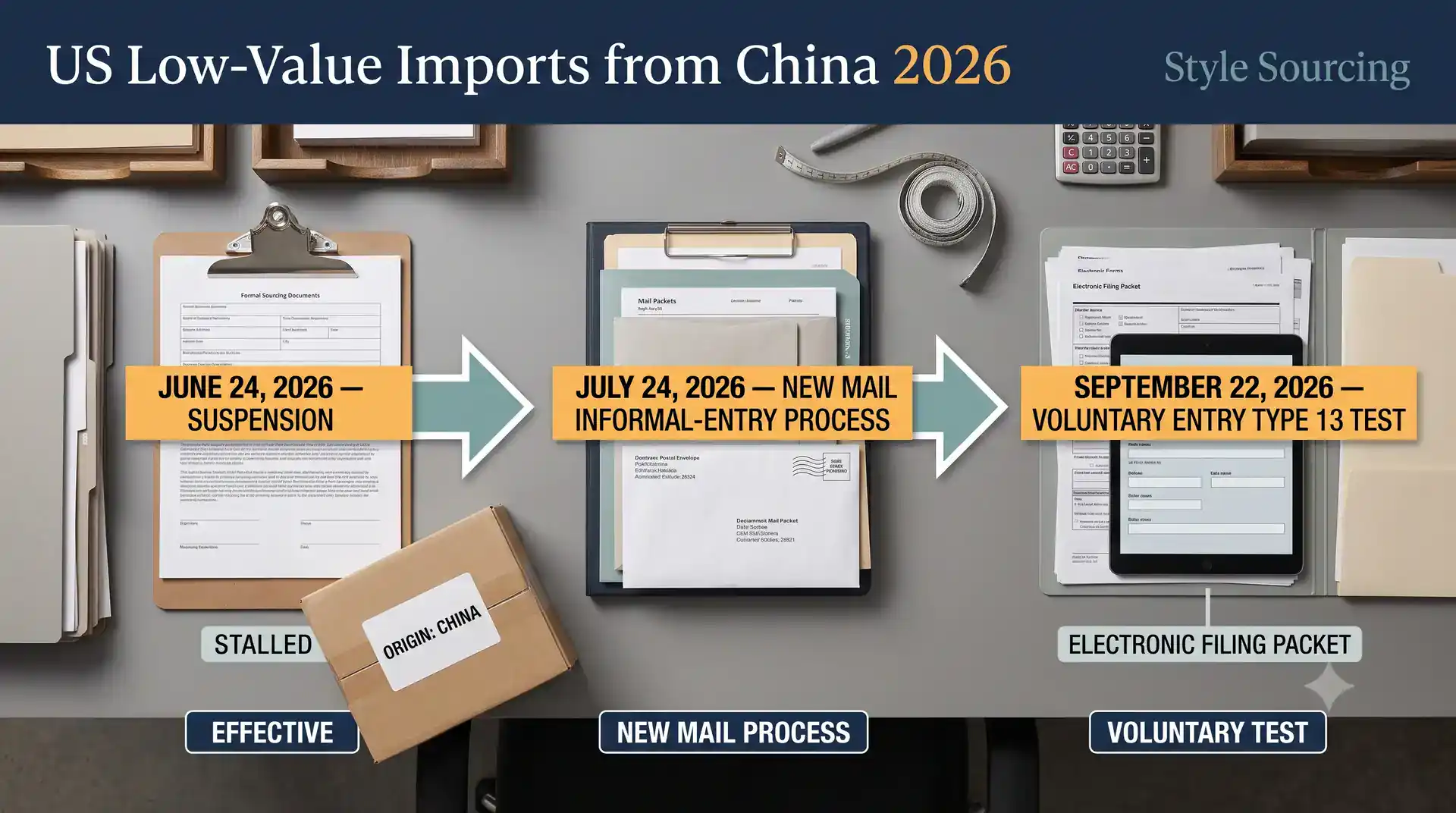
Three official records published on June 24, 2026 define the changes covered here:
- Nonpostal shipments: Federal Register document 2026-12670 states that the de minimis administrative exemption is suspended for merchandise valued at $800 or less arriving through modes other than the international postal network. It is effective June 24, 2026.
- Postal shipments: Federal Register document 2026-12669 addresses the postal suspension and establishes a new postal informal-entry process. That process took effect July 24, 2026.
- Entry Type 13: Federal Register document 2026-12668 announces a voluntary electronic informal-entry test for eligible international-mail merchandise. The test began September 22, 2026 and continues until CBP announces its conclusion.
CBP’s e-commerce FAQ, displayed as last modified September 2, 2026 when checked for this update, says shipments that previously qualified for de minimis treatment must use formal or informal entry procedures unless a specific authority provides an exception. It also says informal entry is generally allowed for shipments valued at $2,500 or less, subject to eligibility. Shipments above that value and certain merchandise, such as goods subject to quota or antidumping or countervailing duties, require a different entry treatment.
Postal route: prepare the mail entry data
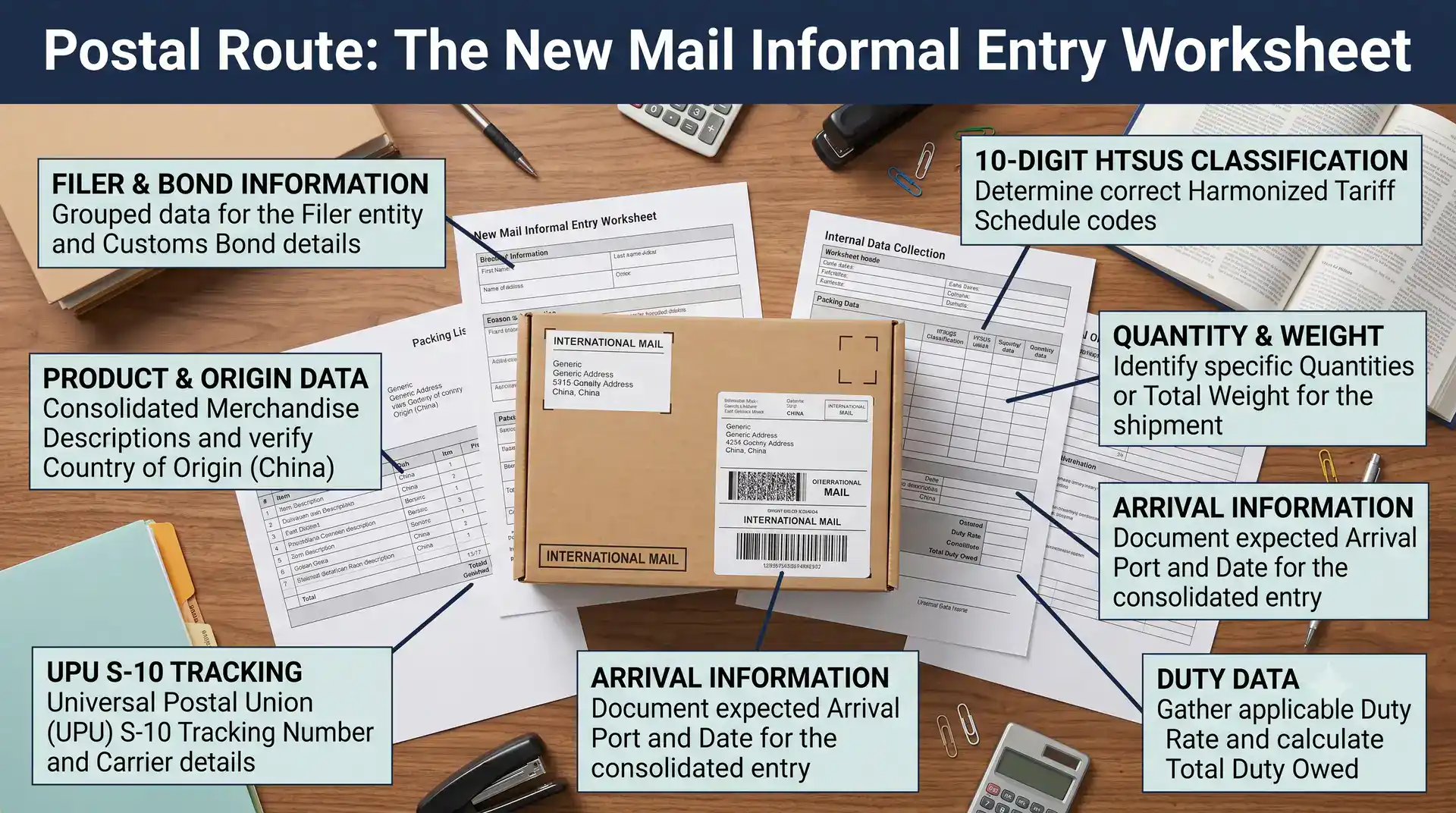
For the new manual mail informal-entry process, CBP’s FAQ lists data such as:
- filer code and value;
- bond number and total duty owed;
- description of merchandise and carrier;
- country of origin;
- flight or conveyance number;
- all applicable 10-digit HTSUS classifications;
- UPU S-10 tracking number;
- quantity or weight where applicable;
- arrival port, duty rate, and arrival date.
The FAQ says the International Mail Duty Worksheet is submitted by Excel or CSV email no later than the seventh day of the month following arrival. Confirm the current submission instructions and shipment-specific requirements with the filer before relying on that deadline.
What the China side should record
The supplier or China warehouse normally does not decide the HTSUS classification or file the US entry. It can still prevent avoidable data gaps by recording the exact SKU, commercial description, country-of-origin information supplied for the goods, quantities, carton weights, dimensions, and the final packing list.
For a postal shipment, ask the carrier or postal operator where the UPU S-10 identifier appears and when it becomes available. Do not replace it with a domestic warehouse reference or an unrelated tracking number.
Nonpostal route: prepare the broker or filer packet
For courier, air, ocean, ground, and other nonpostal shipments, confirm with the broker or filer whether the entry will be formal or informal and what documents they require. A practical starting packet normally includes:
- a specific commercial description for each SKU;
- country of origin;
- quantity and unit of measure;
- unit and total value, currency, and transaction reference;
- gross and net weight;
- carton count, dimensions, and packing list;
- carrier, mode, and tracking or bill-of-lading information;
- the HTSUS classification confirmed by the importer or broker;
- product-specific documents or Partner Government Agency information when applicable.
Do not copy the postal worksheet into a nonpostal filing without checking the route. The broker may need a different data format, filing channel, or supporting document set. The correct classification and entry treatment remain decisions for the importer and qualified customs professional.
Entry Type 13 is not the same as the manual mail process
Entry Type 13 is a voluntary electronic test for eligible merchandise entering through the international mail process. CBP’s FAQ says entry is limited to an owner, purchaser, or properly designated licensed customs broker. A carrier may voluntarily report a foreign postal operator’s tracking number on a manifest, but that act alone does not make the carrier the entry filer.
The FAQ describes a broader eligibility range for the test than for the new manual mail informal-entry process. It says shipments valued at $2,500 or less sent through the international postal network can be eligible for the test, while shipments above $2,500 or subject to quota, antidumping, or countervailing duties must use formal entry. Special-duty, PGA, Chapter 98, Chapter 99, and free-trade-agreement questions still need route-specific review.
Keep the distinction clear in your shipment file:
- Manual mail process: route-specific worksheet and submission process.
- Entry Type 13: voluntary electronic test through ACE.
- Formal entry: required or selected when the shipment or merchandise is not eligible for the informal route.
Who owns each part of the data handoff?

| Task or data | China supplier | China warehouse | Carrier or postal operator | US importer or broker |
|---|---|---|---|---|
| Product description | Provides product facts and SKU reference | Checks the packed goods against the reference | Transports the shipment | Reviews the description used for filing |
| Quantity and weight | Provides order and packing information | Counts, weighs, and records exceptions where assigned | Provides transport data where applicable | Validates the entry packet |
| Country of origin | Provides transaction facts | Checks marks and records evidence | Not the primary product-origin decision maker | Importer and filer confirm the filing treatment |
| HTSUS classification | Should not invent a US classification | May organize product specifications | Not the classification owner | Importer authorizes; broker or qualified adviser reviews or assigns within scope |
| Postal tracking | Provides dispatch reference | Records the packed-item reference | Provides or reports UPU S-10 when applicable | Uses the correct identifier in the route-specific filing |
| Entry and payment | Does not file the US entry | Does not file the US entry | May provide manifest data | Owner, purchaser, or designated licensed broker handles filing and payment authority |
This matrix assigns preparation and review tasks. It does not promise that a broker will accept a shipment, that a bond will be sufficient, or that CBP will release goods by a particular date.
Evidence checklist before the goods leave China
Supplier file
- Exact SKU, model, material, and commercial description.
- Quantity by SKU, unit value, total value, and currency.
- Country-of-origin information and product-specific documents requested by the importer or broker.
- Approved packaging, carton count, dimensions, gross weight, and net weight.
- Supplier quotation, invoice, and final packing list saved together.
China warehouse file
- Receiving count against the packing list.
- Carton numbers and date-stamped photos.
- Visible damage, shortage, relabelling, or repacking exceptions.
- Master packing list when consolidating multiple suppliers.
- Final route and carrier reference recorded after booking.
Importer or broker file
- Confirmed physical route: postal or nonpostal.
- Entry type and filer identified.
- HTSUS classification reviewed for the actual product.
- Importer of Record and consignee details confirmed.
- Route-specific bond, filing, payment, PGA, and special-duty questions sent to the qualified filer.
These records make the handoff easier to review. They do not turn a supplier invoice into a customs classification, and they do not guarantee entry or release.
Common failure points and how to stop them early
The carrier changes the mode after the quotation
A low freight quote can move from postal to courier, or a consolidated shipment can be rebooked under a different mode. Confirm the booked route and update the filing packet before export.
The description is too vague
“Accessories,” “samples,” or “plastic goods” may not tell the filer enough about the actual merchandise. Give the broker the product-specific facts, but do not ask the supplier to invent a US tariff classification.
The six-digit HS code is treated as the final US classification
The postal worksheet described by CBP asks for 10-digit HTSUS classification(s). Classification is not a warehouse guess. Send the technical product information to the importer or broker for the decision.
The postal tracking number is not the UPU S-10 identifier
Record the identifier that the carrier or postal operator uses for the applicable filing. Keep domestic warehouse references separately so they are not substituted by accident.
No one owns the receiving record
Assign the person or warehouse responsible for counting cartons, photographing exceptions, and updating the master packing list. If the count is left until after export, it becomes harder to explain a shortage.
Why the document trail matters beyond one shipment
CBP’s July 2026 EAPA update reported more than $1 billion in additional duties identified through investigations involving issues such as illegal transshipment, misclassification, and undervaluation. That enforcement context does not mean every low-value shipment from China is suspicious. It does mean a buyer should treat the supplier file as a real handoff record: the product description, origin information, commercial documents, and the identity of the company behind the transaction should agree before the shipment is released.
Use this as a document-control check, not as a classification shortcut:
- Match the commercial description to the actual goods. Keep the SKU, material, function, quantity, and product-specific notes together.
- Keep origin evidence with the order file. Do not assume the shipping location alone answers every origin question.
- Separate supplier input from the broker’s decision. The supplier can provide technical and commercial facts; the importer or qualified broker should handle the applicable US entry and classification decision.
- Preserve the transaction identity. The seller, payment beneficiary, warehouse handoff, and shipping documents should not point to unexplained parties.
CBP’s release is enforcement context, not a tariff table or a prediction of clearance. Recheck the current official guidance for your route and product before filing.
A pre-shipment workflow for China-to-US low-value goods
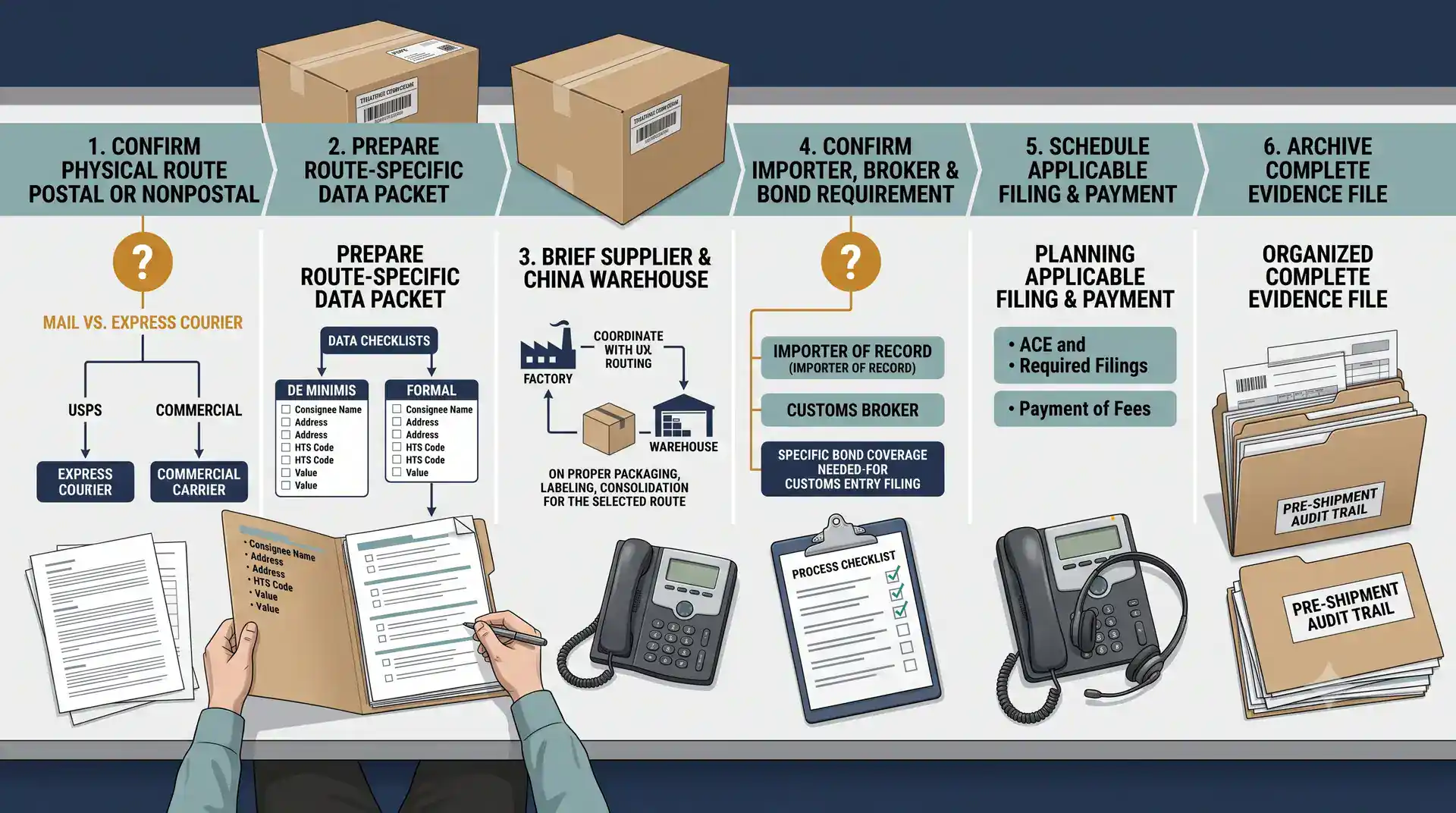
- Confirm the physical mode. Ask the carrier or forwarder whether the shipment enters through the international postal network or another mode.
- Identify the filer and entry treatment. Confirm the importer, purchaser, or broker responsible for the entry and whether formal, informal, manual mail, or Entry Type 13 procedures are being considered.
- Build the product file. Match the SKU, description, origin, quantity, value, weight, carton data, and product documents.
- Brief the supplier and warehouse. Set the required invoice, packing list, carton marks, receiving count, and photo evidence before dispatch.
- Complete the route-specific handoff. Add UPU S-10 and the mail worksheet fields for the postal path, or the broker’s requested packet for a nonpostal path.
- Check classification, bond, and payment with the filer. Do not infer a duty rate, bond amount, eligibility result, or release date from a general article.
- Archive the evidence. Keep the quotation, invoice, packing list, carrier confirmation, warehouse record, route identifier, broker instructions, and filing/payment record in one shipment folder.
How Style Sourcing can support the China-side handoff
Style Sourcing may be able to help with supplier instructions, China-side receiving counts, carton and label photos, mixed-SKU consolidation records, and coordination of the information your broker or carrier requests. The exact scope depends on the assignment and verified supplier access.
This is operational support, not customs representation, customs brokerage, legal advice, tariff classification, duty calculation, bond advice, clearance prediction, or a release-time guarantee. The importer and qualified broker remain responsible for the entry decision.
If you need the China-side evidence organized before the shipment leaves, see our China sourcing service or send the product and shipment details through the contact page.
FAQ: US low-value imports from China in 2026
Does a shipment worth $800 or less automatically enter duty-free?
Do not assume that it does. CBP’s current FAQ says formal or informal entry procedures apply to low-value shipments unless a specific exception applies. Duties, taxes, fees, classification, origin, and value questions are shipment-specific and belong with the importer and qualified filer.
Is the postal worksheet the same as Entry Type 13?
No. The postal worksheet is the manual mail informal-entry process. Entry Type 13 is a voluntary electronic test through ACE. Confirm which process the filer is using before you prepare the data.
Who provides the HTSUS classification?
The supplier can provide technical product facts, but it should not invent the US classification. The importer authorizes the entry and the broker or qualified adviser reviews or assigns the classification within the agreed scope.
What is the UPU S-10 code?
CBP describes it as a standardized 13-character alphanumeric identifier for international postal items. Ask the carrier or postal operator where it appears and keep it with the postal entry records.
How much bond does a low-value shipment need?
CBP’s FAQ says a basic importation and entry bond is required for the cited mail processes and must be effective, on file in ACE eBond, and sufficient for the transaction. It does not provide a universal low-value bond amount. Ask the filer.
When will CBP release the goods?
The sources used here do not give a general release-time promise. The entry, bond, classification, documents, carrier process, and shipment facts can affect the outcome. Ask the broker or filer about the specific shipment.
Final checklist
- I confirmed the actual booked route, not only the supplier’s quotation.
- I identified the importer, purchaser, broker, or other authorized filer.
- I matched the SKU, description, value, origin, quantity, weight, cartons, and documents.
- I prepared the postal worksheet fields or the nonpostal broker packet that applies.
- I checked UPU S-10 information for a postal shipment.
- I asked the qualified filer about classification, bond, payment, PGA, and special-duty issues.
- I have China-side receiving counts and photos before the goods leave.
- I saved the full evidence file without treating it as a guarantee of entry or release.
Sources and limits
This update uses the CBP E-Commerce Frequently Asked Questions and the CBP July 2026 EAPA enforcement update, which displayed Last Modified: Sep 02, 2026 when checked, plus Federal Register documents 2026-12668, 2026-12669, and 2026-12670. Rules, instructions, and test status can change. Check the current CBP page and ask your importer or qualified broker before booking a shipment.
For related buyer workflows, compare this route-specific US guide with the EU low-value import data handoff, the limits of Incoterms, and our factory-ready specification sheet.


