Plenty of people say they do Shopify dropshipping from China.
Far fewer people tell you what actually starts breaking once orders become real.
That is where most beginners lose money, lose customers, or give up too early.
Shopify dropshipping from China can still work in 2026, but not in the lazy old way.
If your plan is just “install an app, import random products, and wait for orders,” you are already playing the hardest version of the game.
The sellers who survive usually do something more practical. They get clearer about their sourcing model, control their shipping expectations, and solve supplier problems before customers ever see them.
In this guide, I will show you how Shopify dropshipping from China really works, what fulfillment models make sense, what usually goes wrong, and when it is smarter to work with a China-side partner instead of trying to manage everything through supplier chat windows.
What Shopify Dropshipping from China Actually Means
At the basic level, Shopify dropshipping from China means:
- you sell through your Shopify store
- the goods are sourced from China
- you do not keep large stock locally before orders come in
- someone on the China side handles packing and shipping, either the supplier, a platform, or a fulfillment partner
That sounds simple. In reality, there are several very different models hiding under the same phrase.
If you do not separate those models clearly, you will compare the wrong suppliers and make the wrong shipping decisions.
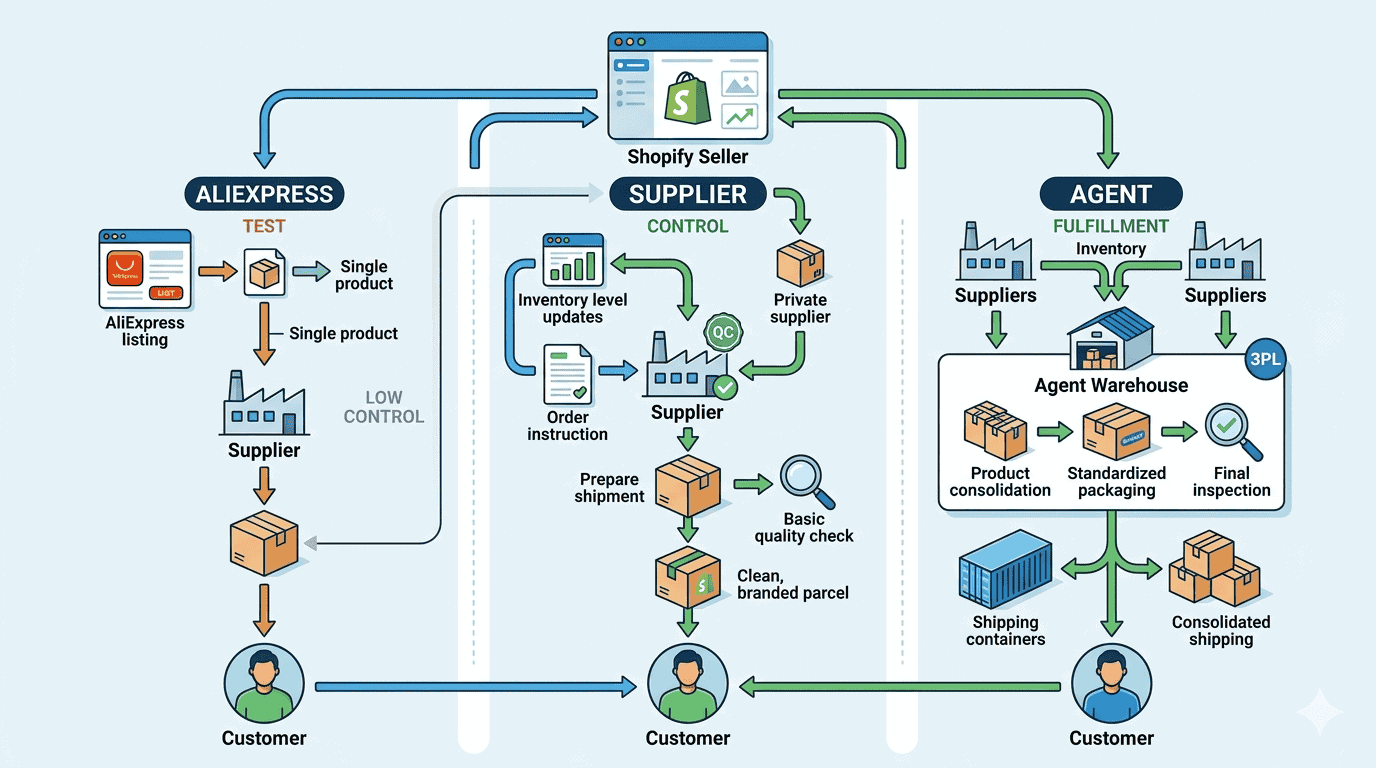
The 3 Main China Models for Shopify Sellers
1. AliExpress-style direct supplier shipping
This is the classic beginner route. You list products, the order comes in, and the supplier ships directly to the customer.
Why people choose it:
- easy to start
- no MOQ pressure
- lots of products available fast
Why it stops working:
- slow shipping
- weak product consistency
- generic packaging
- limited control over stock and communication
If you are testing a niche, this can be useful. If you are trying to build a real brand, it becomes shaky very quickly.
2. Private supplier + manual order handling
This is where a seller moves beyond marketplace suppliers and starts working with one or several direct China suppliers.
Why this model is better:
- better pricing
- more control over product quality
- better room for custom packaging and simple branding
What gets harder:
- you now need someone to coordinate stock, order flow, and shipping
- communication mistakes become more expensive
- one supplier may be fine at making the product but weak at fulfillment
3. China-side fulfillment / agent model
This is often the smarter long-term route once the store has real order volume.
Instead of asking each supplier to handle everything, you use a China-side operator to:
- receive goods
- check samples or basic quality
- standardize packaging
- combine inventory from different suppliers
- ship orders more consistently
This model usually gives better control, especially if you sell from multiple suppliers or you care about customer experience more than just finding the lowest supplier price.
Why China Still Makes Sense for Shopify Sellers
Even with all the problems people talk about, China still matters for Shopify sellers because it gives you three big advantages:
- product range, especially when testing categories fast
- cost control, especially after you move beyond marketplace pricing
- supply chain flexibility, especially when you want to combine sourcing, packaging, and fulfillment
This is especially true if you sell accessories, bags, gift products, home items, beauty tools, packaging-driven products, or other categories where supplier variety matters.
But China is only an advantage when your operation is more organized than your competitors’. If your process is messy, China becomes a source of delay and customer complaints instead of profit.
What Usually Breaks First
Most Shopify sellers do not fail because the product idea is terrible.
They fail because operations start leaking money from places they did not plan for.
The first problems usually look like this:
- shipping time is longer than promised
- supplier says an item is available, then goes out of stock
- the sample looks better than the real bulk units
- different suppliers pack orders differently
- tracking is messy or delayed
- return expectations do not match reality
- the store grows faster than the order process can handle
That is why Shopify dropshipping from China is not only about product sourcing. It is also about execution discipline.
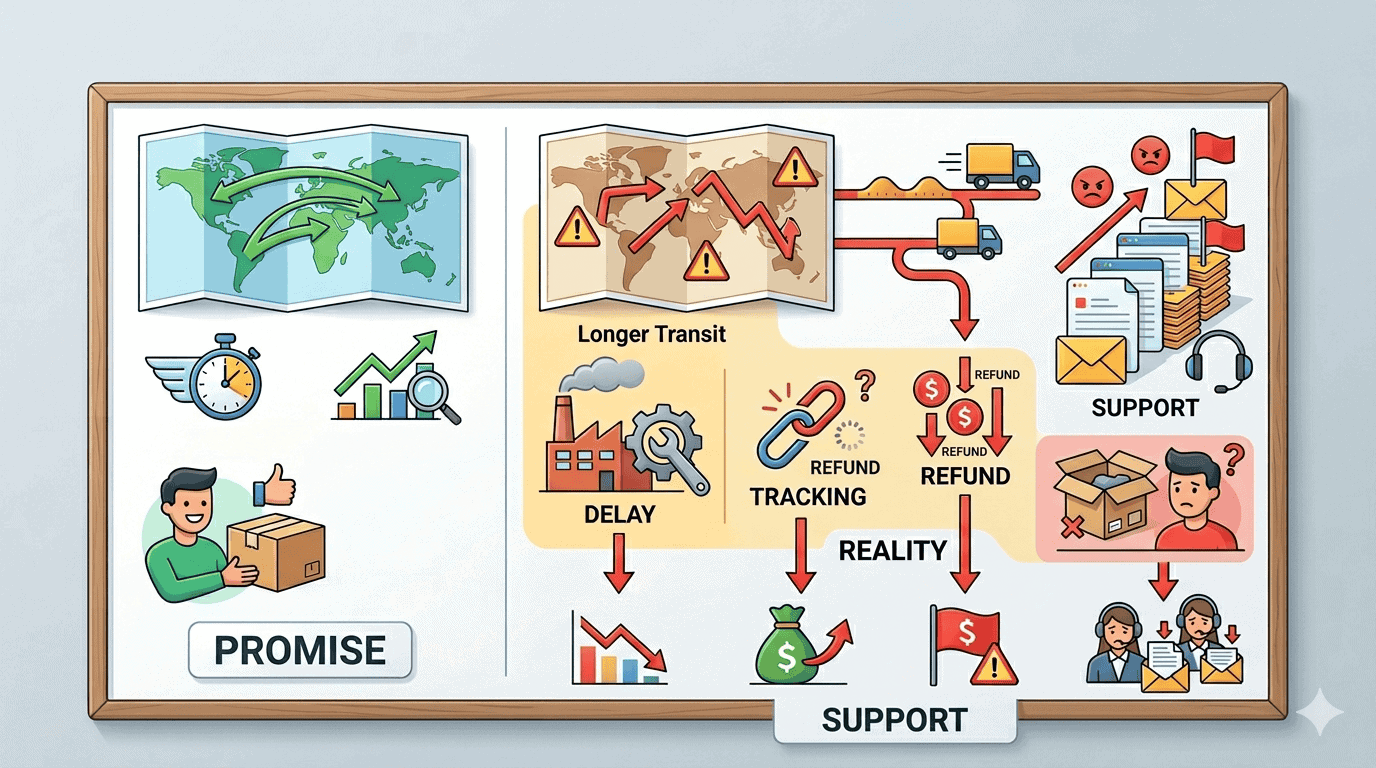
Shipping Expectations: The Part Most Sellers Get Wrong
A lot of old dropshipping advice still assumes buyers will happily wait a long time as long as the product is cheap.
That is much less true now.
In 2026, your shipping model affects:
- conversion rate
- refund pressure
- chargeback risk
- customer support workload
- repeat purchase rate
So when you choose a China fulfillment route, do not just ask “what is the cheapest?” Ask:
- what is realistic delivery time?
- is tracking stable?
- can packaging be standardized?
- what happens when one supplier delays production?
If you have not thought through the shipping side, read our Shipping Cost from China to US guide too, because freight and delivery logic will shape your whole store model.
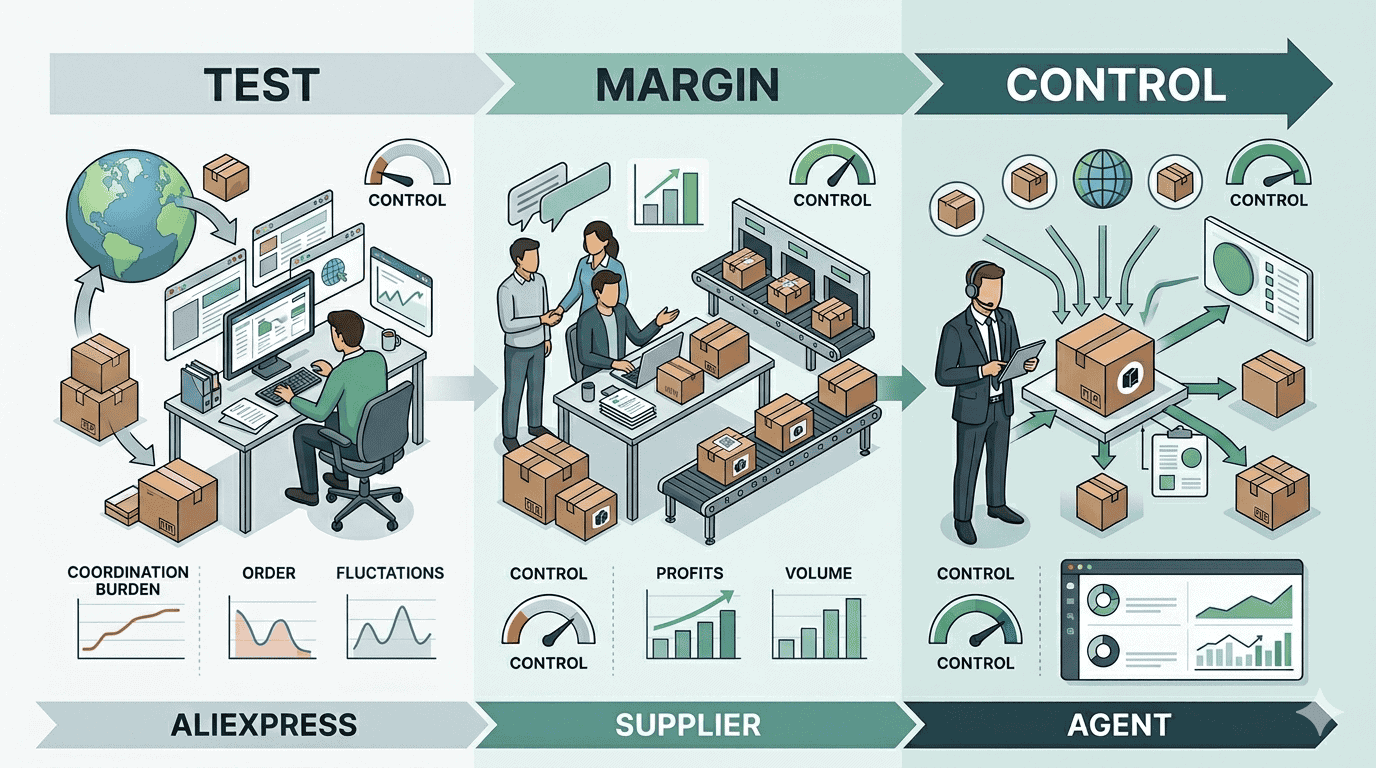
AliExpress vs Private Supplier vs Agent: Which Makes More Sense?
AliExpress still works for quick testing, but it is usually weak for long-term brand building.
Private suppliers are stronger for pricing and customization, but they often need tighter management.
A China dropshipping agent or fulfillment partner becomes valuable when you need consistency more than shortcuts.
A practical rule:
- If you are still validating product-market fit, AliExpress-style sourcing can be acceptable.
- If you already have orders and want better margin, move toward direct suppliers.
- If you are running multiple SKUs, multiple suppliers, or brand packaging, bring in a China-side operator.
How to Choose Products That Fit the China Model
Not every product is a good match for Shopify dropshipping from China.
The model works better when the product is:
- small or medium in size
- not fragile
- not heavily regulated
- not highly return-sensitive
- easy to describe clearly online
It gets harder when the product is:
- oversized
- battery-heavy
- fragile glass or electronics with high complaint risk
- very cheap but very bulky
This is one reason accessories and light lifestyle products often perform better than random “viral” items once operations matter.
What Good Suppliers Need to Prove Before You Trust Them
When sellers say “my supplier is good,” they often mean the supplier replies quickly.
That is not enough.
A supplier that fits a Shopify operation should be able to show:
- stable product quality
- clear stock communication
- packaging consistency
- willingness to handle repeat order flow cleanly
- realistic shipping promises, not fantasy promises
If you are unsure how to judge that, read How to Find a Reliable China Dropshipping Agent and How to Find Reliable China Suppliers.
Why Independent Shopify Stores Usually Need More Control Than Marketplace Sellers
Independent Shopify sellers do not have the same safety net as big marketplaces.
On Amazon, a seller can sometimes survive rough packaging and average communication if the traffic is strong enough.
On Shopify, the customer experience lands directly on your brand.
That means every weak point becomes more visible:
- slow replies
- confusing tracking
- damaged packaging
- wrong variants
- quality inconsistency
That is why serious Shopify sellers usually need tighter product control, tighter shipping control, and better China-side execution than casual marketplace sellers do.
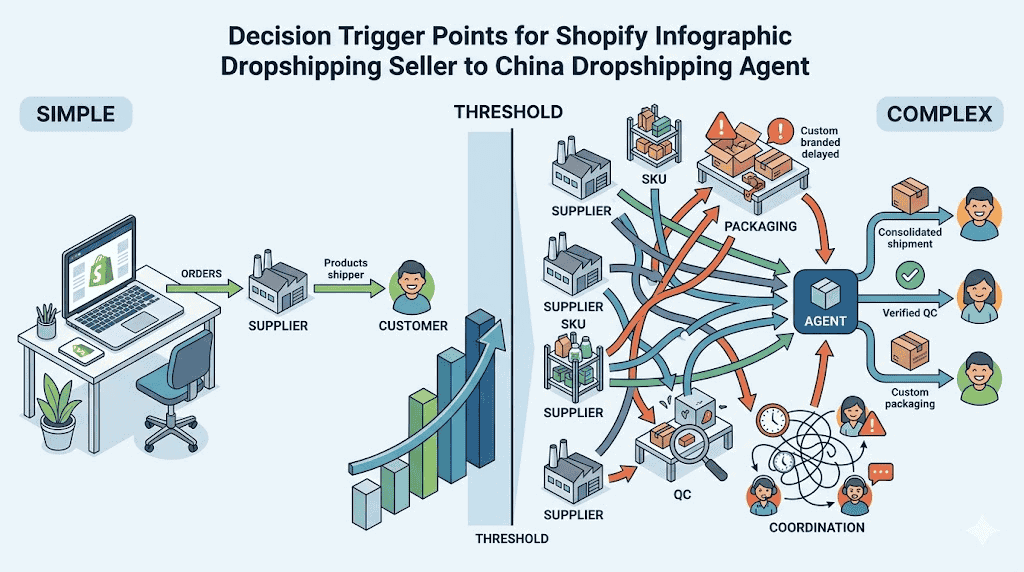
When a China Dropshipping Agent Starts Making Sense
A good agent is not magic. But there is a point where trying to manage everything alone becomes inefficient.
A China dropshipping agent starts making sense when:
- you use more than one supplier
- you want sample checks before scaling
- you want custom packaging or inserts
- you need a cleaner fulfillment process
- you are tired of chasing suppliers for basic coordination
The real value is not just placing orders. It is reducing the operational noise between supplier, stock, quality, and shipping.
If that is the stage you are in now, our China Dropshipping Agent Service explains the execution side more clearly.
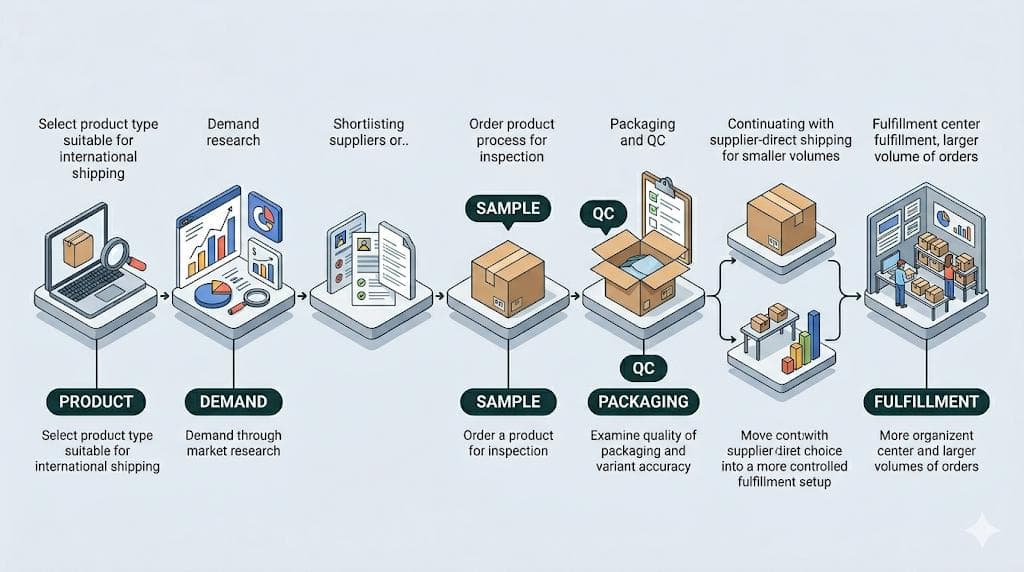
A Practical Workflow That Works Better
If you want a cleaner Shopify-from-China model, this workflow is much more stable than random product importing:
- Choose a product type that fits the shipping model.
- Validate demand first. Do not overbuild before orders exist.
- Shortlist suppliers carefully.
- Order samples.
- Check packaging, quality, and variant accuracy.
- Decide whether supplier-direct shipping is still enough.
- If order flow grows, move fulfillment into a more controlled setup.
This sounds basic, but it is already better than how many stores are run.
Common Mistakes to Avoid
- Depending on one supplier too early.
- Copying generic product pages without checking the real product quality.
- Promising shipping times that your supply chain cannot support.
- Ignoring packaging until complaints start.
- Trying to scale before the China-side workflow is stable.
Most of these mistakes do not hurt on day one. They hurt when the store gets traction and your operation cannot keep up.
Is Shopify Dropshipping from China Still Worth It in 2026?
Yes, but only if you stop thinking of it as a shortcut business.
The easy version is weaker now. The better version is more operational.
If you can control sourcing, product consistency, packaging, and fulfillment better than average sellers, China still gives you a very strong advantage.
If you cannot, then even a good product can turn into refund-heavy chaos.
How Style Sourcing Can Help
We are based in Yiwu, which is useful when a store needs more than just a supplier link.
We can help Shopify sellers with:
- supplier comparison
- sample review
- basic quality control
- packaging coordination
- multi-supplier consolidation
- cleaner shipping and fulfillment workflow
If your store is moving beyond the beginner stage and you need more control on the China side, check our Shopify Fulfillment from China Service or talk to our team here.


