
The supplier sends a commercial invoice. The consolidator sends a packing list. The freight forwarder attaches a bill of lading or air waybill. All three arrive as PDFs. The file names look professional. The fonts are clean. Should you accept them as proof that the named issuer actually issued each document — and that the cartons inside match what you agreed to buy?
Probably not. And that is the actual gap.
A shipment document PDF is a file. It is not self-authenticating, it does not prove that the named issuer actually issued it, and it does not prove that what is inside the cartons matches what the file describes. The first thing a careful buyer does with a shipment PDF set is not “open and trust it.” It is “verify the issuer and cross-check the documents against each other.”
This guide walks through that bounded pre-release check. It is built on two independent institutional surfaces: the International Chamber of Commerce Commercial Crime Services guidance on forged trade and transport documents, and the U.S. International Trade Administration’s description of distinct document roles for the pro forma invoice, commercial invoice, packing list, and ocean or air transport document. It deliberately does not turn a PDF into a customs, title, legal, or payment guarantee.
Important boundary. This article does not state that any document PDF is genuine, that any party is who it claims to be, that title to the cargo has transferred, that customs will accept the documents, that payment is justified, or that any legal outcome follows from the cross-check. The check is operational evidence collection. Customs, broker, legal, and payment decisions remain with the responsible owner for the actual transaction.
Quick Answer: What Does “Shipment PDF Authenticity” Actually Mean Here?
It means running two checks, in this order:
- Issuer verification. Confirm that the document was actually issued by the party named on it, through an independent contact route that does not depend on the document itself.
- Cross-document discrepancy detection. Compare parties, quantities, dates, marks/numbers, and references across the commercial invoice, packing list, and transport document — and against the approved purchase order — before release.
Both checks are operational evidence collection. Neither check decides customs, title, or legal outcome. Both checks belong to the buyer before the cartons are released or the final payment is sent.
If you only remember one line from this article, remember this:
A shipment PDF is a file, not a fact. Verify the issuer through a channel that does not depend on the document, and compare the documents against each other before release.
Why Buyers Get Confused by a “Clean-Looking” PDF
Three reasons.
- The PDF looks like the original. Modern templates, clean fonts, official-looking letterheads, and a digital signature block can all be reproduced. The visual quality of a PDF is not evidence of the document’s issuer.
- The three documents use overlapping language. “Consignee,” “shipper,” “marks and numbers,” “gross weight,” “description of goods” all appear on more than one document. It is easy to assume that identical wording means identical facts, when in fact each document is issued by a different party at a different stage of the export flow.
- Buyers want a single safety net. “Just send me the paperwork” feels reasonable. In practice, no single issuer compares the whole buyer-side file automatically. The supplier may see the invoice, the warehouse may see the packing record, and the carrier or forwarder may see the booking data. The buyer — or a coordinator acting for the buyer — therefore needs to make sure the records are compared at the relevant handoff.
The rest of this article is the check itself.
The Two Independent Institutional Surfaces Behind the Bounded Claim
The cross-check is built on two surfaces, both of which converge on the same operational answer.
ICC Commercial Crime Services due-diligence guidance treats forged trade and transport documents as a known fraud vector. The document set is the unit of risk, and the response is to verify the document through an independent channel, not to assume the file is genuine because it looks professional. This surface supports the issuer verification half of the check.
U.S. International Trade Administration common export documents describes the commercial invoice as the principal customs valuation document, the packing list as a detailed shipment record that should reflect the invoice information, and the ocean bill of lading or air waybill as the transport contract and receipt issued by the carrier or its agent. Each document has a distinct role, issued by a distinct party, at a distinct stage. This surface supports the cross-document discrepancy half of the check.
These are not the only authoritative surfaces available to a buyer. They are the bounded sources used here. Other surfaces — destination customs authorities, licensed customs brokers, freight forwarder standard operating procedures, chamber of commerce attestations, and letters of credit issuing banks — may add checks that are jurisdiction- or transaction-specific. None of those substitutes replace the buyer-side cross-check.
What a Shipment PDF Is Not
It is worth saying directly what a shipment document PDF is not. The cross-check is bounded.
A shipment PDF is not:
- Self-authenticating. The PDF file does not prove that the named issuer actually issued it. Even a digital signature, a stamp, or a watermark can be reproduced or misapplied. Only an independent contact route confirms the issuer.
- A title document. Title to the cargo depends on the contract terms, the Incoterm used, the payment instrument, and the destination legal framework. The transport document is a transport contract and receipt, not a universal title instrument.
- A customs decision. Whether destination customs accepts the documents is a separate question that depends on destination rules, product classification, broker practice, and case-specific facts. The cross-check supports the buyer’s pre-release evidence; it does not decide customs.
- A payment decision. Whether the buyer should release the balance depends on the payment instrument, the documentary collection or letter of credit terms, the buyer’s contract, and the buyer’s risk appetite. The cross-check supports an informed decision; it does not replace it.
- A legal remedy. If a dispute arises, the documents are evidence among many. They are not a self-executing outcome. Legal remedy remains with the parties, the contract, and the applicable forum.
Keep these boundaries in mind as you read the rest of the article.
Check 1 — Issuer Verification
The goal of issuer verification is to confirm, through a channel that does not depend on the document itself, that the named party actually issued each document. The three documents in the export set come from three different issuers in the normal flow:
| Document | Typical issuer | Where the issuer contact should come from |
|---|---|---|
| Commercial invoice | Supplier | Buyer’s pre-existing supplier contact, confirmed independently of the PDF |
| Packing list | Supplier or consolidator warehouse | Buyer’s pre-existing supplier or warehouse contact, confirmed independently of the PDF |
| Bill of lading / air waybill / other transport document | Carrier or its authorized agent | Carrier’s official public contact (carrier website, booking confirmation, container or waybill prefix), confirmed independently of the PDF |
The four sub-checks inside issuer verification

Sub-check 1A — Sender identity in the email or chat. Does the document arrive from a domain and a named person or role that the buyer can match to a pre-existing contact recorded before the shipment? A PDF sent from a free webmail address or from an address that does not match the supplier or consolidator recorded in the buyer’s earlier correspondence is a red flag, not a confirmation.
Sub-check 1B — Independent contact route. Pick up the phone, send a WeChat message, or place a call to the supplier or consolidator through the contact recorded in the buyer’s earlier files. Confirm: did you issue this document? Is the document number recorded on your side? Does the document reference match what we agreed? Use a channel that does not depend on the PDF.
Sub-check 1C — Carrier or forwarder-side verification. For a bill of lading, sea waybill, or air waybill, confirm the reference through the issuing carrier, NVOCC, freight forwarder, or authorized agent shown in the booking record. Use an independently sourced contact route or the booking confirmation already held in the shipment file. Reference formats vary, and a house document may be issued by a forwarder rather than the ocean or air carrier, so a prefix alone is only a clue. The useful check is whether the issuer recognizes the reference and whether it ties back to the recorded booking.
Sub-check 1D — Stamp, signature, and digital signature sanity. A stamp or signature on a PDF is one input. It is not, on its own, a confirmation of issuer. Sanity-check it against the other three sub-checks. A document can carry a stamp and still be unverified; a document can lack a stamp and still be genuine.
What issuer verification can tell you
- Whether the named issuer recognises the document number.
- Whether the document matches what was agreed at booking or order time.
- Whether the sender in the email or chat is the same party the buyer has been working with.
What issuer verification cannot tell you
- Whether what is inside the cartons matches the document.
- Whether destination customs will accept the document.
- Whether title to the cargo has transferred.
- Whether any payment decision is now safe.
A stamp is one clue. Confirmation through an independently sourced issuer contact is stronger evidence.
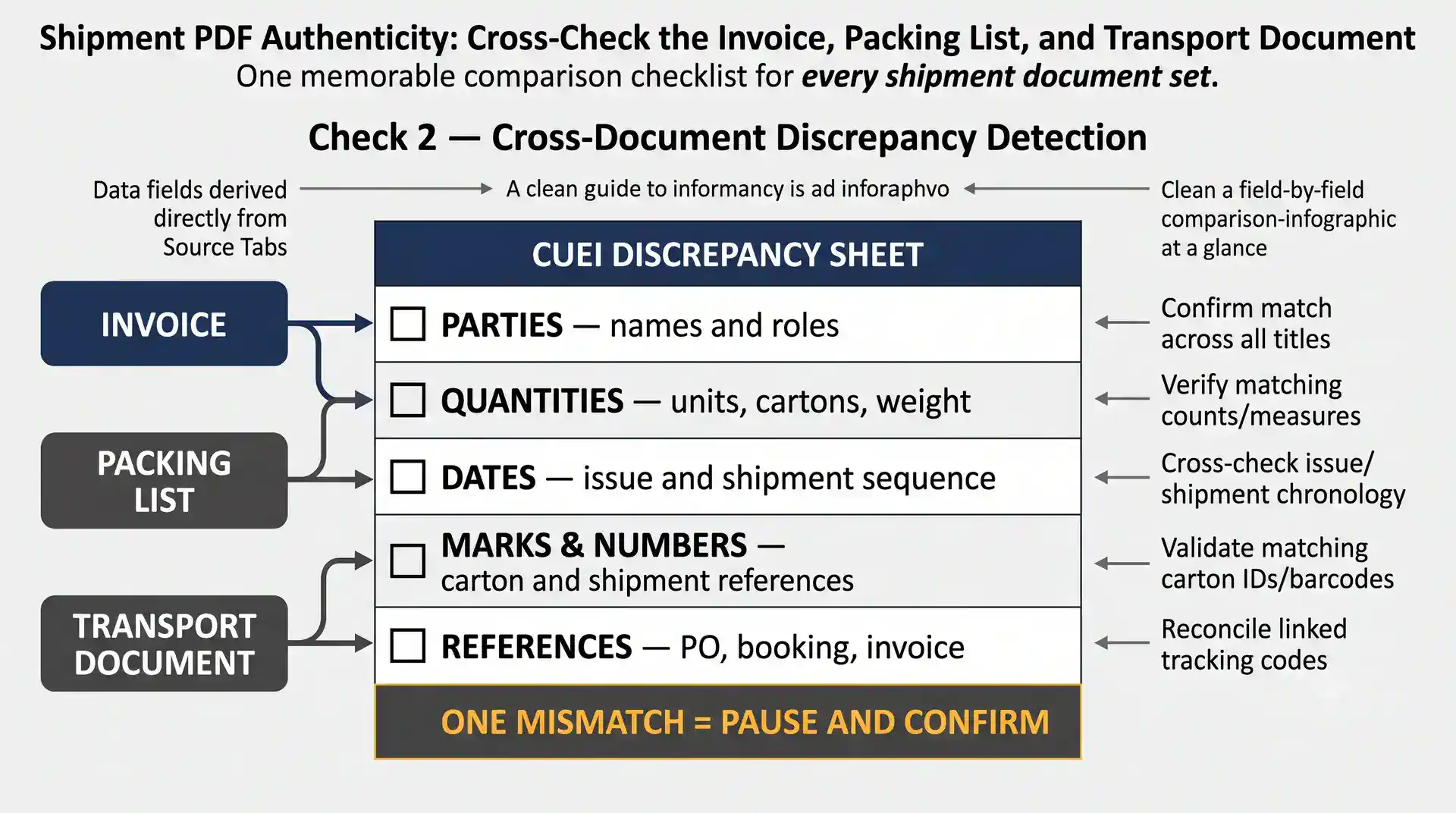
Check 2 — Cross-Document Discrepancy Detection
The goal of the discrepancy check is to compare the documents against each other — and against the approved purchase order — on five fields. A discrepancy on any one field is a reason to pause and confirm before release. A discrepancy on multiple fields is a reason to escalate.
The five fields are a practical comparison set. A field may appear on only some documents; a blank or inapplicable field should be recorded rather than forced into a match.
| Field | What to compare | Why a discrepancy matters |
|---|---|---|
| Parties | Shipper, consignee, notify party across the commercial invoice, packing list, and transport document; and against the buyer’s approved purchase order | A wrong consignee on the transport document is a destination mistake. A different shipper across documents may indicate the document set was not issued by the same supplier flow. |
| Quantities | Total quantity, per-carton quantity, total cartons, and weight wherever those fields appear across the commercial invoice, packing list, and transport record | A mismatch between invoice quantity and packing-list quantity, or between packing-list cartons and the carrier/forwarder record, is a reason to confirm which record needs correction. |
| Dates | Invoice date, packing-list date, transport document date, and the order’s shipping window | A transport document dated before the packing list was issued, or after the buyer’s contractual shipping window, is a red flag. |
| Marks and numbers | Shipping marks, carton numbers, container or seal numbers across the documents and against the physical cartons when received | Different marks across documents, or marks that do not match the physical cartons, are a discrepancy. The marks on the transport document should match the marks the consolidator records. |
| References | Purchase order number, sales contract number, buyer reference, supplier reference across all documents and against the buyer’s files | A missing or wrong purchase order number is a sign that the documents may not belong to the buyer’s order. A wrong sales contract number is a reason to confirm before any payment is tied to it. |
How to run the discrepancy check in practice
- Lay the documents side by side. Use a table, a printed sheet, or a spreadsheet. Do not rely on memory.
- Fill the five fields for each document. Where a field is missing, write “blank,” not “n/a.” A blank field is information, too.
- Compare the fields against each other. A field that matches across documents is not a confirmation. A field that differs across documents is a reason to pause.
- Compare the fields against the approved purchase order. The purchase order is the buyer’s reference. The documents should describe what the buyer agreed to buy.
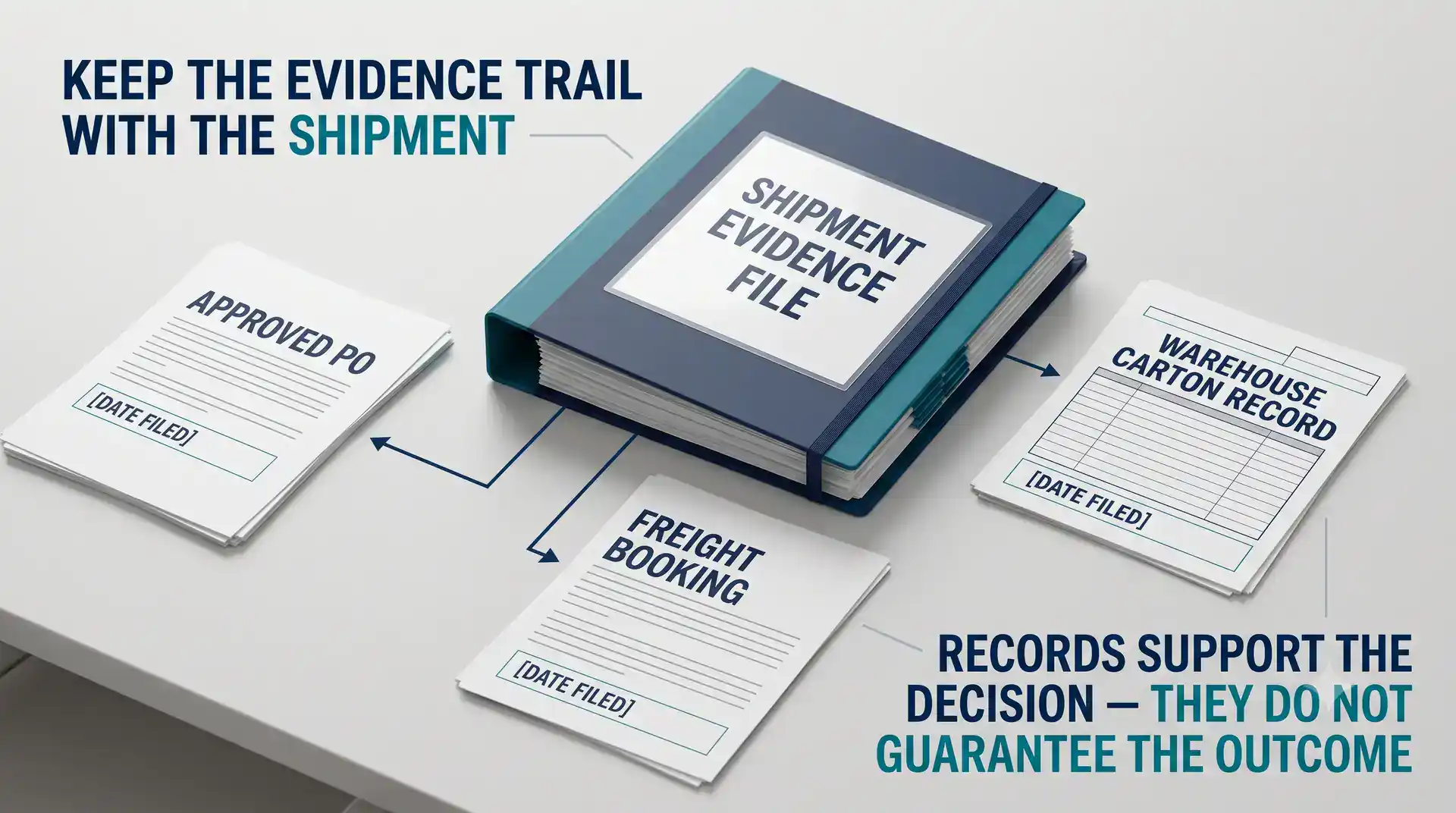
- Record the comparison in a dated file. Keep the record with the shipment’s other evidence. The record is the buyer’s pre-release evidence; it is not a customs, title, or legal decision.
What discrepancy detection can tell you
- Where the document set is internally inconsistent.
- Where the document set is inconsistent with the buyer’s approved purchase order.
- Where the document set is incomplete or carries fields the buyer cannot confirm.
What discrepancy detection cannot tell you
- Whether any discrepancy is intentional or accidental.
- Whether the discrepancy can be cured before the cartons leave the warehouse.
- Whether any party is acting in bad faith.
- Whether customs, broker, or legal outcomes will follow.
The discrepancy check is a buyer-side evidence file. It is not a finding of fact.
Worked Examples: Three Discrepancy Patterns
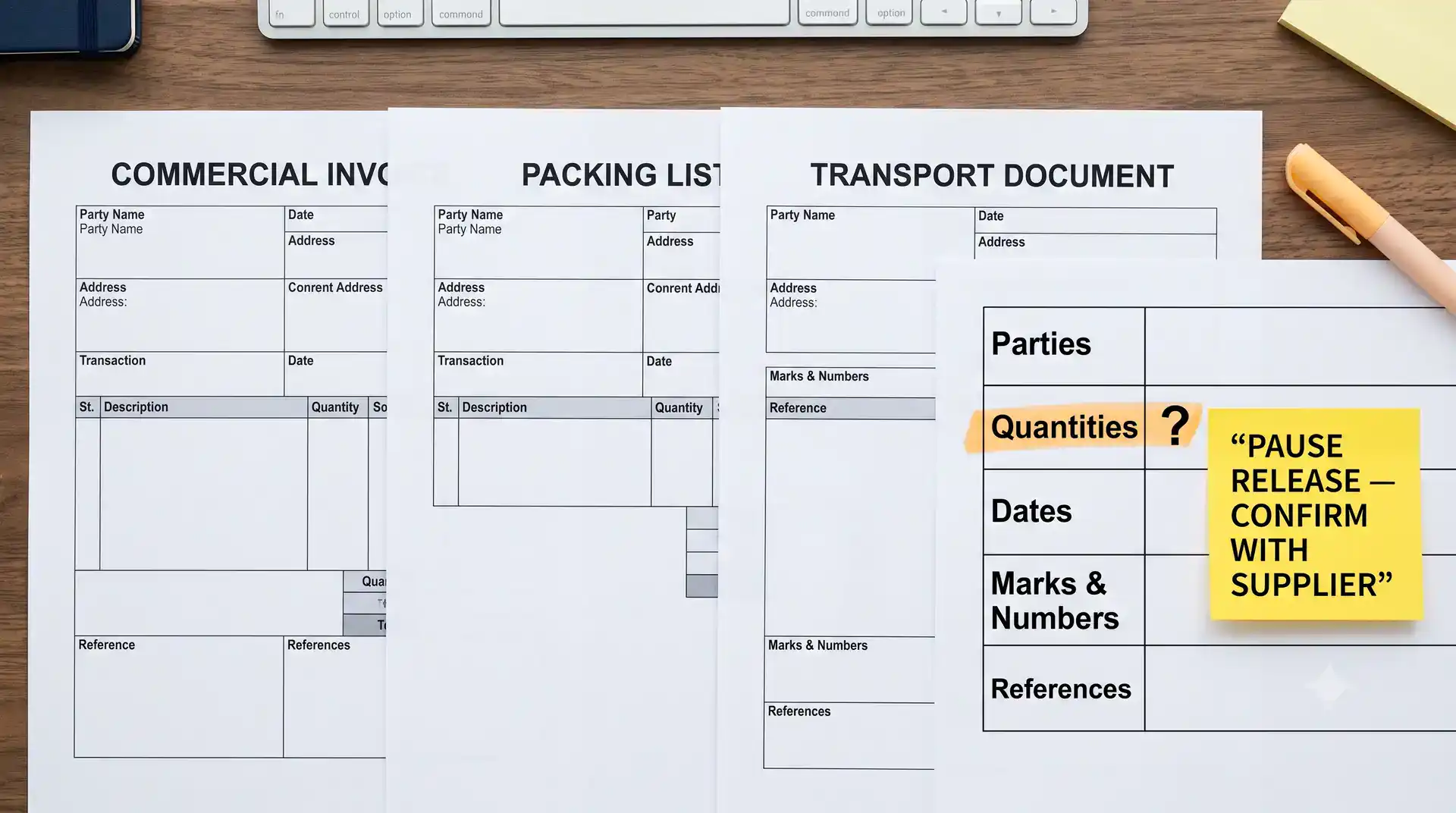
The three examples below are anonymised scenarios. They are not records of any specific buyer, supplier, or shipment.
Example 1 — Quantity mismatch between invoice and packing list
The commercial invoice describes 1,000 units across 100 cartons. The packing list describes 980 units across 98 cartons. The transport document carries the same 100 cartons as the invoice, but the marks only cover 98 cartons.
The discrepancy is on quantities and marks. The buyer pauses the next handoff, contacts the supplier and the consolidator warehouse through independent routes, and confirms whether the invoice should be reissued, the packing list should be corrected, or two cartons remain at the warehouse. The check does not decide which party is at fault; it surfaces the mismatch while the records can still be reconciled.
Example 2 — Date outside the shipping window
The buyer’s purchase order set the shipping window for the third week of July. The transport document is dated in the second week of August. The invoice is dated the day before the transport document. The packing list is dated the same day as the transport document.
The discrepancy is on dates against the approved purchase order. The buyer pauses release, contacts the supplier through the independent contact route, and confirms whether the shipment was delayed, whether the order was rebooked, or whether the document was issued against an unrelated shipment. The check does not decide whether the delay is breach or simple slippage; it surfaces the issue before any payment is released against documents.
Example 3 — Different consignee between invoice and transport document
The commercial invoice names the buyer’s Hong Kong entity as the consignee. The transport document names a third-party logistics company in Shenzhen. The packing list matches the transport document. There is no record in the buyer’s earlier files of a change in consignee.
The discrepancy is on parties. The buyer pauses release, contacts the supplier and the freight forwarder through the independent contact route, and confirms whether the consignee change is a freight-forwarder-side addition for the destination handoff or an unauthorized change. The check does not decide title or destination liability; it surfaces the change before the cartons leave the warehouse.
Where the Cross-Check Sits in the Order Timeline
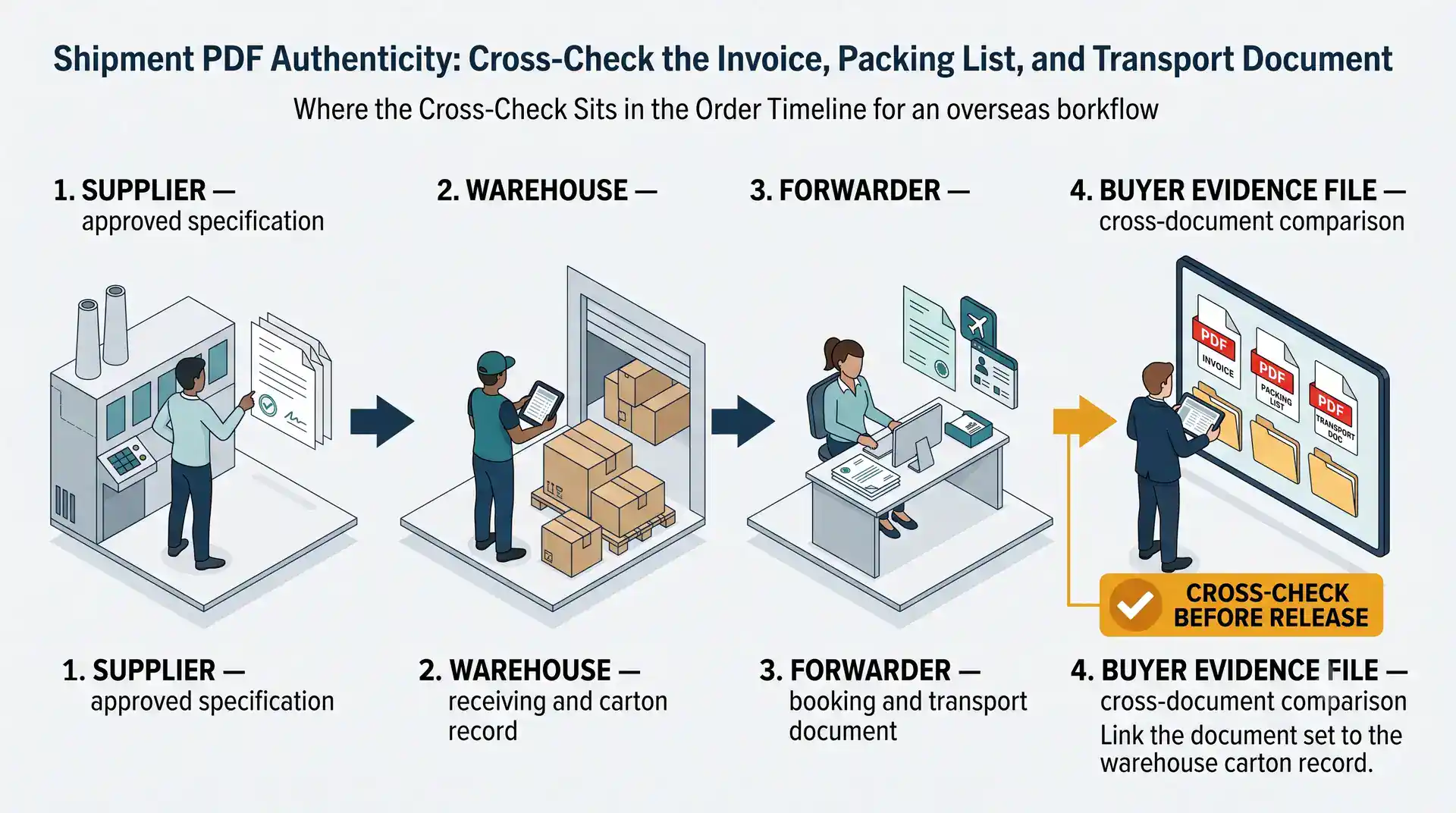
The comparison happens in two passes because the final transport document may not exist before the carrier accepts or loads the cargo.
- Pre-release pass: Compare the approved purchase order, commercial invoice, supplier or warehouse packing list, warehouse carton record, shipping instructions, and the forwarder/carrier booking confirmation. Confirm the issuers and pause the warehouse-to-forwarder handoff if the records disagree.
- Carrier-handoff pass: Record the forwarder’s pickup or carrier-acceptance evidence. Check that the carton count, marks, weights, parties, and booking reference still match the pre-release file.
- Issued-document pass: Once the bill of lading, sea waybill, or air waybill is actually issued, verify the issuer/reference through the carrier, NVOCC, forwarder, or authorized agent and compare the issued document with the earlier file. If it differs, record and resolve the discrepancy before using that document for a payment, broker, or destination-side decision.
This sequence is one evidence-control layer among several. It does not replace pre-shipment inspection, the warehouse carton record, the freight booking, carrier acceptance, or destination clearance preparation.
Relationship to Adjacent Style Sourcing Articles
The cross-check sits at a single layer of the export flow. Adjacent articles cover other layers.
- The Brazil FBA inbound shipment documents guide scopes the supplier-to-Amazon-Brazil handoff and the destination 3PL handoff; it is destination-specific and Amazon-side specific.
- The importer of record vs customs broker guide scopes who owns the import-side responsibility; the cross-check does not allocate importer or broker responsibility.
- The TT vs letter of credit vs documentary collection guide scopes the payment-instrument evidence file; the cross-check feeds the payment decision but does not decide it.
- The China warehouse types, supplier consolidation, and 3PL comparison article scopes the choice of warehouse; the cross-check runs after the warehouse has produced its carton record.
- The warehouse receiving vs QC vs pre-shipment inspection guide scopes the three China-side checks; the cross-check is the document-side counterpart to those checks, not a substitute for them.
- The multi-supplier carton traceability checklist scopes carton-level reconciliation; the cross-check uses the carton-level record but does not replace it.
- The what Incoterms do not cover guide scopes the gaps Incoterms leave open around quality, inspection, and disputes; the cross-check does not close those gaps.
Use the cross-check as one input among several, not as the only buyer-side step.
FAQ
Does a digital signature on the PDF prove the issuer?
No. A digital signature is one input into issuer verification. It is not, on its own, a confirmation of the issuer. Confirm the issuer through an independent contact route that does not depend on the document — the supplier’s pre-existing phone or WeChat contact for the commercial invoice and packing list, the carrier’s official website or customer service for the bill of lading or air waybill.
Is the bill of lading a title document?
The bill of lading is a transport contract and a receipt issued by the carrier or its authorized agent. Whether it functions as a document of title depends on the contract, the Incoterm used, the payment instrument, and the destination legal framework. The cross-check does not decide title. Title decisions remain with the parties, the contract, and the applicable legal framework for the actual transaction.
What if the invoice and packing list agree but the transport document disagrees?
Pause release. Run the carrier-side issuer verification (carrier’s public website, booking confirmation, customer service) and confirm whether the discrepancy is a freight-forwarder-side data entry, a rebooked shipment, or an unauthorized change. The discrepancy check does not decide fault. It surfaces the mismatch and prevents a downstream discovery at destination.
Should I run the check on every shipment or only on first orders?
Run it on every shipment. A clean first order does not exempt the second order from the check. The cross-check is an evidence file that travels with the shipment; it is not a one-time verification.
What if I do not have a pre-existing contact route for the supplier or warehouse?
Pause release. The cross-check depends on an independent contact route that does not depend on the document. If no such route exists, the buyer cannot complete issuer verification, and the cross-check cannot be closed. Build the independent contact route at order time, before the document set arrives. The Style Sourcing China sourcing service page describes how an on-the-ground team maintains supplier and warehouse contact records as part of a normal sourcing workflow.
Sources and Evidence Boundaries
External surfaces used. ICC Commercial Crime Services due-diligence guidance on forged trade and transport documents (fraud-vector framing, issuer-verification response). U.S. International Trade Administration common export documents page (distinct document roles for pro forma invoice, commercial invoice, packing list, and ocean bill of lading or air waybill).
External surfaces intentionally not used as bounded evidence here. No specific customs authority guidance is cited as a destination rule. No specific carrier rule is cited as a transport-document rule. No specific letter-of-credit UCP rule is cited as a payment-document rule. No specific court case, arbitration award, or legal remedy is cited. The three worked examples are anonymised buyer-side scenarios, not records of any specific transaction.
Local sources used. reports/marketing-intel/2026-07-29-daily-marketing-analysis.md, reports/marketing-intel/2026-07-30-daily-marketing-analysis.md, reports/marketing-intel/2026-07-31-daily-marketing-analysis.md, and the three matching KB routing files. Existing Style Sourcing articles named in the W31 Manifest were used only for overlap positioning and internal-link wording: the Brazil FBA inbound documents guide, the importer of record vs customs broker guide, the TT vs letter of credit vs documentary collection guide, the China warehouse types article, the warehouse receiving vs QC vs PSI guide, the multi-supplier carton traceability checklist, and the what Incoterms do not cover guide.
Do not infer from this article. Customs admissibility, classification, or duty for any destination. Title transfer under any specific contract, Incoterm, or legal framework. Payment outcome, refund, chargeback, or recovery under any payment instrument. Legal remedy in any forum. Carrier liability, freight outcome, or delivery result. The identity, ownership, capability, stock, MOQ, or reliability of any supplier, warehouse, forwarder, or carrier. Any date, time, fee, savings, defect rate, or universal claim.
Yoast SEO green is not verified for this local draft. Local SEO metadata is prepared; WordPress and Yoast verification is the next step and is not part of this local draft.
How Style Sourcing Supports This Step
If you want a working layer around the cross-check, Style Sourcing can support the buyer-side evidence file: independent contact-route records for supplier, warehouse, and forwarder, a five-field discrepancy sheet keyed to your approved purchase order, and a pre-release pause-and-confirm protocol. The cross-check is a buyer-side operational check. It is not a customs, legal, payment, or carrier guarantee, and Style Sourcing does not authenticate documents on the buyer’s behalf, act as customs broker, importer of record, or carrier, or guarantee clearance, title, payment, or delivery outcomes.
If you want help applying this check to a current shipment, contact Style Sourcing with your purchase order, your three-document set, and your shipping window, and we can review the evidence file with you.


