If 12338 is the page for deciding whether private label dropshipping from China fits your brand, this page is about what happens after you decide the answer is yes.
This is the execution side.
And this is where many sellers get stuck.
They like the idea of private label because it promises stronger branding and better margins.
But once they actually try to build the workflow, the questions pile up fast:
- Which products are realistic?
- How much customization is too much at the beginning?
- What should be checked at sample stage?
- How do you manage suppliers, packaging, quality control, and shipping without losing control?
That is what this guide is for.
This is a practical step-by-step guide to building a cleaner private label dropshipping China workflow in 2026.

Step 1: Choose a Product That Can Actually Survive the Model
Not every product works well for private label dropshipping.
At the beginning, the best products are usually the ones that are easier to customize, easier to present, and easier to ship.
Good starting traits:
- lightweight or medium weight
- not easy to break
- not overly technical
- easy to make visually brandable
- good enough margin after packaging and shipping
If the product is too fragile, too regulated, or too complicated, private label dropshipping becomes much harder to control.

Step 2: Define the Brand Before You Talk Too Much About Packaging
Many sellers jump straight into logo questions.
That is too early.
Before you talk to suppliers about printing, boxes, inserts, or custom labels, get clear on:
- who the customer is
- what the product should feel like
- what price level you want to support
- whether the brand should look budget, premium, giftable, minimalist, playful, or technical
If the brand direction is fuzzy, the packaging usually becomes random, and the product ends up feeling less professional than it should.

Step 3: Find Suppliers That Can Handle More Than Just the Product
For private label work, the supplier is not only making the product.
They are becoming part of your brand execution system.
That means you should judge them on more than unit price.
What to check:
- sample quality
- communication clarity
- MOQ flexibility
- logo and packaging coordination ability
- whether they stay organized once the discussion becomes more detailed
If you still need a good filtering framework, read this too: How to Find Reliable China Suppliers.
Step 4: Keep the First Version of the Branding Simple
This is one of the biggest execution mistakes.
Sellers often try to do too much in version one:
- complex boxes
- too many inserts
- over-customized details
- too many packaging decisions before the product is even validated
That creates cost, delay, and confusion.
The smarter move is usually:
- keep the first brand version clean
- choose a realistic packaging setup
- make sure the product and presentation feel consistent
- save heavier customization for later once the product is working
Step 5: Use Samples to Test the Whole Experience, Not Just the Product
Sample review should not stop at “Does the item look okay?”
For private label work, samples should help you judge the full first impression.
Check things like:
- print quality
- logo placement
- color consistency
- packaging feel
- label clarity
- whether the item looks cheap in hand even if it looks good in photos
Once your brand name is attached, small finishing problems feel much bigger.
Step 6: Build a Basic QC Process Before the Brand Gets Exposed
A lot of sellers think quality control is something to add later.
That is backwards.
With private label, quality control becomes more important, not less, because the customer associates the problem with your brand directly.
At minimum, your early QC process should cover:
- product consistency
- logo execution
- packaging accuracy
- quantity checks
- obvious visual defects
If you need more support on this part, our Sample Checking and Quality Control Service explains that workflow in more detail.
Step 7: Decide Who Handles Fulfillment
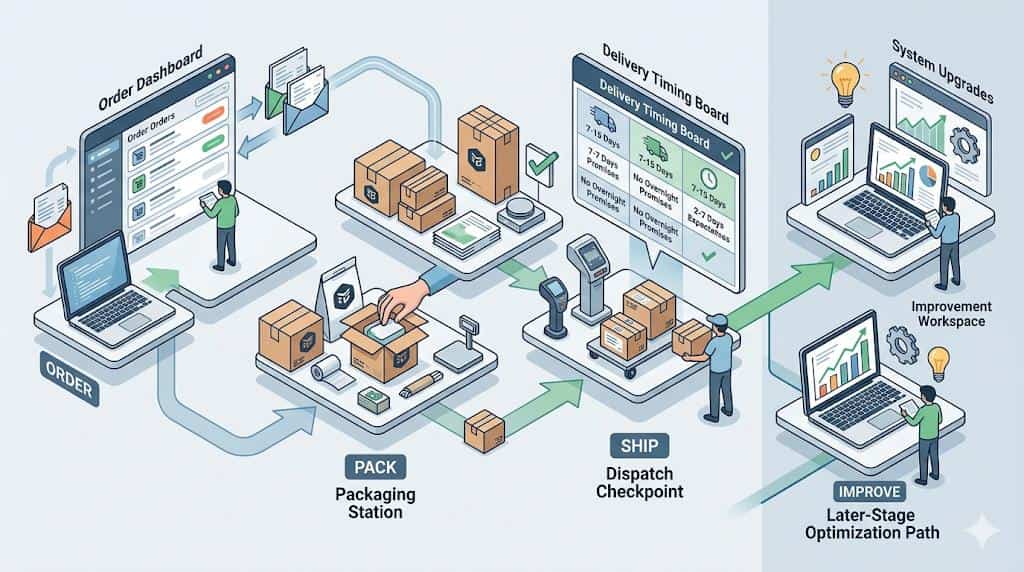
Private label dropshipping only works cleanly when fulfillment responsibility is clear.
You need to know:
- who receives the order
- who prepares the product
- who confirms the packaging rules
- who dispatches the shipment
- who catches mistakes before the parcel goes out
If that chain is vague, brand damage shows up very fast in the form of complaints, refunds, and inconsistent customer experience.
If you sell on Shopify and need a cleaner China-side dispatch process, our Shopify Fulfillment from China Service may also help.
Step 8: Keep Shipping Expectations Honest
Good private label branding can improve perceived value, but it does not change delivery physics.
If shipping still comes from China, the store should communicate realistic expectations.
Do not let better branding create worse disappointment.
If you want to understand the cost side better, this guide also helps: Shipping Cost from China to US.
Step 9: Improve the System Only After the First Version Works
You do not need a perfect private label machine on day one.
You need a clean first version that works well enough to learn from.
Once the product and supplier setup are stable, then you can improve:
- packaging depth
- insert quality
- repeat-order efficiency
- brand consistency across more SKUs
- margin through better sourcing discipline
Trying to build the full “ideal” version too early usually slows the business down.

Common Mistakes That Hurt Private Label Projects
1. Over-customizing too early
It feels exciting, but it often adds complexity before the product model is stable.
2. Choosing suppliers by price only
Weak execution can make the brand feel cheaper than the savings were worth.
3. Treating sample review casually
Private label samples need more scrutiny than generic samples.
4. Leaving fulfillment responsibilities vague
If no one clearly owns the packaging and dispatch details, errors multiply.
Need Help Building the Workflow?
If you are still deciding whether the model itself is right for you, read this first: Private Label Dropshipping China: Is It Right for Your Brand in 2026?.
If you already decided to move forward and need help making the workflow cleaner, that is where China-side support matters more.
How Style Sourcing Can Help
We are based in Yiwu, so we help buyers build private label workflows with more practical control.
We can help with:
- supplier comparison
- sample review
- packaging coordination
- quality control support
- shipping planning
- private label execution follow-up
If you want help building a cleaner branded supply chain from China, our Private Label Sourcing Service can help. You can also talk to our team here.


