The sample bag looked fine, but will the bulk order feel the same in your customer’s hand?
The supplier says the logo is correct, but who checks the logo position before cartons leave China?
The bag price is attractive, but are the zipper, lining, stitching, labels, and packing actually matched to what you approved?
Private-label bag orders fail in small details. A tote bag may use thinner fabric than the approved sample. A backpack may have zipper pulls that feel cheaper. A cosmetic pouch may arrive with the logo shifted a few millimeters off center. A handbag may look acceptable in a supplier photo, but the lining, thread color, and packaging do not match the buyer-agreed specification.
That is why private label bags need a different quality control checklist from generic wholesale bags. You are not only checking whether the bag exists and looks roughly similar. You are checking whether the production order matches the approved sample, the written specification, the branding requirements, and the packing instructions the buyer agreed with the supplier.
This guide is written for overseas buyers sourcing bags from China through Bao66, 1688, Yiwu suppliers, trading companies, or bag factories. It does not give fake AQL levels, inspection percentages, sample costs, MOQ numbers, or production timelines. Those must be confirmed case by case. Instead, it gives a practical checklist based on buyer-agreed specifications and approved sample comparison.
Quick Answer: What Should You Check for Private Label Bag QC?
For private-label bags, the main QC points are:
| QC Area | What to Compare | Main Risk If Missed |
|---|---|---|
| Approved sample | Bulk bag vs approved sample photos and physical sample | Production looks cheaper or different from what buyer approved |
| Material | Outer fabric, lining, texture, thickness feel, color, finish | Bag feels lower grade or does not match product listing |
| Hardware | Zipper, slider, buckle, snap, rivet, D-ring, magnetic button | Breakage, rust, rough operation, color mismatch |
| Stitching | Stitch line, thread color, seam position, loose threads, handles | Weak handles, uneven appearance, poor customer reviews |
| Logo | Method, position, size, color, clarity, alignment | Branding looks unprofessional or wrong |
| Labels | Brand label, care label, barcode, SKU sticker, country label if required | Warehouse confusion, retail compliance issues, customer complaints |
| Packaging | Polybag, tissue, hangtag, sticker, inner packing, carton mark | Damaged presentation, mixed SKUs, shipping confusion |
| Cartons | Carton count, carton marks, SKU/color mapping, export readiness | Wrong receiving records, lost cartons, mixed shipment problems |
The safest starting point is simple: do not let the supplier define quality only by their own internal standard. The buyer should provide a written specification, approve a reference sample, and ask any China-side QC team to compare production against those two references.
Why Private Label Bag QC Is Different from Generic Bag Checking
A generic wholesale bag order may only need a basic check: product type, color, quantity, visible damage, and packing. A private-label bag order has more moving parts.
The buyer may have chosen a logo method. The logo may need to match a brand color. The inner label may need to sit in a specific place. The hangtag may carry a barcode. The outer carton may need a shipping mark that matches the buyer’s warehouse receiving system. If the order includes several colors or SKUs, each color may need separate packaging and carton mapping.
This is where many overseas buyers get caught. They focus on the bag design during sampling, then treat bulk production as a normal repeat order. But the factory may change material, use available hardware, adjust lining, switch packaging, or interpret the artwork differently unless everything is written and checked.
For private label bags, QC should answer three practical questions:
- Does the bulk production match the approved sample?
- Does the bulk production match the buyer-agreed written specification?
- Is the packaging ready for the buyer’s next step, whether that is Amazon, Shopify stock, retail delivery, wholesale distribution, or consolidated export?
If the answer is not clear from photos, documents, and inspection notes, the order is not controlled enough.
Start with the Buyer-Agreed Specification
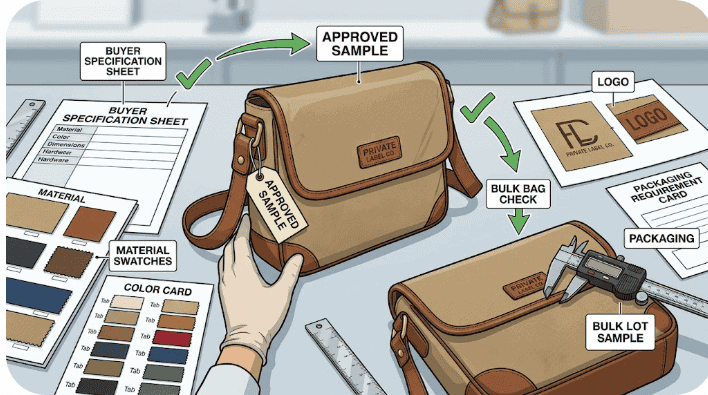
Before checking any bag, the buyer needs a specification that the supplier has agreed to. This does not need to be a beautiful technical document, but it must be specific enough that both sides know what is being checked.
A useful bag specification should include:
- product name and SKU;
- bag type, such as tote, backpack, handbag, pouch, cosmetic bag, cooler bag, or travel bag;
- dimensions and any important tolerance agreed with the supplier;
- outer material and color;
- lining material and color, if applicable;
- hardware type and color;
- zipper type, zipper color, zipper pull style, and opening direction where important;
- handle, strap, buckle, or D-ring requirements;
- logo method, size, position, color, and artwork version;
- inner label, care label, hangtag, barcode, or sticker requirements;
- unit packaging, inner carton, master carton, and shipping mark instructions;
- approved sample reference, including sample date and photos;
- any buyer-specific defect points that must not be accepted.
Do not rely only on a chat message saying “same as sample.” That sentence is too weak when a dispute happens. Better wording is: “Bulk production must match the approved sample dated [date] and the written specification confirmed on [date], including material, color, logo position, hardware color, stitching, label, unit packaging, and carton mark.”
The goal is not to make paperwork complicated. The goal is to remove room for supplier interpretation.
Approved Sample Comparison: The Core of Bag QC
For private-label bags, the approved sample is often more useful than a long generic checklist. It shows the hand feel, material surface, logo location, stitching style, hardware finish, lining, and packing presentation the buyer accepted.
But the approved sample only works if it is properly recorded.
What to Record When Approving a Bag Sample
When you approve a sample, record:
- supplier name or supplier ID;
- sample date;
- product SKU or model number;
- sample photos from front, back, side, bottom, inside, logo close-up, hardware close-up, stitching close-up, label, and packaging;
- dimensions measured on the sample;
- material and color description from the supplier;
- buyer comments and corrections;
- final approval note;
- any changes that still need to be made before bulk production.
If the supplier sends only polished product photos, ask for real sample photos under normal lighting. For bag orders, close-up photos matter. A distant photo can hide loose threads, wavy stitching, thin lining, weak zipper teeth, and poor logo edges.
Do Not Approve a Sample with Unresolved Notes
Many problems start with a sample that is “basically okay” but still has open issues.
For example:
- the buyer approves the bag shape but asks to change the zipper color;
- the logo size is accepted verbally but not confirmed in artwork;
- the supplier says the final lining will be “better” than the sample;
- the packaging sample is missing, but the buyer approves production anyway;
- the buyer confirms the sample in a chat thread but does not mark which sample is final.
These small gaps become expensive during bulk production. If the approved sample is not final, call it a pre-production sample or correction sample, not the approved production reference.
Materials Checklist for Private Label Bags

Material is the first thing customers feel. It is also one of the easiest areas for quiet substitution if the specification is loose.
When checking materials, compare the bulk bag with the approved sample and written specification.
Outer Material
Check:
- color match against the approved sample;
- surface texture and finish;
- thickness feel compared with the approved sample;
- visible wrinkles, stains, scratches, marks, or uneven coating;
- fabric direction or pattern alignment where it affects appearance;
- odor if the bag has a strong smell when opened;
- consistency across different units and colors.
Do not write “high quality PU” or “premium canvas” without defining what that means. Buyers and suppliers often use quality words differently. The inspection reference should be the sample and specification, not a general adjective.
Lining and Inner Structure
The lining is easy to ignore because it is inside the bag, but customers notice it when they open the product.
Check:
- lining material and color;
- whether the lining is clean and properly attached;
- whether pockets, compartments, and seams match the sample;
- whether the lining twists, pulls, or bunches;
- whether there are loose threads inside the bag;
- whether the inner label is sewn or placed correctly.
For backpacks, cosmetic bags, handbags, and organizer pouches, inner structure can matter as much as the outer look. A bag can look fine from the front but fail in use if the inside is messy.
Color Consistency
For mixed-color orders, check each color separately. Do not inspect only the first color and assume the other colors are the same.
A simple record should map:
| Color / SKU | Approved Sample Available? | Bulk Color Compared? | Packaging Checked Separately? | Notes |
|---|---|---|---|---|
| Black | Yes / No | Yes / No | Yes / No | |
| Beige | Yes / No | Yes / No | Yes / No | |
| Pink | Yes / No | Yes / No | Yes / No | |
| Custom color | Yes / No | Yes / No | Yes / No |
For private label, one wrong color can create separate customer complaints even when the rest of the order is acceptable.
Hardware Checklist: Zippers, Buckles, Snaps, Rivets, D-Rings

Bag hardware is small, but it creates a strong impression of quality. It also fails in obvious ways: stuck zipper, loose buckle, scratched metal, weak magnetic button, mismatched color, or sharp edge.
Check the following against the approved sample and specification:
- hardware type;
- hardware color and finish;
- zipper opening and closing smoothness;
- zipper pull shape and logo if customized;
- buckle movement;
- D-ring or hook attachment;
- snap button or magnetic button alignment;
- rivet placement and tightness by visible/manual check;
- scratches, rust, stains, discoloration, or sharp edges;
- consistency between units.
Do not assume the supplier will use the same hardware as the sample if the purchase order only says “gold hardware” or “standard zipper.” Hardware should be named or visually referenced. For private-label orders, photos of the approved hardware are often more useful than words.
If hardware has a special coating, logo, engraving, or brand finish, confirm that the supplier has a correct reference before production. A bulk order with the wrong zipper pull can make the whole batch feel off-brand.
Stitching Checklist: Where Bag Quality Shows Fast
Stitching is one of the fastest ways to judge bag production quality. It affects both appearance and durability.
For bag QC, check stitching in the areas that carry stress first:
- handles;
- shoulder straps;
- backpack straps;
- zipper ends;
- bottom corners;
- side seams;
- pocket openings;
- logo patch or label area;
- strap connection points;
- reinforcement stitching.
Then check general appearance:
- stitch line straightness;
- thread color match;
- skipped stitches;
- loose thread ends;
- broken thread;
- uneven seam allowance;
- puckering around seams;
- visible needle holes or fabric damage;
- symmetry between left and right sides.
A supplier may send a photo of the front of the bag and say everything is fine. That photo does not prove the handle stitching, side seams, or inside pocket are acceptable. Ask for close-ups, or have the inspection scope include these points.
Handle and Strap Checks
Handles and straps deserve special attention because they are stress points. For visual and manual checking, compare the bulk bags with the approved sample:
- handle length;
- handle placement;
- strap width;
- reinforcement position;
- stitch pattern;
- strap color and material;
- buckle or adjuster position;
- visible twisting or uneven length.
This is not the same as a lab strength test. If the buyer needs formal load testing or compliance testing, that must be specified separately with a qualified testing party. A normal China-side visual QC check should not be presented as a laboratory result.
Logo QC Checklist: Printing, Embroidery, Heat Transfer, Labels
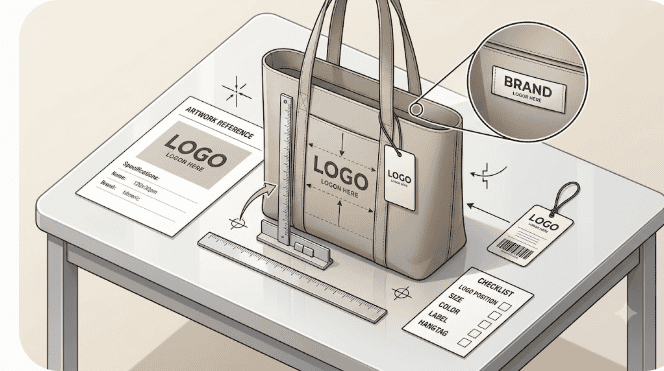
For private-label bags, logo errors are not small errors. A customer may forgive a plain bag with minor variation, but a branded bag with an off-center logo looks unprofessional immediately.
Check:
- logo method matches the agreement;
- artwork version is correct;
- logo size matches the approved reference;
- logo position is correct;
- logo color is consistent with the approved sample;
- edges are clean;
- print is not blurred, cracked, peeling, or uneven;
- embroidery is not loose, messy, or puckered;
- heat transfer is placed straight and properly attached by visual check;
- label is sewn straight and not reversed;
- logo placement is consistent across units.
Do not let the supplier define logo approval only by saying “printed.” The buyer should specify the method and provide artwork. The supplier should confirm the artwork version used for production.
Logo Position Record
For logo placement, use a simple position record:
| Logo Area | Reference Needed | What to Check |
|---|---|---|
| Front panel | Approved sample photo or marked drawing | Centering, height, distance from edge |
| Inner label | Sample photo or label placement note | Straight sewing, correct direction, clean edge |
| Zipper pull logo | Hardware sample photo | Shape, engraving/print, finish |
| Hangtag | Artwork and sample | Paper/card quality, print clarity, string position |
| Carton mark | Shipping mark instruction | SKU, quantity, carton number, destination code if required |
A measuring tape photo can help if position is important. Even if the tolerance is not formally defined, photos make the conversation more concrete.
Packaging Checklist: Retail Presentation and Shipping Readiness
Packaging is often treated as the last step, but for private-label bags it can affect customer experience, warehouse receiving, and resale readiness.
Check unit packaging first:
- polybag size and thickness feel compared with sample or agreement;
- tissue paper, dust bag, insert card, or filler if agreed;
- hangtag placement;
- barcode or SKU sticker;
- warning label if required by buyer;
- color/SKU sticker if needed;
- folding method;
- whether hardware is protected from scratching;
- whether handles or straps are protected from deformation.
Then check carton packaging:
- carton count;
- units per carton;
- color/SKU split by carton;
- carton mark;
- gross weight and dimensions if required for shipping planning;
- carton condition;
- inner protection;
- whether mixed SKUs are clearly mapped;
- whether the packing list matches carton photos.
If your order will go to an Amazon warehouse, Shopify 3PL, retail store, or distributor, packaging requirements should be confirmed before production. Do not wait until the goods are finished to ask the supplier to add labels or change carton marks.
Carton and SKU Mapping for Mixed Bag Orders

Many bag buyers order several colors, styles, or small SKUs in one shipment. This is where warehouse receiving mistakes happen.
A useful carton map should show:
- supplier name;
- product SKU;
- color;
- quantity per carton;
- carton number;
- total cartons;
- carton mark photo;
- unit packaging photo;
- any mixed carton notes.
For example:
| Carton No. | SKU | Color | Units | Carton Mark Checked? | Notes |
|---|---|---|---|---|---|
| 1-5 | TB-01 | Black | 50 each | Yes / No | |
| 6-8 | TB-01 | Beige | 50 each | Yes / No | |
| 9 | TB-02 | Mixed | 30 | Yes / No | Mixed carton needs detail list |
If a buyer is consolidating from several Bao66, 1688, or Yiwu suppliers, carton mapping becomes even more important. A China-side warehouse photo can help document what arrived, but warehouse receiving is not the same as full QC. The buyer should define whether they need only receiving photos, a visual bag check, a packaging check, or a more detailed inspection scope.
Pre-Shipment Bag QC Workflow
A practical private-label bag QC workflow usually follows this order:
- Confirm buyer-agreed specification.
- Confirm approved sample reference.
- Confirm inspection scope before goods are finished.
- Ask supplier for production completion status and packing status.
- Check materials, hardware, stitching, logo, labels, and packaging against the sample and specification.
- Record photos and notes for each key point.
- Flag differences clearly.
- Ask the supplier for explanation or correction plan if needed.
- Confirm whether the buyer accepts, rejects, asks for rework, or requests further checking.
- Prepare carton, packing list, and shipping handoff only after the buyer decision is clear.
This workflow does not guarantee that every issue will be found. It also does not replace laboratory testing, legal compliance review, or a formal third-party inspection standard if the buyer needs those. But it is much stronger than trusting supplier photos and waiting until the goods arrive overseas.
AQL, Sampling, and Defect Limits: What Not to Fake
Many buyers search for AQL when they think about QC. AQL can be useful, but it must be defined correctly. Do not copy a random AQL level from a competitor article and apply it to your order without confirming the product risk, order size, defect classification, and buyer requirement.
For this draft, no AQL level, sample size, or acceptable defect rate is claimed. Those details must be agreed case by case between the buyer, supplier, and inspection party.
Instead, buyers should define three things before inspection:
- what defects are critical for this bag order;
- what differences from the approved sample are not acceptable;
- what inspection method or sampling plan will be used.
A private-label bag buyer may classify defects like this:
| Defect Type | Examples | Buyer Decision Needed |
|---|---|---|
| Branding defect | Wrong logo, off-center logo, incorrect label, wrong hangtag | Usually high priority because brand presentation is affected |
| Functional defect | Zipper stuck, buckle broken, strap not attached correctly | Buyer must decide acceptance rule before shipping |
| Appearance defect | Stain, scratch, uneven stitching, visible thread | Depends on severity and product positioning |
| Packaging defect | Wrong barcode, missing polybag, wrong carton mark | Can affect warehouse receiving and resale readiness |
| Specification mismatch | Wrong material, color, size, hardware, lining | Compare against approved sample and written specification |
The important point is not the table itself. The important point is that the buyer defines the decision rules before the supplier asks for final payment or shipment approval.
Common Private Label Bag QC Mistakes
Mistake 1: Approving Only Supplier Photos
Supplier photos can be useful, but they are not enough. Photos may show the best unit, not the average production quality. They may avoid close-ups. They may not show the inside, bottom, seams, or carton marks.
Ask for specific photos, or arrange China-side checking if the order matters.
Mistake 2: Checking the Bag but Ignoring Packaging
A bag can pass visual checking but still be a problem if the barcode is wrong, carton marks are missing, colors are mixed, or hangtags are not attached. For ecommerce and retail buyers, packaging is part of the product.
Mistake 3: Treating the Sample as Decoration
The approved sample is not just a nice thing to keep on the desk. It is the production reference. If the bulk order does not match it, someone needs to explain why before shipment.
Mistake 4: Not Separating Warehouse Receiving from QC
Warehouse receiving usually checks what arrived: carton count, visible damage, labels, photos, and basic matching. QC checks the product against agreed requirements. These can be connected, but they are not the same service.
Mistake 5: Leaving Defects Undefined
If the buyer never defines unacceptable defects, the supplier may argue that the goods are normal. Before production, list the defects that matter most to your brand and customer.
What to Send a China-Side Team Before Bag QC
If you ask Style Sourcing or another China-side team to help check private-label bags, send enough information before inspection. Do not wait until the goods are packed and urgent.
Send:
- supplier link or supplier contact;
- purchase order or order summary;
- SKU list;
- color and quantity breakdown;
- buyer-agreed specification;
- approved sample photos;
- artwork file and logo placement reference;
- packaging requirements;
- carton mark instruction;
- known risk points from sampling;
- what kind of check you need: sample comparison, visual QC, packaging check, warehouse receiving, or pre-shipment inspection coordination.
The more specific the buyer is, the more useful the China-side check becomes. If you only say “please check quality,” the result will be too broad.
How Style Sourcing Can Help with Private Label Bag QC
Style Sourcing can support overseas buyers by helping organize the China-side workflow around supplier communication, sample comparison, QC scope discussion, warehouse receiving, packaging photo checks, consolidation, and shipping handoff.
For private-label bag orders, the practical support usually starts with clear references:
- What did the buyer approve?
- What did the supplier agree to make?
- What must be checked before shipment?
- What photos and notes should be recorded?
- What differences need buyer confirmation?
If you are sourcing bags from Bao66, 1688, Yiwu, or other China suppliers, you can send the supplier links, bag specification, approved sample photos, logo artwork, and packaging requirements. The scope, inspection method, timing, and responsibility should be confirmed before work starts. MOQ, production timing, inspection level, and supplier correction results must be handled case by case.
This is not about hard selling a service. It is about avoiding the most common buyer mistake: paying for a private-label order without a clear reference and then discovering the mismatch after the cartons arrive overseas.
Private Label Bags QC Checklist Summary
Use this checklist before approving shipment:
Documents and References
- Buyer-agreed specification confirmed.
- Approved sample recorded with date and photos.
- Artwork version confirmed.
- Packaging instruction confirmed.
- Carton mark instruction confirmed.
- SKU/color/quantity list confirmed.
Product Checks
- Outer material compared with approved sample.
- Lining checked.
- Color checked by SKU.
- Dimensions checked where required.
- Hardware checked.
- Zipper checked.
- Stitching checked at stress points.
- Handles and straps checked.
- Logo method, position, size, and color checked.
- Labels and hangtags checked.
- Visible defects recorded.
Packaging and Shipment Checks
- Unit packaging checked.
- Barcode/SKU stickers checked if used.
- Color/SKU separation checked.
- Carton count checked.
- Carton marks checked.
- Packing list checked against carton photos.
- Mixed carton details recorded.
- Exceptions sent to buyer before shipment approval.
FAQ: Private Label Bags Quality Control
What is the most important QC reference for private-label bags?
The two most important references are the buyer-agreed written specification and the approved sample. The specification defines what the supplier agreed to make. The approved sample shows the real material, construction, logo, hardware, and packaging reference the buyer accepted.
Is supplier photo checking enough for bag QC?
Supplier photos are useful, but they are not enough for important private-label orders. They may not show inside lining, stress-point stitching, zipper function, hardware finish, logo alignment, packaging, carton marks, or average production consistency.
Is warehouse receiving the same as quality control?
No. Warehouse receiving usually records cartons, visible damage, labels, photos, and basic matching. Quality control checks the product against the approved sample and buyer specification. A buyer should define which service is needed.
Should every private-label bag order use AQL inspection?
Not automatically. AQL level, sampling plan, and defect limits must be confirmed based on order size, product risk, buyer requirement, and inspection scope. Do not copy random AQL numbers from the internet.
What bag details should be locked before bulk production?
At minimum, lock material, color, dimensions, hardware, zipper, stitching expectations, logo method and position, labels, unit packaging, carton marks, and approved sample reference.
What if the bulk bags do not match the approved sample?
Record the differences with photos and notes, then ask the supplier for explanation or correction options before approving shipment. Refund, rework, replacement, or compensation outcomes cannot be guaranteed and depend on the supplier agreement, evidence, and situation.
Can Style Sourcing help compare bag samples from several suppliers?
Yes, sample comparison is a practical China-side workflow when buyers are choosing between suppliers. The buyer should send supplier links, sample requirements, comparison points, and shipping instructions. Final supplier selection remains a buyer decision.
What photos should I request before shipping private-label bags?
Ask for front, back, side, inside, bottom, logo close-up, hardware close-up, stitching close-up, label, unit packaging, carton mark, and packed carton photos. For mixed SKU orders, request photos by SKU or color, not only one general photo.
Related Guides
- Bao66 Bag Sourcing Service for Overseas Buyers
- Bao66 vs 1688: Which Is Better for Wholesale Bags?
- Best Bag Categories to Source on Bao66
- Sample Checking and Quality Control Service in China for Importers and E-commerce Sellers
- China Sample Consolidation: How to Compare Products Before Placing a Bulk Order
- 1688 Inspection Service: How to Check Quality Before Shipping
- Pre-Shipment Inspection China: A Practical Checklist Before You Ship
- China Sourcing Service
- Contact Style Sourcing


