
Last updated: June 26, 2026
Sample looked perfect, but the bulk goods arrived with weak stitching?
Supplier photos looked fine, but your warehouse found wrong labels and crushed cartons?
You paid the balance before checking — and now the goods are already on the water?
That is exactly why pre-shipment inspection China matters.
A good inspection will not make a bad supplier perfect. But it gives you one last chance to catch quantity problems, visible defects, wrong packaging, missing labels, poor workmanship, and obvious function issues before the shipment leaves China.
Once the goods are overseas, every problem becomes slower, more expensive, and harder to negotiate.
In This Guide
- What pre-shipment inspection means
- When inspection is worth it
- The practical inspection checklist
- How many units to check
- What happens after a failed inspection
- How Style Sourcing handles inspection
- FAQ
Quick Answer: What Is Pre-Shipment Inspection in China?
Pre-shipment inspection is a quality check done after production is finished but before final payment or international shipping.
The inspector checks whether the goods match your order requirements: quantity, appearance, size, function, packaging, labels, shipping marks, carton condition, and visible defects.
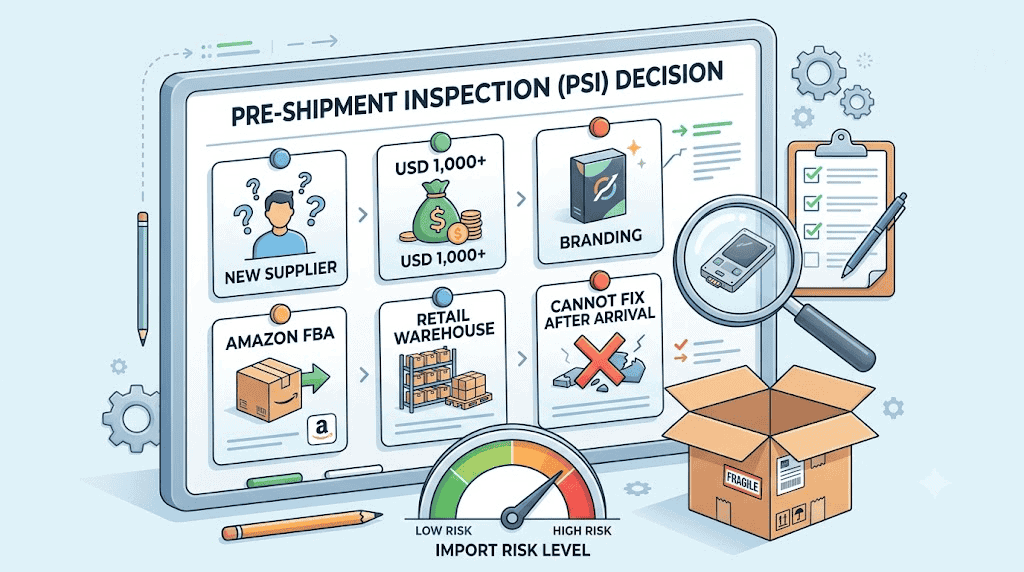
For most China sourcing orders, inspection is most useful when:
- the supplier is new to you
- the order value is above USD 1,000
- the product has branding, labels, size, color, or packaging requirements
- you are shipping to Amazon FBA, a retail warehouse, or an e-commerce fulfillment center
- you cannot afford to fix the problem after arrival
Think of it as the cheapest point to catch mistakes. A small inspection cost in China can prevent a much larger loss overseas.
Why Inspection Matters More in 2026
China still has excellent suppliers. But the supplier landscape is wider and more mixed than before.
On platforms like 1688, Alibaba, Yiwugo, and Bao66, a foreign buyer can find thousands of suppliers in minutes. That sounds convenient, but it also creates a problem: quality levels are not equal.
Two suppliers may sell the same-looking product with very different:
- material thickness
- stitching quality
- color consistency
- packaging strength
- label accuracy
- export experience
- willingness to rework defects
If you only compare price, you may not see the risk until the cartons are finished.
A pre-shipment inspection gives you evidence before the goods leave China. Photos, videos, defect lists, and carton checks make negotiation much easier.
When Is Pre-Shipment Inspection Worth It?
Inspection is not always necessary. For a very small sample order, supplier photos may be enough.
But for serious orders, skipping inspection is usually false economy.
| Order Profile | Recommended Inspection Level | Typical Logic |
|---|---|---|
| Under USD 1,000 sample order | Sample check or supplier photos | Formal inspection may cost too much relative to order value |
| USD 1,000 – USD 5,000 simple goods | Basic random inspection | Good for catching visible defects and packing mistakes |
| USD 5,000 – USD 20,000 branded goods | AQL-style pre-shipment inspection | Better for logo, packaging, size, color, and workmanship control |
| USD 20,000+ or compliance-sensitive goods | Mid-production + final inspection | Catch problems earlier, not only at the end |
| Full container shipment | Final inspection + container loading check | Protects carton count, loading sequence, and shipping marks |
One simple rule: if a failed shipment would hurt your cash flow, inspect before shipping.
Pre-Shipment Inspection China Checklist
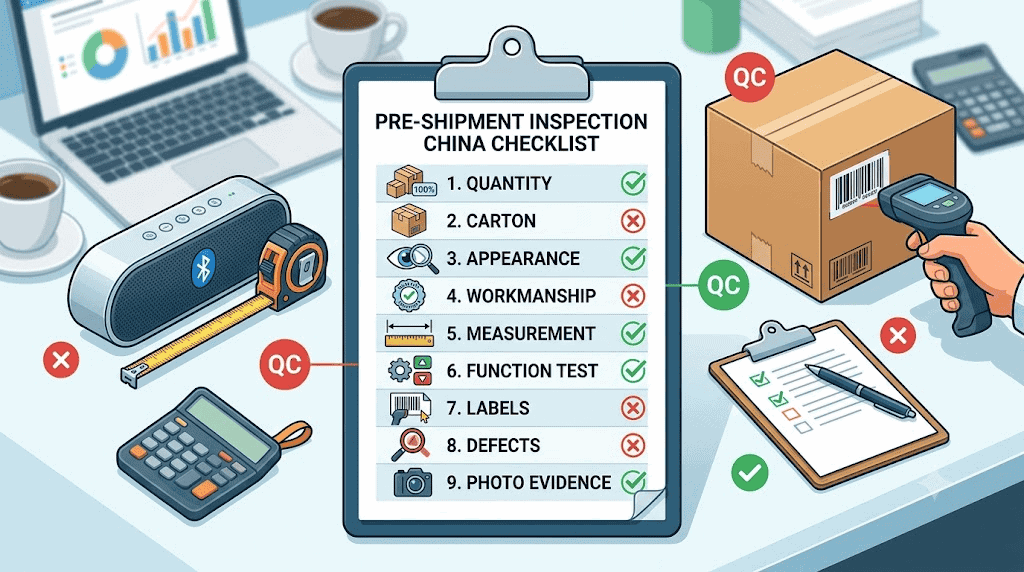
Use this checklist before paying the balance or booking final shipment.
1. Quantity and Carton Count
Check:
- total finished quantity matches the proforma invoice
- carton count matches the packing list
- inner quantity per carton is correct
- shortage / overage is recorded clearly
- mixed SKU cartons are labelled correctly
This sounds basic, but quantity mistakes are common when one order includes several colors, sizes, styles, or suppliers.
2. Carton and Outer Packaging
Check:
- master carton size matches your shipping plan
- carton strength is suitable for international freight
- no crushed, wet, torn, or weak cartons
- shipping marks are printed or pasted correctly
- fragile products have enough protection
- FNSKU, barcode, or warehouse labels are scannable
For Amazon FBA or retail warehouse orders, label mistakes can create receiving delays and extra fees.
3. Product Appearance
Check:
- color matches the approved sample
- surface is clean and consistent
- no scratches, stains, dents, rust, glue marks, or discoloration
- logo position is correct
- printing / embroidery / engraving is clean
- product shape is not deformed
For visual products such as bags, accessories, stationery, toys, home decoration, and gifts, appearance issues are often the first thing customers notice.
4. Workmanship
Check:
- stitching is even
- seams are strong
- loose threads are trimmed
- zippers, buttons, snaps, buckles, or handles are attached firmly
- glue is clean
- assembly is complete
- no missing parts or accessories
For bags, apparel accessories, shoes, hats, packaging, and home products, workmanship problems can make the product look cheap even if the material is acceptable.
5. Size, Weight, and Measurement
Check:
- product size matches the spec sheet
- size tolerance is acceptable
- weight is close to agreed standard
- carton dimensions match freight planning
- set items contain all required pieces
Small differences matter when products need to fit shelves, packaging inserts, Amazon size tiers, or retail display units.
6. Function Test
Check:
- electronic products power on
- mechanical parts move smoothly
- zippers open and close without catching
- locks, buttons, clips, wheels, handles, and hinges work
- lights, sounds, motors, chargers, or batteries function as expected
- simple stress tests are done where relevant
Do not rely only on appearance. Some products look fine but fail during use.
7. Branding, Labels, and Compliance Marks
Check:
- logo size and position are correct
- care labels are correct
- country-of-origin label is present where required
- barcode / SKU / FNSKU is correct
- warning labels are present for age-sensitive products
- CE, FCC, FDA, CPC, or other required marks are present where applicable
- packaging language matches destination-market requirements
This is especially important for Amazon, retail chains, children's products, electronics, cosmetics tools, and branded private-label goods.
8. Defect Classification
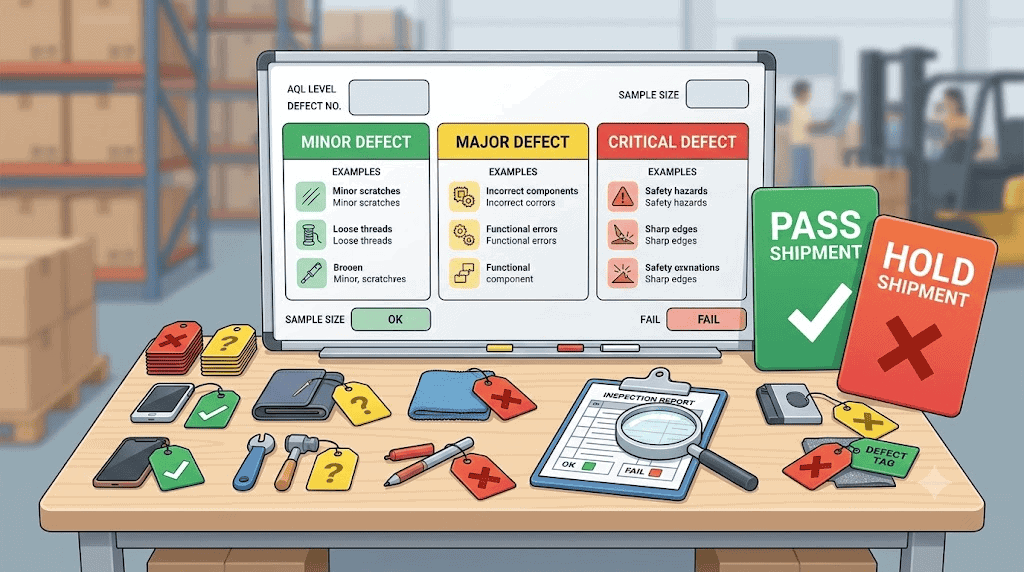
Group problems into:
- Critical defects — safety, legal, or unusable product issues
- Major defects — customer-visible problems that affect selling quality
- Minor defects — small cosmetic issues that may still be acceptable within tolerance
Without defect classification, the supplier may argue that all problems are “small.” A clear report helps you decide whether to accept, rework, discount, or reject the shipment.
9. Photo and Video Evidence
A useful inspection report should include:
- carton photos
- product overview photos
- close-up defect photos
- measurement photos
- function test photos or videos
- label and barcode photos
- packing list / shipping mark photos
- final pass / fail summary
If there is a dispute, photos and videos matter more than vague comments.
How Many Units Should Be Checked?
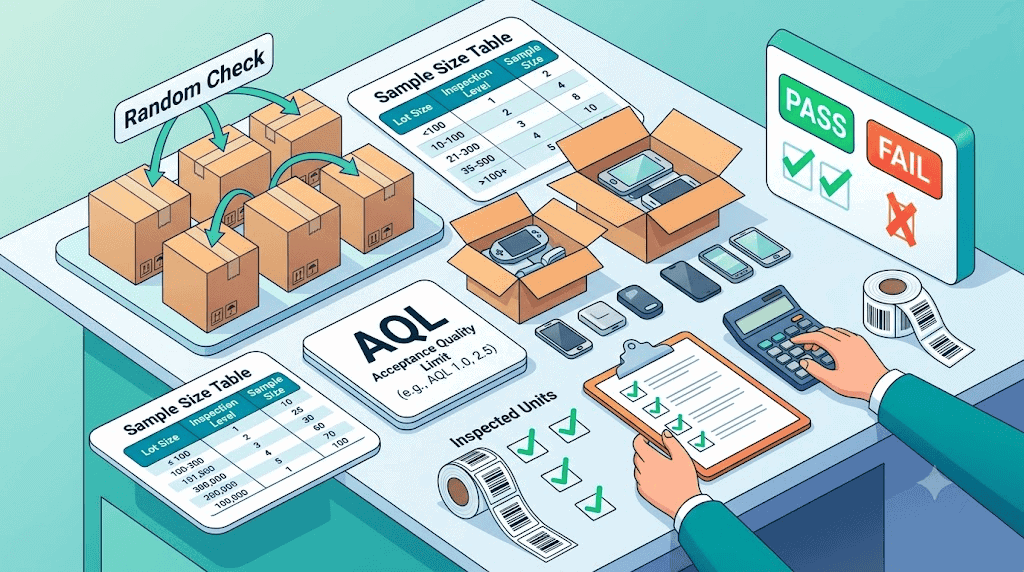
For very small orders, checking 5–10 pieces may be enough.
For larger orders, many inspection companies use an AQL-style sampling method. AQL stands for Acceptable Quality Limit. It defines how many units to inspect and how many defects are acceptable before the batch fails.
You do not need to become an AQL expert, but you should know this:
- random sampling is better than letting the supplier choose the “best” pieces
- different defect types should have different tolerance levels
- high-value or safety-sensitive products need stricter checks
- if the first inspection fails, re-inspection should happen after supplier rework
For a first order with a new supplier, be stricter. Once the supplier proves stable, you can adjust the inspection level.
What Happens If the Inspection Fails?

A failed inspection is not always the end of the order. It is a negotiation point.
Option 1: Supplier Rework
The supplier fixes the defects, repacks the goods, and submits them for re-inspection.
This is the best option when defects are visible and fixable: loose threads, wrong labels, dirty packaging, missing accessories, weak cartons, or small assembly issues.
Option 2: Partial Acceptance
You accept the good units and reject or discount the defective units.
This can work for mixed-SKU orders, but only if the defect quantity is clear.
Option 3: Discount or Compensation
Sometimes rework is impossible before the shipping deadline. In that case, you may negotiate a discount, spare parts, replacement goods in the next order, or partial refund.
Use this carefully. A discount does not help if the goods cannot be sold.
Option 4: Cancel or Hold Shipment
For serious problems, do not ship just because the goods are finished.
If the defect affects safety, compliance, customer trust, or your brand reputation, holding shipment is usually cheaper than importing a bad batch.
Common Inspection Mistakes Buyers Make
Mistake 1: Inspecting Too Late
If the container is already booked and the supplier is rushing, your negotiation power drops.
Schedule inspection before final payment and before cargo pickup.
Mistake 2: Only Checking Supplier Photos
Supplier photos are useful, but they are not independent evidence.
Ask for random checks, defect close-ups, carton photos, and video where needed.
Mistake 3: Not Defining Standards Before Production
Inspection works best when the supplier already knows your standard.
Before production, confirm:
- approved sample
- size tolerance
- packaging method
- logo position
- label requirements
- defect tolerance
- inspection timing
If the standard is unclear, the supplier can argue later.
Mistake 4: Skipping Packaging Checks
Many buyers focus only on the product.
But weak cartons, wrong labels, or missing shipping marks can cause warehouse delays, damaged goods, and extra freight costs.
Mistake 5: Treating Inspection as a Guarantee
Inspection reduces risk. It does not guarantee every single unit is perfect.
The goal is to catch major problems early enough to make a smart decision.
How Style Sourcing Handles Pre-Shipment Inspection
Style Sourcing is based in Yiwu, so we can support inspection across Yiwu Market suppliers, 1688 suppliers, Alibaba suppliers, and nearby factories.
Depending on the order, we can help with:
- sample comparison before bulk order
- mid-production check
- final pre-shipment inspection
- packaging and label check
- carton count verification
- photo / video inspection report
- supplier rework follow-up
- re-inspection after failed QC
- consolidation warehouse check before shipping
For buyers who already use our sourcing service, inspection is built into the order workflow when needed. For buyers who only need QC help, we can review the product type, order value, supplier location, and inspection scope first.
The most important point: we inspect before shipping, not after the problem becomes expensive.
Need Help Checking Goods Before They Leave China?
If your order is already in production, send us the product details, supplier location, order value, and shipping deadline.
Our Yiwu-based team can help you decide whether you need a basic check, AQL-style inspection, packaging review, or container loading check.
You can also read our China-side sourcing workflow here:
- Yiwu Order Process: 8 Steps From Supplier Search to Shipping
- Yiwu Sourcing Agent Fees Explained
- 1688 Supplier Verification Checklist
- Quality Control Service
- Contact Style Sourcing
FAQ About Pre-Shipment Inspection in China
Is pre-shipment inspection really necessary?
For very small sample orders, maybe not. For bulk orders, new suppliers, private-label goods, Amazon FBA shipments, or branded packaging, inspection is strongly recommended.
How long does a pre-shipment inspection take?
Most simple inspections take one working day once the goods are ready. Rework and re-inspection can add several days.
What if the supplier refuses inspection?
That is a red flag. A reliable supplier should allow inspection before final payment or shipping. If a supplier refuses, understand why before paying the balance.
Can I inspect goods remotely?
You can ask for supplier photos and video, but remote checking is weaker than an independent local inspection. For higher-value orders, use someone local to check randomly and document defects.
What is AQL?
AQL means Acceptable Quality Limit. It is a sampling method used to decide how many units to inspect and how many defects can be accepted before the batch fails.
How much does inspection cost in China?
Cost depends on location, product complexity, inspection depth, and whether re-inspection is needed. Instead of quoting a blind rate, Style Sourcing reviews the order scope first and gives a written quote.
What should I do after a failed inspection?
Ask for a clear defect list, supplier rework plan, timeline, and re-inspection. Do not pay the final balance or release shipment until the fix is confirmed.
Quick Recap
- Pre-shipment inspection China is one of the cheapest ways to reduce sourcing risk.
- Inspect before final payment and before international shipping.
- Check quantity, cartons, appearance, workmanship, function, labels, compliance marks, and documents.
- Use photos, videos, and defect classification to support negotiation.
- Failed inspection does not always mean cancel — but it should trigger rework, re-inspection, discount, or shipment hold.
- If your order is important enough to hurt your business when defective, inspect it before it leaves China.
Related Guides
- Yiwu Order Process: 8 Steps From Supplier Search to Shipping — see where inspection fits before final payment and shipping.
- Yiwu Sourcing Agent Fees Explained — understand what a sourcing agent fee should include, and which inspection costs are usually separate.
- 1688 Supplier Verification Checklist — useful if your inspection issue starts with supplier screening.


