Agreed on the product and price on 1688, then got stuck the moment the supplier asked for Alipay, WeChat Pay, or a Chinese bank transfer? Or wondering how overseas buyers should pay 1688 suppliers safely without sending money too early or paying before the real details are stable?
That is one of the most common 1688 bottlenecks for overseas buyers.
The hard part is not only sending money. It is making sure the supplier, sample, specs, quantity, packaging, and delivery terms are already clear before payment happens.
In many 1688 orders, payment risk comes more from rushing than from the transfer method itself.
In this guide, I’ll break down how to pay 1688 suppliers from overseas, which payment methods are common, what risk points matter most, and when China-side support makes the payment workflow much safer.
Quick Answer: Can Foreign Buyers Pay 1688 Suppliers Directly?
Sometimes yes, but not always easily.
That is the honest answer.
A lot of 1688 suppliers are used to domestic Chinese buyers.
That means they often prefer:
- Alipay
- WeChat Pay
- Chinese bank transfer
- RMB settlement
For local buyers, that is normal.
For an overseas buyer, it can become the first real obstacle.
So yes, foreign buyers can sometimes pay 1688 suppliers directly.
But in many real cases, the smoother route is:
- paying through a sourcing agent
- paying through a China-side company
- using a local payment support process
- arranging a domestic transfer path before the order moves forward
If you are asking can foreigners pay on 1688, the practical answer is yes, sometimes, but many real orders still need a China-side payment path to move safely and smoothly.

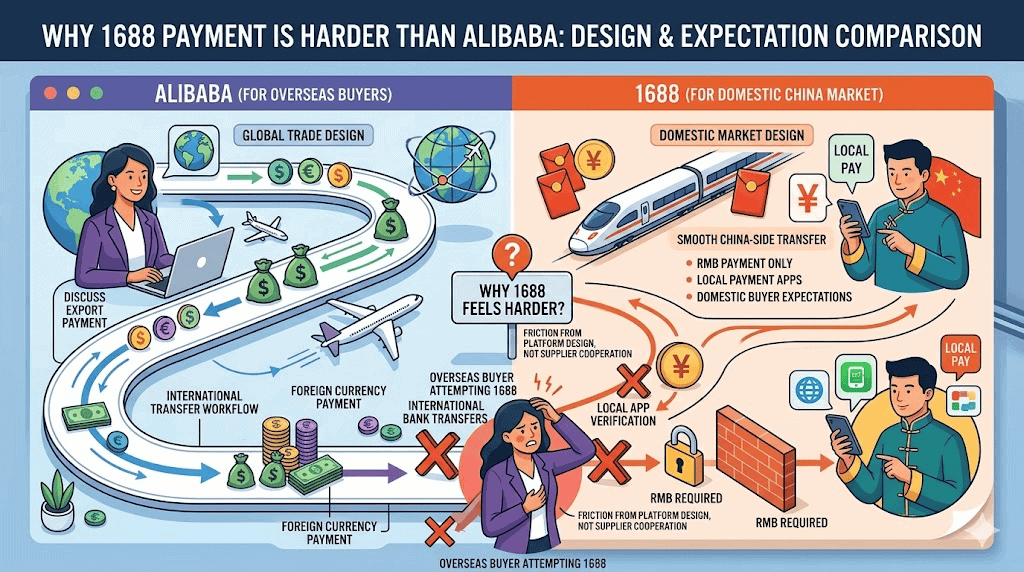
Why 1688 Payment Feels Harder Than Alibaba Payment
This comes down to platform design.
Alibaba is built for international buyers.
1688 is built for China’s domestic market.
That changes the whole payment expectation.
On Alibaba, suppliers often expect:
- overseas buyers
- export payment discussion
- foreign currency questions
- international transfer workflows
On 1688, suppliers often expect:
- domestic buyers
- RMB payment
- local payment apps
- smooth China-side transfer
So the issue is not that 1688 suppliers are doing something strange.
It is that the system was not designed around foreign payment convenience.
The Most Common Ways 1688 Suppliers Want to Be Paid
Let’s start with what suppliers usually ask for.
1. Alipay
This is one of the most common options.
For domestic Chinese buyers, it is simple.
For foreign buyers, it may or may not be practical depending on account setup and local limitations.
Good for:
- buyers already operating in China
- local team payments
- sourcing agent workflows
Hard for:
- buyers without Chinese payment setup
- people trying to do everything directly from abroad
2. WeChat Pay
Some suppliers also accept WeChat Pay.
Again, this is very normal in China.
But for overseas buyers, it is usually not the smoothest option unless they already have working local setup.
3. Chinese bank transfer
This is very common too.
The supplier sends a domestic bank account, usually expecting RMB.
For a foreign buyer, this can be inconvenient unless there is a reliable local partner handling the transfer.
4. Payment through a sourcing agent or local company
This is often the most practical route for overseas buyers.

The agent or China-side team receives your payment through an agreed method, then pays the supplier domestically.
That can simplify:
- currency handling
- domestic transfer
- payment confirmation
- supplier trust
- order follow-up after payment
What Foreign Buyers Need to Confirm Before Paying Any 1688 Supplier
Never rush the payment step just because the price looks good.
Before money moves, confirm these things clearly.
1. What exactly are you paying for?
Do not assume the quote covers everything.
Confirm:
- unit price
- sample fee or bulk price
- material version
- logo cost
- packaging cost
- carton details
- domestic freight inside China
A lot of confusion starts because buyers pay based on an incomplete quote.
2. What quantity does the price apply to?
A supplier may show a very low price online.
But that number may only apply at:
- 500 pieces
- 1000 pieces
- the most basic packaging version
- one specific color or spec
So before payment, make sure the price matches your actual order.
3. What happens after payment?
Ask clearly:
- when production starts
- expected lead time
- whether samples are approved first
- whether packaging details are confirmed
- where goods will be shipped in China
Payment without process clarity is how small mistakes turn into expensive ones.

The Safest Payment Workflow for Foreign Buyers
If you want a practical workflow, use this one.
Step 1: Confirm the sample first
If the product matters, do not pay for bulk before checking samples.
Step 2: Confirm final bulk details in writing
That includes:
- product spec
- quantity
- unit price
- logo requirement
- packaging requirement
- lead time
- delivery address in China
Step 3: Use a payment path you actually trust
That may be:
- your own verified China-side setup
- a sourcing agent
- a company payment arrangement
- a trusted local payment channel
Step 4: Keep proof of the order details
Make sure you keep the payment record tied to a clear product agreement.
Step 5: Ship to a China-side address first
This makes inspection and follow-up much easier.
Step 6: Inspect before export
Payment safety is not only about transferring money safely.
It is also about making sure the goods are correct before they leave China.

Should You Pay a 1688 Supplier 100% Upfront?
Usually, buyers should be careful here.
In some low-value, simple commodity orders, suppliers may request full payment in advance.
That is not unusual in domestic Chinese trade.
But foreign buyers still need to be smart.
The key question is not only whether upfront payment is “normal.”
The key question is whether the supplier has earned enough trust yet.
Before paying, ask yourself:
- Have I compared multiple suppliers?
- Have I checked sample quality?
- Are the order details clearly confirmed?
- Does the supplier communicate clearly?
- Do I have a China-side inspection plan?
If the answer to those questions is shaky, the payment is too early.
Red Flags to Watch Before You Send Money
Here are the payment-related warning signs I would take seriously.
Red Flag 1: The supplier pushes for payment before confirming details
That is not a good sign.
Red Flag 2: The price keeps changing right before payment
If the numbers move every time you ask a new question, slow down.
Red Flag 3: They refuse to confirm packaging or quantity clearly
This creates disputes later.
Red Flag 4: They want payment fast but answer slowly on real questions
That balance is wrong.
Red Flag 5: They cannot handle normal China-side delivery arrangements
If even domestic delivery feels confusing, later stages will probably be worse.
Red Flag 6: They avoid samples but want bulk payment
That is one of the easiest ways to lose confidence.
What If You Cannot Pay 1688 Suppliers Directly?
This is where many overseas buyers give up.
But it does not mean the order is impossible.
It usually means you need the right support structure.
Common practical solutions
- use a Yiwu-based sourcing agent
- use a local company payment process
- use a domestic receiving and transfer setup
- combine supplier communication, payment, and QC under one local team
This often makes more sense than forcing direct payment from abroad when the supplier was never set up for that workflow in the first place.
Why a Sourcing Agent Often Makes 1688 Payment Easier
For foreign buyers, payment is rarely just a money-transfer issue.
It is tied to:
- supplier communication
- quote clarity
- sample approval
- packaging confirmation
- warehouse receiving
- inspection before export
A sourcing agent can help connect all of those steps.
That is why many overseas buyers do not just pay “through an agent” for convenience.
They do it because it reduces friction across the whole order.
FAQ: How to Pay 1688 Suppliers from Overseas
Can I pay 1688 suppliers with PayPal?
Usually no.
Most 1688 suppliers prefer domestic Chinese payment methods instead of international consumer-style payment tools.
Is paying a 1688 supplier directly always risky?
Not always.
But the risk gets higher if you have not confirmed product details, sample quality, and delivery arrangements clearly.
What is the safest way to handle a first 1688 order?
Usually: compare suppliers, order samples, confirm the full quote, use a trusted payment path, ship to a China-side address first, and inspect before export.
Do I need a Chinese bank account to buy from 1688?
Not necessarily, but having a China-side payment solution makes the process much easier.
Final Advice
If you want to pay 1688 suppliers from overseas, do not think only about how to transfer money.
Think about how to control the entire order.
Confirm the real quote.
Check samples.
Use a payment path you trust.
Ship to a China-side address first.
Inspect before export.
That is how you make 1688 payment safer and less stressful.
Need Help Paying 1688 Suppliers Safely?
If you want help confirming supplier details, arranging payment, checking goods in China, or managing export shipping, our Yiwu-based team can help.
At Style Sourcing, we help overseas buyers reduce payment mistakes before they become sourcing problems.
If you need help with the whole 1688 workflow rather than payment alone, you can also see our 1688 buying support page.
Our China Sourcing Service can help confirm supplier quotes, arrange payment, receive goods in China, and inspect orders before shipment.
Need help paying a 1688 supplier safely from overseas? Talk to our team here.


