
Packaging Approval Checklist Before Bulk Production in China
You approved the product. The color looks right. The supplier says production can begin.
But have you approved the packaging with the same care?
A surprising number of avoidable order problems sit outside the product itself: the barcode belongs to the wrong variation, the carton mark uses an old purchase order number, the insert contains outdated instructions, the country-of-origin wording was never confirmed, or the supplier sends one attractive mock-up while the production team follows a different file.
Packaging approval is not a decorative last step. It is a controlled handoff between your commercial team, designer, supplier, production line, warehouse, freight partners, and destination-market advisers. The purpose is not to make one perfect presentation sample. The purpose is to create a written, visual record that the factory can reproduce and that your receiving team can check.
This checklist covers cross-category labels, carton marks, barcodes, inserts, and photo proof before bulk production in China. It provides a general compliance handoff, but it does not tell you which marks, warnings, tests, or statements a specific product legally requires. Those questions depend on the product and destination market and should be checked with the appropriate official source or qualified adviser.
Quick Answer: What Should Be Approved Before Bulk Packaging Starts?
| Approval area | What the buyer should confirm | Useful evidence to retain | Common handoff risk |
|---|---|---|---|
| Retail label | Final copy, placement, size, language, SKU relationship, and version | Approved artwork file plus applied-label photo | Old copy or wrong variation used |
| Product barcode | Barcode value, barcode type supplied by buyer, readable placement, and SKU mapping | Barcode list plus scan/readability confirmation | Correct-looking code linked to wrong SKU |
| Inner packaging | Bag, box, wrap, protection, quantity per pack, and closure method | Photos of an assembled packed unit | Supplier substitutes packing method |
| Insert | Final text, language, page order, size, and inclusion rule | Final PDF plus photo inside packaging | Insert omitted or outdated |
| Carton mark | Consignee or brand mark, PO/SKU/carton references, destination instructions supplied by buyer | Carton-mark artwork plus completed-carton photo | Old PO, missing carton number, or inconsistent format |
| Carton contents | Units per carton, variation separation, internal protection, and packing-list mapping | Carton content photo and packing record | Mixed SKUs cannot be identified at receipt |
| General compliance handoff | Product and destination questions sent to the responsible adviser or importer | Written question list and response record | Supplier assumption treated as legal confirmation |
| Production proof | First completed packaging set from the actual production method | Dated photo set with visible labels, inserts, barcode, and carton | Mock-up approved but production differs |
The short version is simple: approve the files, approve an assembled packed unit, approve the first production-format packaging, and keep the evidence connected to the correct SKU and purchase order.
Why Packaging Approval Often Breaks Down
Packaging work crosses several teams. A designer may own the artwork, a salesperson may forward it, a subcontracted printer may produce it, and a packing team may apply it. Each handoff creates room for version confusion.
The supplier may also interpret silence as approval. If your purchase order says “standard export carton” but does not identify the carton mark, unit count, barcode relationship, insert, or internal protection, the packing team still has to make decisions. They may use a familiar method that does not match your warehouse or sales channel.
Another problem is timing. Buyers sometimes wait until goods are nearly finished before checking labels and cartons. At that point, a file error is no longer only a design issue. It can affect printed materials, line planning, packing, receiving, and freight release.
A better approach is to make packaging a controlled specification before bulk work begins, then verify the first production execution before the remaining units are packed.
Step 1: Build a Packaging Specification by SKU
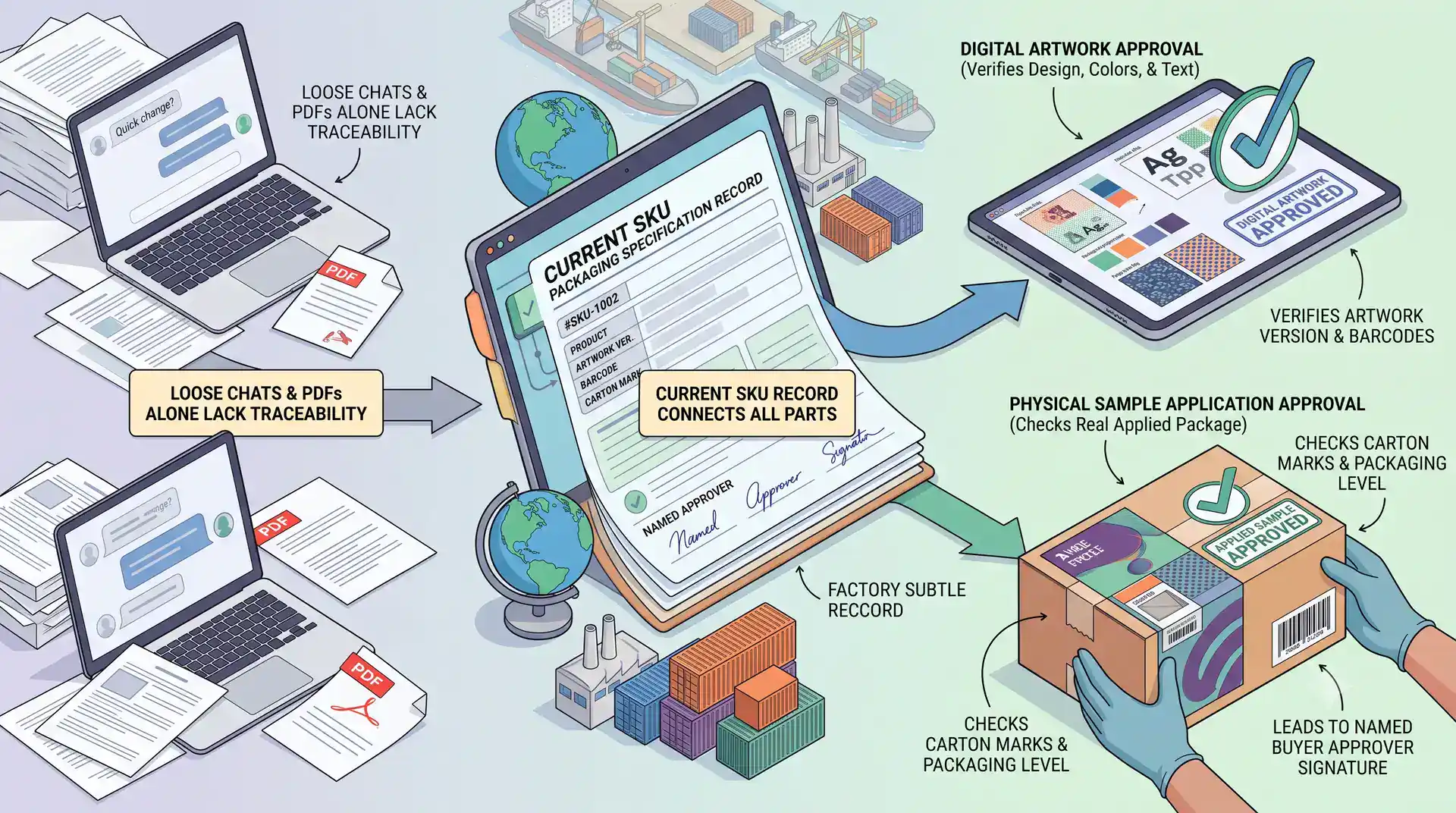
Do not send packaging instructions as a loose collection of chat messages. Create one packaging record that identifies the product, variation, and current file version.
Core identification fields
For each SKU or variation, record:
- Buyer SKU and supplier SKU, if both are used.
- Product name and variation description.
- Purchase order or order reference.
- Packaging level: product, inner pack, retail pack, master carton, or shipping unit.
- Artwork filename and version date.
- Barcode value assigned to that SKU.
- Insert filename and language version.
- Units per inner pack and units per master carton, where already commercially agreed.
- Carton-mark file or field list.
- Named buyer approver and approval date.
The goal is traceability. Someone looking at a barcode file should be able to identify which product it belongs to. Someone viewing a carton photo should be able to match it to an order and packing record.
Keep “design approval” separate from “production approval”
A PDF can show that the copy and layout are approved. It cannot prove that the production label is the expected size, that it adheres correctly, that the print is readable, or that workers apply it in the correct place.
Use two clear statuses:
- Artwork approved: the buyer accepts the content and layout file.
- Applied packaging approved: the buyer accepts how the approved file appears on the real product or package.
This distinction prevents the supplier from treating a digital mock-up as approval of the finished execution.
Step 2: Approve Retail Labels as Operational Data
A retail label can carry product identity, variation, brand, barcode, handling information, or destination-market information. Not every product needs the same fields, so avoid copying a generic label from another category.
Check the label in four ways.
Content check
Confirm spelling, punctuation, numbers, product names, variation names, website or contact text supplied by your team, and any translated copy. If regulated or mandatory wording may apply, route that question to the responsible compliance adviser or official destination-market resource before production.
Do not ask the supplier a vague question such as, “Is this label compliant?” A useful handoff names the product, destination, intended use, material or composition information available, and the exact label statement being reviewed.
Placement check
Mark the location on a product photo, dieline, or package drawing. “Put it on the back” can be unclear when a box has several panels or when a bag, bottle, garment, tool, or accessory can face different directions.
Physical readability check
Ask for a close photo and a wider contextual photo. The close image shows print quality and content. The wider image shows placement, orientation, scale, and whether another sticker or seam blocks the label.
Version check
The photo should be matched to the current filename or approval record. If an earlier file is withdrawn, label it clearly as obsolete in the communication thread. Avoid maintaining several files called “final,” “new final,” and “final revised.”
Step 3: Lock the Barcode-to-SKU Relationship
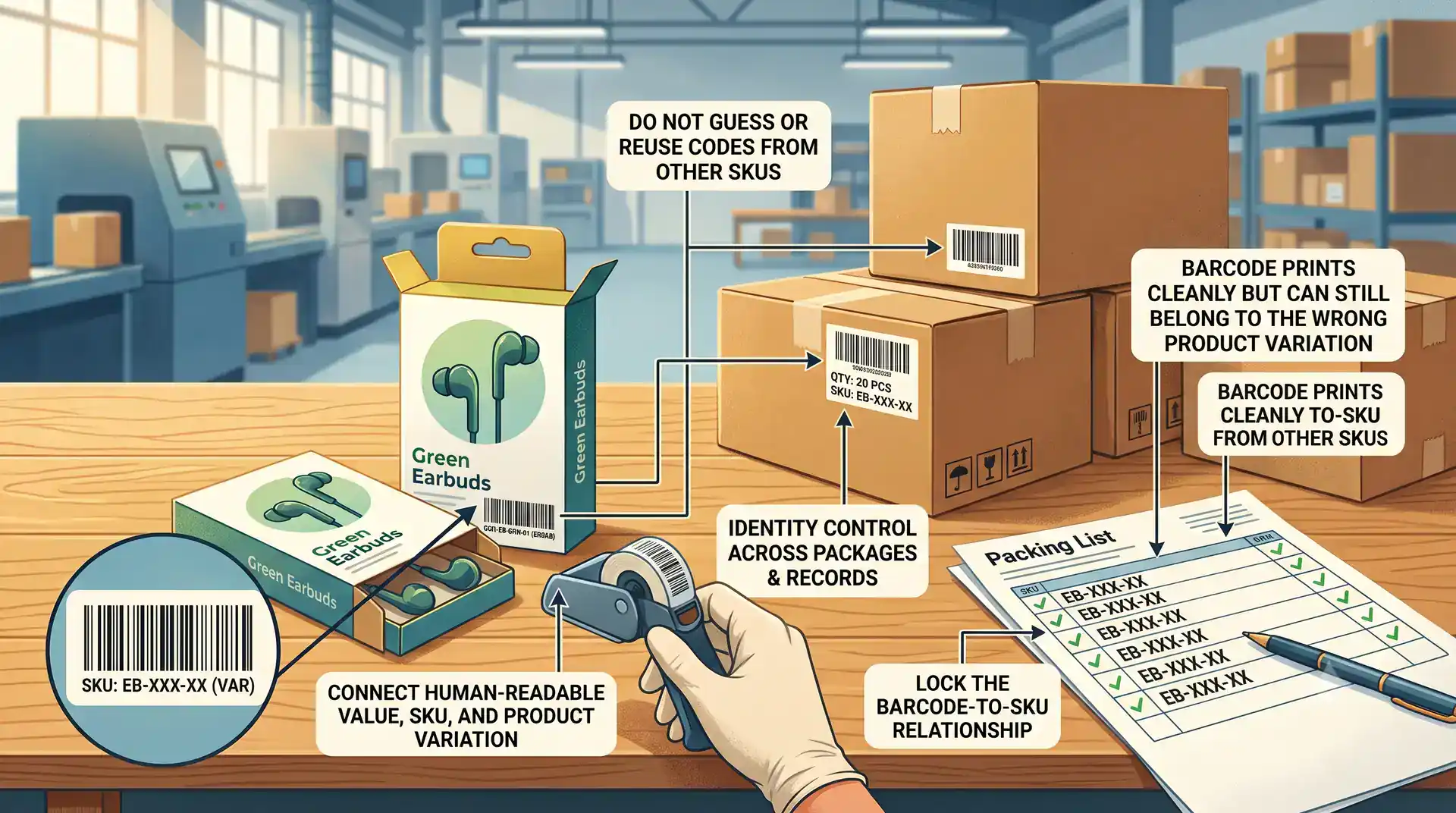
A barcode that prints cleanly can still be wrong. The important question is not only whether it scans, but whether it maps to the intended product and variation in the buyer’s system.
Prepare a simple barcode table:
| Buyer SKU | Product and variation | Barcode value | Artwork filename | Placement | Approval status |
|---|---|---|---|---|---|
| Example field only | Product description | Buyer-supplied value | Current file | Defined panel/location | Pending or approved |
The supplier should not guess barcode values or reuse an image from another SKU. Give the printer or supplier the production-ready code in the required format and retain the master mapping on the buyer side.
Before bulk printing or application, verify:
- The human-readable number matches the buyer’s master list.
- The barcode belongs to the correct variation.
- The surrounding artwork does not crop or distort it.
- The applied position is flat and unobstructed where practical.
- A physical sample can be read using the buyer’s intended checking method.
- The barcode on the retail pack matches the SKU on the carton and packing list.
Barcode verification is an identity-control task. It should not be presented as a guarantee that every marketplace, warehouse, carrier, or retail system will accept the package.
Step 4: Approve Inserts, Instructions, and Enclosed Materials
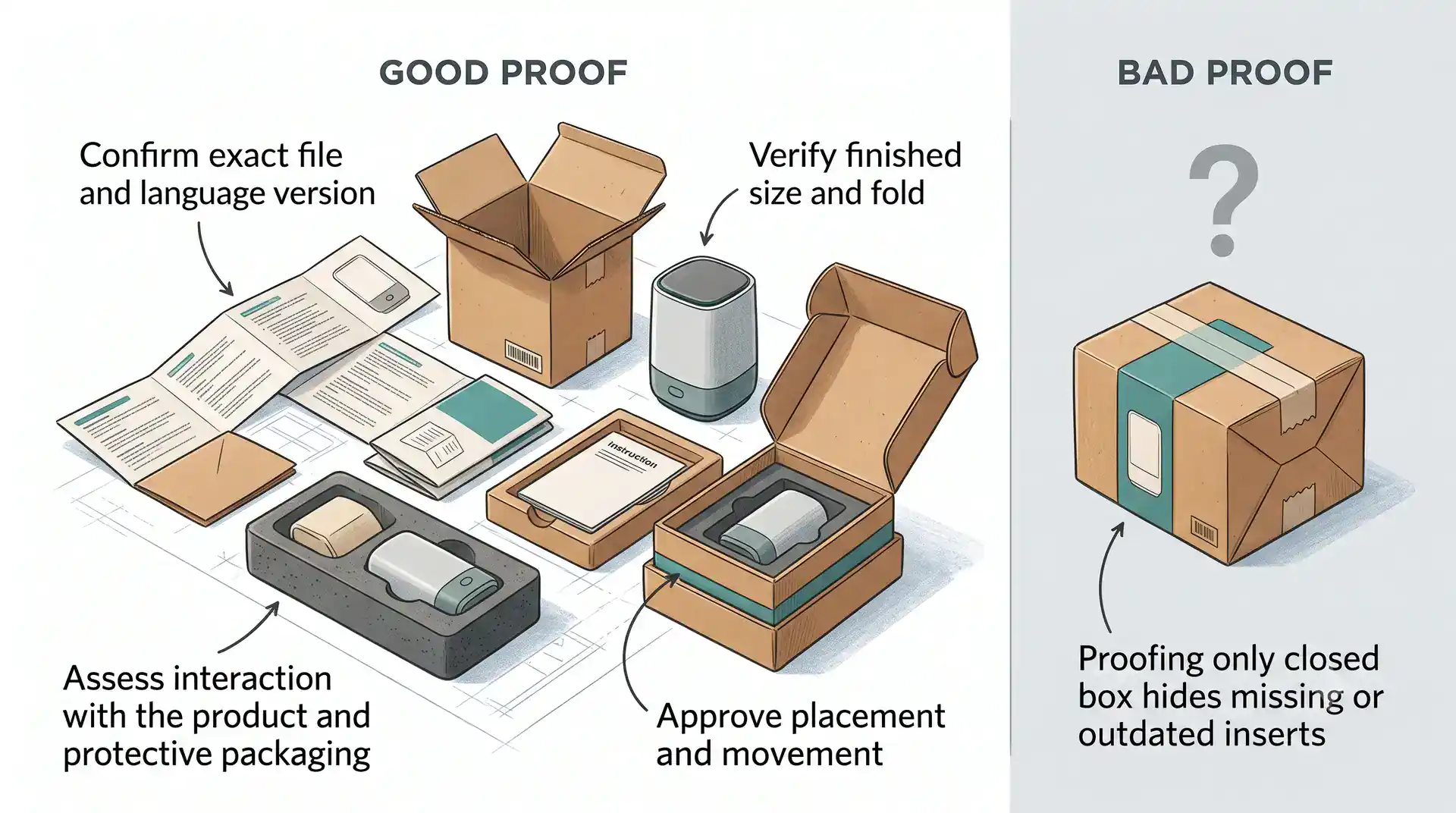
Inserts are easy to overlook because they disappear after the package closes. Yet an omitted or outdated insert may create customer confusion or make receiving checks harder.
Confirm:
- Exact insert filename and version.
- Language or market version.
- Finished size and page order.
- Fold orientation, if relevant.
- Whether one insert goes into every unit or only specified variations.
- Where it sits inside the package.
- Whether it can move, crease, stain, or damage the product.
- Whether a sealed pack can be opened for verification without disrupting the entire order.
Ask for a photo sequence rather than one closed-box image: insert beside the product, insert placed in position, and final closed package. This shows both inclusion and packing method.
If the insert contains safety, regulatory, warranty, legal, or usage claims, get the wording reviewed through the appropriate product and destination process. A sourcing coordinator can help make sure the approved file reaches the factory, but should not be treated as the legal authority for the statement.
Step 5: Make Carton Marks Useful at Receiving
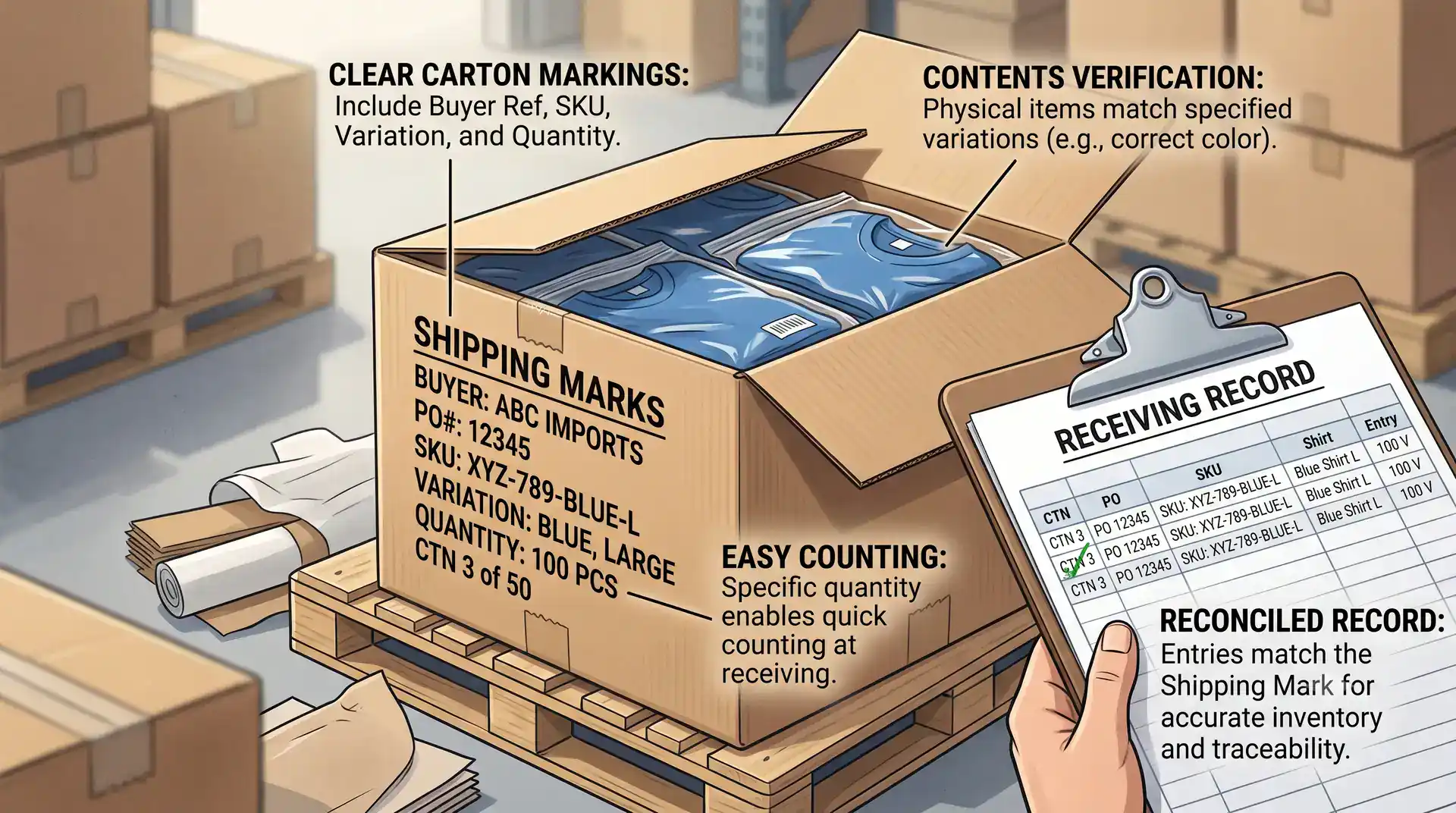
Carton marks are not only for shipping appearance. They can help the warehouse identify, count, separate, and investigate goods.
The fields depend on the order and destination, but an operational carton-mark record may include buyer-provided references such as:
- Brand or consignee mark.
- Purchase order reference.
- Product or SKU reference.
- Variation or color.
- Carton sequence, such as carton number within a shipment.
- Quantity in the carton.
- Gross or net weight and dimensions when provided through the shipping workflow.
- Country-of-origin wording where confirmed for the product and destination.
- Handling marks specifically required by the buyer or freight partner.
Do not copy another importer’s carton mark without understanding each field. Do not add compliance symbols because they look familiar. Carton and package statements can have market-specific implications.
Cross-check the carton, contents, and packing list
A carton mark is most valuable when it matches the contents and the packing list. Before release, compare:
- The SKU printed on the carton.
- The visible product variation inside.
- The stated quantity.
- The carton sequence.
- The corresponding packing-list line.
This does not replace a full inspection. It is a traceability check that makes receiving and exception handling more practical.
Step 6: Approve Inner Protection and Packing Method
Two suppliers can use the same outer carton while protecting the product very differently. Document how the product is placed, separated, wrapped, supported, and closed.
Check the assembled packaging from the product outward:
- Is the correct variation inside the correct retail package?
- Are removable parts or accessories present and identifiable?
- Does the product contact ink, adhesive, staples, rough edges, or moisture-sensitive material?
- Can units rub against one another?
- Are heavier items placed in a way that may crush lighter ones?
- Does the retail package remain presentable after ordinary handling?
- Does the inner arrangement support accurate counting?
- Does the carton close without forcing or excessive empty movement?
These questions are category-neutral. The correct packaging material and protection method depend on the product, route, storage conditions, and buyer requirements. Avoid inventing a universal carton grade, plastic thickness, drop-test standard, or packing formula.
Step 7: Request a Production Photo-Proof Set
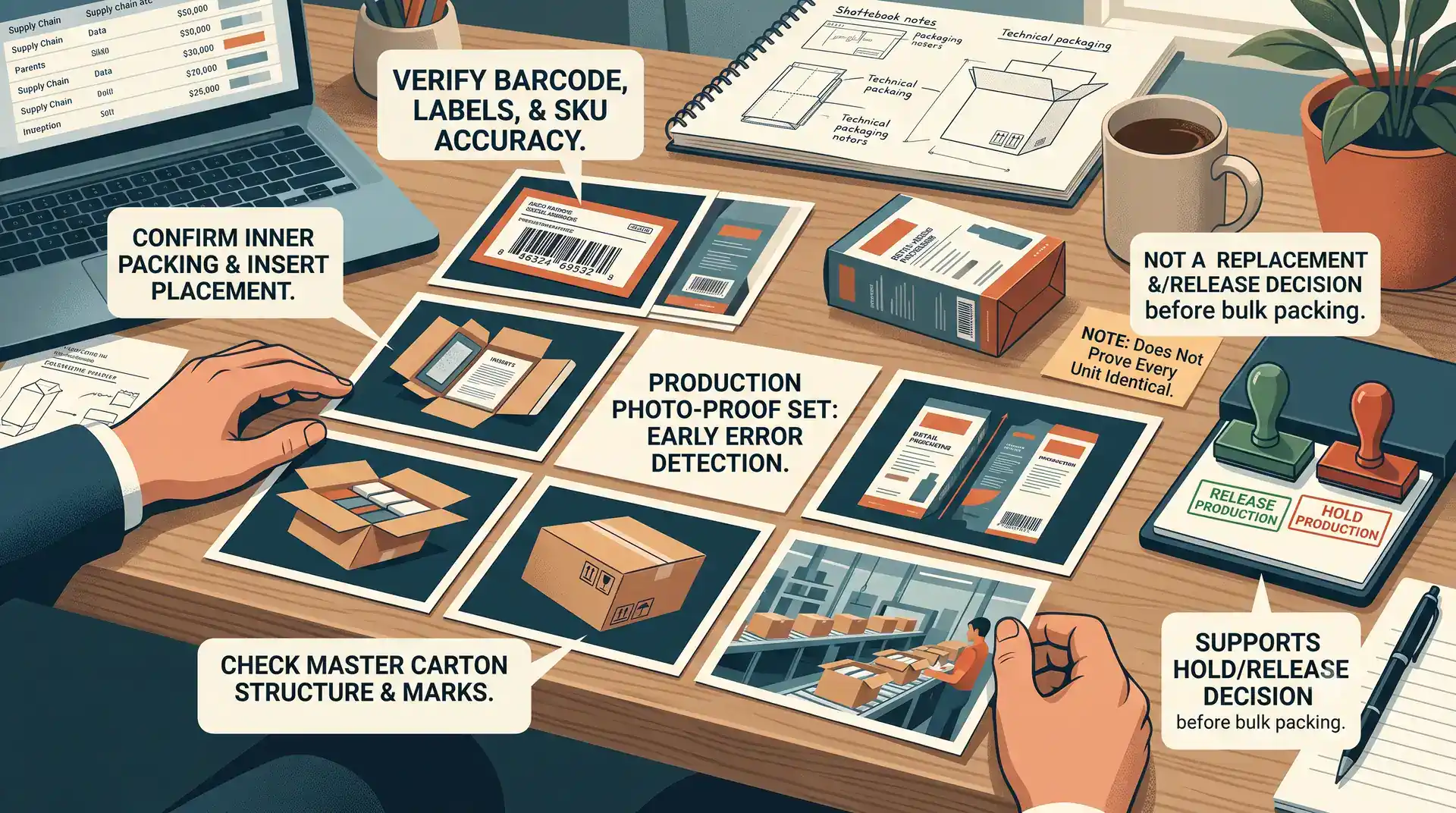
A useful photo-proof set is structured, not a stream of random images.
Request the following views for the first production-format packed unit and carton:
- Product and SKU identifier together.
- Front, back, and relevant sides of the retail package.
- Close-up of each label.
- Close-up of the barcode and human-readable value.
- Insert beside the product.
- Insert placed inside the package.
- Inner packing arrangement before carton closure.
- Open carton showing contents and separation.
- Closed carton showing all marks.
- Carton sequence or order reference.
- Wider image showing that the evidence comes from the current production setting where feasible.
Ask the supplier to send original-resolution files through an agreed channel. Messaging-app compression can make small text impossible to review.
Photo proof has limits. It shows selected units at a selected moment. It does not establish that every unit is identical, and it does not replace a defined inspection or receiving process. Its value is early error detection and a clearer approval record.
Step 8: Use an Approval Gate Before Bulk Printing and Packing
Create a written release point. The supplier should know which items can proceed and which remain pending.
Packaging release checklist
- [ ] Product and variation list is final for this order.
- [ ] Packaging specification is connected to each SKU.
- [ ] Retail-label content and artwork are approved.
- [ ] Label placement is approved on a real package or sample.
- [ ] Barcode values match the buyer’s SKU master.
- [ ] Physical barcode placement and readability have been checked.
- [ ] Insert content, language, version, and inclusion rule are approved.
- [ ] Inner packaging and protection method are documented.
- [ ] Units per pack and carton match the commercial record.
- [ ] Carton-mark fields and layout are approved.
- [ ] Carton mark, contents, and packing-list identifiers align.
- [ ] Product-and-destination compliance questions have been handed to the responsible party.
- [ ] First production-format photo proof has been reviewed.
- [ ] Changes and rejected versions are clearly recorded.
- [ ] The supplier has received written authorization to proceed.
If one item is unresolved, state exactly what is pending. “Packaging not approved” is less useful than “barcode mapping for blue variation and Spanish insert version remain pending; do not print or pack those variations.”
Step 9: Control Changes After Approval
Packaging files often change after an initial approval. A retailer updates a barcode, a translation is corrected, or the order mix changes. The risk is not the change itself; it is uncontrolled change.
Use a simple change record:
| Change field | Record |
|---|---|
| What changed | Exact artwork, text, barcode, quantity, or placement change |
| Affected SKU | Specific products or variations |
| Old version | Withdrawn filename and date |
| New version | Approved filename and date |
| Production impact | Not started, printing in progress, packed units affected, or other confirmed status |
| Buyer decision | Proceed, pause affected units, rework discussion, or further review |
| Evidence | Updated mock-up, applied sample, and written acknowledgment |
Never assume that sending a new file automatically cancels an old one. Ask the supplier to confirm which version the printer and packing team currently hold.
General Compliance Handoff: What the Supplier Cannot Decide for You
Official EU guidance notes that product requirements may cover design, labeling, marking, packaging, functionality, performance, and production-related characteristics, and that requirements vary by market and product. CBP guidance similarly reminds US importers that commodity-specific details matter and that importer responsibility does not disappear simply because a broker is used.
Operationally, this means the buyer should identify unanswered questions before packaging approval. Prepare a handoff package containing:
- Exact product description and intended use.
- Destination market or markets.
- Material or composition information available from the supplier.
- Manufacturer and origin information available.
- Proposed label, marking, and packaging statements.
- Photos or drawings showing placement.
- Questions for the customs broker, compliance adviser, marketplace, retailer, or testing body.
Style Sourcing or another China-side coordinator may help collect supplier information and implement the approved files. That is different from certifying legal compliance or guaranteeing customs acceptance.
Packaging Approval Process at a Glance
| Stage | Buyer action | Supplier action | Evidence output |
|---|---|---|---|
| 1. Define | Build SKU-level packaging specification | Confirm feasibility and identify missing inputs | Written specification and question list |
| 2. Prepare | Supply controlled artwork and barcode mapping | Produce mock-up or sample | Digital proof and physical photos |
| 3. Review | Check content, placement, pack method, and handoff questions | Correct discrepancies | Approval comments and revised evidence |
| 4. Release | Give written approval for named files/SKUs | Send approved files to production teams | Dated approval record |
| 5. Verify | Review first production-format proof | Photograph applied labels, inserts, inner pack, and carton | Structured photo-proof set |
| 6. Monitor | Record any change and affected SKU | Stop or segregate affected work where agreed | Change log and updated approval |
| 7. Inspect/receive | Use the approval record as a checking reference | Support access and document handoff | Inspection or receiving evidence |
How Style Sourcing Can Support the Packaging Handoff
If you are buying from Yiwu, 1688, a factory, or several suppliers, Style Sourcing may be able to help coordinate the China-side packaging handoff. Depending on the product, supplier access, destination, and agreed assignment, that can include organizing packaging files by SKU, following up on applied samples, collecting structured photo proof, checking that carton identifiers match the packing record, and preparing materials for a later inspection or warehouse-receiving step.
This support is conditional. It does not replace your product compliance adviser, customs broker, testing body, marketplace requirements, or legal review. Send the product links, destination market, SKU list, artwork, barcode mapping, packaging requirements, and current supplier status so the actual scope can be assessed before work begins.
Frequently Asked Questions
Should I approve packaging before or after the product sample?
The product and packaging often develop in parallel, but do not release bulk packaging simply because the product sample looks good. Approve the packaging specification, files, applied execution, and first production-format proof as separate records. If the final product dimensions or components affect the package, wait for those inputs before locking the packaging.
Is a digital packaging mock-up enough for bulk production?
Usually it is only one part of approval. A digital mock-up can confirm copy and layout, but it cannot show actual print, scale, adhesion, placement, folding, product fit, insert inclusion, or carton execution. Ask for an applied sample or production-format proof.
Can my Chinese supplier confirm whether my labels are legally compliant?
A supplier can provide product and material information and implement approved artwork. Some suppliers may have relevant experience, but the buyer should not treat a general supplier assurance as product-specific legal confirmation. Check the exact product and destination through appropriate official or qualified channels.
What photos should I request before bulk packing?
Request product identification, all relevant package sides, close-ups of labels and barcodes, the insert before and after placement, inner packing, open-carton contents, and the closed carton with marks visible. Keep the photos linked to the SKU, order, and file version.
Does photo proof replace pre-shipment inspection?
No. Photo proof is selective evidence and an early approval tool. It may help catch obvious file, placement, or packing errors, but it does not prove the condition or conformity of every unit. Inspection scope should be separately defined for the order.
What if the supplier already printed the wrong packaging?
First establish the facts: affected SKU, quantity or production stage confirmed by the supplier, wrong file used, current stock status, and whether packing has started. Preserve the file history and communications. Then discuss practical options based on verified status. Do not assume a refund, rework, or recovery outcome.
Should every carton have a unique carton number?
A carton sequence can improve traceability, especially for mixed products or multiple cartons, but the appropriate system depends on the order and receiving workflow. The key is that carton identifiers, contents, and the packing list can be reconciled.
Who should own the final packaging approval?
The buyer should name an approver with access to the current product, SKU, barcode, destination, and artwork records. Designers, suppliers, coordinators, brokers, and advisers can contribute, but unclear ownership creates conflicting approvals.


