
Two luggage quotations are not comparable until they describe the same product. Send every candidate one product brief, normalize the quotation rows, identify the approved sample and components, and agree on the product-use and transport-package tests before paying a production deposit.
This page is about wheeled luggage: hard-shell or soft-sided cases built around a trolley handle, wheels, closures, lining and a packing system. Duffels, weekenders and gym bags without that case system belong in the separate Travel Bag Manufacturers in China guide.

Write one product brief before you request quotations
Start with the product you intend to sell, not a factory list. Two suppliers can quote a “20-inch PC suitcase” while pricing different shell constructions, wheels, handles, locks, linings and cartons.
Use one brief for every candidate:
| Brief field | What the buyer should state |
|---|---|
| Product format | Hard shell or soft side; carry-on, checked case or set; nesting requirement |
| Size | External and internal measurements, including wheels and handles; buyer-defined tolerance |
| Main material | Named resin, sheet, fabric or composite; color and finish reference; whether substitutions need written approval |
| Wheel system | Wheel type, housing, axle or fastener reference, color, replaceability and agreed evaluation method |
| Trolley and carry handles | Number of stages, tube and grip specification, mounting points, retraction and extension requirements |
| Closures | Zipper or frame closure, lock type, pullers, sliders and any licensed trademark requirement |
| Interior | Lining, divider, straps, pockets, stitching and trim references |
| Branding | Logo method, artwork version, placement, label and packaging files |
| Packing | Inner protection, polybag or cover, nesting method, carton, carton marks and pallet rules if used |
| Target market | Destination, retail channel and the compliance or documentation questions that need specialist review |
| After-sales parts | Wheel, handle, lock or puller parts the buyer wants retained or available, without assuming a universal support period |
Do not copy an airline dimension into the brief and call it universal. IATA says baggage allowances remain airline-specific and carry-on limits can vary by airline, cabin class and aircraft type.[3] Define the airlines, retailers or channels you are designing for, then record the measurement method.
Build the candidate list, then ask the first six questions
B2B platforms, trade shows, specialist referrals and a China-side sourcing team can all produce candidate names. None of those channels proves that a supplier is the right factory for this order.
Do not begin with a 40-question audit form. Start with six requests:
- the legal company and production-site identities;
- the exact processes completed at that site;
- the processes or components subcontracted elsewhere;
- examples made with a comparable shell or fabric, wheel system and trolley system;
- the factory’s proposed sample route for your brief;
- a quotation that identifies exclusions instead of hiding them in one unit price.
Use the broader China Bag Wholesale Guide to understand sourcing routes. For the identity and payment checks that apply to any bag supplier, use How to Verify Bag Suppliers in China Before You Pay. This page stays with luggage-specific process fit and evidence.
Match the factory to the way the case is built
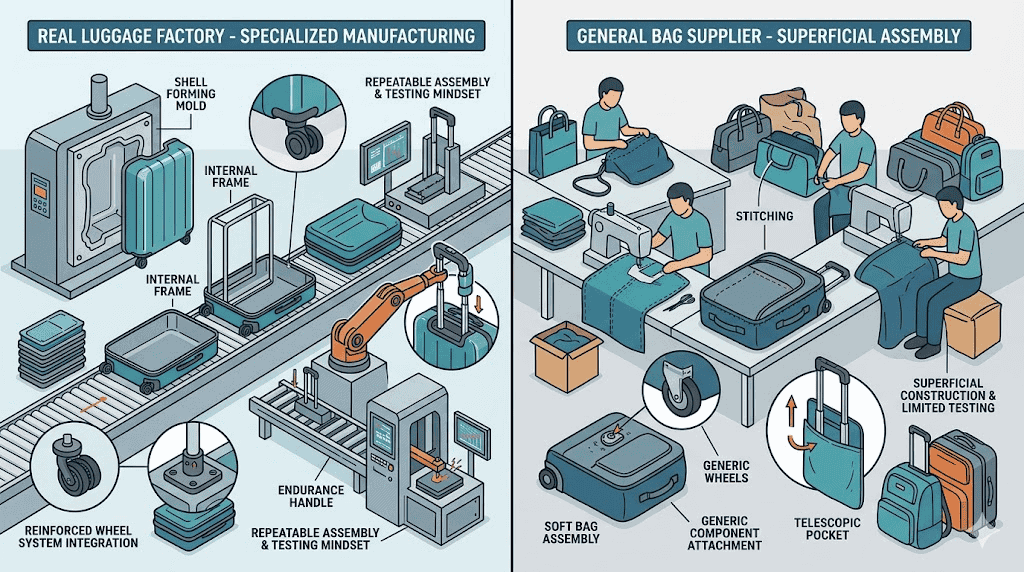
Hard-shell and soft-sided luggage do not use the same production sequence. A hard-shell project may depend on sheet or resin control, forming or molding, trimming, drilling and component assembly. A soft-sided case depends more on fabric and reinforcement control, cutting, sewing, frame construction and assembly.

Ask each supplier to mark its process map as in house, named subcontractor or buyer-nominated component. Then request evidence that matches the answer: a production-floor view, equipment record, sample traveler, component purchase reference or subcontractor name. A factory visit is useful when it checks those records against the actual line; a staged showroom tour is not enough.
Do not turn ABS, PC, PP, aluminum or a fabric name into a quality grade by itself. Record the exact material offered and the evidence you need for the target market. Compare price only after the material and construction scope are aligned.
Put every quotation on the same comparison sheet
A total unit price hides the reason two offers differ. Break each offer into the same rows before comparing totals.
| Quote row | What to reconcile |
|---|---|
| Shell or outer fabric | Material identification, construction, finish, color and approved substitution rule |
| Wheels | Complete assembly, housing, fasteners, replaceability and included test evidence |
| Trolley handle | Tube, stages, grip, mounting and included evaluation evidence |
| Carry handles and closures | Handle attachments, zipper or frame, lock, pullers and spare parts |
| Interior | Lining, divider, straps, pockets and trim |
| Tooling or molds | New or existing tooling, ownership, storage, maintenance and transfer terms written into the commercial agreement |
| Sample | What version will be made, what is excluded and what triggers a revised sample |
| Testing | Product-use tests, packaged-distribution tests, sample identity, method, conditions and report responsibility |
| Branding and labels | Logo process, artwork version, labels, marks and licensing evidence where applicable |
| Packing | Product protection, nesting, carton and route-specific transport requirements |
| Production scope | Included quantities and variants, subcontracted steps, change-control route and inspection points |
| Commercial exclusions | Taxes, tooling, testing, packaging, spare parts, freight or other items not included in the unit price |
A lower quote can be a valid offer. It can also be a different product. The comparison sheet tells you which one it is without guessing.
Tie the approved sample to named components
A sample approval needs more than a photograph and the word “approved.” Give the physical sample an ID and bind it to a record containing:
- dated photos from all sides and of the interior;
- external dimensions, empty weight and the measurement method;
- shell, fabric, lining, trim and color references;
- wheel, trolley handle, carry handle, zipper and lock identities;
- branding and label files;
- packing method and carton reference;
- accepted deviations and the person who accepted them.

If the supplier proposes a component change after approval, reopen the affected rows. A wheel, tube, zipper or lock change is not automatically minor simply because the silhouette stays the same. Record the reason, approve the replacement evidence and update the sample record before bulk production uses it.
Separate product-use tests from transport-package tests
Luggage itself and the packed shipping carton answer different questions.
Intertek lists fastenings, buckles, handles and wheels or rollers among the parts that need strength testing.[1] Product-use checks can therefore cover the loaded wheel system, trolley handle, carry handles, closures, shell or frame response and seams. The buyer still needs to define the load, conditioning, cycle or distance, equipment, sample identity and pass/fail rule. This guide does not invent universal thresholds.
A 2023 SGS article summarizing Hong Kong Consumer Council tests on 15 hard-shell cases reported detached wheels, cracked shells, loose or broken retractable handles and a chemical failure in one handle.[5] That small test group does not establish a universal defect rate. It does show why an attractive sample photo is not a durability or chemical-compliance record.
Transport-package testing is separate. ISTA distinguishes screening, partial-simulation and general-simulation procedures, and notes that partial-simulation testing is not intended to predict shipping performance.[2] Choose a procedure or a buyer-defined protocol for the actual distribution route, package weight and decision you need to make.

Use one test-plan table for both lanes:
| Field | Record it before testing |
|---|---|
| Objective | Product-use risk or distribution-package risk |
| Sample | Exact sample ID, production status and quantity tested |
| Condition | Load, packing, conditioning and any pre-test measurements |
| Method | Named standard or written buyer protocol and current revision |
| Equipment | Machine or fixture and calibration evidence where relevant |
| Pass/fail rule | Buyer-approved limit stated before the result is known |
| Result | Raw observations, photos, data and deviations |
| Decision | Approve, revise, retest, hold or reject, with owner and date |
For the later shipment-release inspection, keep the scope in Quality Control for Bags from China. A final inspection should check production against the approved record; it should not invent that record after the goods are finished.
Check compliance and licensed claims for the target market
A factory audit certificate, a product test and a chemical-compliance file are different evidence. Build a market matrix for the product, components, packaging and labels, then ask a qualified laboratory or compliance adviser to confirm the scope.
For EU-bound goods, the European Commission states that REACH puts responsibility on industry to manage chemical risks and provide substance safety information.[6] Do not accept a broad “REACH compliant” line without identifying the materials, components, test scope, report owner, sample and applicable requirement.
Treat lock branding as a separate verification row. Travel Sentry says a company manufacturing Travel Sentry® Approved locks or luggage, or distributing products with its trademark, needs a license.[4] If that system is in your brief, verify the licensed party and exact lock model rather than relying on a red-diamond image in a catalog.
Products with batteries, electronics or child-specific features need their own requirement review. Keep those additions out of a standard-luggage test file unless the actual SKU includes them.
Ask what capacity is actually available
Published capacity does not tell you what is free during your production window. Ask which line would make the order, which process sets the pace, when the components are due, what the current schedule looks like and who owns the order inside the factory. The answers should connect your dates to real people and equipment.
Before deposit, agree on the bulk handoff:
- the approved sample and component record;
- the purchase specification and artwork versions;
- the change-control contact and response deadline;
- incoming component checks;
- any pilot or first-off review;
- in-process checkpoints;
- final inspection and packing evidence;
- release authority and exception process.
Do not treat a sample made on one line as proof that an unchanged bulk order will come from the same line or components. Ask the supplier to confirm the production site and disclose changes in writing.
Make a written go, clarify or stop decision
Give every candidate one of three statuses: ready, clarification required or stop.
| Gate | Ready means |
|---|---|
| Product brief | The supplier accepted the same version and listed every deviation |
| Process fit | In-house and subcontracted steps are named and supported by evidence |
| Comparable quote | Components, packing, testing and exclusions are visible |
| Sample record | The physical sample and its component references are identified |
| Test plan | Product-use and packaged-distribution tests have defined conditions and pass/fail rules |
| Market file | The required compliance, label and licensed-claim checks have named owners |
| Capacity plan | The order is tied to a site, schedule, components and responsible person |
| Change control | The supplier cannot silently substitute an approved item |
| Bulk handoff | Inspection, exception and release responsibilities are written down |
Keep a candidate in clarification until the missing evidence arrives. Stop when a material decision remains hidden and the supplier will not put it in writing; a polished showroom or quick reply does not close that gap.
How Style Sourcing can help
If you need a China-side team to collect comparable quotations, organize samples, follow component questions, coordinate an agreed inspection scope and connect the approved order to shipping, review the Bao66 bag sourcing service or the broader China sourcing service.
Send the product brief, target market, quantity range and open decisions through the contact page. We can confirm a practical scope before you commit to production. No checklist can guarantee the factory, shipment or market result.
Sources
[1] Intertek: Luggage and Bags Testing
[2] ISTA: Test Procedures
[3] IATA: Passenger Baggage Rules
[4] Travel Sentry: Industry Licensing
[5] SGS: Safety and Durability Concerns in Luggage
[6] European Commission: REACH Regulation


