
Short answer: 1688 is a real Chinese wholesale marketplace, but a real platform does not make every listing or supplier safe for an overseas buyer. The safer approach is to verify the supplier and product, approve a sample, confirm MOQ and packaging, pay through a documented China-side workflow, receive the goods in China, inspect them, and only then arrange export.
Use this guide before you transfer money. It does not certify a supplier or guarantee a refund, product quality, delivery date, or import result.
Many 1688 problems start with a simple mistake: treating the product listing as if it were a complete supplier file. A low price may be genuine for a different material, quantity, packaging level, or domestic order condition. A professional-looking store may be a trader rather than the producer. A good sample may still be followed by an inconsistent bulk order if nobody records the reference standard.
The useful question is not only “Is 1688 safe?” Ask instead: Can I identify this supplier, verify this product, control the payment, inspect the goods, and document the China-to-destination handoff?
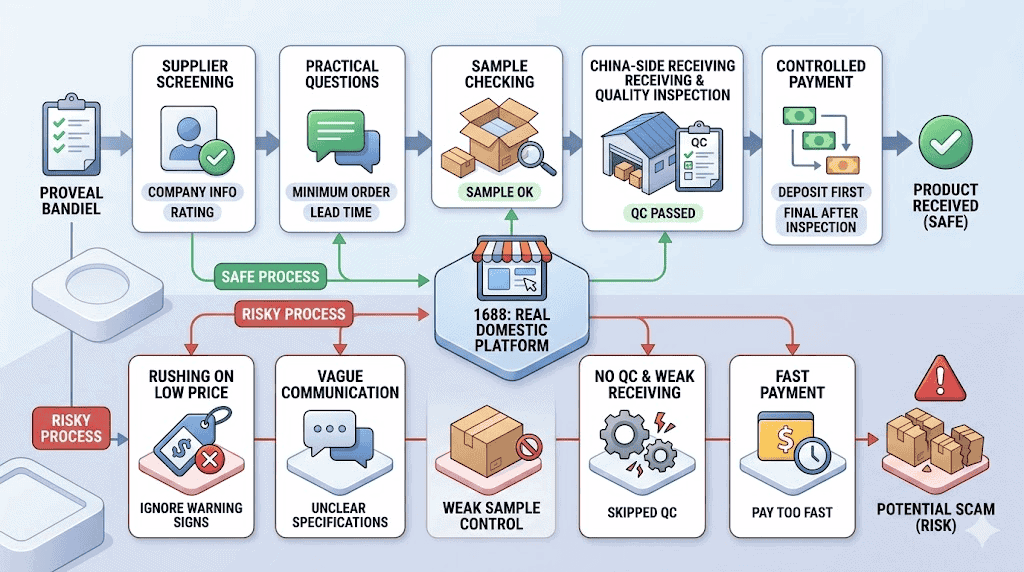
What does “safe” mean when buying from 1688?
Break safety into four separate questions:
- Platform: Are you using the correct 1688 listing, account, payment route, and order record?
- Supplier: Is the seller transparent about what it sells, how it handles the product, and where it fits in the supply chain?
- Product: Does the sample match the written specification, packaging, function, and target market?
- Export: Who receives, counts, inspects, consolidates, documents, and ships the goods from China?
Passing one question does not prove the others. A legitimate marketplace can contain different types of sellers. A responsive supplier can still send the wrong specification. A good product can still be damaged by weak packing or a poorly documented export handoff.
Why 1688 feels difficult for overseas buyers
1688 is mainly designed for the domestic Chinese wholesale market. Overseas buyers often need to work through Chinese product information, domestic delivery arrangements, supplier communication, payment limitations, and a separate export workflow.
That creates practical friction:
- product pages may not explain export packaging or destination-market documents;
- the displayed price may depend on quantity, material, colour, or packaging;
- MOQ and customization conditions may be confirmed only after you ask;
- many sellers expect a China delivery address rather than an overseas checkout;
- similar listings may come from factories, traders, or wholesalers with different capabilities.
These are workflow issues, not proof that every 1688 supplier is dishonest. They are the reason an overseas buyer should verify the order before paying.
Seven checks before you pay a 1688 supplier
1. Save the exact listing and supplier identity
Save the product URL, product code, supplier or shop name, screenshots, visible price, date checked, and any options you selected. Ask the seller to confirm that the quotation refers to the same item and variation.
Do not rely on a product photo alone. Similar photos can appear across different shops, and the same-looking product may have different materials, functions, packaging, or carton quantities.
2. Ask what kind of supplier you are dealing with
A supplier may be a factory, a trading company, a wholesaler, or a business that combines several routes. Being a trader is not automatically a problem. The key questions are whether the seller is transparent, responsive, and able to control the order you need.
Ask:
- Which products do you handle regularly?
- Are you quoting stock, standard production, or a custom order?
- Who controls production and who handles the final inspection?
- Can you provide the requested specification, packaging, and sample?
- Can you ship to the China warehouse or forwarder that will receive the goods?
3. Confirm the real price, MOQ, and packaging
Ask the supplier to separate the cost of the product, logo or customization, packaging, sample, domestic delivery, and any other China-side charge. Confirm the unit quantity and carton quantity separately.
| Item to confirm | Why it matters |
|---|---|
| Unit price and currency | A displayed starting price may not match your chosen material, option, or quantity. |
| MOQ by colour and SKU | The total order minimum may differ from the minimum for each variation. |
| Sample price and sample version | A stock sample may not represent a customized bulk order. |
| Packaging and labels | Retail packaging, barcode, warning, manual, and carton requirements affect cost and compliance. |
| Domestic shipping and carton data | Your forwarder needs a China delivery point, carton count, dimensions, and estimated weight. |
4. Order and compare a sample
A sample gives you something concrete to compare. Check material, dimensions, colour, function, stitching or finishing, accessories, packaging, labels, and instructions. Save photos and measurements with the supplier quotation.
If the seller refuses a reasonable sample without a clear explanation, slows down when you ask for details, or sends a sample that differs from the listing, pause the bulk order. Do not “make it work” because the price looks attractive.
5. Put the specification in writing
Use a simple specification sheet. Include the product code, material, dimensions, colour, tolerances where important, functions, packaging, logo, carton quantity, and destination-market requirements. The more customized the product, the less useful a product photo becomes as the only reference.
For a product with batteries, electrical parts, children’s use, cosmetics, food contact, or branded artwork, identify the document and labelling questions before you pay. Ask for documents tied to the exact product version rather than accepting a generic certificate image.
6. Control the China-side payment and receiving route
Many overseas buyers use a China-side purchasing or sourcing workflow because 1688 is primarily domestic. Before payment, identify:
- who places or confirms the order;
- whose account receives the payment;
- which supplier and product the payment refers to;
- where the goods will be delivered in China;
- who checks the quantity and condition on arrival;
- what happens if the seller ships the wrong item or short-ships a carton.
Keep the order record, quotation, transfer record, supplier chat, and receiving record together. Never assume that a private payment or a verbal promise has the same protection as a documented order route.
7. Inspect before export
Receiving the goods in China is not the end of the check. Count the cartons and units, compare the product with the approved sample, inspect the packaging, photograph visible defects, and record any shortage or mismatch before consolidation and export.
If you buy from multiple suppliers, keep each supplier’s cartons and records identifiable until the count and inspection are complete. Consolidation is easier when the receiving file already contains the SKU, carton, quantity, and exception information.
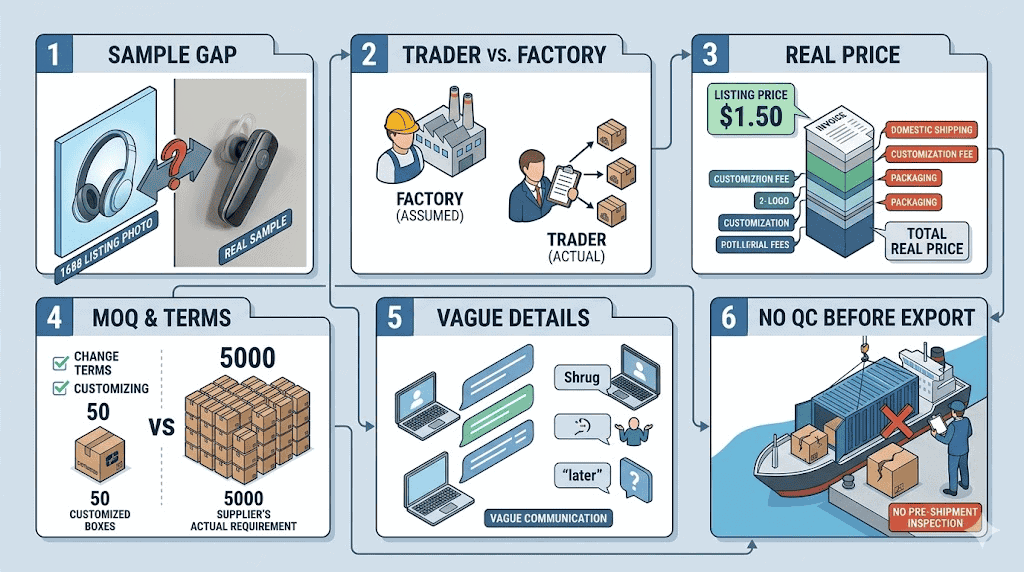
Common 1688 risks that are easy to miss
The listing price is real, but not for your order
The price may apply to a larger quantity, a basic version, domestic packaging, or one specific variation. Ask the supplier to quote your actual material, quantity, packaging, and delivery point.
The seller is not the factory you assumed
A trader can sometimes be a workable supplier, while a factory can still be a poor fit. Record the supplier role and judge it against the buyer’s need: product control, communication, customization, sample, MOQ, and follow-up.
The sample and bulk standard are not connected
Ask the supplier to identify the approved sample and explain how bulk production will follow it. For private-label products, attach the artwork, packaging file, and reference photos to the order record.
The supplier communicates well until the details become specific
Vague answers about material, dimensions, MOQ, packaging, or lead time are a process risk. Ask the same practical questions to several suppliers and compare the quality of the answers, not only the numbers.
There is no one responsible for China-side receiving
If everyone assumes someone else will count and inspect the goods, a shortage or quality mismatch may be discovered only after export. Assign the receiving, inspection, exception, and release steps before the shipment leaves China.
Seven red flags: when to slow down
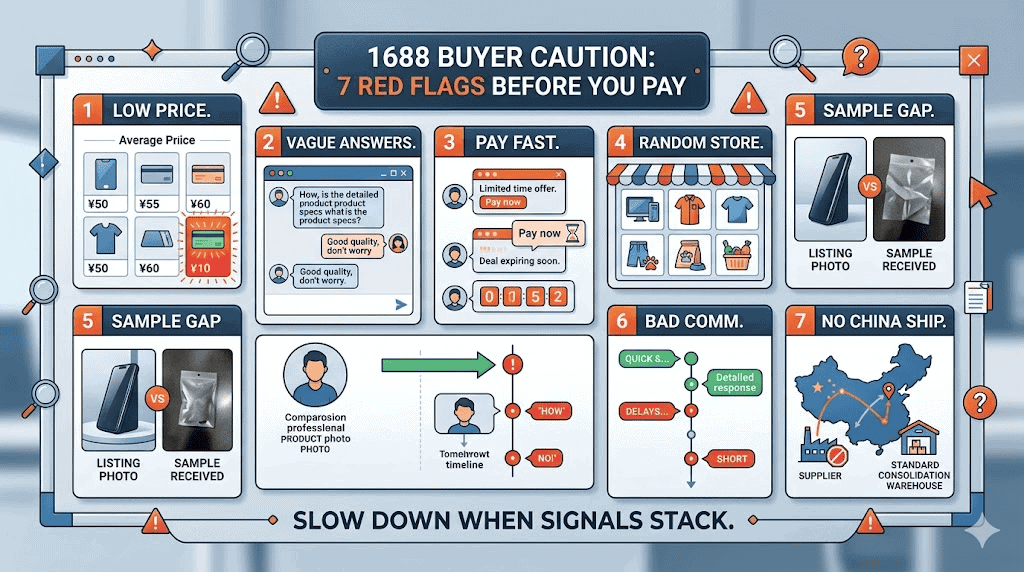
- The seller refuses to identify the exact product version or material.
- The price changes sharply when you confirm a normal quantity or packaging requirement.
- The supplier will not state the MOQ by SKU or colour.
- The sample is clearly below the listing standard and the seller avoids the difference.
- The seller pressures you to pay before the quotation and order details are clear.
- The product, company, payment recipient, and delivery information do not line up.
- The supplier resists a normal China-side delivery, receiving, or inspection arrangement.
One red flag may have an explanation. Several together are a reason to pause, ask for documents, compare another supplier, or stop the order.
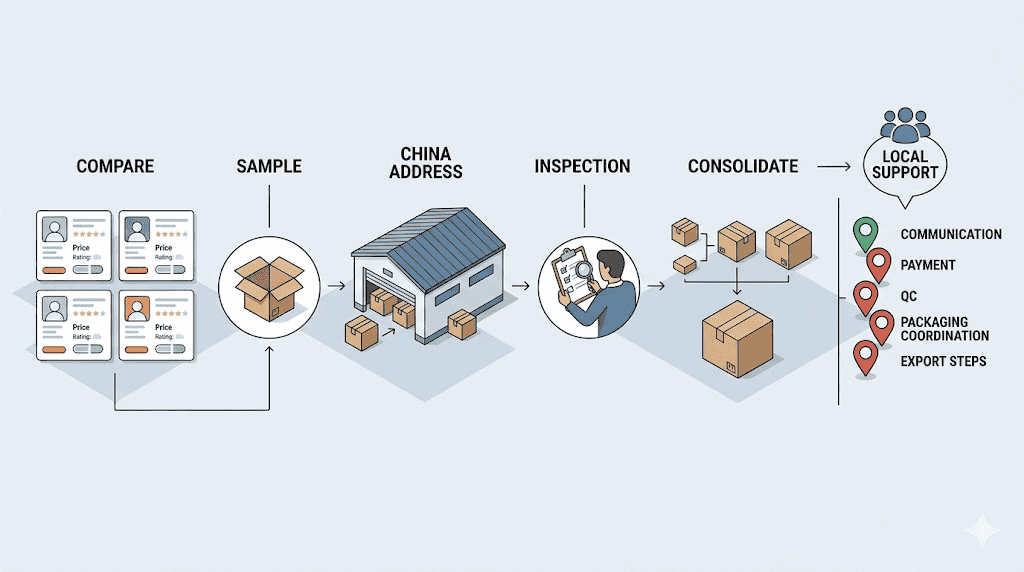
A practical 1688 buying workflow for overseas buyers
- Define the product, target market, quantity, packaging, and document requirements.
- Save several relevant 1688 listings and identify each seller.
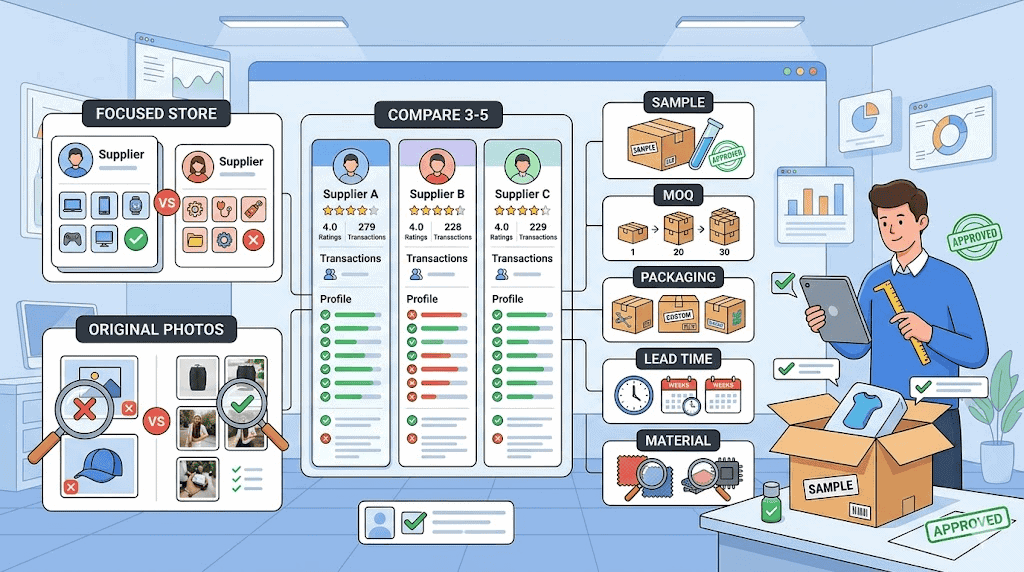
- Ask the same specification, MOQ, sample, packaging, and delivery questions.
- Compare quotations and supplier answers in one sheet.
- Approve the sample and written specification.
- Confirm the China-side payment and receiving route.
- Place a test order or controlled first order when appropriate.
- Receive, count, inspect, photograph, and record exceptions in China.
- Consolidate and arrange export only after the release decision is documented.
When should you use a sourcing partner?
A China sourcing partner may be useful when you need Chinese-language follow-up, supplier comparison, sample coordination, China-side payment or receiving, inspection, consolidation, packaging, or shipping handoff.
You may not need the same level of support if you already have a trusted China-side warehouse, understand supplier verification, and can inspect the goods yourself. The right question is not whether every buyer needs an agent. It is which control steps you can genuinely handle before payment and before export.
Style Sourcing can help with supplier screening, sample follow-up, inspection coordination, China-side receiving, consolidation, and shipping planning. Scope and cost should be confirmed before work starts. See our China Sourcing Service or send the product link and destination through the contact page.
FAQ: Is 1688 safe?
Is 1688 itself a scam website?
1688 is a real domestic Chinese wholesale marketplace. That does not certify every seller or product. Supplier checks, sample approval, payment records, receiving, and inspection remain the buyer’s responsibility or must be assigned to a trusted partner.
Is a 1688 supplier safe because the store looks professional?
No. A professional store is one signal, not proof of factory ownership, product quality, capacity, or export readiness.
Can a trader on 1688 be a workable supplier?
Yes. Ask whether the trader is transparent about the supply route and can control the product, sample, packaging, quantity, and follow-up you need. Do not use “factory” as a shortcut for verification.
Should I place a bulk order without a sample?
Usually not when product quality, material, function, packaging, or compliance matters. A sample will not remove every risk, but skipping it removes an important comparison point.
Can 1688 suppliers ship directly overseas?
Do not assume it. Confirm the China delivery point and treat domestic receiving and international export as separate steps unless the supplier has clearly agreed to the full route and documents.
Final checklist before sending money
- I saved the exact listing, supplier identity, quotation, date, and product version.
- I confirmed material, dimensions, function, colour, MOQ, quantity, packaging, and domestic delivery.
- I approved a sample or documented why the order does not require one.
- I know who receives, counts, inspects, and records exceptions in China.
- I understand who receives the payment and which order it belongs to.
- I checked any destination-market labelling, testing, battery, or product-document requirements that apply.
- I will not release the goods for export before the receiving and inspection record is reviewed.
So, is 1688 safe for overseas buyers? It can be, but safety comes from the buying process around the listing. Verify the supplier, approve the sample, document the order, control the China-side handoff, inspect before export, and slow down whenever the seller cannot answer a basic question clearly.
For related buying workflows, see how to buy from 1688 as a foreigner, 1688 vs Alibaba, and our 1688 supplier verification checklist.


