
The short answer: improve packaging quality for 1688 orders by turning pre-shipment packaging review into one controlled approval record per order. Pin the spec before production finishes, collect sample and photo evidence you can compare against, audit each layer on site in China, log every exception with a named owner, then sign off either rework, release with a documented exception, or hold. That record — not the supplier’s verbal assurance — gives the buyer an auditable basis for the release decision.
This page owns the buyer-side pre-shipment packaging approval record for a single 1688 order. The production-stage specification belongs in the Packaging Approval Checklist Before Bulk Production in China; a separate retail-versus-transport matrix covers the two approval paths for private-label packaging. The detailed inspection-method lane lives in the 1688 Inspection Service guide. This page stops before multi-supplier consolidation and international freight decisions.
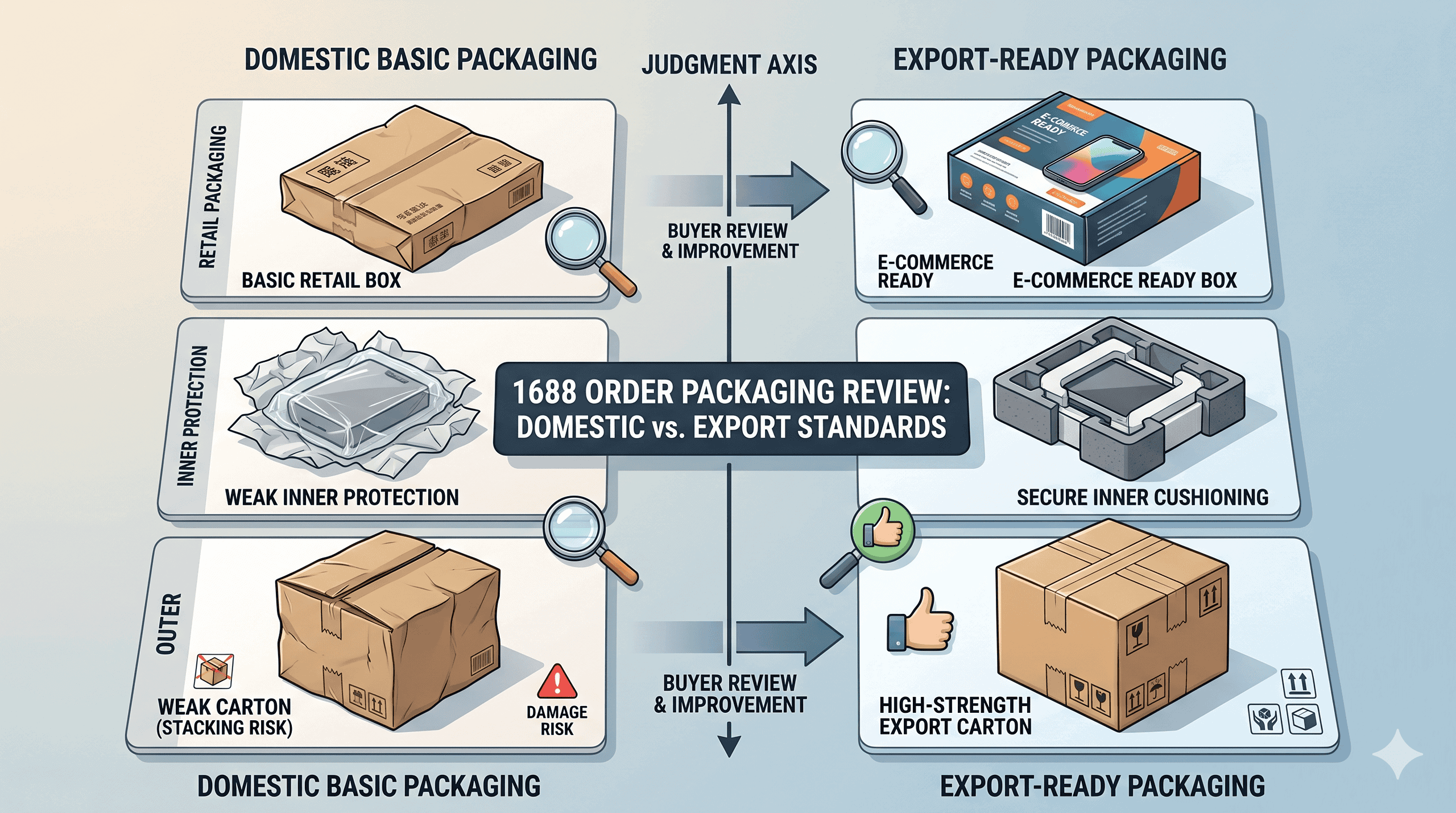
The three layers — retail packaging, protective inner packaging, outer export carton — are useful scaffolding, but the buyer-side decision is not whether the layers “look right.” It is whether the layers match the spec, the sample and the photos on the order’s own approval record.
Pin the packaging spec before production is finished
The packaging spec is the document the supplier produces against and the buyer signs against. Without a written spec, phrases such as “the supplier’s standard” leave room for different interpretations, so the buyer has no stable reference for approval.
Send the spec to the supplier while production is still moving, not after it is finished. For message wording on what to ask the supplier to confirm, see How to Communicate with 1688 Suppliers. Keep the product, artwork, packaging and inspection references in one version-controlled brief.
| Spec field | What to pin down | Why it matters at pre-shipment review |
|---|---|---|
| Retail or inner box | Type, material, dimensions with tolerance, print reference (Pantone or photo), structural strength reference | Compare the selected finished packaging with the approved reference before release. |
| Inner protection | Foam, bubble, dividers, sleeves, corner guards — material and amount | If the specified protection is missing or different, record the exception before release. |
| Inserts, cards, stickers, labels | Content, placement, language, version number if applicable | A mismatch can affect downstream receiving, fulfillment or customer presentation. |
| Master carton mark content | Buyer PO or order reference, SKU, quantity per carton, gross and net weight, dimensions, case number, destination marks, country-of-origin wording where required | The receiving warehouse, freight provider and destination process may use different fields. Verify each field for the actual route. |
| Outer carton strength and sealing | Corrugated grade or reference, sealing tape type, moisture barrier if specified, stacking limit | International handling may differ from the domestic leg, so compare the carton with the route-specific brief. |
| Barcode or label type | GS1 or platform-specific barcode, label position, scan-test expectation | A failed scan or duplicate identifier needs a documented hold or exception decision before handoff. |
A spec field that the buyer never wrote down leaves room for interpretation. Record what you requested, not what you assumed the supplier understood.
Collect sample and photo evidence you can actually compare against
The order may contain two different types of visual reference, and the distinction matters at approval time.
- Listing or sales-chat references — the box and inserts shown on the product page or during quotation. They help define the requested appearance, but they do not establish what is in the finished cartons.
- Order-specific review evidence — the retained reference sample and dated photos of the selected finished cartons, opened units, labels and barcodes. This is stronger evidence of the reviewed goods, but it still proves only what was sampled and recorded.
Keep both. Use the listing or sales-chat image as a reference for the visual style discussed with the supplier. Use the order-specific evidence as the comparison object at approval. For how the upstream sample stage feeds this comparison, see How to Order Samples from 1688.
Use the following as a starting photo set, then adjust it to the product, packaging risk and agreed inspection scope:
| Photo | What it should show |
|---|---|
| Retail or inner box exterior | Style, print, color, logo placement |
| Retail or inner box opened | Insert card, inner protection, product position |
| Master carton exterior | Mark content, seal, surface condition |
| Master carton opened | Inner packing layout, dividers, protection in place |
| Every visible label and barcode | Legibility, content, scan-test result |
| Batch markings | Date code, batch number, line reference if applicable |
If a carton cannot be opened under the buyer’s instruction, record that limitation instead of implying its contents were reviewed.

Run the on-site review in China before export
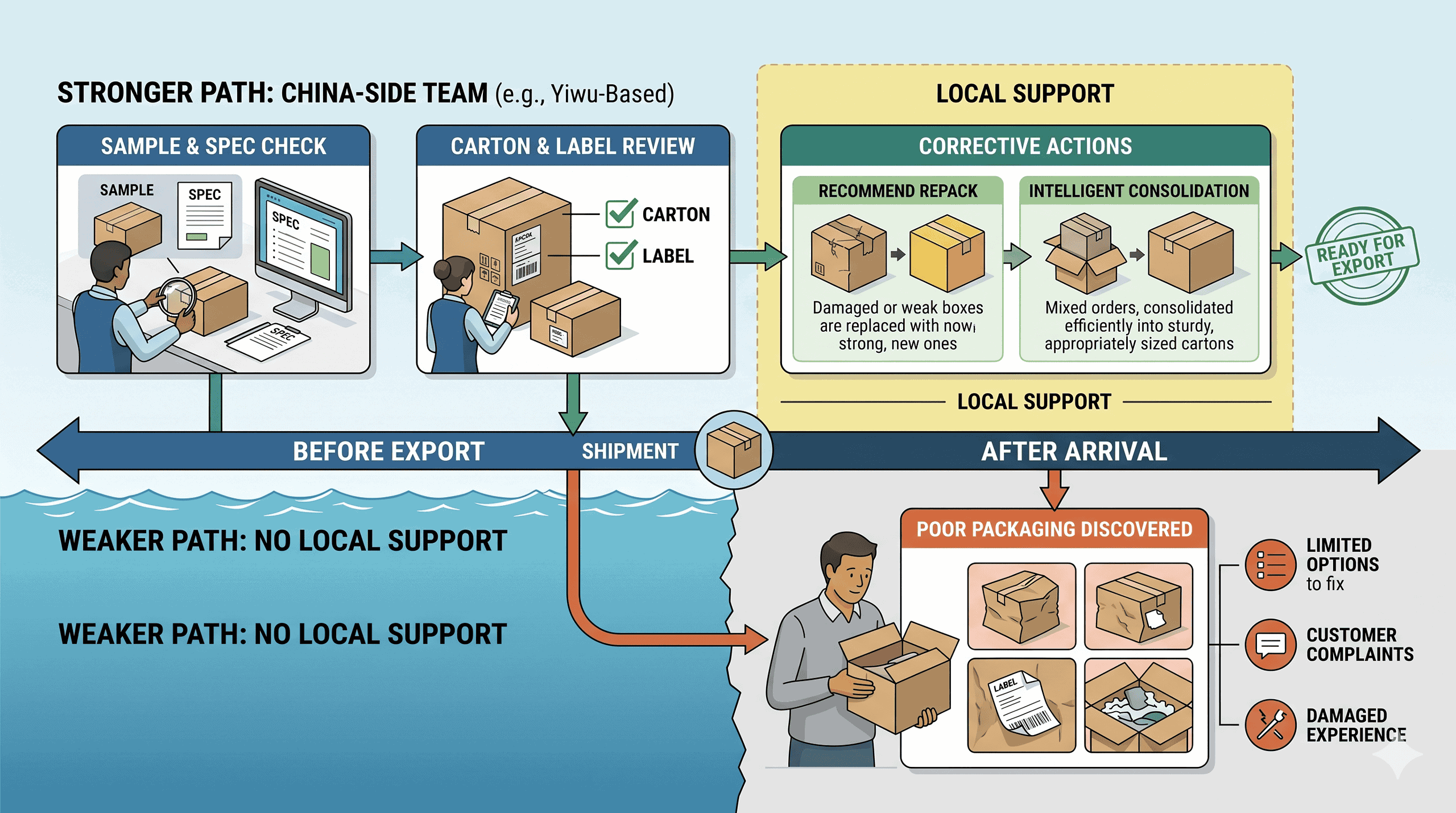
A packaging review performed only after overseas arrival cannot support a pre-export release decision. Complete the buyer-side review in China while the cartons are still under the supplier’s or consolidation warehouse’s control and the buyer can still compare the practical choices: accept, rework, hold or release with an exception.
Run the review as four layers, in this order. Stop and log an exception whenever a layer does not match the spec or the physical evidence.
Layer 1 — Retail and inner packaging. Use the order’s agreed sampling rule rather than an invented universal quantity. Compare the selected units with the spec and reference sample. Record print color, logo placement, insert content, language, structural feel and any visible protection between product and retail box.
Layer 2 — Master carton. Check carton material and sealing against the written spec, verify mark legibility, measure dimensions and weight, and confirm any specified moisture barrier is present. International handling and stacking conditions may differ from the domestic leg, so use only a test method approved for this product and carton; this article does not set a universal compression or drop test.
Layer 3 — Batch consistency. Select cartons across the finished lot under the buyer’s documented sampling plan, then record which carton IDs were opened. Matching selected cartons supports only the sampled result; it does not prove that every carton matches.
Layer 4 — Labels and shipping marks. Verify the selected labels, barcodes and shipping marks against the written spec. Record destination marks, the case-number sequence, buyer reference and any applicable country-of-origin wording. If scan verification is part of the brief, document the devices, barcode types and sampled labels checked rather than claiming one test proves the entire SKU.
A packaging review can be carried out by the buyer’s own on-site team, by a named China-side team the buyer has briefed, or as part of an optional third-party pre-shipment inspection that includes packaging, shipping marks and labeling in its agreed scope. The evidence requirements and final sign-off authority still need to be written into the buyer’s order record.

The illustration shows the workflow direction: define expectations first, then collect evidence, then review on site, then decide. The decision itself is the next section.
Log every exception and decide: accept, rework, hold, or release with exception
Every exception gets a row. A packaging review without an exception log is a packaging review the buyer cannot audit later, and “we looked at it and it was fine” is not a sign-off the freight forwarder can rely on.
| Exception observed at review | Evidence to record | Owner | Possible disposition |
|---|---|---|---|
| Retail packaging differs from spec or sample | Side-by-side photo, sample reference, spec field | Buyer decision owner / supplier rework owner | Request rework at China side, accept as documented deviation, or hold |
| Print color, logo or text differs from the approved reference | Photo with reference swatch or approved file | Buyer decision owner / supplier rework owner | Hold for reprint or accept the deviation in writing |
| Inserts, cards or stickers differ from the approved content | Photo of insert content, approved file | Buyer decision owner / supplier rework owner | Hold for replacement or accept the deviation |
| Inner protection differs from the written spec | Photo of an opened selected unit | China-side evidence collector / buyer decision owner | Request rework or hold |
| Master carton material or sealing differs from spec | Photos plus measured dimensions and weight | China-side evidence collector / supplier rework owner | Request corrective work or hold |
| Carton marks are missing or differ from the release data | Photos of the visible carton faces | Buyer decision owner / supplier rework owner | Hold for corrected marks or accept the deviation |
| Barcode fails the agreed scan check or an identifier is duplicated | Scan record and label photo | China-side evidence collector / buyer decision owner | Hold for relabeling or accept the deviation |
| Selected cartons do not match one another | Sampled carton IDs and comparison photos | China-side evidence collector / buyer decision owner | Extend the check, split the order, hold affected cartons, or accept the deviation |
| Damage observed at an outer or inner layer | Photo at receipt or during an authorized opening | China-side evidence collector / supplier response owner | Hold, request corrective action, or accept the deviation |
| Supplier asks to override the written spec verbally | Written record of what was said and by whom | Buyer decision owner | Do not treat the statement as approval; compare the result with the written spec. |
The disposition is one of four: accept as is, request rework at China side, hold the carton, or release with documented exception. A verbal approval — “the supplier said it’s normal” — is not a disposition; it is the absence of one. Record every disposition against a named person and a timestamp.
What this check cannot prove, and should never be claimed to prove:
- It cannot prove nothing changes after sign-off. Its finding is limited to the cartons and units identified in the record.
- It cannot prove every carton in the batch matches the reviewed cartons. Batch consistency is an inference from a sample.
- It cannot override destination-market legal requirements, customs marks or labeling rules. Those are confirmed separately with the relevant professional.
- It cannot make a weak spec into a strong packaging result. A vague spec reviewed honestly still ships a vague result.
Keep the exceptions and dispositions with the order’s sample, payment, inspection and freight-handoff records. If the goods later move into a dispute, that dated evidence is more useful than reconstructing the packaging decision from chat messages.

Close the loop: rework sign-off, release packet, and handoff
A packaging approval is not finished when the cartons look acceptable. It is finished when the rework outcome is recorded, the release packet is built, and the next person in the chain — the consolidation warehouse or the freight forwarder — has a single document they can act on.
Sign off the rework, if any. When the disposition is “request rework,” the approval record stays open until the rework is verified against the original exception. Take the same photo set against the same spec fields. Compare before and after. Sign off with a name and a timestamp, or escalate.
Build the release packet. The release packet is the controlled document the consolidation warehouse, the freight forwarder and the buyer’s own records all read from. For the multi-supplier version at the receiving warehouse, see How to Consolidate Orders from Multiple 1688 Suppliers.
| Release-packet field | What it should contain |
|---|---|
| Order reference and supplier identity | Buyer PO or quote reference, supplier name and contact |
| Approved SKU and quantity per SKU | Final unit count after any rework |
| Approved carton count and IDs | Carton numbers, pallet IDs if used |
| Final carton data | Measured dimensions and gross weight |
| Final pack-and-mark photos | Closed carton, opened carton, all visible labels |
| Packaging review status | Per-layer result with photo references |
| Exception log and disposition | Each row from the exception table above, with owner and date |
| Rework outcome | Before / after evidence and the sign-off name and timestamp |
| Final disposition | Accept as is, rework complete, hold removed, or release with documented exception |
| Authorization | Named person and timestamp authorizing release |
Hand the packet off. The release packet goes to the consolidation warehouse or, if the order ships direct from the supplier, to the freight forwarder with the booking. Do not release cargo on the strength of “the supplier said it shipped” alone. For the international leg after sign-off, see How to Ship from 1688 to Your Country.
FAQ: improve packaging quality for 1688 orders
Who actually owns the packaging approval? The buyer names the person authorized to make the release decision. The supplier produces against the spec, while an optional third-party inspector reports against the agreed scope. The approval record should distinguish evidence collection from final authorization.
What if the supplier says the packaging is “normal” or “our standard”? Record the disagreement against the spec field it touches. Do not accept the supplier’s verbal override of a written spec field. If the spec is too thin to support the exception, update the spec, not the sign-off.
Can packaging be fixed after the goods leave China? Sometimes, but it happens later, may add handling and material costs, and is outside the buyer’s pre-shipment approval record. Treat overseas repacking as an exception, not a plan. For orders with private-label packaging, keep the artwork, material and approval scope in the upstream production record rather than expanding this pre-shipment page into a private-label guide.
Is a third-party pre-shipment inspection required? Not in every order. It is one option. If the buyer wants an auditable packaging decision, the buyer should keep an approval record regardless of who collects the evidence. Whether to add an inspector depends on the product, order, agreed scope and the buyer’s own China-side capacity.
How is this different from the production-stage packaging approval? Production-stage approval locks the spec, the artwork and the photo proof before bulk production runs. This page locks the actual finished cartons against that spec before they leave China. Both records are useful; they answer different questions.
Evidence boundaries and next step
Alibaba Group describes 1688 as a domestic wholesale marketplace.[1] That platform context does not support a claim about how every 1688 supplier packs an order.
One AQI sample pre-shipment inspection report separates packing, shipping marks and labels, and product conformity, while leaving the final approve-or-reject decision to the client.[2] It is one report-format example. Its product-specific sample sizes, AQL values and test methods are not reused here.
This guide does not promise damage-free shipping, return reduction, brand-quality improvement or any specific inspection outcome. It does not promise a particular AQL level, defect count, sample size, PSI fee or rework cost. It does not prescribe customs, restricted-goods or destination-market labeling. Confirm the actual shipment against the relevant professional in each case.
If you want a China-side team to collect the agreed packaging evidence before export, contact Style Sourcing with the order brief, specification and open decisions; the team can confirm the applicable review scope without promising the outcome.
Sources
[1] https://www.alibabagroup.com/en-US/about-alibaba-businesses-1941299332078632960 — Alibaba Group: 1688 [2] https://aqiservice.com/wp-content/uploads/2024/09/AQI-Service-Sample-Report-Garments_Pants.pdf — AQI Service: Sample Pre-Shipment Inspection Report


