Importer of Record vs Customs Broker: A China-to-US Handoff for First-Time Importers
Your supplier in Yiwu or Shenzhen has finished production. The carton count is on the packing list. Your freight quote came back. The broker your freight forwarder recommended sent an onboarding form. Now someone asks: “Who is the importer of record on this shipment?”
That is the question this guide is built to answer, in operational language, for a China-to-US flow.
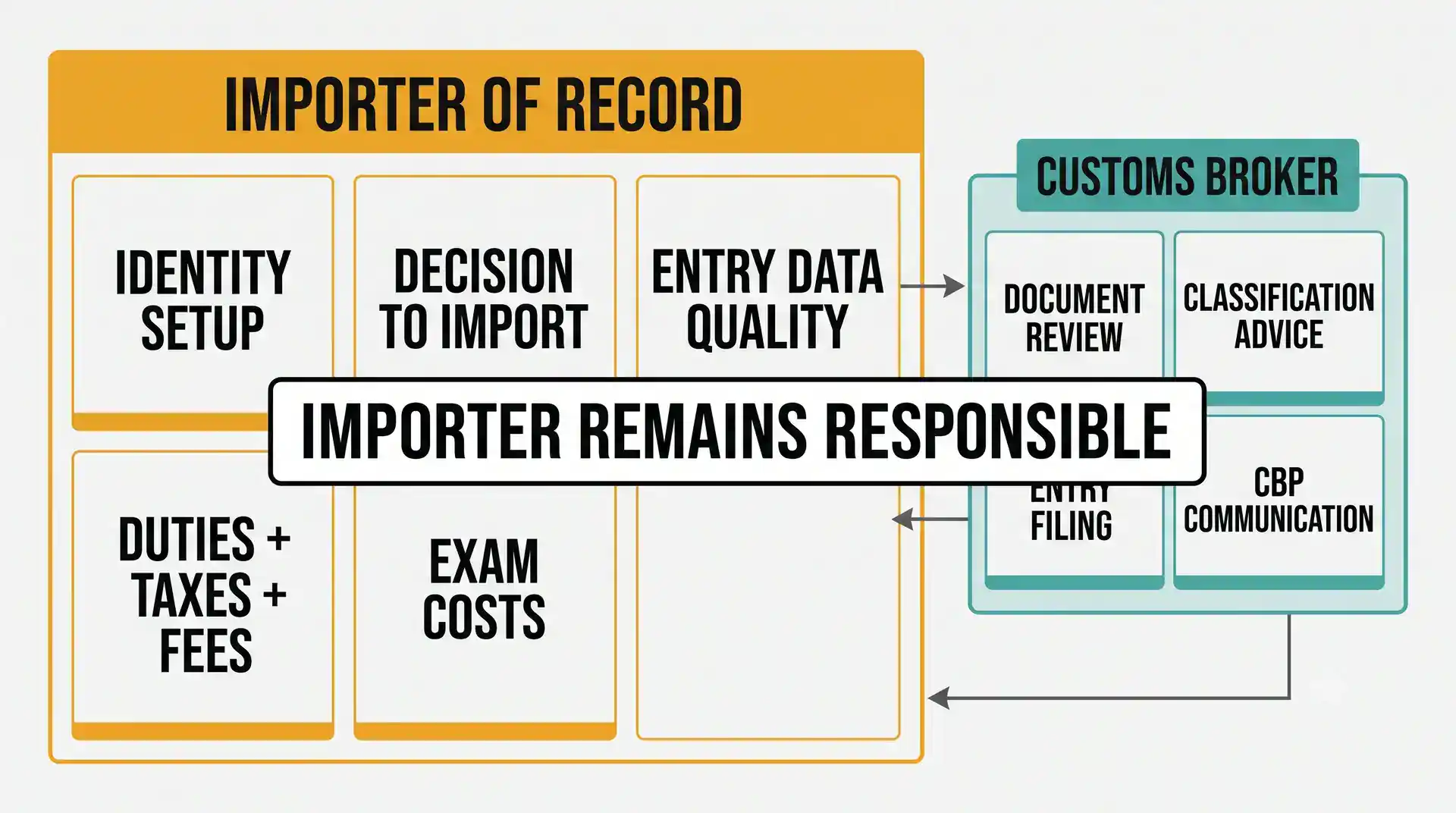
Importer of record and customs broker are not competing roles. They sit on opposite sides of the same handoff. The importer of record is the party who owns entry correctness, duties, taxes, and fees at US Customs and Border Protection (CBP). The customs broker is a licensed private professional the importer hires to file the entry. Using a broker does not move the responsibility to the broker. The importer remains responsible even when a broker is filing on their behalf.
That distinction is what makes the rest of this article worth reading. It is one thing to know that two roles exist on a flow; it is another to know which data each role needs from you, which decisions each role can make, which documents your China-side team has to prepare, and which questions still have to be answered by the importer before freight touches US soil.
This article is bounded by what CBP’s general guidance supports in 2026-07-24. It is not HS-code advice, duty-rate advice, product-classification advice, agency licensing advice, or a guarantee of clearance. It is a working handoff explainer, with a checklist of the data the importer needs to own, the broker’s natural scope, and the documents your China side has to deliver on time.
Quick Answer: Responsibility Split on a China-to-US Order
| Question | Importer of record’s call | Customs broker’s call | Outside both |
|---|---|---|---|
| Who decides whether to import the goods? | Yes — strategic and commercial | No — broker does not choose | Outside both |
| Who decides HS classification? | Owns the call, broker can advise | Advises based on importer-supplied info | Final answer is the importer’s record with CBP |
| Who pays duties, taxes, and fees? | Yes — by definition | No | Outside both |
| Who files the entry with CBP? | Can self-file | Files on importer’s behalf when engaged | Outside both |
| Who signs the entry documentation? | Yes — by definition | Files as the importer’s representative | Outside both |
| Who maintains importer identity (CBP Form 5106, IRS / SSN)? | Yes — importer | No | Outside both |
| Who picks the broker? | Yes — importer | Cannot appoint itself | Outside both |
| Who handles physical exam or CES costs if CBP examines? | Yes — importer | No | Outside both |
| Who prepares the commercial invoice, packing list, and product description? | Owns the data via the supplier | Receives from importer | Outside both |
| Who can guarantee clearance? | No | No | Neither role can guarantee clearance |
| Who handles freight, port handling, and last-mile? | Owns the decisions | Out of scope | Outside both |
| Who handles state-level compliance, licensing, product safety? | Owns — broker does not advise | Out of scope | Outside both |
The pattern is the answer. The importer of record owns the entry, the data, the money, and the consequences. The broker is a licensed filer. Anyone promising that a broker takes responsibility for the entry is selling something the agreement does not support.
Why This Handoff Matters for China-Sourced Goods
China-sourced orders create the classic separation of evidence. Your supplier has the product data. Your freight forwarder has the route. Your broker needs the entry data on time. You, the importer, own what happens at the US border.
Evidence travels across multiple parties
- The supplier in China holds the material, color, finish, carton, and packaging data.
- The freight forwarder holds the carrier, vessel or flight, port, and ETD/ETA.
- The broker holds the entry form, classification advice, and CBP interaction.
- You hold the commercial decision to import, the budget for duties and taxes, the importer identity, and the responsibility for what CBP sees as the entry.
A single missing field — composition, intended use, value, manufacturer, country of origin — can stall the entry. Each of those fields belongs to a different party. That is the source of most first-time importer friction.
The boundary CBP draws for you
CBP’s Tips for New Importers and Exporters is explicit: a customs broker is licensed by CBP, is not a CBP employee, and the broker’s appearance on a port list is not CBP endorsement. The page is equally clear that the importer of record remains ultimately responsible for the correctness of the entry documentation presented to CBP and for all applicable duties, taxes, and fees, even when a broker files the entry.
That sentence is the spine of this article. Everything below hangs on what that sentence does and does not change in your day-to-day operations.
What the Importer of Record Actually Owns
The importer of record is the party named on the entry as the importer. That role comes with ownership, not blame — it is the role that decides whether and how to import, sets up the importer identity with CBP, owns the data CBP evaluates, pays duties and fees, and absorbs the cost when CBP decides to examine the goods.
Importer identity setup
CBP’s guidance lays out three identity paths available to a US importer:
- Use your IRS-issued business registration number if your business is registered with the IRS.
- Use your SSN if you are importing as an individual or your business is not IRS-registered.
- Request a CBP-assigned number by submitting CBP Form 5106 and presenting it to the Entry Branch at a CBP port of entry.
The right path depends on the importing entity. Whatever path you use, that number is your importer number on CBP entry forms and bond applications (where applicable).
Decision ownership
The importer decides:
- Whether to import at all.
- Which party serves as consignee and which as buyer.
- Whether to use a broker or self-file.
- How the entry is funded (ACH, Fedwire, broker trust, customs account).
- Whether to engage other US agencies (FDA, FCC, USDA, CPSC, EPA, ATF, etc.) on products that need them.
CBP notes that it does not require an importer to hold a license or permit, but that other agencies may require permits, licenses, or other certifications depending on the commodity. That line is the reason first-time importers must stop thinking that “no CBP license = no compliance.” The license lives elsewhere when product-specific regulation applies.
Financial ownership
The importer pays:
- All applicable duties.
- All applicable taxes (where applicable to the entry).
- All applicable fees, including CBP user fees and, where relevant, merchandise processing fees.
- Costs of cargo examination when CBP examines a shipment, including costs of moving cargo to a Centralized Examination Station and any storage during exam (CES rates vary and “a complete devanning may cost several hundred dollars” per CBP’s page).
These costs are not the broker’s. The broker is paid for entry work; the importer owes CBP and the carrier.
What the Customs Broker Actually Does
A customs broker is a private professional licensed by CBP. Brokers charge for their services; the rate is a commercial question between importer and broker. Brokers do not become the importer of record by filing an entry on the importer’s behalf. They remain a service provider.
A broker’s natural scope
A broker typically:
- Reviews the commercial documents the importer supplies (invoice, packing list, bill of lading or airway bill, etc.).
- Advises on classification, valuation, and applicable CBP programs, subject to the broker’s own due diligence.
- Files the entry, including any required electronic messages such as Importer Security Filing (10+2) for vessel cargo.
- Communicates with CBP on routine entry questions, holds, and exam arrangements.
- Maintains records consistent with CBP recordkeeping rules.
A broker does not replace the importer’s responsibility, does not pay duties on the importer’s behalf (unless explicitly arranged), does not decide whether the importer should import, and does not guarantee classification outcomes.
Where scope ends
Out of scope for most brokers:
- Verifying the supplier in China beyond invoice/packing data review.
- Verifying product quality or conformity at origin (the broker is not an inspector).
- Handling destination warehousing or last-mile delivery.
- Advising on state-level compliance, retailer compliance, or marketplace policies.
If you are relying on your broker for any of those, you are using the wrong vendor.
What CBP Expects Before the Entry is Filed
CBP’s Tips page is clear on what the importer needs to provide before calling the broker’s work “complete.” The list below paraphrases that expectation into operational fields the importer must own.
Product identity data
- Country of origin and manufacturer.
- Composition of the merchandise.
- Intended use of the item.
- Pricing and payment information (value of the shipment, parties to the transaction, terms).
A broker cannot conjure this data. The importer’s China-side team must collect it from the supplier and deliver it as part of the entry packet. Asking the supplier to guess composition or country-of-origin is the single most common cause of entry friction on consumer-goods imports.
Importer identity
- IRS business registration number, SSN (individual importer or non-IRS-registered), or CBP-assigned number on CBP Form 5106.
- Importer name and address as it will appear on the entry.
- Bond (where applicable) — this is a separate commercial product, often handled through a surety, sometimes coordinated through the broker. CBP’s guide does not assert any single bond mechanic.
Consignee / buyer / seller structure
Entries reflect a real commercial structure. Who is the buyer, who is the consignee, who is the seller, who is the manufacturer? A first-time importer who treats these as identical fields often produces an entry that does not match the commercial reality.
Product classification, valuation, and program eligibility
CBP notes that importers can request a written ruling on HTSUS classification and duty rate via Part 177 of the Customs Regulations (19 C.F.R. 177). CROSS (Customs Rulings Online Search System) is also referenced as an indexed source of prior rulings.
This article does not assert any specific HTS classification, duty rate, or program eligibility. Those are importer-side decisions supported by the broker’s advice and, where appropriate, by binding ruling requests or counsel.
How the China Side Fits Into This Handoff
Most of the friction on a first China-to-US import shows up at the China side, not at the CBP side. The importer must work backward from CBP’s expectations and ask the China-side team for matching fields.
What the supplier owns
- A signed commercial invoice with the goods, value, and parties.
- A packing list that matches the invoice line by line.
- Country-of-origin and manufacturer identification.
- Composition, material, and intended-use data.
- Carton marks, labels, and any product-specific declarations the broker says are required.
- Any certificates, test reports, or agency-required documents for restricted or regulated products (where applicable and confirmed by the importer’s compliance process).
What the freight forwarder owns
- The booking and the carrier (ocean vessel or air).
- The bill of lading or airway bill.
- The ISF (10+2) for vessel cargo, which the importer or its agent (often the broker) must file electronically before cargo loads at the foreign port.
- The freight cost, the destination handling cost, and the last-mile delivery plan.
What the importer’s China-side coordinator owns
- Reconciling the invoice, packing list, and shipping instruction against the order record.
- Collecting the data above into the broker’s preferred packet.
- Version-controlling changes (carton counts, weights, last-minute substitutions) so the broker files against the current record.
- Issuing timely shipment updates so the broker can prepare entry timing.
A China-side coordinator who has done this work and uses version-controlled folders saves the importer weeks of friction on first entries.
The Importer-Side Identity and Setup Workflow
Walk through this in order on a first import. Each step has a defined owner.
Step 1 — Decide the importing entity
The importing entity is the party who will be the importer of record. For US importers, common structures include:
- A sole proprietor using their SSN.
- A US LLC or corporation using its IRS-issued business registration number (typically an EIN).
- A non-US entity entering goods into the US through a US resident importer or designated importer of record (a more advanced setup outside this article’s scope).
Picking the right entity decides which identity number CBP expects on the entry.
Step 2 — Establish the importer identity
- For an IRS-registered entity, the IRS business registration number is the importer number.
- For an individual importer or non-IRS-registered business, the SSN is sufficient according to CBP’s page.
- Where neither SSN nor IRS number applies, submit CBP Form 5106 to the Entry Branch at a CBP port of entry for a CBP-assigned number.
Step 3 — Engage a broker (or commit to self-filing)
If engaging a broker, sign the broker’s service agreement, share importer identity details, and confirm scope. Most brokers will not begin substantive work until importer identity is established.
If self-filing, confirm that the importer has the operational capacity to file ACE entries directly, maintain recordkeeping, and handle CBP holds.
Step 4 — Address product-side compliance
CBP’s guidance warns that other agencies may require a permit, license, or certification depending on the commodity, and that CBP acts in an administrative capacity for those agencies. For many consumer products sourced from China, this is the line that triggers FDA, FCC, CPSC, USDA, or other agency requirements. That work is the importer’s, not the broker’s.
Step 5 — Bond and financial setup
Where a bond is required, the importer obtains a continuous or single-entry bond through a surety. Some brokers can coordinate this; it remains the importer’s obligation.
Step 6 — Begin classifying, valuing, and recording
The importer, often with broker support, develops working classifications and valuations for recurring products. Maintaining an internal classification record with version, source, and date reduces re-work on the next shipment.
A Practical Document Handoff Between the Importer and the Broker
Treat this as a working packet template, not a legal form list.
Broker onboarding (one-time)
- [ ] Importer identity (EIN, SSN, or CBP-assigned number) on file.
- [ ] Importer entity name and address confirmed.
- [ ] Broker service agreement signed; scope and fee disclosed.
- [ ] Bond information (if applicable) confirmed.
- [ ] Power of attorney or CBP-authorized representation on file where the broker files on the importer’s behalf.
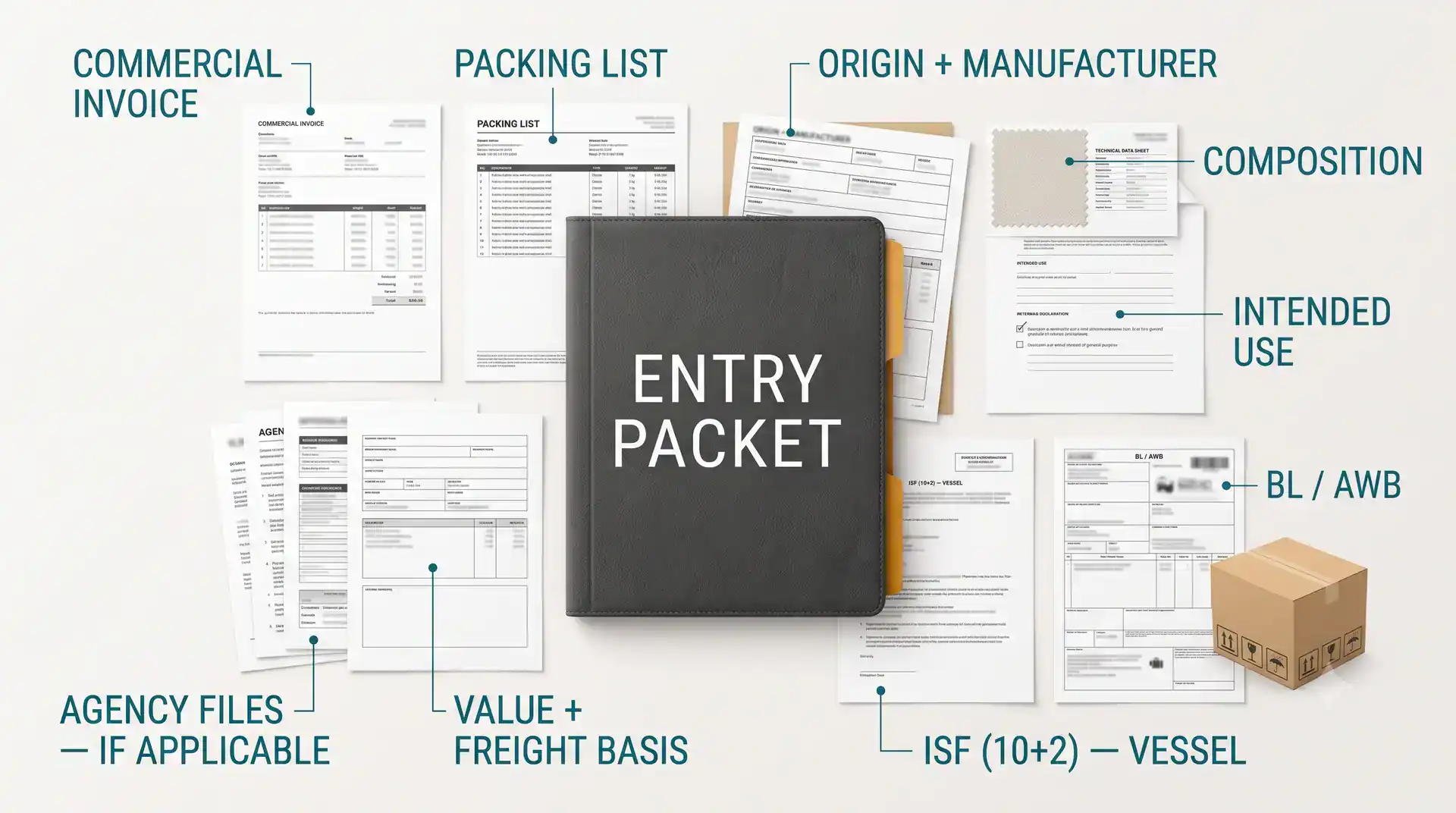
Per-shipment packet (every entry)
- [ ] Signed commercial invoice (goods description, parties, value, terms).
- [ ] Packing list (cartons, weights, dimensions, contents).
- [ ] Country of origin and manufacturer identification.
- [ ] Composition, intended use, and any product-specific declarations.
- [ ] Bill of lading or airway bill.
- [ ] ISF filing confirmation (for vessel cargo, where applicable).
- [ ] Any product-specific certificates, test reports, or agency-required documents (where applicable and confirmed).
- [ ] Consignee, buyer, and seller fields reconciled against the commercial contract.
- [ ] Currency, Incoterm, and freight basis reconciled to the invoice.
- [ ] Special program references (where applicable) — FTA, Section 321 de minimis considerations, drawback, etc. — flagged for the broker.
Per-shipment timing (every entry)
- [ ] Commercial data delivered to the broker at least several working days before ETD.
- [ ] ISF (10+2) submitted at least 24 hours before vessel loading at origin per CBP rules (the importer or its agent files this).
- [ ] Final packing data and any last-mile carton substitutions delivered before arrival at the US port.
- [ ] Broker notified of any changes after the entry is filed.
How This Handoff Plays Out on First Entry vs Recurring Entry
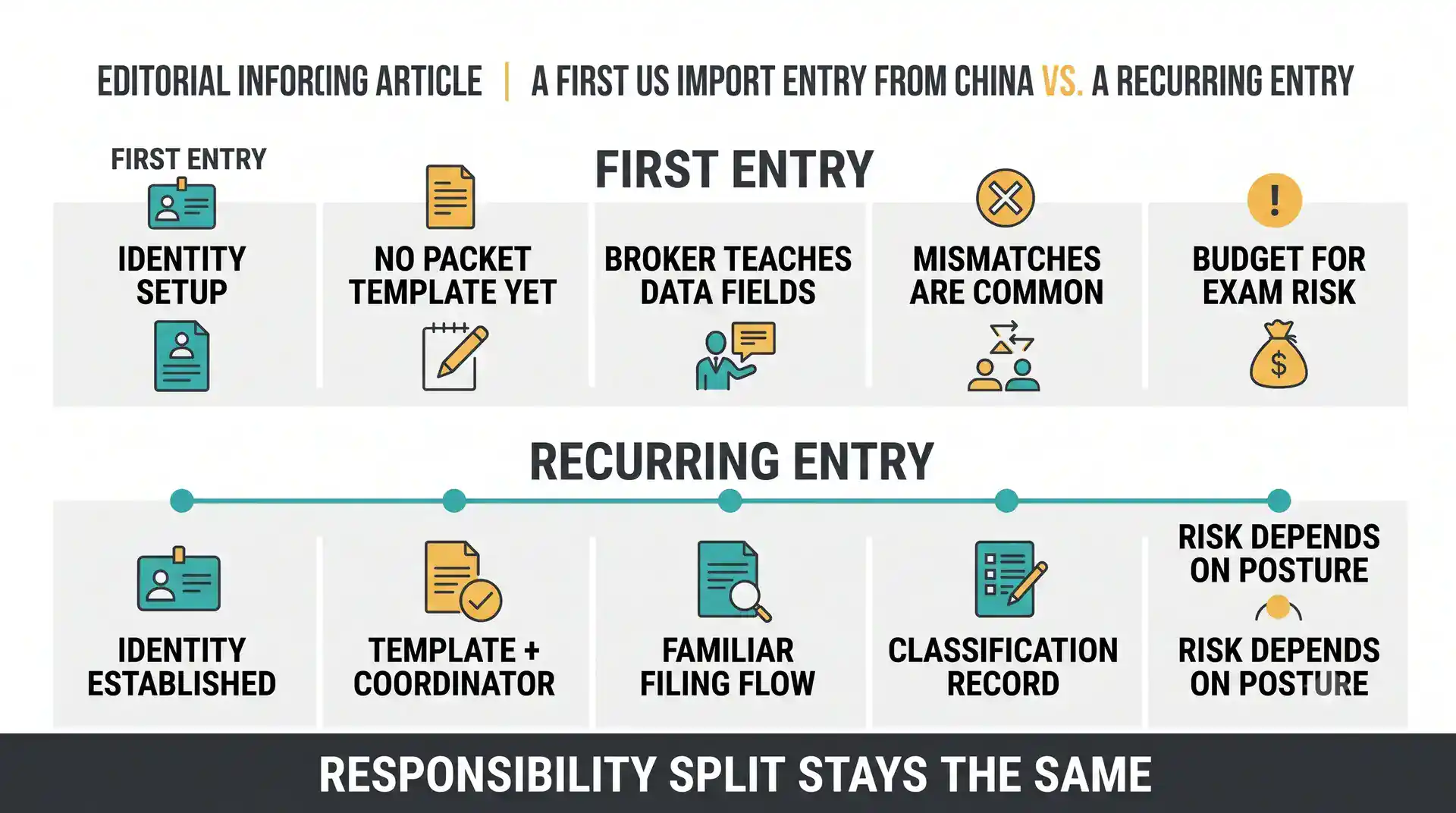
The split does not change, but the operational weight shifts.
First entry
- Identity setup is the long pole.
- The China side has not yet built a packet template.
- The broker is teaching the importer the data fields.
- Misalignment on Incoterm, value, or party names is common.
- Examination risk is real; budget for it.
Recurring entry
- Identity is established.
- The China side has a template and a coordinator.
- The broker is filing a familiar flow.
- The importer’s internal classification record can pre-populate entries.
- Examination risk depends on the product, supplier, and compliance posture.
The principle stays the same: the importer owns the entry, the broker files it, and the China side has to deliver clean data on time.
Common Misreads on a China-to-US Flow
A handful of misreads show up often enough to deserve their own treatment.
“The broker takes responsibility for the entry”
CBP’s page is explicit: even when using a broker, the importer of record is ultimately responsible for the correctness of the entry documentation presented to CBP and all applicable duties, taxes, and fees. Brokers advise; brokers file; brokers do not become the importer.
“No CBP license means no compliance”
CBP does not require an importer to hold a license or permit. Other agencies may require permits, licenses, or certifications depending on the commodity. For many China-sourced consumer goods, the binding constraint is an FDA registration, FCC declaration, CPSC certificate, USDA permit, or another agency filing — not a CBP license.
“If something is held at the port, the broker will fix it”
CBP holds are evaluated against the entry and the underlying record. A broker can communicate with CBP, but the importer is the party who provides the underlying evidence, makes the disposition decision (reliquidate, abandon, export, destroy), and pays the costs.
“A low HS code means a low duty — that’s how it works”
HS classification is a serious CBP determination, not a marketing shortcut. The right code comes from composition, intended use, and CBP’s classification rulings. CROSS is referenced as a public search tool; PART 177 governs binding ruling requests. Classification errors can trigger additional duties, penalties, and loss of program eligibility.
“DDP means the supplier handles US customs”
DDP (Delivered Duty Paid) is an Incoterm. It defines the seller’s obligation to bring the goods to the named place, with duties paid. It does not turn the seller into a US importer, does not bypass CBP identity requirements, and does not eliminate the importer’s record-keeping duty. For an overseas seller to be the importer of record, separate, US-specific arrangements apply.
“Section 321 de minimis means I never need a real entry”
Section 321 of the Tariff Act (19 U.S.C. 1321) allows for informal entry of qualifying low-value shipments under a per-day, per-person threshold, with corresponding entry-type implications. The article you are reading does not assert a threshold, an eligibility rule, or a changelog; check current CBP guidance and qualified counsel for product-specific eligibility.
“My freight forwarder can also be my broker”
Some forwarders have broker subsidiaries or partner brokers; some do not. The two roles are licensed and regulated separately. A forwarder’s quote should not be assumed to include brokerage.
Working Roles for Each Party on a Recurring China-to-US Flow
| Party | Owns | Does not own |
|---|---|---|
| Importer of record | Decision to import; identity setup; entry correctness; duties, taxes, fees; exam cost; ultimate responsibility for the record | Filing on behalf of other importers; product sourcing decisions |
| Customs broker | Entry filing; classification advice subject to importer review; CBP communication; routine exam facilitation | Import decision; identity setup; paying duties; product sourcing; freight |
| China-side supplier | Product data; commercial invoice; packing list; carton marks; composition, intended use, manufacturer | US import decision; US identity; US customs filing; duties |
| Freight forwarder | Booking; carrier; bill of lading / AWB; ISF filing (if it holds broker authority or partners with one); destination handling | Entry filing unless also a broker; duties; exam cost |
| US warehouse / 3PL | Receiving, storage, dunnage, last-mile if scoped | Customs decisions; entry filing |
| US compliance / counsel (when engaged) | Product classification risk review; agency filings; binding ruling requests; dispute handling | Filing entries unless separately licensed as broker |
A Practical Decision Sheet on First Imports
If you are running your first China-to-US entry, work through this in order.
Before the order
- [ ] Decide the importing entity.
- [ ] Establish importer identity (EIN/SSN/CBP Form 5106 path).
- [ ] Pick the broker (or commit to self-filing).
- [ ] Identify any product-side agency registrations required (FDA, FCC, CPSC, USDA, EPA, ATF, etc.).
- [ ] Confirm bond posture (where applicable).
Before the booking
- [ ] Lock the commercial terms (price, currency, Incoterm, freight basis, who pays duty).
- [ ] Confirm the carrier / forwarder and the destination port or airport.
- [ ] Confirm the broker has an active onboarding.
Before the goods ship
- [ ] Receive the supplier’s commercial invoice and packing list draft.
- [ ] Capture composition, intended use, country of origin, and manufacturer.
- [ ] Capture value and currency, with the Incoterm reflected in the invoice total.
- [ ] Reconcile buyer, consignee, seller, and manufacturer names against the contract.
- [ ] Send the entry packet to the broker at least several working days before ETD.
Before the vessel loads (vessel cargo)
- [ ] Confirm the ISF (10+2) filing is complete.
- [ ] Confirm any product-specific agency registrations are active.
Before arrival at the US port
- [ ] Confirm the entry is filed.
- [ ] Confirm there are no last-mile carton changes that the broker has not been told about.
- [ ] Budget for exam: physical exam devan, CES costs, storage during exam.
After release
- [ ] Keep the entry packet and the broker’s filing copies in your file for the CBP-recordkeeping window.
- [ ] Build an internal product-classification record for the next shipment.
How This Article Fits With Related Import Guides
This article owns the U.S. importer-side responsibility split: who controls the importer identity, entry data, duties, and broker relationship on a China-to-U.S. shipment. The related guides below cover adjacent decisions without replacing that role.
- For postal versus nonpostal low-value imports, see the separate data-handoff checklist.
- For a broader supplier-to-importer document checklist, use the China import document guide.
- For the limits of Incoterms around quality, inspection, and disputes, see the Incoterms scope guide.
- For the China-side difference between a sourcing agent and a freight forwarder, see the role-comparison guide.
Those pages cover neighboring decisions. Keep this article focused on the importer of record, the customs broker, and the document handoff between the U.S. importer and the China-side supply chain.
How Style Sourcing Can Support the Handoff
If you are setting up the importer side of a China-to-US flow for the first time, Style Sourcing may be able to help with the operational layer that neither the broker nor the supplier owns. Depending on the assignment and verified supplier access, support can include aligning the supplier’s commercial invoice, packing list, country-of-origin data, and product description against the broker’s expected entry packet; reviewing the carrier, route, and ISF considerations for vessel cargo; coordinating with the destination broker where requested by the importer; and version-controlling changes during production and pre-shipment so the broker files against the current record.
That support is conditional and operational. It is not legal advice, customs representation, classification advice, duty-rate advice, agency filing, bonding advice, tax advice, contract interpretation, or a guarantee of clearance, examination outcome, or release timing. The Style Sourcing role ends where the broker’s and CBP’s roles begin. To scope it, use the Style Sourcing contact page and share the importing entity profile, the broker relationship status, the product category, the route, the freight basis, and the entry target date.
Frequently Asked Questions
Does a customs broker become the importer of record on a US entry?
No. A customs broker is a CBP-licensed private professional who files entries on the importer’s behalf. The importer of record remains the party responsible for the entry’s correctness and for duties, taxes, and fees, even when a broker files it.
Do I need an importer license to import into the United States?
CBP does not require an importer to have a license or permit. Other agencies may require permits, licenses, or other certifications depending on the commodity you are importing. Check the specific product side for any FDA, FCC, CPSC, USDA, or other agency requirement.
How do I set up my importer identity with CBP?
According to CBP’s Tips for New Importers and Exporters, an importer number can be an IRS business registration number, an SSN where applicable, or a CBP-assigned number obtained by submitting CBP Form 5106 to the Entry Branch at a CBP port of entry.
What happens if CBP examines my shipment?
CBP may examine shipments under 19 U.S.C. 1467. The importer must make the goods available for examination and bear the cost, including moving the cargo to a Centralized Examination Station. The CES may bill you for its services, and there may be storage costs during the exam.
Does DDP from my China supplier mean I do not need a US importer setup?
No. DDP is an Incoterm that allocates delivery and duty-paid responsibilities between buyer and seller; it does not turn your supplier into a US importer of record, and it does not bypass CBP identity requirements for a US entity importing into the United States.
Can my freight forwarder also act as my broker?
Some forwarders hold or partner with broker entities; some do not. Broker and forwarder are separately licensed roles. A forwarder quote that does not explicitly include a broker should not be assumed to provide brokerage.
Who decides the HS classification of my product?
The importer is responsible for the entry’s classification. A broker can advise based on the importer-supplied information. Importer Security Filing (10+2) for vessel cargo must be filed before loading. For ambiguous products, an importer can request a binding ruling under 19 C.F.R. Part 177, and CROSS offers a searchable index of prior rulings.
What documents does the broker need from me?
The broker needs the importer’s identity, the entity profile, the supplier’s commercial invoice and packing list, country of origin, composition, intended use, value, freight basis, the carrier document (BL or AWB), and any product-specific certificates the importer’s compliance posture requires. The exact packet depends on the product and route.
What is the difference between an importer of record and a consignee?
The importer of record is the party named on the entry who owns entry correctness and duties. The consignee is the party to whom the carrier delivers the cargo at destination. The two roles can be the same party or different parties depending on the commercial structure; each appears in different fields.
Does the China supplier’s DDP quote cover all US customs costs?
No. A supplier’s DDP quote is a commercial quotation. It does not guarantee clearance, does not classify the goods for CBP, does not act as the importer of record in your name, and does not shield you from additional duties, fees, or exam costs. The importer remains responsible regardless of the supplier’s quotation.
Who pays when CBP holds the goods for examination?
The importer pays. Under CBP’s published position, the importer bears the cost of preparing the merchandise for CBP examination and closing the packages (19 C.F.R. 151.6). Movement to a Centralized Examination Station, devanning, and storage are typically billed by the CES.
Can I self-file entries instead of hiring a broker?
Yes. CBP’s general guidance states that certain resident importers and exporters may file entries on their own behalf. Many first-time importers consult a licensed customs broker because the procedures can be complicated. Self-filing requires ACE access, recordkeeping capacity, and operational ownership of every field above.