Practical advice, not a marketing page. This article gives an overseas buyer the practical execution workflow for buying from Bao66 end-to-end — from a written product brief, to shortlist, to sample, to documented payment, to China-side receiving, to QC, to consolidation and export handoff. It deliberately stays in the execution lane; it does not cover platform safety in depth (covered in our Bao66 safety guide), whether to use a sourcing agent in depth (covered in our Bao66 sourcing-agent guide), or MOQ, payment mechanics, and shipping mechanics in depth (covered in our Bao66 MOQ, payment and shipping guide).
This page stays with the purchase-execution lane for Bao66. The related safety, sourcing-agent, and MOQ/payment/shipping questions have their own guides linked above. Keeping those questions separate lets this article concentrate on the order sequence a buyer needs after choosing Bao66; that is why the body is narrower than the earlier version.

Quick answer
Yes, a foreigner can buy from Bao66, but the buying itself happens through a China-side workflow, not a direct overseas checkout. Bao66 is built for the Chinese domestic wholesale market, and the platform is in Chinese; suppliers are domestic; payments and shipping are arranged inside China.
So the practical question is not “can a foreigner open a Bao66 account and click pay?” It is “what does the China-side execution path look like from brief to export, and where do I plug in?” That is what this article walks through, in the same order an experienced Yiwu operator would plan it.
| Phase | What happens | Who usually handles it | Where it tends to break |
|---|---|---|---|
| 1. Product brief | Lock target product, specs, quantity tier, packaging, destination | Buyer | Brief drifts after supplier input; scope creep |
| 2. Supplier shortlist | Manageable set of candidates evaluated on the same brief | Buyer + China-side | Comparing suppliers on different specs |
| 3. Sample order | Paid sample shipped to a China-side receiving address | Supplier → China-side | Sample sent to a wrong address or stuck in transit |
| 4. Documented payment | Bulk quote confirmed, deposit + balance on written terms | Buyer → Supplier → Payment path | Payment split, currency, or method changed verbally |
| 5. China-side receiving | Goods delivered to a Yiwu warehouse, sourcing office, or forwarder | Supplier → China-side | Carton count, packaging, or labelling off-spec on arrival |
| 6. Pre-shipment QC | Inspection against the locked spec, photo and defect record | China-side | Defects found at destination instead of before export |
| 7. Consolidation and export handoff | Goods consolidated with other orders; export documents, freight booked | China-side → Freight | Freight quote misses carton weight/dim; customs doc mismatch |
Each row of that table is a phase, not a fixed number of steps. Whether you run some of these phases yourself, or run them all with a China-side partner, depends on your language ability, your China-side setup, your payment path, and how much time you have to coordinate in writing.
This page is the purchase execution page for Bao66. If your question is “is Bao66 safe as a platform?”, see our Bao66 safety guide. If your question is “should I use a sourcing agent?”, see our Bao66 sourcing-agent guide. If your question is “how do MOQ, payment and shipping actually work on Bao66?”, see our Bao66 MOQ, payment and shipping guide.
Why buying from Bao66 as a foreigner is a different workflow than Alibaba
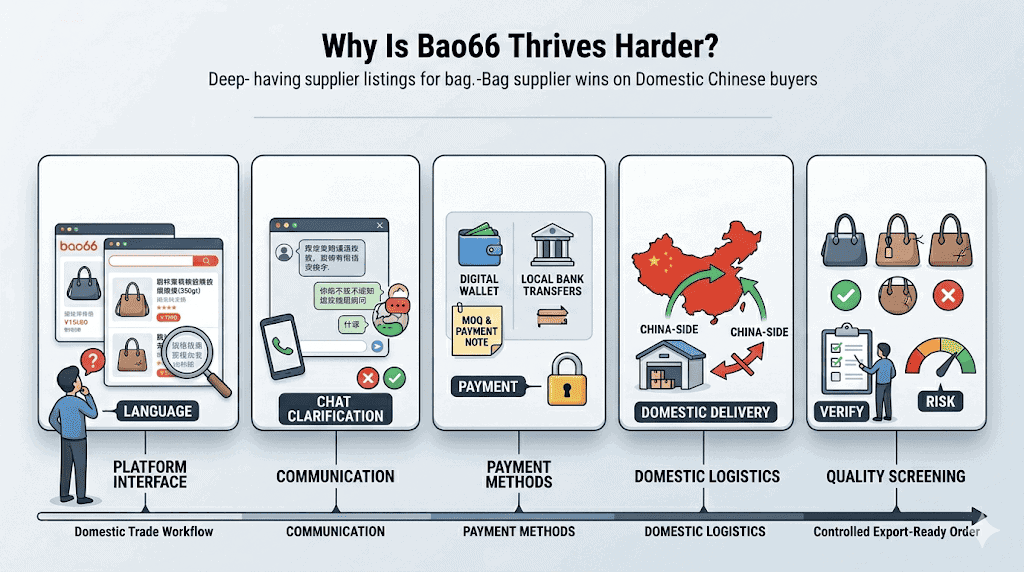
Three practical constraints shape the workflow above. None is a reason to skip Bao66; each is a reason to plan the China-side path before you shortlist.
- The platform is Chinese, not English. Browser translation handles listing titles. It handles material specs, packaging rules, MOQ tiers, customization thresholds, and lead-time conditions much worse. Translated listing text can still leave important details open to interpretation, so ask the supplier to confirm the material, packaging, MOQ, and lead-time conditions in writing. The Style Sourcing Bao66 wholesale bags overview describes the platform-side registration friction in more detail.
- Bao66 is oriented toward domestic Chinese trade. Listings are commonly presented in RMB and a supplier may expect delivery to a Chinese address; confirm the actual payment and delivery options for your order. This is consistent with what the Style Sourcing Bao66.com factory guide calls out as the “domestic wholesale” character of the platform.
- The current account-registration flow may require a Chinese mobile number. This is a platform constraint to confirm before you plan the account path. The Style Sourcing factory guide notes that the sign-up flow may not support foreign phone numbers; workable paths involve a WeChat login plus a Chinese number, or running the account side through a China-side partner. This is one practical reason the execution path goes through a China-side receiving address.
What this means in practice: the decision the buyer is making is not “which listing should I pick?” but “what does my China-side execution path look like, and where does each phase plug in?” Answer that question first and the rest of the workflow reads differently.
What to prepare before you shortlist a Bao66 supplier
A Bao66 purchase becomes harder to control when the brief drifts, the supplier changes the reference photos, or the deposit/balance conversation leaves the written record. The five checks below give you a reference before the first message goes out.
- A written product brief. Material, dimensions, colour, quantity tier, target unit cost (in your currency), packaging, lead time target, customization, and intended destination. Write it before you talk to any supplier; revise it after.
- A reference-photo folder. Several close-up photos of the product you actually want: a current sample, a competitor’s sample, and at least one photo showing the inside, lining, hardware, or finish. Listing photos are not enough.
- A realistic MOQ target. A workable bulk quantity for the first order — not a number copied from another buyer’s order. Whether the supplier will accept a smaller first order is a question for them, not an assumption.
- A China-side receiving address. Yiwu warehouse, sourcing office, or domestic forwarder with a known contact and a documented receiving protocol. See the Bao66 MOQ, payment and shipping guide for how the receiving side is usually arranged.
- An inspection standard. A simple spec sheet that a third-party inspector or your China-side partner can score against: defects counted, carton count expected, packaging rules, label position, photo evidence required. Without this, “passed QC” is a verbal claim, not a record.
When those five are in writing before the first message goes out, the rest of the workflow reads as a sequence of decisions instead of a sequence of surprises.

Before you place a paid sample, lock these three things in writing
This is the one bounded execution-utility block v2 adds that v1 did not have. It stays inside the procedural lane — it is not a safety guide, not an agent decision, not an MOQ/payment/shipping deep-dive. It exists because the seven phases below assume the sample phase has already been gated by a written agreement on the three points most likely to cause a “different product from the sample” dispute at receiving (Step 6).
- Spec on the sample matches the brief. The same material, dimensions, colour, hardware, lining, finish, and packaging as the locked brief — not “similar to listing photos”. If the supplier cannot meet the brief on a paid sample, the bulk quote conversation has not started.
- Sample shipping address on the quote. The sample ships to the same China-side receiving address the bulk order will use. A sample delivered to a different address or handed off informally is not a useful test of the receiving chain.
- What happens if the sample drifts from the brief. In writing, before payment: re-sample at supplier cost, refund, or move to a different candidate. Without this written, “the sample was not exactly what we wanted” becomes a verbal dispute at the receiving step.
Lock those three in writing before the sample ships. Everything in Steps 1–7 below depends on the sample being a fair test of the supplier, not a partial one.
Step-by-step: how to buy from Bao66 as a foreigner
The seven phases below are the same workflow a Yiwu-based operator would plan for an overseas buyer. Run them in order; treat each phase as a gate to the next one.
Step 1 — Confirm fit and write the brief
Before you open a single supplier conversation, confirm that Bao66 is the right surface for this product. Bao66 is a bag-and-accessories-focused domestic platform; products outside that lane usually have a thinner supplier pool than 1688 or Alibaba.com. Once confirmed, write the brief from the checklist above, lock the unit-cost ceiling in your currency, and resist changing it after the first supplier replies.
Step 2 — Build a small workable shortlist
A workable shortlist is a small group you can actually evaluate against the same brief. Choose enough candidates to compare the important rows without making the review unmanageable; the right number depends on the product and order. The goal is answerable comparison rows, not a fixed count.
For each candidate, capture the same ten rows you would on any platform — material, MOQ per SKU and per order, tiered unit price at your low/mid/high quantity, sample cost and lead time, bulk lead time, packaging, customization thresholds, China-side delivery capability, payment method preference, and two close-up photos of the actual product. The full shortlist structure used on the 1688 lane lives in our 1688 supplier shortlist workflow; the same row logic applies on Bao66.
Step 3 — Order a paid sample from the selected candidates
A sample is not a free preview; it is a paid test order against the locked spec. Send the brief, the reference photos, and the receiving address to a small set of selected candidates. Order one sample per candidate on the same spec. The “lock these three things in writing” block above applies before payment goes out.
What to check when the sample lands:
- Material matches the listing, not just the photos
- Dimensions and weight are within the brief’s tolerance
- Hardware, stitching, lining, finish, and colour match the reference photos
- Packaging is the packaging you will receive at bulk
- The sample was sent to the receiving address you specified, with tracking
A clean sample at this stage is one strong positive signal for how the bulk process might run; a sample that drifts from the listing is one strong negative signal.
Step 4 — Lock the bulk quote in writing
Once the sample is approved, ask every shortlisted supplier for a written bulk quote on the same locked spec, MOQ, packaging, and lead time. Compare the quotes on the same rows. Anything verbal — price, lead time, customization cost — does not count as a locked quote.
A workable bulk quote on Bao66 looks like a single document with: SKU list, per-unit price at your quantity tier, total price, MOQ per SKU, packaging details, customization details, lead time in working days, payment terms (deposit + balance, currency, method), and the China-side delivery address it will be shipped to.
Step 5 — Pay through a documented path
Pay through a path that leaves documentation — an invoice, a payment record, a conversation log that matches the quote. Whether that means a domestic agent invoice, a verified RMB payment method, or a platform-supported checkout depends on what the supplier accepts and what your payment setup supports.
What the documented path is not: a verbal deposit, a currency conversion arranged outside the quote, or a payment method that has no record of what it paid for. The three plain-language rules are: pay on the same terms the quote specifies, pay on a path that produces a receipt, and keep the receipt with the quote. The Bao66 MOQ, payment and shipping guide covers the payment mechanics in more depth; this article stays on the documented-evidence principle.
Step 6 — Receive the bulk order in China
The supplier ships to your China-side receiving address — Yiwu warehouse, sourcing office, or domestic forwarder. On arrival, count cartons against the packing list, photograph the outer cartons before opening, and run an open-package check against the spec. Discrepancies found at this stage are easier to resolve than the same discrepancies found at destination.
What to record on arrival:
- Carton count vs. packing list
- Outer carton condition (no crushed, water-stained, or resealed cartons)
- Random open-package check on one or two cartons: quantity per inner pack, product vs. spec, packaging vs. quote
- Photo evidence of any discrepancy, before anything is restacked
Step 7 — Run pre-shipment QC and hand off
A pre-shipment inspection scores the bulk against the locked spec and the inspection standard you set in Step 1. Whether you run it yourself at the receiving address or pay a third-party inspector depends on order size, product risk, and how repeatable the supplier has been at the sample stage.
After QC, the goods move to consolidation with any other orders, export documents are prepared, and freight is booked. The handoff from China-side to international freight is its own decision point — see the Bao66 MOQ, payment and shipping guide for the export side of the chain.

When this execution lane gets harder
The seven-phase workflow above is the standard path. A few situations deserve a mention because they change which phases deserve more attention.
- First order with a new supplier. Treat the first order as a paid test, not a forecast. Keep the quantity at a tier that lets you absorb a partial loss, not the tier you would order at steady state.
- Customization beyond logo or color. Logo, color, and retail box are common customization thresholds; anything beyond that (custom tooling, custom material, custom hardware) usually changes MOQ, lead time, and the sample protocol. Ask the supplier for setup cost and MOQ per option in writing.
- Multiple orders from multiple suppliers. Consolidation becomes a phase of its own. Group receiving windows, agree on inner-pack and master-carton labelling, and verify carton dimensions against the freight quote before pickup. The receiving protocol in Step 6 is the input to this.
- Repeat orders. The same workflow runs again, but the shortlist, the brief, and the documented payment path become assets. Keep the conversation log and the inspection standard from the first order; reuse them.

FAQ: Buying from Bao66 as a Foreigner
Do I need a Chinese mobile number to use Bao66?
The account registration flow currently expects a Chinese mobile number for the verification step, which is one practical reason many overseas buyers run the account side through a China-side partner or use a WeChat-bound login plus a Chinese number. Whether you can run the account yourself depends on your ability to receive the verification SMS in mainland China; this is a constraint of the platform, not a judgement about the buyer.
Can I pay with a foreign credit card or PayPal on Bao66?
Bao66 is a domestic Chinese wholesale platform; payments are arranged inside China. Whether a particular supplier accepts a specific foreign payment method is a question for that supplier, not a default. The practical pattern is to pay through a documented China-side path — agent invoice, RMB bank transfer, or a verified payment method — and keep the invoice and the conversation log together.
How long does the whole process take from shortlist to export?
It depends on sample lead time, bulk lead time, receiving window, and freight booking. None of those is fixed at the platform level; each is a question for the supplier, the receiving address, and your freight forwarder. Use the bulk lead time from the locked quote as the most reliable anchor; everything else adds or subtracts from that.
What if the supplier sends a different product from the sample?
Treat it as a discrepancy at the receiving step (Step 6), not as a delivery surprise. Photograph the product against the locked spec and the approved sample before anything is restacked. Discrepancies recorded at receiving are far easier to resolve than the same problem raised at destination.
Can I skip samples if I am in a hurry?
You can, but skipping samples means the bulk order is your first physical test of the supplier, not the sample. The receiving and QC phases still run; they just run on the bulk order instead of a paid sample. Whether that risk is acceptable depends on the product, the order size, and how repeatable the supplier has been for other buyers — a question to ask the supplier directly, not an assumption.
Should I use a sourcing agent to buy from Bao66?
That is a separate decision, covered in our Bao66 sourcing-agent guide. Short version: whether a sourcing agent makes sense depends on your language ability, your China-side setup, your payment path, and how many of the seven phases you want to run yourself.
A short pre-execution checklist for Bao66
Use this before you send the first message to a shortlisted supplier.
- [ ] Product brief written and locked (material, dimensions, colour, quantity tier, packaging, lead time, destination)
- [ ] Reference photos in a folder the supplier can be sent
- [ ] Realistic MOQ target decided for the first order
- [ ] China-side receiving address confirmed with a contact and a receiving protocol
- [ ] Inspection standard written down (defects counted, carton count expected, packaging, labels, photo evidence)
- [ ] Manageable shortlist evaluated on the same brief
- [ ] Samples ordered from selected candidates on the same spec
- [ ] Sample evaluated against the locked brief, not against the listing photos
- [ ] Bulk quote received in writing, with the same rows across all candidates
- [ ] Payment path chosen for documentation, not just for speed
- [ ] Pre-shipment QC planned and agreed before bulk ships
- [ ] Consolidation and export handoff plan agreed before bulk ships
How Style Sourcing supports Bao66 purchase execution
Our Yiwu-based team can discuss the China-side steps above — product brief, supplier shortlist, sample handling, documented payment coordination, China-side receiving, pre-shipment QC, consolidation, and the export handoff — and explain which parts are currently within our service scope and which you may prefer to run yourself. The relevant service pages below describe what we offer in general; ask us directly for the parts you specifically need help with:
If you want help running the seven-phase execution workflow on a specific Bao66 order before you place it, talk to our team.


