
Practical advice, not a marketing page. This article gives an overseas buyer a pre-payment shortlist and message → specification → sample → payment → China receiving → QC handoff workflow for evaluating a 1688 domestic-platform supplier before money moves. It deliberately stays in the pre-payment lane; we do not cover how to order samples in depth (covered in our 1688 sample order guide), how to pay from overseas in depth (covered in our overseas 1688 payment guide), or 1688 sourcing-agent fees in depth (covered in our 1688 sourcing-agent fee guide).

Quick answer
Yes, you can find reliable 1688 suppliers, but you do not find them by sorting only by price or by chasing the lowest listing.
You find them by doing four things before money leaves the buyer:
- Shortlist a small workable set of suppliers against the same product brief, not one. A handful is usually enough to compare; the exact number is something to decide per product, not a fixed rule.
- Send a single, well-built pre-payment message (the one in this article) and compare the quality of the reply.
- Treat sample + spec + China receiving + QC handoff as one evaluation chain, not four separate decisions.
- Pay only after the chain above produces written, consistent answers across the suppliers you shortlisted.
1688 is Alibaba Group’s domestic B2B platform, built around the China wholesale market. A serious pre-payment evaluation here looks different from one on Alibaba.com, in part because the platform is geared toward buyers operating inside China.
Editorial note (intentional scope): this article is the pre-payment evaluation page for 1688. If your question is “is 1688 safe as a platform?”, see our 1688 safety guide. If your question is “should I use a 1688 sourcing agent?”, see our 1688 sourcing-agent guide.
Why finding a reliable 1688 supplier is harder than it looks
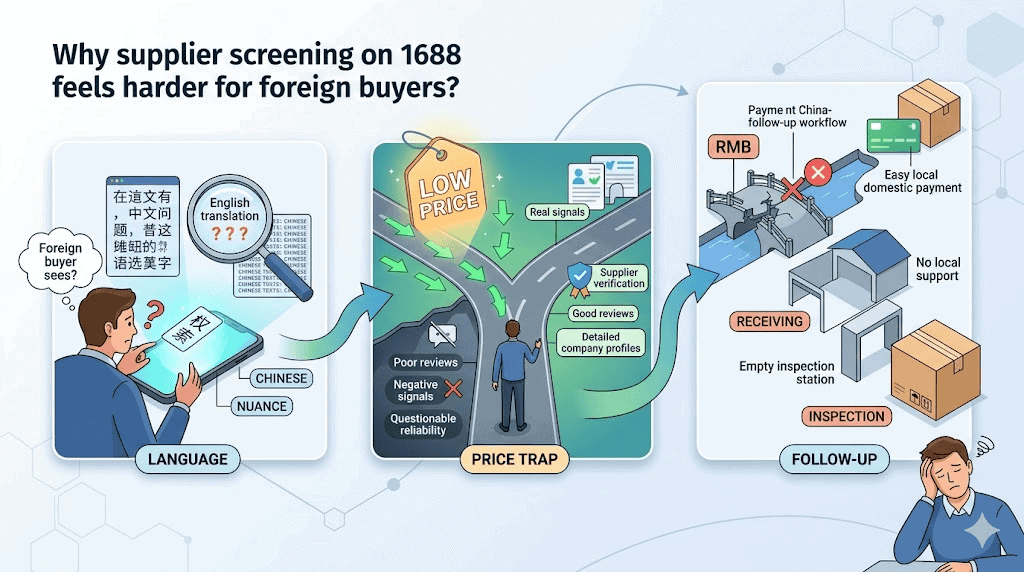
Three structural frictions make 1688 supplier evaluation harder for an overseas buyer than on most export platforms. None of them is a reason to skip 1688; all three are reasons to evaluate the supplier, not the listing.
- The platform is in Chinese. Browser translation handles listing titles. It handles material specs, packaging rules, MOQ tiers, customization thresholds, and lead-time conditions much worse. This is one practical reason the same five questions, asked in plain English, often produce five different answers.
- 1688 storefronts include a mix of sellers. The same platform hosts factories, trading companies, and individual sellers. The platform exposes fewer export-oriented signals and less English documentation than Alibaba.com, so the factory vs trader question usually has to be answered through the supplier itself, not the storefront. (This is a qualitative observation of how 1688 storefronts are organized; no specific seller-type ratio or platform-wide share figure is separately verified for this article.)
- Working with a 1688 supplier without a China-side setup adds friction. A workable 1688 supplier should be able to ship to a Yiwu warehouse, a sourcing office, or a domestic forwarder without confusion. If the domestic handoff is messy before payment, that is a signal worth slowing down for; whether that becomes a hard blocker depends on the buyer’s own China-side setup, language ability and payment path.
What “reliable 1688 supplier” actually means in 2026
Strip the marketing away and the practical definition is small and honest.
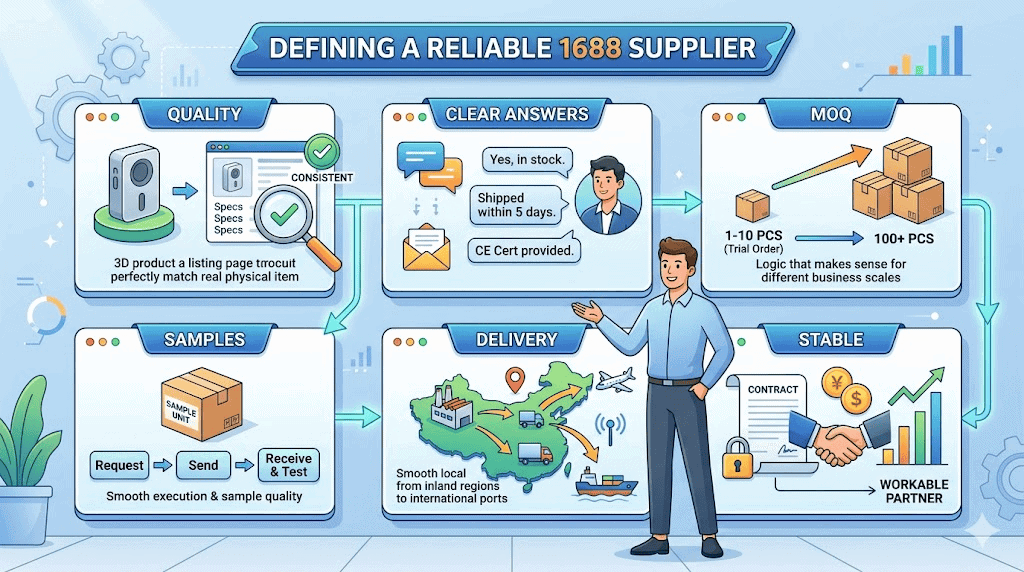
A reliable 1688 supplier is one who can do all six of these without slipping into vague answers:
- Consistent listings: product photos and the actual product match closely enough that a sample is a confirmation, not a discovery.
- Practical answers: they answer material, MOQ, sample, packaging, lead time and customization questions with specifics, not generalities.
- Stable MOQ logic: the MOQ does not move between the first reply and the third.
- Workable samples: the sample order is treated as a real order, with normal packaging and tracking.
- China-side delivery cooperation: they can clearly say where the goods will be sent inside China and how.
- Steady behavior around payment: they remain precise once the conversation includes deposit, balance, currency or RMB mechanics.
If any one of those six is weak, the supplier may still be workable for low-risk products. For any product where repeat ordering, packaging, or QC matters, the chain has to be strong across the board.
A 1688-specific supplier shortlist comparison table
The most underrated step on 1688 is treating the shortlist as a side-by-side comparison, not a stack of single conversations. The table below is a structure, not a recommendation; fill it in for your own candidates before sending the message in the next section.
| What to capture | Why it matters on 1688 | Where to find it |
|---|---|---|
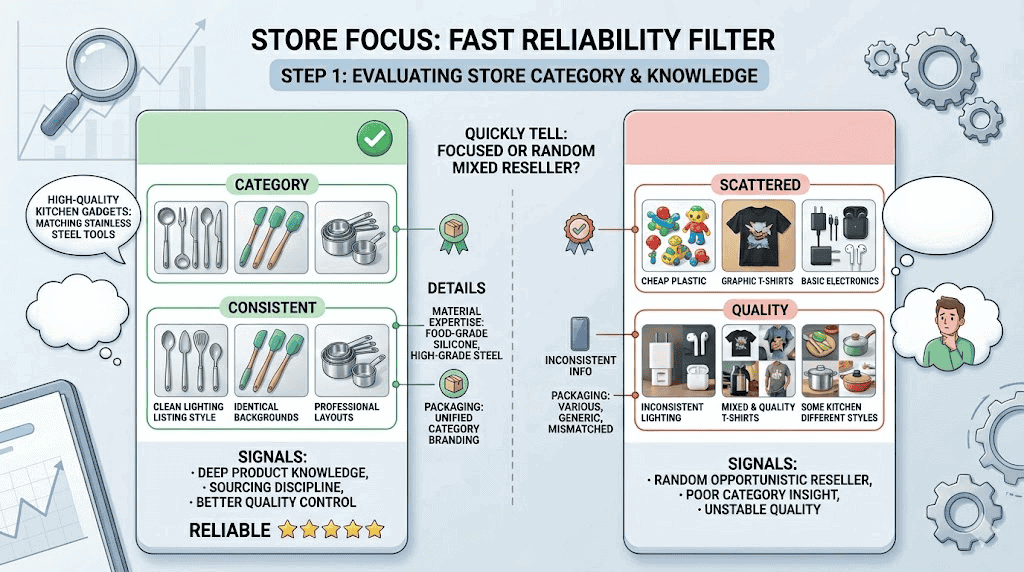
| Store category focus (1 main category vs scattered) | A single-category store is one practical signal of familiarity with the product; treat it as one data point, not proof | 1688 storefront, product list filter |
| Tenure and any platform-side store-level indicator where visible | Long tenure on the platform is one positive signal among several, not proof of reliability on its own | Store home page |
| Repeat-buyer or repurchase indicator where visible | These numbers are supplemental context if you can see them, not a threshold you can rely on | Storefront metrics block (often shown only on the Chinese-language view) |
| Sample cost + sample shipping cost + sample lead time | Whether the sample cost is refundable against a confirmed bulk order is a question to ask the supplier, not a default to assume | Direct message |
| Bulk MOQ (per SKU and per order) | 1688 listing MOQs vary widely by category, supplier and SKU; ask the supplier for the actual number you would order | Product detail page + direct message |
| Tiered pricing (per SKU, per carton, per color) | Listing price is rarely the price you actually pay at the quantity you order | Direct message |
| Lead time at your quantity | 1688 listings rarely show lead time for overseas buyers; ask for working days at your mid-quantity tier | Direct message |
| Customization thresholds (logo, packaging, color) | The “customizable” tag is rarely the full story; ask for setup cost and MOQ per option | Direct message |
| China-side delivery capability (Yiwu warehouse, sourcing office, forwarder) | Reveals whether they have done this before for non-Chinese buyers | Direct message |
| Payment method preference (Alipay, WeChat Pay, RMB bank transfer, agent invoice) | A supplier who can name a clean payment path is one practical signal of experience | Direct message |
If two suppliers in your shortlist cannot fill in more than half of these rows clearly, that is worth treating as a signal. You are not looking for perfect rows; you are looking for answerable rows.
The pre-payment message: one message, ten questions
Do not start a 1688 conversation with “What is your price?”. Start with a single, structured message that asks the same ten things of every shortlisted supplier. The message below is what an experienced China-side operator would actually send. Copy it, adapt it to your product, and send it verbatim to all candidates.

Hello,
We are an overseas buyer sourcing [your product category] in [target quantity range] units per order. Before we shortlist suppliers for sampling, please reply with the following for this listing:
- Exact material specification (composition, grade, finish) — please confirm whether the listing photo shows this exact material.
- MOQ per SKU and per order, and tiered unit price at [your low quantity], [your mid quantity], and [your high quantity].
- Sample cost per unit, sample lead time, and whether the sample cost is refundable against a confirmed bulk order.
- Bulk lead time from deposit to ready-to-ship, in working days, at our [your mid quantity] tier.
- Packaging: standard inner pack quantity per carton, master carton dimensions and weight, and any optional retail packaging you can supply.
- Customization options: logo, color, retail box — minimum order and setup cost for each.
- Whether you can ship the bulk order to a Yiwu / domestic China warehouse address on our side, and what domestic delivery/collection arrangement you normally use.
- Whether you support payment by [your preferred path: Alipay, RMB bank transfer, agent invoice] and how you normally structure deposits and balances for new overseas buyers.
- Two recent close-up photos of the actual product (not listing photos) and one photo of the production line or workshop.
- Two or three examples of similar products you have shipped recently (for example, a cotton drawstring bag to a European retail buyer, a stainless steel lunch box to a North American distributor, or a polyester tote to an Australian wholesaler — replace with categories that match your product).
Please reply in this same order, one number per item. We will compare your reply against other shortlisted suppliers on the same questions.
Thank you.
A note on question 10: asking a 1688 supplier to share identifiable end-customer references is not appropriate. Asking for anonymized recent examples by product type and destination region is a reasonable way to understand their experience.
Why this message works on 1688 specifically:
- It forces a structured reply. A supplier who can answer in the same order is one signal of internal pricing/spec discipline. A supplier who answers around the questions is telling you something important.
- It exposes price logic (tiered), not just a single number.
- It forces payment and delivery into the conversation before money, so behavior around the hardest parts of the workflow gets tested early.
- It keeps the supplier on the record: in writing, in order, with photos. That record becomes the basis for sample evaluation, change-order negotiation and dispute evidence later.
Compare replies across the shortlist, not within one. Two suppliers who both answered question 6 with “yes, we can customize” tells you nothing. Two suppliers who both answered question 6 with “logo: ¥X setup, MOQ 500 units; retail box: ¥Y setup, MOQ 1,000 units, add 7 days” tells you a lot.
The pre-payment evaluation chain: sample → spec → payment → China receiving → QC handoff
Below is the workflow that ties the shortlist together. Treat it as one chain, not five separate decisions — the breakdowns on 1688 usually show up at the handoffs between steps, so the same chain has to be tested as a whole.
Step 1 — Specification lock
Confirm the specification in writing before paying for samples. Use the supplier’s reply to questions 1, 5 and 6 above. If anything in the reply is hedged (“depends on order quantity”, “we can discuss”), lock it down in a second short message; do not assume hedging will resolve on its own.
Step 2 — Sample order as a process test
Order samples from your top two (or three) shortlisted suppliers at the same time. Samples test two things at once: the product and the supplier’s process. Pay attention to whether they:
- confirm the sample order in writing with the spec locked,
- ship within the lead time they quoted,
- pack the sample in a way that is consistent with their bulk packaging claim,
- respond during shipping when you ask for a tracking number or a photo.
A clean sample process at this stage is one strong positive signal for how the bulk process might run; a messy one is one strong negative signal. Sample-order detail (cost recovery, what to compare across samples, plain vs custom samples) is covered in depth in our 1688 sample order guide.
Step 3 — Sample evaluation against spec, not against feeling
When samples arrive, evaluate against the spec, not against “does this look like the listing”. Use a short, written scorecard: material, finish, color match, dimension, hardware, packaging standard. A sample that fails any single item is a clear “no”. A sample that passes everything is a clear “yes, proceed to bulk quote”. A sample that passes everything but feels “different” usually has a labeling, packaging, or quantity issue; do not pay bulk to resolve that ambiguity.
Step 4 — Bulk quote, in writing, on the same parameters
Ask the shortlisted suppliers to re-quote the bulk order using the locked spec, the agreed MOQ tier, and the locked packaging. Confirm:
- unit price at your agreed quantity,
- deposit/balance structure,
- currency and payment method (Alipay, WeChat Pay, RMB bank transfer, or sourcing-agent invoice),
- bulk lead time from deposit,
- the domestic delivery/collection arrangement to your China-side receiving address (for example, supplier delivery to a Yiwu warehouse, or buyer collection from the supplier’s workshop).
Do not pay on a verbal quote. Lock them in writing in the same chat thread. That thread is your evidence file if anything goes wrong later; see our before-payment evidence record checklist for what a clean evidence file looks like.
Step 5 — Pay through a method that leaves a documented evidence trail
Choose a payment path that leaves documentation you can verify later — invoices, bank references, platform order records, or an agent’s formal receipt — rather than informal channels with no paper trail. The reason is not trust in the supplier; the reason is that a documented payment path gives you something to refer back to if anything needs to be reconstructed. Payment mechanics in depth are covered in our overseas 1688 payment guide and our 1688 sourcing-agent fee guide.
As a working rule, pay a documented amount only after the pre-payment evaluation chain above has produced written answers you have actually received. A supplier who is unwilling to commit anything in writing is a separate signal from the payment method itself. Specific payment splits and balances vary by product, order size, supplier track record, and which payment path you choose — there is no single split that fits every situation.
Step 6 — China-side receiving, not international shipping yet
Have the bulk goods shipped to a China-side address — your Yiwu warehouse, your agent’s warehouse, your consolidator, or your freight forwarder’s domestic warehouse — before anything goes international. Receiving the goods domestically first lets you catch count errors, packaging damage, spec drift, and substitution before they become an international shipping cost.
Step 7 — Pre-shipment QC handoff
Inspect at the China-side receiving address before international shipment. What to inspect and how detailed the inspection should be depends on product value, fragility and packaging sensitivity; the full inspection workflow is in our 1688 inspection service guide. A simple count + appearance + carton check is the minimum; for branded packaging or detail-sensitive products, a fuller check is worth the cost on any first bulk order.
Step 8 — International handoff only after QC passes
Once QC passes at the China-side address, hand the goods to your international freight forwarder. Only at this point does the order become an export order, not a 1688 order. Treating these as two separate orders — one to the supplier, one to the forwarder — is a clean way to keep accountability clear.
8 red flags that usually mean “slow down”
These are not guarantees of fraud; they are signs that the shortlist has weak entries and should be re-filtered, not rushed.
- The price is dramatically lower than everyone else. A 1688 quote that is far below the others usually means a different material, a different grade, a different MOQ, or a different supplier. Ask why in writing.
- The supplier avoids direct answers. If they cannot clearly explain material, MOQ, packaging, or lead time, do not rush to pay. Vague answers rarely get sharper after deposit.
- Their product range is too random. A 1688 store selling unrelated categories often feels less controlled, with thinner product knowledge per category.
- The listing photos look lifted from elsewhere. Photos that are inconsistent with each other in lighting, background, and style — or that reappear under many different suppliers — are a signal worth slowing down for.
- They push hard for immediate payment. Pressure is not a trust signal on any platform, including 1688.
- Sample quality does not match listing quality. Believe the sample. Promises about bulk matching the sample are not evidence.
- MOQ, lead time, or pricing shifts between replies. If the numbers keep moving, the supplier is either improvising or has no internal pricing discipline.
- Communication gets worse after the first reply. Fast first contact followed by vague second contact is a common pattern on 1688.
Factory or trader: should you care on 1688?
On 1688 specifically, the factory vs trader distinction is one signal among several, not a guarantee of better or worse reliability. What matters more in practice is how the supplier behaves on the chain above:
- Transparency — can they tell you who they really are, where they are, and what their role in the chain is?
- Consistency — does the spec hold across listings and across replies?
- Sample quality — does the sample match what they said?
- Problem-solving ability — when you ask a real question, do they engage with the answer?
If factory status matters to your pricing or production timeline, verify it. “Factory” on 1688 is one practical signal, not a guarantee. Verification depth (business license, audited factory report, independent third-party check) is covered in our 1688 supplier verification checklist.
When a China-side sourcing partner makes sense
A workable supplier-evaluation setup for a first 1688 bulk order typically looks like this: a small workable shortlist of suppliers, the structured message above, sample + spec + payment + receiving + QC handoff as one chain, and (when needed) a China-side partner who handles Chinese-language communication, RMB mechanics, and domestic receiving/inspection.
Whether you run this workflow yourself or with a China-side partner depends on your own language ability, your China-side setup, and how much time you have to coordinate in writing. If you already speak Chinese and have a China-side setup, you can run it yourself. If you do not, a Yiwu-based sourcing team can run the supplier-comparison and pre-payment evaluation work for you.
FAQ: how to find reliable 1688 suppliers
Can I trust 1688 store ratings alone?
No. Store-level ratings can be one useful filter among several, but they should not be the only decision tool. Run the shortlist comparison and the structured pre-payment message against any supplier you are considering, regardless of rating.
Should I pick the cheapest 1688 supplier if the listing photos look the same?
Not automatically. Similar photos do not guarantee similar material, packaging, MOQ, or sample quality. On 1688, listing-photo similarity is one of the more common reasons a “cheapest” supplier turns out to be a higher-cost supplier after the sample arrives.
How many 1688 suppliers should I compare before choosing one?
A small workable shortlist is usually enough to compare. Whether that means three, five, or another number depends on your product and how easy the supplier pool is to filter. The goal is answerable comparison rows, not a fixed count.
Is it ever okay to skip samples on 1688?
For some low-risk orders — small value, no repeat ordering, packaging does not matter — skipping samples may be acceptable. If product quality, packaging, repeat ordering, or brand presentation matters, samples are still the more conservative move. The sample process in detail is in our 1688 sample order guide.
What payment split should I use with a 1688 supplier?
There is no universal split. What matters is that the agreed amount, currency, and timing are documented in writing before any money moves, that you can verify the payment path afterwards, and that the deposit/balance structure matches the documentation the supplier has already provided. Specific splits vary by product, order size, supplier track record, and payment method. Our overseas 1688 payment guide covers the mechanics in depth.
What if a 1688 supplier does not want to ship to a Yiwu warehouse?
That is a meaningful signal. A workable 1688 supplier should be able to ship to a Yiwu warehouse, a sourcing office, a domestic forwarder, or a consolidation point in China without confusion. If the domestic handoff is messy before payment, that is worth slowing down for.
A short pre-payment checklist for 1688
Use this at the end of your shortlist, before you pay.
- [ ] A small workable shortlist, all evaluated against the same brief
- [ ] The structured 10-question message sent to every shortlisted supplier
- [ ] Replies received in the same order, with specifics, not generalities
- [ ] MOQ, lead time and tiered pricing consistent across the replies
- [ ] Samples ordered from the top 2–3 suppliers, paid through a verifiable method
- [ ] Sample evaluation done against the locked spec, not against the listing
- [ ] Bulk quote received in writing on the locked spec, MOQ, packaging and lead time
- [ ] Payment path chosen for documentation, not just for speed
- [ ] China-side receiving address confirmed before bulk ships
- [ ] Pre-shipment inspection plan agreed before bulk ships
- [ ] Internal references recorded (spec, replies, sample photos, quote, payment, shipping)
Final advice
If you want to find reliable 1688 suppliers, do not chase the cheapest listing and hope for the best. Shortlist a small workable set of suppliers against the same brief. Send one structured pre-payment message. Treat sample → spec → payment → China receiving → QC handoff as a single evaluation chain. Pay through a path that leaves documentation. Inspect before export. That is how a 1688 bulk order becomes a repeatable workflow rather than a one-off risk.
How Style Sourcing supports pre-payment evaluation on 1688
Our Yiwu-based team can discuss any of the evaluation steps above with you — supplier shortlisting, the structured pre-payment message, sample handling, payment coordination, China-side receiving, and pre-shipment QC — and walk you through what we actually cover for each. The relevant service pages below describe what we offer in general; ask us directly for the parts you specifically need help with:
If you want help running the shortlist and pre-payment evaluation workflow on a specific 1688 supplier before you transfer money, talk to our team.


