Factory vs Trading Company vs Wholesaler vs Yiwu Market Booth: Which Route Fits Your Order?
You have a product idea, a destination market, and a small team — but the first supplier search returns a wall of factory ads, trading company storefronts, wholesaler listings, and Yiwu booth photos. Which one actually fits your order?
A trading company promises lower MOQ and English support — but is that the same factory making the goods?
A factory page looks impressive — but does the factory actually speak to overseas buyers, or only to domestic trading companies?
A Yiwu market booth looks cheap — but what is missing once you fly home?
Most buyers do not pick a supplier type on purpose. They pick whatever appears first in search. That is how the same factory ends up quoted through three different layers, the same trading company ends up selling two unrelated categories, and the same Yiwu booth ends up confused with a freight forwarder.
This article is a decision matrix, not a ranking. There is no universally best route. Each route has trade-offs, and the right route depends on your order size, customization needs, language capability, timeline pressure, and risk tolerance. We will keep the comparison honest and finish with the questions you should be able to answer before you contact anyone.
Quick Answer: Which Supplier Route Should You Try First?

Use the table below to shortlist the route that matches your order, not to declare a winner. Two buyers can choose different routes and both be correct.
| Route | Best fit when | Strengths to expect | Watch-outs to plan for |
|---|---|---|---|
| Factory | You can meet a reasonable MOQ, want direct production control, and accept slower English communication | Direct pricing logic, closer control of process changes, clearer production-line feedback | Many factories only sell in Chinese, require domestic agents for overseas buyers, and may resist small test orders |
| Trading company | You need one contact for multiple factories, English communication, smaller-than-factory quantities, or product mix | One English-speaking point of contact, can aggregate SKUs from several factories, often handles documents and consolidation | Adds a margin layer, may not own the production line, can blur responsibility for defects or delays |
| Wholesaler / distributor | You need ready-stock goods, fast delivery, or you do not yet have a customized spec | Shortest time to ship, often lower per-unit price for in-stock designs, useful for resale and dropshipping | Limited customization, stock may not match your exact spec, color/size runs can change without notice |
| Yiwu market booth | You want to compare many similar SKUs in person (or via remote booth service), buy small mixed cartons, or source consumables/fashion accessories | Huge SKU variety, in-person photo and price negotiation, flexible sample quantities, strong for low-MOQ multi-SKU orders | Each booth is small, English is rare, post-purchase follow-up depends on your own tracking and consolidation plan |
The rest of this article explains why these strengths and watch-outs exist, what evidence to gather before you commit, and how the routes overlap in real supplier lists.
Why the Four Routes Are Often Confused

A factory can sell through a trading company. A trading company can list stock bought from a wholesaler. A Yiwu booth can be operated by a wholesaler, a trading company, or a small front office for a factory. The labels on a website or marketplace do not always reflect the actual supply chain behind the goods.
That is why the route you pick is not the same as the supplier you end up talking to. A “factory” page on 1688 or Alibaba may actually be a trading company listing other factories’ products. A “trading company” email signature may belong to someone who also operates a Yiwu booth three seasons a year.
If 1688 is one of your starting routes, use this 1688 supplier verification checklist before you shortlist a seller.
The goal of this article is not to label suppliers. It is to help you pick the route that matches your order and then verify that the supplier behind the route can actually deliver.
Three things cause the most confusion:
- Same product, different seller. A stainless steel water bottle can be sold by a factory, a trading company, a wholesaler, and a Yiwu booth at the same time. The price ladder reflects route margin, not necessarily quality.
- English ≠ manufacturer. English fluency is a service feature of the trading-company and Yiwu agent layer, not proof that the seller owns the production line.
- Marketplace labels are sales claims. 1688, Alibaba, Bao66 and Yiwu supplier pages are storefronts. The storefront label is what the seller chose, not an audited category.
When you keep these three points in mind, the four routes become clearer.
Factory Route: When Direct Production Is Worth the Effort
A factory is a business that owns the production line for the product you want. In China, factories range from large vertically integrated manufacturers to small workshops with a few sewing machines or injection molds. They often sell through Alibaba, 1688, factory-direct websites, or via trading companies.
What a factory route is good for
- Larger orders where the factory’s MOQ can be met or negotiated.
- Customized products where you want process changes tracked (material, color, hardware, finish, packaging).
- Long-term production planning where consistent output matters more than one-off speed.
What to expect from a factory route
- Direct pricing logic: the quote is closer to the actual production cost, but it does not include export handling, English communication, or warranty.
- Slower English communication: many factories communicate in Chinese first, and they may rely on WeChat, QQ, or domestic email patterns. If you do not speak Chinese, expect to use translation or a China-side contact.
- Process discipline: factories usually follow production milestones (sample, pre-production, mid-production, final inspection, packing). If you want changes, raising them at the right milestone matters.
- Export handling is separate: most factories do not arrange international shipping, customs documents, or destination-market compliance. You, your freight forwarder, or your sourcing agent owns that handoff.
Honest watch-outs
- A factory may refuse a small test order, or quote a high sample fee, because the order does not fit its line capacity. That is a normal business decision, not a sign of bad faith.
- “Factory” labels on marketplaces are not always accurate. Verification needs license, video walk-through, production photo, or third-party check — see our supplier verification checklist.
- A factory can still ship defective goods. Production line discipline is not the same as zero defects. Inspection is still on your side.
If your order is large enough, customized enough, and you can handle slower English communication, the factory route gives you the closest production visibility.
Trading Company Route: When One Contact for Multiple Things Saves Time
A trading company (also called sourcing agent, sourcing company, or trading firm) sits between you and one or more factories. Some trading companies are independent; others are export arms of a factory group; others are simply buyers with English-speaking staff who resell from factories and Yiwu booths.
What a trading company route is good for
- Buyers who want one English-speaking point of contact instead of coordinating 3–10 factories.
- Mixed orders where each SKU comes from a different factory but ships in one consolidation.
- New importers who need help with export documents, packaging, or basic QC.
- Smaller-than-factory quantities where a trading company can aggregate SKUs across factories.
What to expect from a trading company route
- A service fee or margin is built into the quote. The per-unit price may be higher than direct factory price, but the time and translation cost you save may be worth it.
- One quote, one invoice, one tracking number per shipment — usually.
- Negotiation on MOQ, packaging, and small changes is part of the service, not an extra charge.
- They usually arrange export documents and may offer warehouse consolidation before international shipping.
Honest watch-outs
- A trading company does not always own the production line. If a defect happens, the trading company mediates with the factory — but the factory still makes the goods. Responsibility can be blurry if you do not ask who owns what.
- Fees, markups, and service scope vary widely. Some quote “free sourcing” and embed the cost. Others list a clear commission or service fee. Always confirm in writing what the quote includes.
- A good trading company is genuinely useful. A bad one forwards messages without adding verification. The route is only as strong as the company behind it.
If your order is small, mixed, or you need help with English and document handoff, a trading company can save real time — provided you verify their track record first.
Wholesaler / Distributor Route: When You Want Ready Stock Fast
A wholesaler or distributor buys in bulk from factories and resells smaller quantities. On Chinese marketplaces, “wholesaler” is a common label, but it can include stock traders, distributors of branded goods, and small batch resellers. On Yiwu, the same booth may also operate as a wholesaler when it sells in larger packs.
What a wholesaler route is good for
- Ready-stock goods that ship within days, not weeks.
- Resale, dropshipping, retail replenishment, and promotional product orders where customization is not required.
- Products with regulated specs (CE-marked items, branded cosmetics, sealed electronics) where the wholesaler holds the necessary certifications.
What to expect from a wholesaler route
- The shortest time to ship: goods are already in stock, sometimes already in a carton ready for export.
- Per-unit price is usually higher than factory-direct, but lower than retail or small-lot retail platforms.
- Customization is limited: many wholesalers only sell what they already have, and they may refuse private-label changes.
- Stock changes without notice: a SKU that was available yesterday may be out of stock tomorrow, and a “same model” replacement may have small spec differences.
Honest watch-outs
- Wholesalers may carry mixed-origin stock. If consistent origin matters for your customs or compliance paperwork, ask early.
- “Wholesaler” listings on marketplaces are not regulated. A small office with no inventory can still call itself a wholesaler.
- For private label, OEM/ODM, or any product where you need a stable spec, the wholesaler route is usually the wrong starting point.
If your priority is speed, low customization, and you accept stock-driven changes, the wholesaler route is efficient.
Yiwu Market Booth Route: When Variety and Small Quantities Matter
Yiwu International Trade City in Zhejiang is one of the world’s largest small-commodity markets, with thousands of booths across multiple districts. Most booths are small businesses, often run by a family or a few staff, and they sell specific categories (bags, stationery, jewelry, holiday decorations, beauty tools, pet products, etc.). Some booths are fronts for factories; others are fronts for trading companies; others are pure resellers.
What a Yiwu booth route is good for
- Comparing many similar SKUs in one trip (or via a remote booth service).
- Small mixed-cart orders where you want 5–50 units of many styles rather than 500 of one style.
- Consumables, fashion accessories, packaging items, and low-cost goods where each unit value is small.
- Buyers who can either visit Yiwu in person or use a Yiwu agent to walk the market on their behalf.
What to expect from a Yiwu booth route
- Each booth is small. One booth typically specializes in one or a few closely related categories. Variety comes from visiting many booths, not from one booth carrying everything.
- English is rare. Most communication is in Chinese, often via WeChat. Price negotiation is expected.
- Samples are usually available on the spot, often at a small fee per piece, sometimes refunded against a bulk order.
- Post-purchase follow-up depends on you: tracking, photo evidence, warehouse receiving, consolidation, and export handoff are not automatically included.
Honest watch-outs
- Booth contact details (WeChat, phone, business card) often change between market seasons. If you build your supply around Yiwu booths, plan how you will keep contact continuity.
- Each booth typically sells to many small buyers. Your order may not be priority unless you consolidate through a Yiwu-side agent or warehouse.
- Yiwu is a market, not a brand guarantee. The same product category can vary widely in material, finish, and quality across booths, even at similar price points.
If your order is small, mixed, and SKU-heavy, and you can handle either a trip or a Yiwu-side contact, the booth route offers flexibility that factories and trading companies rarely match.
Decision Matrix: Match Your Order to the Right Route

Use the questions below before you start supplier search. They work for first orders and for adding a second supplier.
If your priority is price on a large customized order
- Shortlist factories first, then a trading company if you cannot reach them in English.
- Verify with supplier verification checklist, sample approval, and pre-shipment inspection.
If your priority is one contact for a mixed order
- Shortlist trading companies that can aggregate SKUs from different factories.
- Ask for a written quote with fee structure, MOQ per SKU, and consolidation plan.
If your priority is fast shipment of ready stock
- Shortlist wholesalers / distributors.
- Confirm stock at order time, accept replacement SKUs policy, and ask about origin and certifications.
If your priority is small mixed-cart variety and in-person comparison
- Shortlist Yiwu booths by district and category, or use a Yiwu agent.
- Plan booth visits, sample collection, photo records, and a consolidation warehouse for receiving.
If your priority is private label with custom logo, packaging, hardware
- A factory is usually the strongest starting point, often reached through a trading company.
- Combine with our sample consolidation workflow and bag hardware / logo approval checklist.
There is no rule that you must pick only one route. Many successful buyers use:
- a factory for hero SKUs,
- a trading company for mixed SKUs and consolidation,
- a Yiwu agent for testing new small-quantity products,
- and a wholesaler for emergency replenishment.
The point of the matrix is to be deliberate about which route you are using and why.
Overlap Map: Where the Four Routes Touch Each Other
In real supplier lists, the four routes overlap more than the labels suggest. Below are the overlap patterns that catch buyers off guard, and how to handle them.
| Overlap pattern | How to recognize it | How to handle it |
|---|---|---|
| “Factory” listing is actually a trading company | The same supplier appears in many unrelated categories; English reply is fast; no license or production photo on request | Ask for business license, factory video walk-through, or third-party verification; switch to trading company route if confirmed |
| “Trading company” is actually a factory’s export arm | Their price is close to factory, their lead time is consistent, and they refuse to share the factory name | Accept the route, but lock the production reference and quality standard before bulk |
| “Wholesaler” is selling factory seconds or mixed lots | Small price gap vs. factory, varied carton marks, “same model” replacements | Ask about lot origin, return policy, and defect rate expectations; do not use for brand-sensitive SKUs |
| “Yiwu booth” is operated by a trading company or a factory office | Booth card lists a company name, booth size is unusually large, English communication available | Decide whether to use them as booth (small mixed order) or as long-term supplier; document the choice |
The route label is the start of the conversation, not the end. The supplier behind the label is what matters.
What to Verify Before You Commit to Any Route
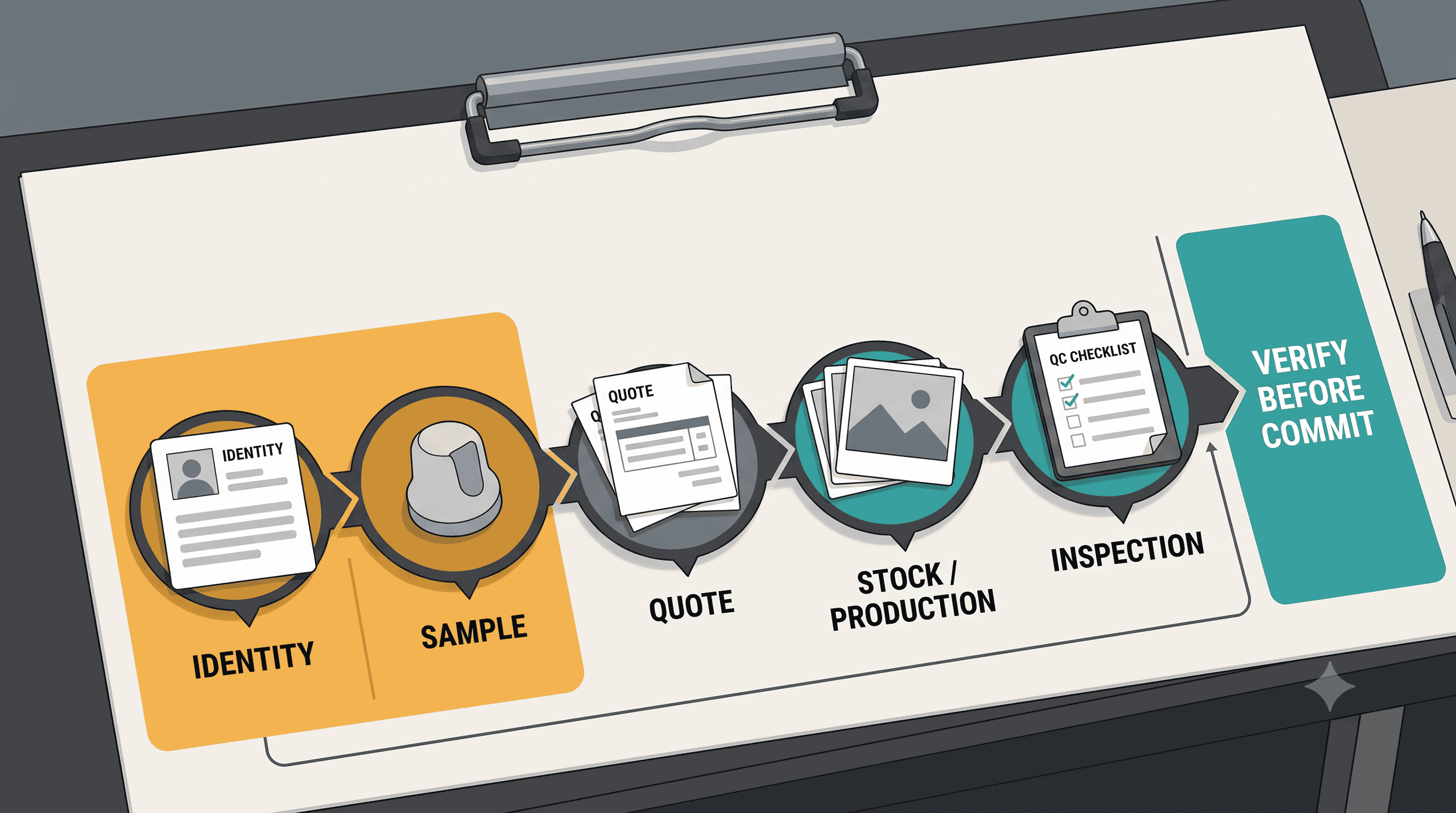
Whichever route you choose, the same early verification steps apply. They protect you from common mistakes without requiring deep China-side experience.
- Business identity. Business license, registered address, and a real contact method. Do not rely on WeChat-only contacts for first orders.
- Production or stock proof. For factories: short production video, recent production photos, license category that matches the product. For wholesalers and Yiwu booths: warehouse or booth photos, current stock list, and recent shipment record.
- Reference order. Ask for two or three overseas buyers you can contact, with their permission. If the supplier refuses every time, treat that as a red flag.
- Sample before bulk. Always order samples that match your destination-market spec. Compare 2–4 suppliers side by side before committing.
- Written quote. Include unit price, MOQ per SKU, payment terms, lead time, packaging, and what is not included (inspection, freight, customs, insurance).
- Sample consolidation plan. Decide in advance how you will receive, photograph, and compare samples from multiple suppliers. See our sample consolidation guide.
- Inspection plan. Decide who checks the bulk order before shipment — you, a third-party inspector, or a sourcing agent on your behalf.
These steps do not guarantee perfect suppliers, but they raise the floor of your supplier pool dramatically.
What This Article Does Not Do
To be honest about the limits of this guide:
- It does not name any specific factory, trading company, wholesaler, or Yiwu booth as recommended. Choosing suppliers depends on your product, your order, and your market, and we do not promote individual listings.
- It does not promise that one route always beats another. Each route has trade-offs, and the “right” route changes with your order.
- It does not invent MOQ figures, fee percentages, lead times, or pass rates. Those numbers vary by supplier and by season, and they should be confirmed in writing.
- It does not replace legal, tax, or customs advice for your destination market.
If you want help with a specific route, we can review your supplier shortlist, support your Yiwu trip, consolidate samples from several factories, or arrange pre-shipment inspection. The starting point is always your product, your order, and your destination market.
FAQ
Can a trading company give me factory-direct pricing?
Sometimes, but not always. A trading company that buys in volume or aggregates orders across buyers can approach factory pricing. A small trading company with no volume will add a margin. Ask for the price breakdown and confirm what the trading company actually does (negotiation, QC, consolidation, documents). Pricing transparency is the test, not the title.
Is a Yiwu booth cheaper than a factory?
Not always. Yiwu booth prices are usually higher per unit than factory-direct for the same SKU, but Yiwu booths allow smaller order sizes and mixed cartons. The real comparison is total landed cost for your specific order, not unit price alone. For very small orders, Yiwu may actually be cheaper after you factor in factory MOQ constraints.
Can I work directly with a factory if I do not speak Chinese?
It is possible, but slow and risky for first orders. Many factories rely on Chinese-speaking staff, and translation gaps cause spec errors. If you want a factory route without speaking Chinese, a small-scope bilingual contact (your own staff, a freelance translator, or a paid service) helps, but you still need a written spec and a sample to compare against.
What if the same product is sold by all four routes?
This is normal. The four routes often list the same product at different price points. The difference is the service layer around the product: factory route gives production visibility, trading company gives English and consolidation, wholesaler gives ready stock, Yiwu booth gives variety. Pick the route that matches the part of the order you cannot easily fix later.
How do I avoid counterfeit or imitation goods when using Yiwu or wholesalers?
Refuse to source any product that copies a protected brand, logo, character, or patented design. Ask for proof of authorization when in doubt. Use our supplier verification checklist and refuse orders that rely on imitation claims. Style Sourcing does not support counterfeit or imitation sourcing, regardless of route.
Do I need to verify the supplier even if the marketplace shows a “verified” badge?
Yes. Marketplace verification badges (Alibaba Gold Supplier, 1688 verified, etc.) are paid listing features, not independent quality audits. They confirm some basic identity and license checks, but they do not replace your own supplier verification, sample comparison, and pre-shipment inspection.
How Style Sourcing Can Help
If you are weighing routes for a real order, we can review your supplier shortlist, support your Yiwu trip, consolidate samples from several factories, or help you run pre-shipment inspection — depending on which stage you are in. Service scope, fees, and timing are confirmed per order. Send your product, supplier links, and target destination market if you want to discuss which route fits.


