
Factory-Ready Spec Sheet for China Sourcing: What to Lock Before You Ask for Samples
You sent the supplier a one-line brief — “we want a cotton tote, similar to the photo.” The first sample arrived close, but not close enough. The second sample fixed the fabric but changed the handle length. The third sample looked right but had the wrong logo position. Are you ready to pay for bulk yet?
You asked for “premium PU leather” — but the supplier’s idea of premium is not the same as yours. Will the bulk feel right, or will customers feel the difference?
You approved a sample in a WeChat voice note. Two weeks later, the bulk order arrives with a different stitch spacing, a darker lining, and a slightly smaller interior pocket. What evidence do you actually have?
Final inspection can catch some problems, but it cannot undo every decision made earlier. A clear specification gives the supplier and your inspection team the same reference before sampling and production.
A factory-ready spec sheet is a written document you send before you ask for samples. It locks the details that the supplier needs to quote accurately, the factory needs to produce correctly, and you need to verify against later. Without one, you are giving the supplier permission to guess.
This guide explains what belongs on a factory-ready spec sheet, why each item matters, and how to keep it realistic — without inventing tolerances, certifications, or lead-time claims the factory has not actually agreed to.
Quick Answer: What Goes on a Factory-Ready Spec Sheet Before You Ask for Samples?
Below is the minimum set of fields a serious spec sheet should cover. Each is explained in detail later in the article.
| Spec area | What to write down | Why it matters |
|---|---|---|
| Product identity | Product name, internal SKU, intended market, intended use | Stops confusion when the same product is reused across categories |
| Reference sample / photo | Link or photo of reference, photo of your inspiration, version date | Avoids “similar to the picture” arguments |
| Dimensions and tolerances | Length, width, height, weight, capacity, strap drop, key feature sizes | Prevents silent size drift in bulk production |
| Material and finish | Material name, grade, finish, color code (Pantone / supplier code), lining | Stops “premium leather” debates later |
| Hardware and components | Zipper, slider, buckle, snap, button, D-ring, thread, lining, foam | Hardware changes are easy to miss in supplier photos |
| Color and shade | Approved color, shade range, comparison swatch, lighting note | Gives the supplier and QC team a defined reference for color checks |
| Logo and artwork | File version, size, position, method (print / emboss / stitch / metal plate), color | Wrong logo ruins a brand’s presentation |
| Packaging | Polybag, tissue, insert card, hangtag, barcode label, unit carton | Wrong packaging fails retail compliance and shipping tests |
| Carton and master pack | Inner pack qty, master carton qty, dimensions, weight, marks | Prevents receiving chaos at the warehouse |
| Labels and compliance fields | Brand label, care label, country of origin line, barcode, RFID if any | Records the labels and buyer checks that still need confirmation for the destination market |
| Destination-market notes | EU / US / UK / AU destination, language, marking, recycling, materials rules | Records the buyer’s destination-market questions before the sample and packaging decisions are finalized |
| Inspection reference | Sample marked as reference, photo file, written approval date | Connects bulk QC back to your approved sample |
| Revision history | Date, what changed, who approved | Stops “the supplier changed it without telling me” arguments |
If a row is missing, the supplier may fill in the gap using its usual option. Write the decision down before sampling so you can compare the reply, the sample and the later production reference.
Why the Spec Sheet Stage Matters Before Sampling
Buyers often assume that quality is decided at final inspection. In reality, by the time bulk goods reach the inspection stage, most decisions are already baked in:
- The material was sourced months ago.
- The pattern was cut weeks ago.
- The logo file was sent in early production.
- The packaging was agreed before sampling.
If the spec sheet did not lock those decisions, the factory will follow the path of least resistance: whatever is fastest, cheapest, or most familiar to its production line.
This is not bad faith. Factories work to specifications. If you did not specify, they specified for you.
A factory-ready spec sheet does three things at once:
- It tells the supplier exactly what to quote against.
- It gives the production team exactly what to produce against.
- It gives your QC, warehouse, and receiving teams exactly what to compare bulk goods against.
When the supplier, production team and QC team reference the same document, it is easier to spot a change and decide whether to approve, correct or hold it. The document does not replace a sample or inspection.
Step 1 — Lock the Product Identity First

Before any spec row, the product itself needs a clear identity. Otherwise the supplier’s “quote team” and your “design team” may be talking about different things.
Include:
- Internal product name and SKU.
- Intended market (US, EU, UK, AU, JP, etc.) and language for any printed text.
- Intended use (retail, ecommerce, promotional, gift, corporate).
- Brief product description in one or two sentences.
This is also the moment to flag if the same product will be sold under multiple SKUs (color variants, size variants, packaging variants). If yes, list the variants explicitly before the first sample so the quote and sample reference are tied to the right version.
Step 2 — Pin a Reference Sample or Photo, Not Just Words
“We want a canvas tote like the one in the photo” leaves room for different interpretations. A dated reference set gives the supplier something specific to quote and sample against.
Words are not enough. A reference sample or a clear reference photo set is what the supplier will actually compare against. Pin it now, with a version date.
For each reference:
- One primary photo from the buyer (your design team or your own photos).
- One or two supplier reference samples if available.
- One annotated photo showing what you want and what you do not want.
Add a short note: “Match this reference for silhouette, fabric weight, handle length, and overall look. Match Pantone X for color.”
Step 3 — Lock Dimensions, Weight, and Capacity

Dimensions are the easiest place to lose accuracy in transit. Suppliers quote nominal sizes; production often drifts a few millimeters. Bulk can drift more.
Include:
- Outer dimensions (length × width × height) with units.
- Key feature dimensions (strap drop, handle length, pocket size, lid clearance).
- Weight target and tolerance band if your shipping plan depends on it.
- Capacity if relevant (liters, ml, kg load, fits-X-objects language).
Be honest about which dimensions are critical and which are flexible. If handle length is critical to your customer experience, say so. If width can flex ±5 mm, say that too. Factories will not volunteer that information.
Do not invent “±0.5 mm” tolerances you have not actually verified. Tolerance discipline comes from your QC standard, not from a number on a spec sheet. If you do not know the tolerance, write “to be confirmed with first sample.”
Step 4 — Specify Material, Grade, and Finish in Supplier Language

Material descriptions can drift between English, Chinese and supplier shorthand.
“We want soft PU leather” can mean ten different things to a factory. “We want microfiber PU with 1.2 mm thickness, peach-skin finish, color code Pantone 7527 C” gives the factory a much narrower target.
For each material, include:
- Material name in English and Chinese if you can.
- Grade or spec (e.g., 600D polyester vs. 300D; full-grain leather vs. split; 18/8 stainless steel vs. 201).
- Finish or surface treatment (matte, glossy, brushed, anti-slip, water-repellent).
- Color reference (Pantone, RAL, supplier’s own color card code).
- Source or supplier if you have a preference.
- Lining material, interlayer, foam, board — separately.
If you do not know the exact grade, ask the supplier for their standard option and write it down. Do not pretend to know a grade you have not actually verified.
Step 5 — Lock Hardware and Components Separately
Hardware is where many “looks right, but feels wrong” moments come from. A bag can be made with the right fabric and the wrong zipper pull. A water bottle can have the right capacity and the wrong lid thread.
For hardware and components, list them one by one:
- Zipper (size, brand if required, color, finish, locking/non-locking).
- Slider (auto-lock, non-lock, puller type, branded / unbranded).
- Buckle, snap, D-ring, rivet, magnetic button, hook.
- Thread (color, weight, bonded / unbonded).
- Interfacing, board, foam, lining.
- Feet, studs, protective corners.
- Carry handles, straps, webbings.
For each item, note the approved reference photo and the supplier code if available. If the factory is expected to source the hardware, ask them to send a hardware sample for your approval before bulk.
Step 6 — Specify Color with a Reference, Not a Description
Color disagreements cause more sample revisions than almost anything else. Three things cause the problem:
- The buyer and supplier see the same color under different lighting.
- Dye lots vary between sample and bulk.
- The supplier’s “available colors” do not include the buyer’s target color.
To reduce color disagreement:
- Send a Pantone / RAL code, not just a name.
- Send a physical swatch if your order is large enough.
- Specify lighting condition (D65 light box, daylight, indoor warm light).
- Approve a color card from the supplier, dated, with your signature or initials.
- For multi-color products, specify each color separately.
Do not promise color matches the buyer has not actually verified. If the supplier provides a color card, write down the card version and the date.
Step 7 — Lock Logo and Artwork Files With Version Numbers
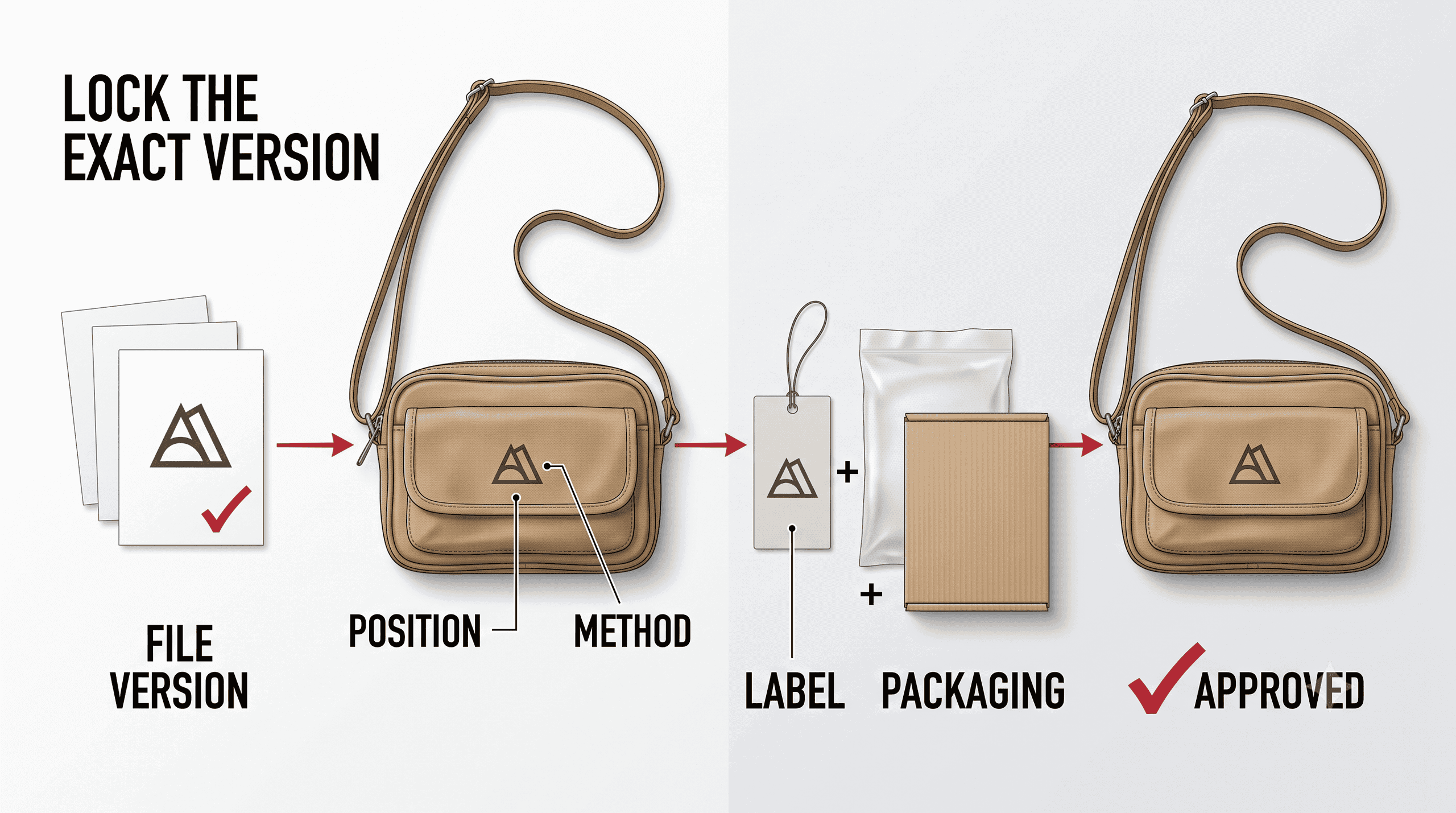
Logo drift is one of the most expensive mistakes in private-label production. It is also one of the easiest to prevent.
For each artwork file:
- File name and version (e.g., brand-logo-v3.ai).
- File format sent (AI, PDF, EPS, PNG).
- Size on product (width × height in mm).
- Position (center, left, top, distance from seam, distance from edge).
- Method (silkscreen print, embroidery, deboss, emboss, metal plate, woven label).
- Color (Pantone, thread color, plate color).
- Pantone match requirements (color match vs. close match).
- Mockup photo approved before sampling.
If the logo applies to more than one product position (e.g., front + back + inside label), list each position separately. The factory will not assume. If you want the inside label to match the front label, say so.
This is also the right place to mention if the brand name, tagline, or label text must be in a specific language (e.g., Japanese characters, French accent marks, Spanish ñ). Missing diacritics create legal and brand problems later.
Step 8 — Define Packaging at the Unit and Carton Level
Packaging is often an afterthought — until bulk arrives and the inner bag is the wrong size, the insert card is missing, or the master carton is too tall to stack.
For each unit:
- Polybag (size, material, thickness, suffocation warning if for US retail).
- Tissue paper, insert card, brand card, hangtag.
- Dust bag, gift box, magnetic box, sleeve — depending on product tier.
- Barcode sticker position and orientation.
- Country-of-origin line and required language.
For each inner pack and master carton:
- Inner pack quantity (e.g., 6 pcs per inner bag).
- Master carton quantity (e.g., 24 pcs per master carton).
- Carton dimensions and weight (filled).
- Carton marks: SKU, color, quantity, size, carton number, destination, handling marks.
- Shipping marks and palletization plan if relevant.
If your destination market requires specific label language (e.g., French for France, German for Germany), include that here. Customs and retail teams often reject products because the language is missing — not because the product is bad.
Step 9 — Add Destination-Market Notes, Not Legal Conclusions
Compliance is its own deep topic, and Style Sourcing is not a legal advisor. But the spec sheet is the right place to record what the buyer has decided about their market — not what a regulator has decided for them.
Include only the facts the buyer knows and has confirmed for their specific product and destination:
- Destination market(s).
- Required label language.
- Materials restrictions the buyer is aware of for their product category.
- Recycling / packaging marks they have decided to add (e.g., CE, recycling triangle, FSC mark for paper packaging).
- Any product-specific test reports the buyer has asked for or already has.
Do not invent CE, FCC, REACH, FDA, CPSIA, UKCA or other compliance claims you have not actually verified. If a test report is required, the buyer or a qualified lab should confirm what test and which standard.
Step 10 — Connect the Spec Sheet to Your Inspection Reference

The spec sheet only works if the inspection team uses it too. The cleanest way to do that is:
- Mark one sample as the reference sample.
- Photograph it from multiple angles in the same lighting.
- Save the photos and the spec sheet in one folder.
- Reference the spec sheet version in every inspection order.
When bulk arrives, the inspector compares bulk photos against the reference photos and the spec sheet rows. If the spec sheet said “thread color: Pantone 19-4052” and the bulk shows a different thread color, the inspector can flag it without guessing.
Without that chain, sample approval and bulk inspection are two unrelated conversations.
Step 11 — Keep a Revision History
Every spec sheet needs a revision history. Even small changes (“logo color one shade darker”, “stitch spacing 4 mm instead of 5 mm”) should be logged with:
- Date of revision.
- What changed.
- Who requested the change.
- Who approved the change on the buyer side.
- New spec sheet version number.
Many sample-to-bulk disputes begin with a small change that was not recorded. A revision history gives the buyer and supplier a shared record to check.
Realistic Limits of a Spec Sheet (Read This Before You Send It)
A spec sheet cannot do everything. Honest limits include:
- It cannot replace a physical sample. The first sample is still the moment the supplier’s interpretation becomes visible.
- It cannot force a factory to deliver what it cannot produce. If the supplier does not have the right machine, your spec sheet does not change that.
- It cannot remove the need for sample consolidation. Comparing 2–4 suppliers’ samples in one place still finds differences no spec sheet can predict.
- It cannot prevent every communication error. WeChat, email, machine translation, and time zones all introduce noise.
- It cannot guarantee that bulk production matches the sample perfectly. Inspection and warehouse receiving still matter.
The spec sheet is a starting control, not a substitute for the rest of the workflow. It makes supplier conversations easier to compare, but samples, inspection and receiving checks still matter.
Spec Sheet Checklist — Ready-to-Use Quick Reference
Below is a condensed version you can copy into a working document.
Product identity
- Product name / internal SKU: ___
- Intended market: ___
- Intended use: ___
- Variants (color / size / packaging): ___
Reference
- Primary reference photo / sample: ___
- Secondary reference: ___
- Reference version / date: ___
Dimensions & weight
- Outer L × W × H: ___
- Key feature sizes (handle, strap, pocket): ___
- Weight target: ___
- Critical vs flexible dimensions: ___
Material & finish
- Main material (English + Chinese if possible): ___
- Grade / spec: ___
- Finish / surface treatment: ___
- Color reference (Pantone / RAL / supplier code): ___
- Lining / interlayer: ___
Hardware & components
- Zipper / slider: ___
- Buckle / snap / D-ring / rivet: ___
- Thread: ___
- Other: ___
Color
- Pantone / RAL code: ___
- Lighting reference (D65 / daylight): ___
- Color card version / date: ___
Logo & artwork
- File name & version: ___
- File format sent: ___
- Size on product (mm): ___
- Position description: ___
- Method (print / embroidery / emboss / plate / woven): ___
- Color (Pantone / thread): ___
Packaging
- Unit polybag: ___
- Tissue / insert / hangtag / box: ___
- Inner pack qty: ___
- Master carton qty: ___
- Master carton marks: ___
Labels & compliance
- Brand label: ___
- Care label: ___
- Country-of-origin line: ___
- Barcode position: ___
- Destination label language: ___
Destination-market notes
- Confirmed destination(s): ___
- Required marks / recycling icons: ___
- Buyer-confirmed test reports (if any): ___
Inspection reference
- Reference sample marked? Y/N
- Photo file location: ___
- Spec sheet version used for approval: ___
Revision history
- v1 (date, changes, requestor, approver): ___
- v2 (date, changes, requestor, approver): ___
- ...
This is not a finished document. It is a starting structure. Adjust the rows to your product and your market.
FAQ
Do I really need a spec sheet if I only have one product and one supplier?
Yes. With one supplier, the document gives you a written reference for checking whether the first quote and sample match your brief. You can then record any changes before approving the next version.
What if the supplier cannot meet my spec?
You have three honest options: revise the spec to what the supplier can actually produce, switch to a supplier that can meet the spec, or accept a partial match with a written risk note. Pretending the spec was met when it was not is the most common cause of disputes later.
How detailed should the spec sheet be?
Detailed enough that two strangers reading the same spec would produce the same product. That usually means a few pages for simple products, longer for multi-component products. A spec sheet that fits in one paragraph is rarely enough.
Do I need a spec sheet if I am only buying stock from a wholesaler?
Stock orders still benefit from a short product spec: SKU, color code, size, packaging, and any destination-market label rules. Wholesale SKUs change without notice, and a written spec gives you a comparison point when the supplier ships “the same model.”
Can the spec sheet replace a sample?
No. The spec sheet tells the supplier what to make. The sample tells you whether the supplier understood. When you have several suppliers, compare their samples side by side using our sample consolidation workflow.
Should I send the spec sheet in English or Chinese?
English is fine if your supplier’s contact reads English. If your supplier is a factory with limited English, send both — and ask them to confirm in writing that they understood the spec, not just that they received it.
What about patent, trademark, and design protection?
Do not include any spec that copies a protected brand, design, character, or patented invention. Style Sourcing does not support counterfeit or imitation sourcing. If you are unsure, talk to a qualified IP advisor in your destination market before sampling.
How Style Sourcing Can Help
If you want a second pair of eyes on your spec sheet before you send it to suppliers, we can review the document against our sample-stage workflow and flag missing fields. We can also consolidate samples from several factories so you can compare versions of the same product in one place. Service scope, fees, and timing are confirmed per order; send your product category, target market, and a draft of your spec sheet if you would like to discuss support.


