
Quick answer: For a covered EU distance-sale consignment from outside the EU with an intrinsic value of €150 or less, prepare the product and declaration data before dispatch. The temporary €3 duty began on 1 July 2026, PIDs can be supplied voluntarily from that date, and PID declarations become mandatory from 1 November 2026. The exact duty effect depends on the declaration type and how goods are grouped by classification, so do not treat €3 as a universal per-parcel charge.
The practical question for a China-side seller or sourcing buyer is not “Who pays a €3 fee?” It is: which product identifiers and shipment fields must reach the declarant, who validates them, and where is the handoff recorded?
The change is not theoretical. Council Regulation (EU) 2026/382 and the implementing acts published in the Official Journal of the EU on 8 June 2026 set a hard date for covered distance-sale consignments moving from non-EU origins to EU consumers from 1 July 2026 onward. The former duty exemption no longer applies by default to a €149 distance-sale order. The temporary replacement is a €3 duty per item as defined by tariff classification, subject to the scope and exclusions in the Commission guidance, plus a separate Product Identifier (PID) timeline.
This guide is not a tariff calculator. It is a workflow for the data that has to move between the supplier, the seller, and whoever actually files the customs declaration. We will use the European Commission’s own guidance as the source, keep EU VAT, IOSS, and customs broker scope out of the equation, and stay on the question a Style Sourcing buyer can actually answer pre-shipment: what fields do I capture, where do they go, and where does the responsibility stop with me?
EU Low-Value Imports 2026: Quick Answer
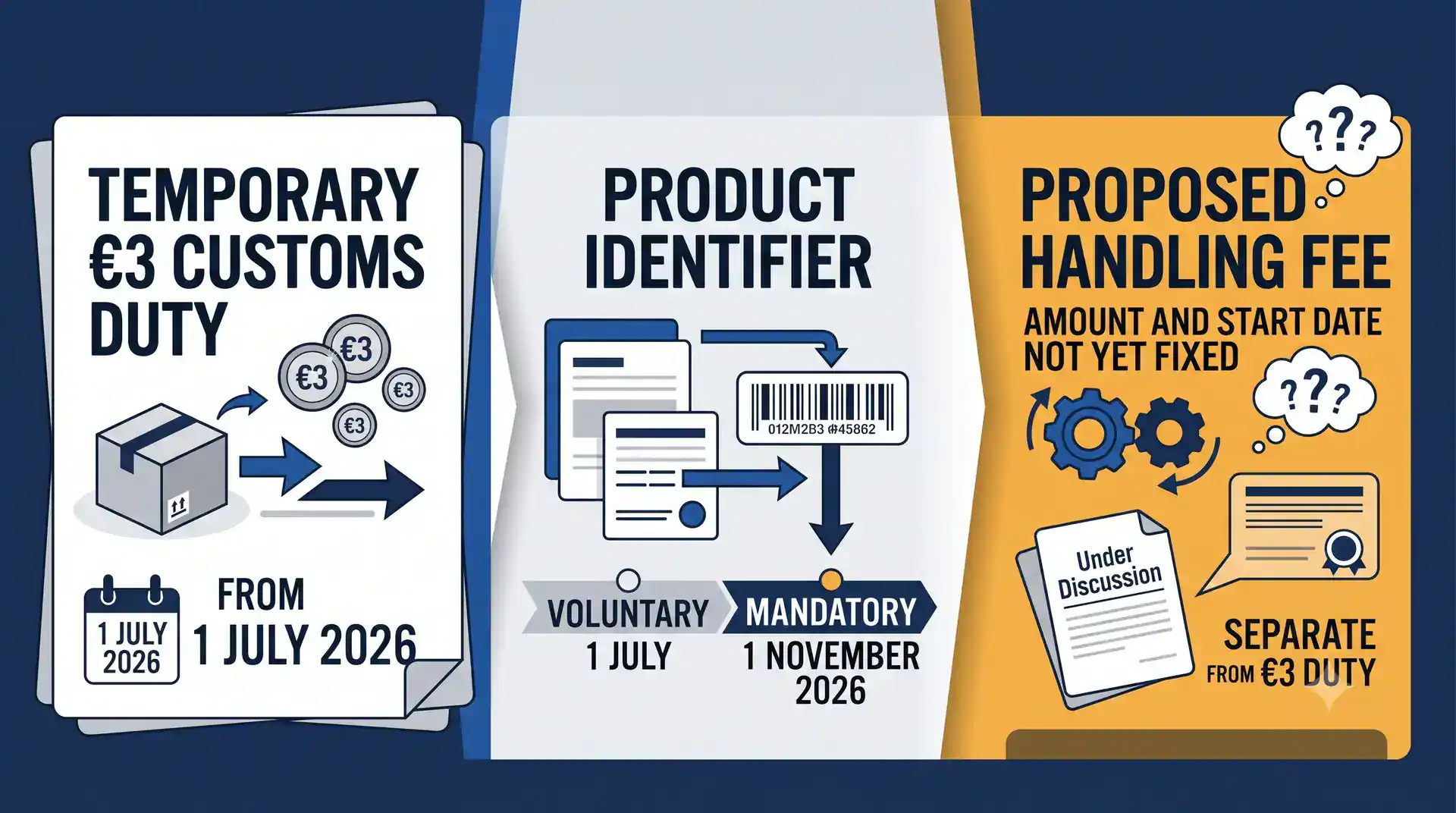
| Element | Status before 1 July 2026 | Status from 1 July 2026 | Status from 1 November 2026 | Source |
|---|---|---|---|---|
| Customs duty for distance-sale consignments ≤ €150 | Duty-free under the de minimis exemption | Temporary flat €3 customs duty per item (per tariff classification, not per parcel) | Same temporary €3 duty | EC guidance, 2026-06-08 |
| Product Identifiers (PIDs) | Not required | Voluntary declaration possible | Mandatory declaration | EC guidance, 2026-06-08 |
| Proposed Union handling fee | Not applicable | Separate from €3 duty; amount and start date in autumn 2026 to be determined | Same — separate from €3 duty | EC guidance, 2026-06-08 |
| Application horizon | Permanent until replaced | Temporary measure | Temporary measure | Until 1 July 2028, then normal customs duties apply |
That table is the frame. The rest of this article is about operationalising it on a real shipment.
What the €3 Temporary Customs Duty Actually Covers
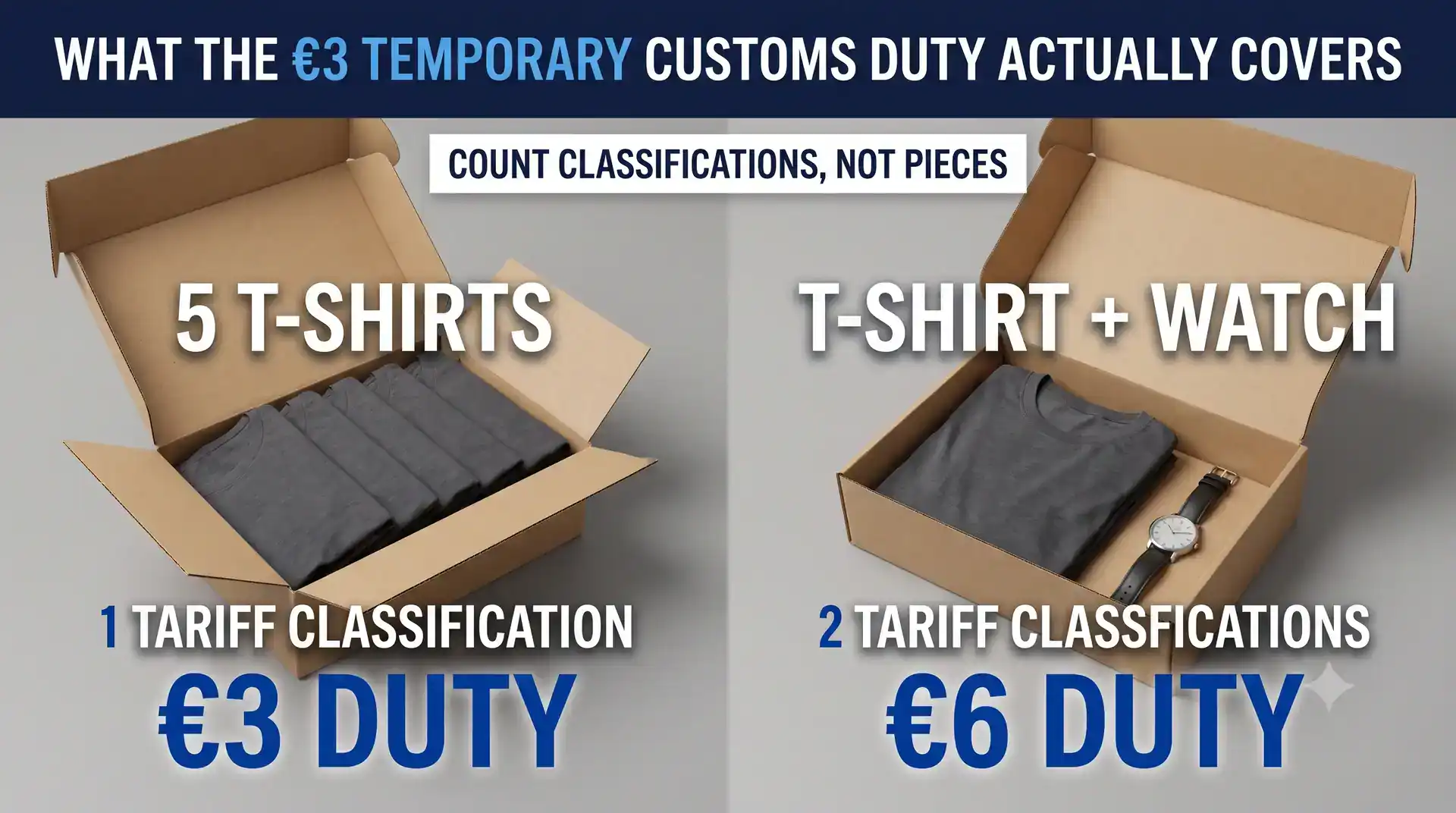
The €3 amount is a customs duty, not the proposed handling fee. It replaced the former duty exemption for covered distance-sale consignments up to €150 from 1 July 2026.
One important correction to the usual “€3 per item” shorthand: the practical charge follows the declaration line and the classification level available to the declaration type. The European Commission’s Access2Markets explanation distinguishes H6, H7 and H1 declarations: H6 uses CN-level grouping, H7 uses HS-level grouping, and H1 uses 10-digit TARIC classification with separation by description and origin. A mixed shipment can therefore produce a different total depending on the declaration route. Treat the examples below as an operational prompt for your declarant, not as a tariff calculation.
| Example | Declaration | Classification detail | Illustrative duty |
|---|---|---|---|
| Three goods share the same HS code but have different TARIC codes | H6 | CN-level grouping applies | €3 for one declaration line |
| Three goods share the same CN code but have different TARIC codes | H7 | HS-level grouping applies | €3 for one declaration line |
| Three goods have separate TARIC classifications | H1 | 10-digit TARIC, description and origin separation | €9 for three declaration lines |
These examples come from the Commission’s 30 June 2026 Access2Markets explanation. Confirm the declaration type, classification and line treatment with the party filing your shipment. Do not forecast landed cost from parcel count alone.
Three further points matter before you plan the data:
- The duty is attached to the customs declaration. The seller, importer, IOSS holder, special-arrangements user, indirect representative or, in limited cases, another permitted declarant may carry the responsibility. Confirm the actual declarant for the specific consignment.
- It is paid by the declarant. The EC guidance lists the seller or importer, IOSS holder, special arrangements user, or an indirect representative among the possible declarants. Confirm the actual role for the consignment in writing.
- It is non-discriminatory. The cited guidance says the duty applies regardless of the goods’ origin or the logistics operator handling the parcel.
The €3 duty is explicitly separate from the proposed Union handling fee. The Commission pages cited below describe the handling fee as a separate measure whose amount and application date were still under discussion at the time of the cited updates. If a quote includes another “fee” or “service charge,” ask the provider to identify it instead of labeling it as the €3 duty.
This article stays on the data capture and declarant handoff side. We will not calculate landed cost, recommend a customs broker, or advise on VAT registration. Those depend on your business structure, your VAT scheme, and your Member State.
Product Identifiers: What Changes on 1 July and What Changes on 1 November 2026
The PID is the second operational element of the EC’s reform. Its purpose is traceability: customs authorities will use it to detect and block unsafe or non-compliant goods that arrive under the low-value regime.
The dates are deliberate and sequential:
- From 1 July 2026, PIDs can be declared on a voluntary basis. Use that period to ask the platform or declarant what identifier format and supporting product fields they require; the Commission page does not promise faster processing for voluntary declarations.
- From 1 November 2026, PIDs become mandatory. The Commission page says the change is intended to improve traceability and safety checks, but it does not specify a universal consequence, processing time, or clearance outcome for a missing or disputed PID.
The June 2026 DG TAXUD news page gives the timeline, while the Commission’s 30 June 2026 Access2Markets explanation sets out the operational identifier codes. From 1 November 2026, the product information must reach customs through the import declaration’s Supporting documents data element. The codes described there are:
| Code | Identifier | Operational meaning |
|---|---|---|
| C127 | Merchant product identifier (M-PID) | Assigned by the online seller, marketplace or platform; mandatory in all cases described by the source. |
| C128 | Non-standardised manufacturer identifier (NS-PID) | Assigned by the manufacturer, producer or product supplier; mandatory in all cases described by the source. |
| C129 | Standardised manufacturer identifier (S-PID) | Use where it exists, such as an EAN, ISBN or another standardised identifier. |
| Y081 | Exception | Declare that no standardised identifier exists when the S-PID is unavailable. |
This is more specific than a generic “SKU” instruction, but it still does not turn the article into a customs filing guide. Your platform, forwarder or declarant must confirm how these codes are implemented in the declaration system used for the shipment. Keep the source product record and the identifier handoff together.
What the China-side supplier or sourcing team should prepare:
- Capture merchant and manufacturer identity: the seller or platform identifier, the factory or manufacturer identifier, GTIN/EAN or other standardised identifier when available, model number, photo reference, and a description that identifies the product by material, function and intended use.
- Capture classification support: material, function, origin and the description your declarant needs to map the product to the relevant customs classification. Do not invent an HS/CN/TARIC code when the responsible declarant has not confirmed it.
- Capture the handoff record: which party supplied each identifier, who validated it, when it was transmitted, and how a missing S-PID or rejected field is corrected.
The voluntary window is a preparation period. Even if you do not declare a PID immediately, having a clean product record makes it easier to answer the declarant’s format questions before the mandatory date. That is an operational benefit, not a promise of faster customs processing.
Who the “Declarant” Really Is for a Low-Value Consignment
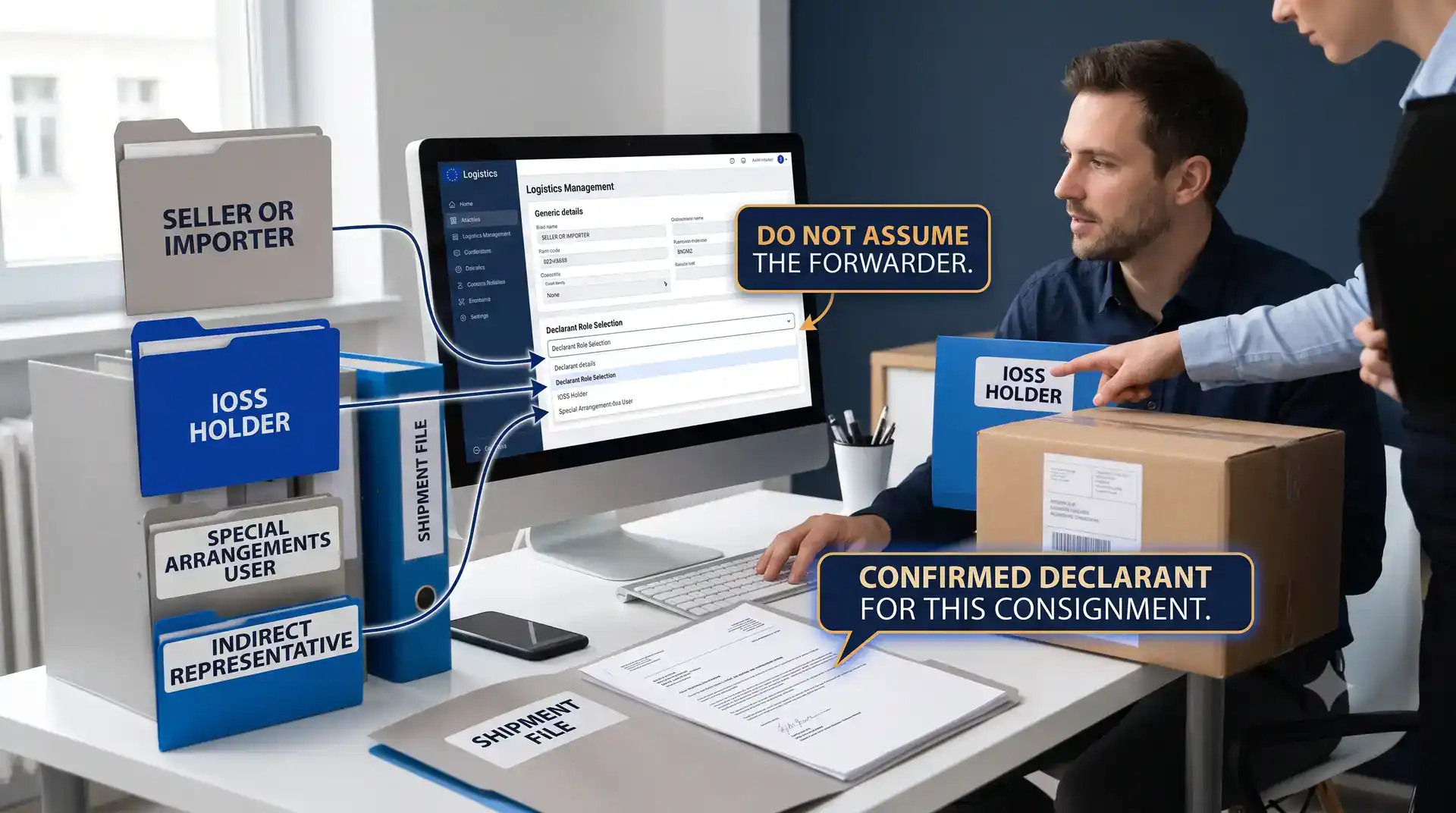
For distance-sale consignments under €150, the EC guidance defines the declarant as one of:
- the seller or importer of the good,
- the IOSS holder,
- the special arrangements user,
- their indirect representative, or
- the indirect representative of the importer.
The phrasing matters because job titles do not settle legal responsibility. A freight forwarder, marketplace, IOSS intermediary, or customs representative may perform part of the filing workflow, but the declarant role for a specific consignment depends on the actual arrangement and the applicable procedure. Confirm that role in writing with the party filing the declaration rather than inferring it from who booked the freight.
What you need pre-shipment is a written record of three things:
- Who is the declarant for this consignment? Is it you, the IOSS intermediary, your platform, or your indirect representative? Confirm this in writing for the specific order.
- Who supplies the data the declarant will use? If the declarant is you, the data is yours to provide. If the declarant is a platform or intermediary, the data flow has to be defined in advance.
- What happens if a PID is rejected? Member State practice will differ, and your forwarder will know the local handling — but the responsibility for fixing the data sits with the declarant, not the carrier.
If you cannot answer question 1 before the goods ship, the consignee, the carrier, and the customs authority will each fill in the answer differently. That is how low-value consignments end up blocked at the border.
A Practical Capture Workflow: Supplier → Seller → Declarant
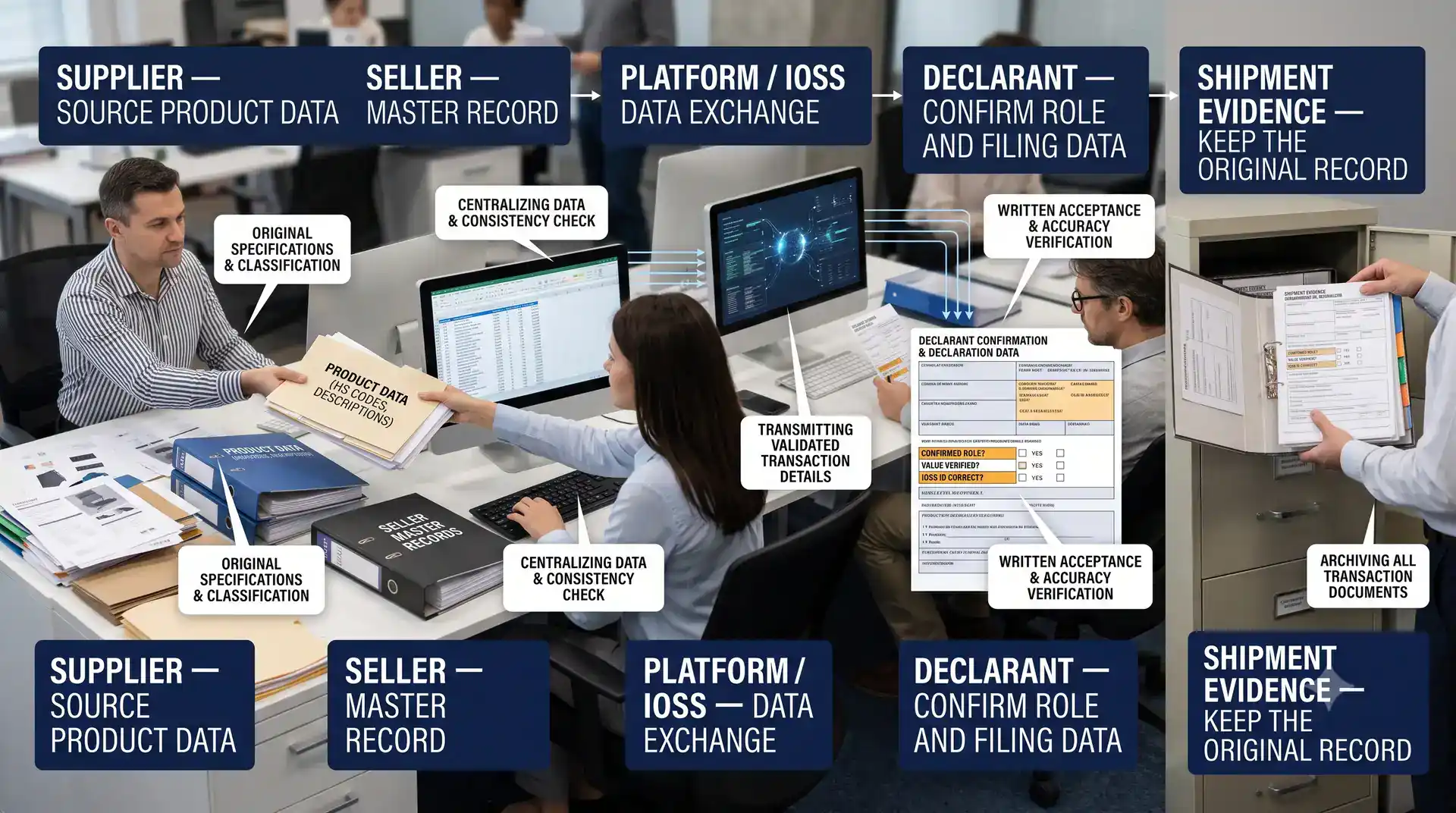
The data capture is the part you control. The declaration is the part your declarant controls. The handoff is the part you have to design.
A workable capture workflow has five steps. They are described for a seller’s own operations; if you use a sourcing agent or a trading company, treat the agent as the “supplier” step and adjust the data field ownership accordingly.
- At the supplier side, capture for every SKU that may ship under the low-value regime: SKU or factory code, product description (functional, material, intended use), composition, stated country of origin, brand status, dimensions, weight, and packaging unit. Product-specific compliance records belong in a separate destination-specific file and must be verified for the actual product; the Commission page does not provide a universal certificate checklist.
- At the order side, capture the consignment-level fields: total intrinsic value, currency, quantity per SKU, total items by tariff classification (the EC’s illustrative example is 5 T-shirts = 1 item, 1 T-shirt + 1 watch = 2 items), recipient name and address, and seller identity in the EU.
- At the declarant handoff side, capture the chain of custody: which party provides what data, who validates it, what timestamp the handoff happens at, and how corrections flow back if a field is rejected. Put this in writing with your declarant before the first shipment under the new rules.
- At the carrier or declarant side, capture the consignment tracking number, carrier name, mode (postal or express), planned EU entry point, and the party filing the declaration. The Commission guidance recognises that a carrier or agent can be the declarant in some workflows, so do not assume that the transport booking alone settles responsibility.
- At the audit side, keep the consignment record for the period your Member State and your platform require. If a customs authority queries a consignment three months after delivery, you need to be able to show the original data set, not a re-created one.
Keep the identifier packet with the shipment record. The order of these steps is the order in which errors compound. A weak description at step 1 can feed an incorrect classification assumption at step 2 and an inconsistent declarant data set at step 3. Correcting the source record before shipment is usually more controlled than reconstructing it later, although the Commission page does not state a universal processing consequence.
Checklist: Fields to Capture Before the Goods Leave the Origin Warehouse
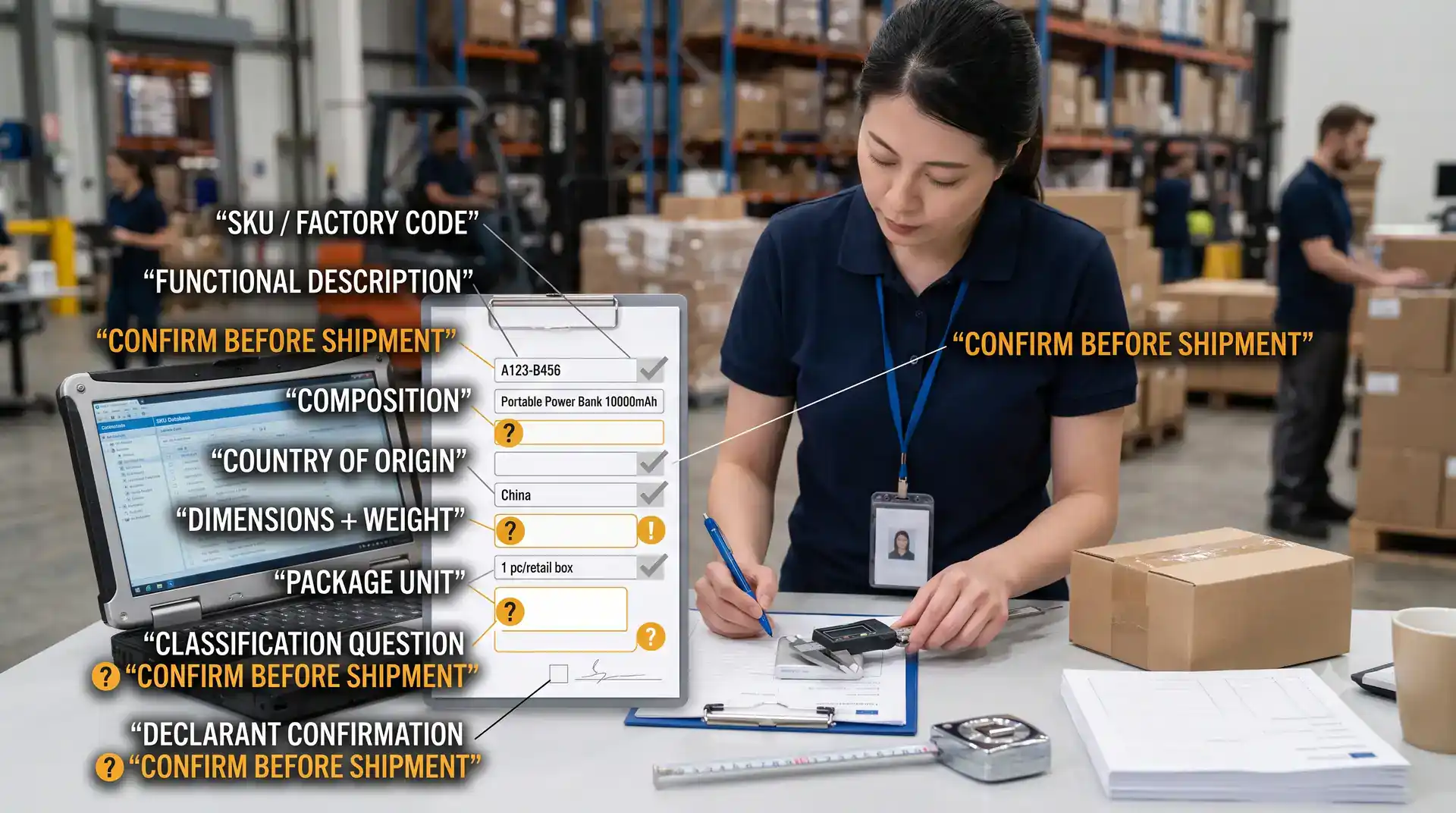
Use this as the minimum data set to have ready before the first consignment under the new rules. It is a starting point, not a complete customs declaration. Member State practice will add fields we cannot list from the EC guidance alone.
| Layer | Field | Why it matters | Source |
|---|---|---|---|
| Product | SKU / factory internal code | Backbone identifier for PID mapping | Supplier |
| Product | Functional description (material, function, intended use) | Maps to tariff classification, which is the unit of duty | Supplier |
| Product | Composition / material breakdown | Required for many product categories in EU customs and product safety | Supplier |
| Product | Country of origin | Affects whether preferential treatment can apply | Supplier |
| Product | Brand / trademark status | Customs will check intellectual property rights | Supplier |
| Product | Destination-specific compliance record reference, when applicable | Keeps product-compliance evidence separate from the PID and tariff data | Seller + qualified compliance adviser |
| Consignment | Intrinsic value per item, currency | Defines whether the consignment is in the ≤ €150 regime | Order side |
| Consignment | Quantity per SKU and number of distinct tariff classifications | Determines €3 vs €6 vs €9 duty for the consignment | Order side |
| Consignment | Recipient name and address | Customs declaration field | Order side |
| Consignment | Seller or EU importer identity | Customs declaration field | Order side |
| Declarant | Declarant identity for this consignment | Determines who has legal responsibility | Pre-shipment written confirmation |
| Declarant | Data handoff timestamp | Audit trail for PID completeness | Declarant + seller |
| Carrier | Mode (postal / express / other) and planned entry point | Routing for customs authority assignment | Carrier |
| Audit | Consignment record retention period | Aligns with Member State and platform requirements | Legal + platform |
If any of these fields are missing before the goods leave the origin warehouse, mark the record incomplete and ask the declarant which missing items are material to the filing. Do not fill gaps with assumptions or predict a customs outcome.
Bounded Failure Scenarios
Failure scenarios for EU low-value imports are not catastrophic by default, but they are common. We list four that recur in real consignments, with the operational lesson each one teaches.
Scenario 1 — “The supplier description is wrong, the duty doubles.” A supplier lists a mixed carton of watches and bracelets. At customs, the watch and the bracelet fall under different tariff headings. The duty is €6, not €3. The carton count is not the unit; count distinct tariff classifications when you forecast the temporary duty.
Scenario 2 — “The PID is voluntary, so we skip the preparation.” A seller treats the July voluntary period as irrelevant and reaches the November mandatory date without knowing which identifier format its platform or declarant expects. Use that window to map data and responsibility instead of assuming every platform will use the same format.
Scenario 3 — “The forwarder must be the declarant.” A seller assumes that the company arranging transport also carries the declarant role. The Commission guidance lists several possible declarants. Put the actual role in writing for the consignment; a freight booking alone does not settle it.
Scenario 4 — “The €3 duty is treated as a handling fee.” A seller is quoted a “€3 charge per order” and assumes it is the EC’s customs duty. Ask the provider to identify every line item. The temporary €3 duty and the proposed Union handling fee are separate measures, and the cited June guidance had not yet fixed the latter’s amount or start date.
FAQ
Does the €3 duty apply to all consignments under €150?
It applies to distance-sale consignments of imported goods with an intrinsic value up to €150, regardless of VAT scheme (IOSS, Special Arrangements, or standard VAT). Goods benefiting from preferential trade agreements or Customs Union measures are excluded where the VAT has not been collected using IOSS and the goods are declared in H1. This is the scope from the EC’s June 2026 guidance; the practical effect on a specific consignment depends on its goods, its origin, and its VAT treatment.
Is the proposed Union handling fee the same as the €3 duty?
No. The €3 figure is a temporary customs duty. The proposed Union handling fee is a separate charge intended to cover customs processing costs; the EC’s June 2026 guidance describes the amount and the date it will start applying as still to be determined in autumn 2026. Treat them as two separate items in any forwarder quote.
Who is the declarant for my consignment?
In the EC guidance, the declarant for a low-value distance-sale consignment is the seller or importer of the good, the IOSS holder, the special arrangements user, or their indirect representative — and only in very residual cases, the consumer (where a Member State offers a free web-based declaration system). Confirm who acts as declarant in your specific order in writing before the goods ship.
When does the PID become mandatory?
The EC guidance states that PIDs can be declared on a voluntary basis from 1 July 2026 and become mandatory from 1 November 2026. The Access2Markets explanation also identifies C127, C128, C129 and Y081 in the Supporting documents data element. Ask your declarant which codes and supporting records apply to your shipment before the mandatory date.
Will this affect my Amazon FBA inbound to an EU fulfilment centre?
That depends on whether your Amazon FBA shipment is treated as a distance-sale consignment at the moment of EU customs clearance. The EC guidance is structured around distance sales to consumers; B2B shipments to EU-based warehouses may follow a different customs procedure and a different data set. Confirm with your forwarder, your customs broker, or Amazon’s EU compliance team for your specific case.
Is there a single EU-wide landed-cost calculator for these consignments?
No. The €3 duty is a customs duty on the consignment; VAT, the proposed handling fee, carrier charges, and any platform fees are separate items that depend on the consignor, the consignee, the carrier, and the Member State. A single landed-cost calculator would require inputs that vary by consignment and are not in the EC’s guidance.
Will the temporary €3 duty disappear after 2028?
The EC guidance describes the temporary €3 customs duty as applying until 1 July 2028, after which normal customs duties will apply, depending on the type of good. The EU Customs Data Hub for e-commerce is scheduled to become operational around the same date. The post-2028 framework is not yet finalised in the guidance we have read.
Sources and limits
This article was checked against the European Commission’s public materials available for the 2026 measures:
- Access2Markets: EU applies €3 customs duty per item on low-value e-commerce consignments (2026-06-30) — declaration-line examples, H6/H7/H1 classification detail, and PID codes C127–C129/Y081.
- DG TAXUD: Guidance and legal text on the temporary flat fee (published 2026-06-08; page last updated 2026-07-20) — scope, dates and distinction between the €3 duty and the proposed handling fee.
- DG TAXUD temporary €3 customs-duty guidance PDF — use the current official document when checking declaration practice.
Rules and implementation details can change. This article is a pre-shipment data-handoff checklist, not legal, VAT, broker, tariff, or customs-clearance advice. Confirm the declaration route and the fields required for your specific product, destination and operator before dispatch.
How Style Sourcing Can Help
If you sell to EU consumers and your supplier or platform is preparing the data set, we can help you build the SKU-level capture fields your declarant will need, review the consignee and seller fields against the EC’s published guidance, and flag the points where the EC’s wording is silent and where Member State practice will differ. We do not provide customs clearance, tax, or VAT registration advice. The starting point is always your product, your destination market, and the channel you actually sell on. Send your product list and the EU entry point you are considering if you want to discuss the handoff.


