
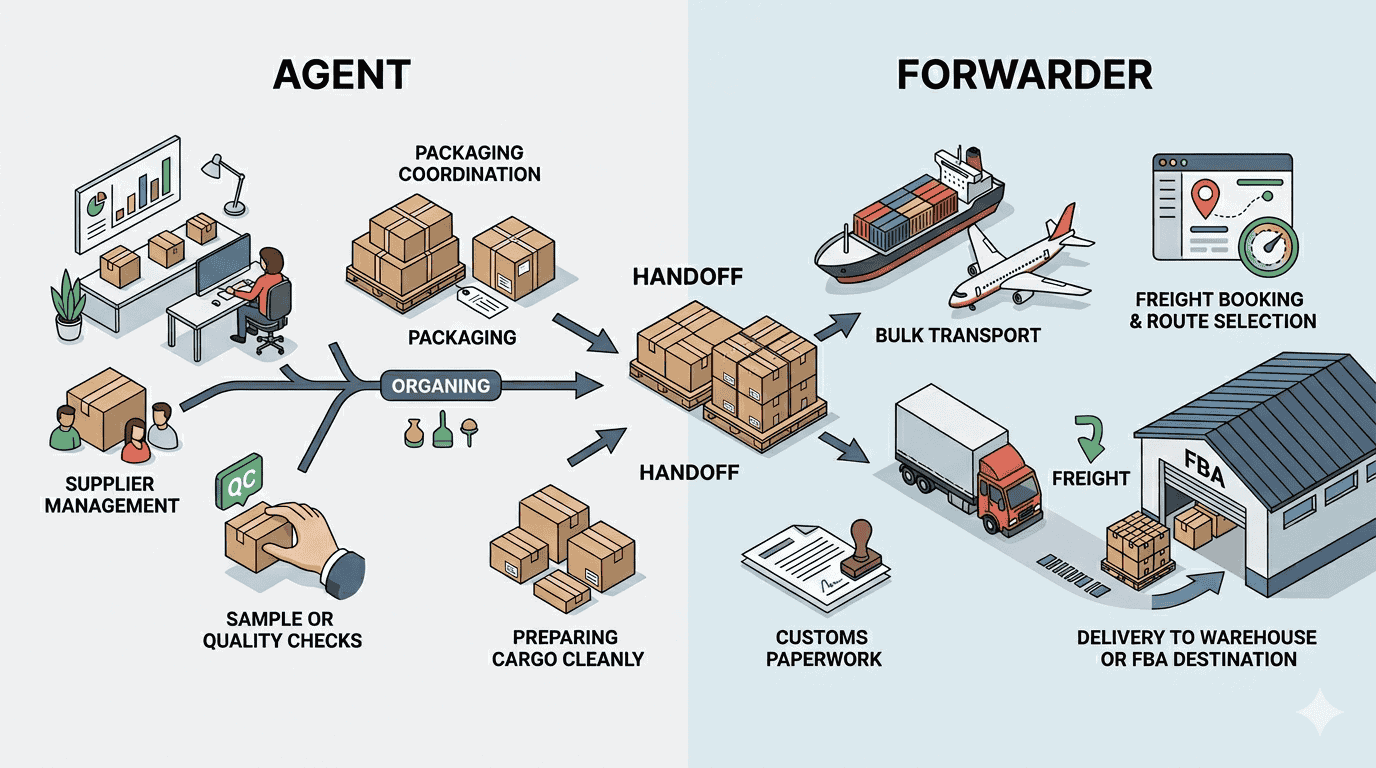
The short answer: use a dropshipping agent for the China-side product and order workflow; use a freight forwarder for the international cargo movement named in its quote or contract. The handoff is not complete because someone says “the goods are ready.” It is complete when the cartons, documents, booking reference and open exceptions all have named owners.
That is more useful than asking which provider is “better.” If the sample, packaging or order data is still moving, a forwarder cannot repair the product workflow. If the cartons are ready but nobody has booked pickup or checked the shipment data, an agent alone may not be enough.
One practical warning: provider names are not scope documents. Some agents arrange freight through partners; some forwarders offer warehousing, packing or other logistics add-ons. Ask what is actually included before you pay.
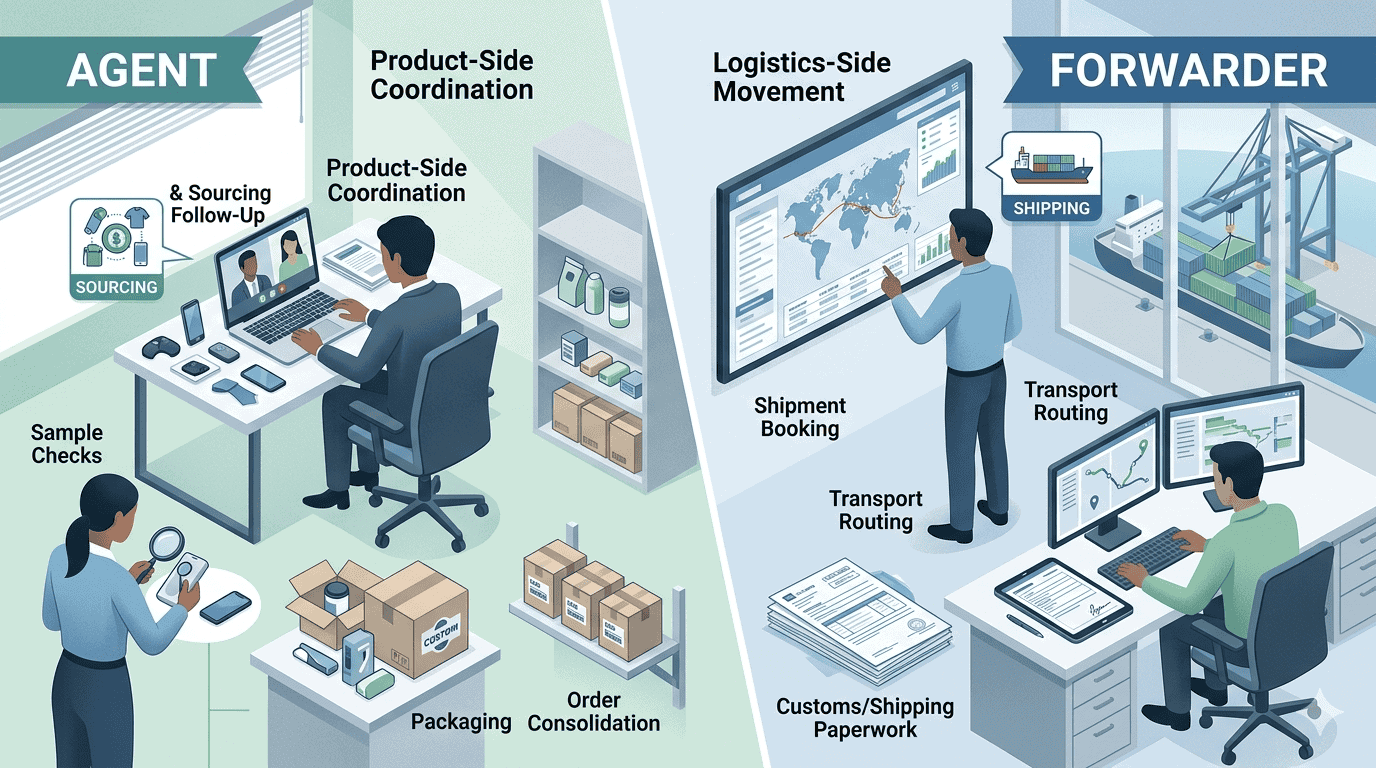
Dropshipping Agent vs Freight Forwarder: Responsibility at a Glance
| Workstream | Dropshipping agent / China-side operations role | Freight forwarder / transport role | Buyer must confirm |
|---|---|---|---|
| Supplier and product | Supplier communication, sample/specification follow-up, packaging instructions and order exceptions when included in scope | Usually relies on cargo and document data supplied by the shipper or buyer | Who approves the final product and packaging version? |
| Goods receiving and consolidation | May receive, count, sort or combine goods when the agreed workflow includes a China warehouse | May arrange pickup, consolidation, storage or handling as transport-related services | Who issues the receiving record, and what does it prove? |
| Quality check | Can coordinate a written product/QC check when specifically agreed | Inspection is not automatically included just because a company handles freight | What will be checked, by whom, and against which reference? |
| Cargo-ready data | Provides or coordinates carton count, weight, dimensions, packing list, commercial data and pickup contact | Uses the final data to plan pickup, routing, booking and documents | Who signs off changes after the quote or booking? |
| International transport | May coordinate with a forwarding partner but should state who holds the transport contract | Arranges the agreed carriage, routing and transport handoffs | Is the quote port-to-port, door-to-door or another defined scope? |
| Customs handoff | Helps make supplier-side product and commercial information available | May coordinate with customs specialists, depending on lane and contract | Who is the importer, who files the entry, and who answers data questions? |
| Exception ownership | Product, supplier, packaging and China-warehouse exceptions within scope | Pickup, booking, transport-document and cargo-movement exceptions within scope | Who decides, who pays and who records the change? |
What a Dropshipping Agent Should Own
In this comparison, “dropshipping agent” means the China-side operator that supports product and order execution. The exact scope varies, but it may include:
- communicating product specifications and approved changes to suppliers;
- coordinating samples, labels, inserts and packaging references;
- receiving goods from one or more suppliers and recording shortages or visible damage;
- coordinating a written QC scope rather than promising a vague “quality check”;
- preparing products or parcels for the agreed fulfillment route;
- providing cargo-ready data and a clear warehouse/pickup contact to the forwarder;
- owning unresolved supplier, packaging or product exceptions before release.
A dropshipping agent is not automatically the importer of record, customs broker or international carrier. If the same company sells those services, ask which legal entity and partner perform each part and which terms govern it.
What a Freight Forwarder Should Own
FIATA defines freight-forwarding and logistics services broadly around carriage, consolidation, storage, handling, packing, distribution and related advisory services. That broad definition is useful, but it also proves why a provider label is not enough: actual coverage still depends on the agreed route and service scope.
For a China-origin shipment, a forwarder may arrange:
- pickup from a supplier, agent warehouse or consolidation point;
- space with road, rail, air or sea transport providers;
- consolidation, handling and transport-document workflows;
- routing and milestone updates;
- coordination with export, import and destination partners;
- delivery to the destination named in the quote, such as a warehouse, 3PL or FBA facility.
Do not assume that freight scope includes product approval, supplier negotiation, custom-packaging approval or batch QC. Those services may be available, but they need their own written deliverables.
The Critical Handoff: When Goods Become Cargo-Ready
The risky moment is not simply “agent first, forwarder second.” It is the moment responsibility moves while information is still changing.
Before pickup or booking is treated as final, the handoff packet should identify:
- seller, shipper and pickup contact;
- pickup address and available time window;
- carton or pallet count;
- gross/net weight and outer dimensions;
- commercial invoice and packing-list version;
- product description and codes supplied for transport/customs review;
- battery, liquid, magnet, brand, wood-packaging or other handling declarations where relevant;
- destination, consignee and required delivery appointment;
- approved shipping mode and quote/booking reference;
- open exceptions that have not been accepted by the buyer.
If carton data changes after booking, the new version needs to reach the forwarder. A “cargo ready” message also should not be read as proof that the product, labels and QC are approved. One buyer-side owner should accept the handoff and retain the final document set.
Why Incoterms Do Not Replace a Handoff Checklist
Terms such as EXW, FOB, CIF and DDP help allocate certain costs, tasks and risk between seller and buyer. They do not, by themselves, tell your agent and forwarder who approves the sample, freezes carton data, supplies a compliant product description or owns a late packaging change.
| Term buyers often see | Operational question still to document |
|---|---|
| EXW | Who collects from the named place, manages origin handling and obtains complete cargo data from the supplier? |
| FOB | Who coordinates delivery to the named port and confirms the carrier/forwarder has the final booking and document set? |
| CIF | Which destination costs and import-side tasks are outside the seller’s quoted scope, and who controls the post-arrival handoff? |
| DDP | Which entity is legally able to complete the named-country import steps, and who remains responsible for product and importer requirements? |
Use the exact named place and current contract wording. For legal or tax consequences, ask a qualified professional in the destination country. This article does not replace the official ICC Incoterms rules or destination-specific advice.
A Freight Forwarder Is Not Automatically Your Customs Broker or Importer
These roles are often bundled in a quote. They are still not interchangeable.
- Freight forwarder: arranges transport and related logistics under the agreed scope.
- Customs broker: performs regulated customs business where the destination requires a licensed or authorized broker.
- Importer of record: the party legally identified for the import entry and associated obligations under the destination’s rules.
For a U.S.-specific example, U.S. Customs and Border Protection says customs brokers are licensed to conduct CBP business for importers, while the importer remains ultimately responsible for knowing CBP requirements and ensuring compliance. That boundary should not be copied to another country without checking its rules.
Before shipping, ask for the broker or filer name, importer identity, required authorization, data owner and escalation contact. “Customs included” is not enough detail for a controlled handoff.
Choose by the Bottleneck, Not by the Company Label
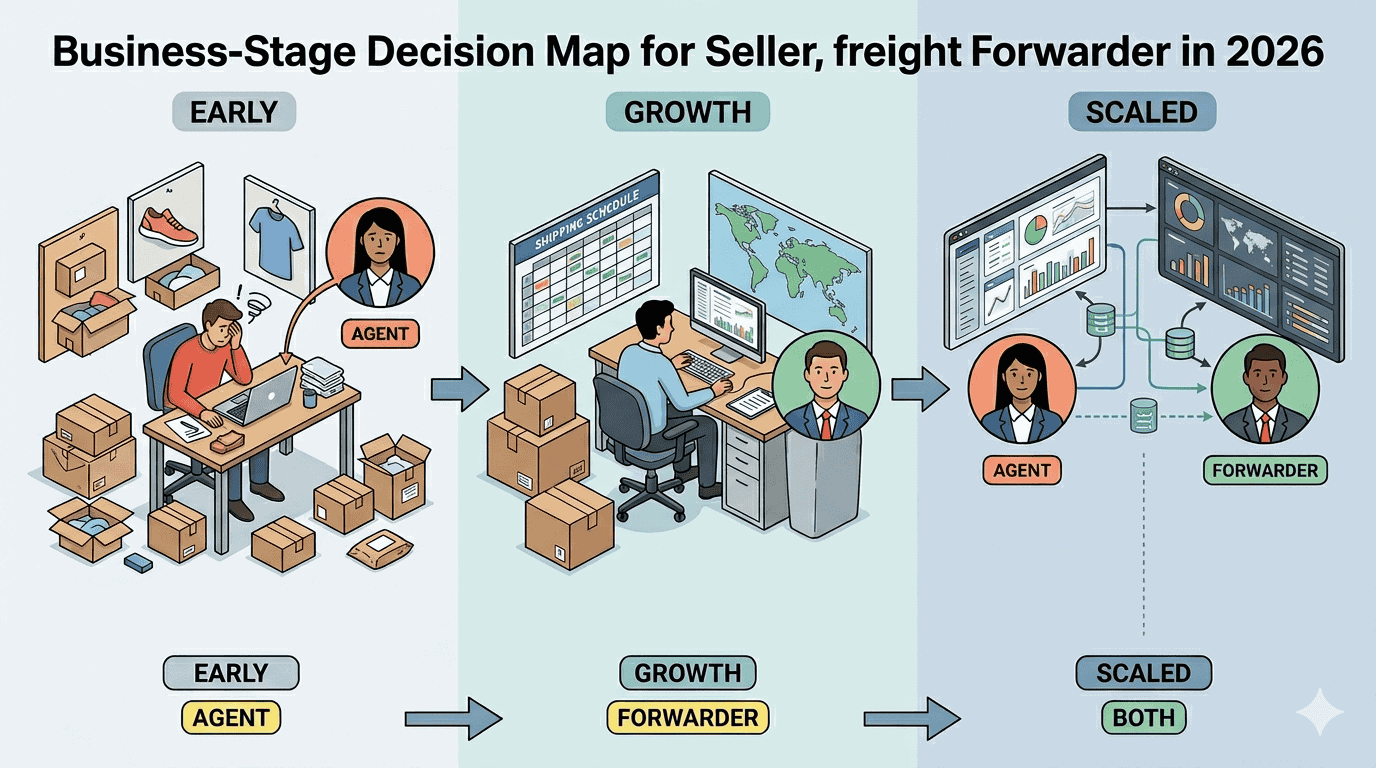
| Your current bottleneck | Primary owner to evaluate | Why |
|---|---|---|
| Supplier replies, sample/specification changes, packaging or QC remain unstable | Dropshipping/operations agent | The problem exists before transport planning can be reliable |
| Goods and documents are stable, but pickup, routing or international transport is unclear | Freight forwarder | The remaining work is cargo movement and transport coordination |
| Multiple suppliers must finish, deliver and be consolidated into one shipment | Both, with one written handoff | Product readiness and freight booking depend on each other |
| Individual customer orders ship from China | Agent/fulfillment operator plus the parcel-carrier route | The workflow is order-level receiving, pick/pack, data and dispatch |
| Validated stock moves to an overseas warehouse or FBA | Forwarder plus any required broker/destination partner | The workflow is a defined cargo shipment rather than one consumer parcel at a time |
| Import party, broker or filing responsibility is unknown | Buyer and destination compliance owner | Neither an agent label nor a freight quote removes importer obligations |
When the Dropshipping Agent Is the Better First Call
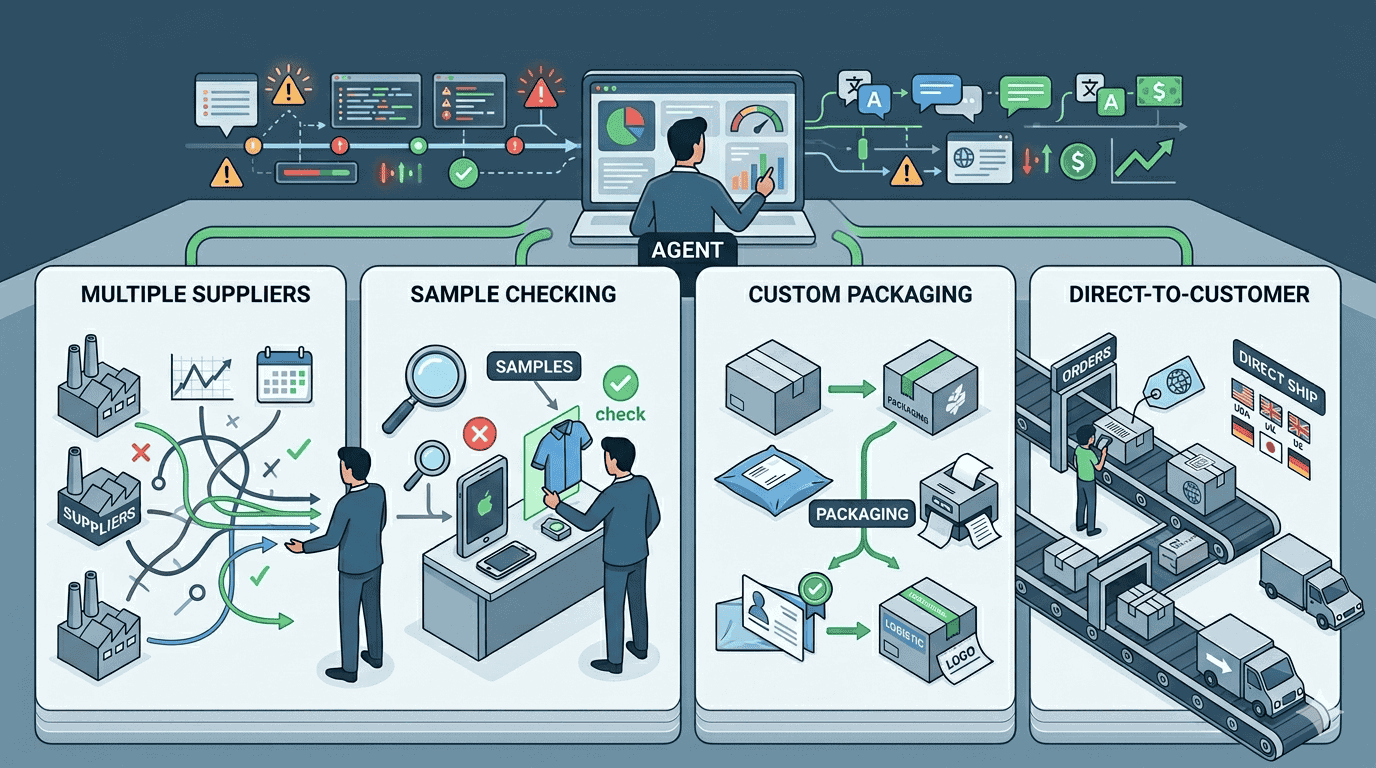
Start on the agent/operations side when the uncertainty is still inside the product or supplier workflow:
- the supplier has not confirmed the final specification;
- samples from several suppliers need to be compared;
- custom labels, inserts or packaging need approval;
- goods from several suppliers need receiving and exception records;
- you need order-level pick, pack and dispatch coordination;
- the supplier cannot provide reliable cargo-ready data in English.
When the Freight Forwarder Is the Better First Call
Start with the forwarder when the product side is stable and the open decisions are about the cargo movement:
- goods are packed and the final carton data is available;
- you need a defined pickup-to-destination quote;
- you are comparing transport modes, routing or consolidation options;
- you need booking, shipment-document and milestone coordination;
- stock is moving to a warehouse, 3PL or FBA location;
- you need the forwarder to identify which destination broker or partner is involved.
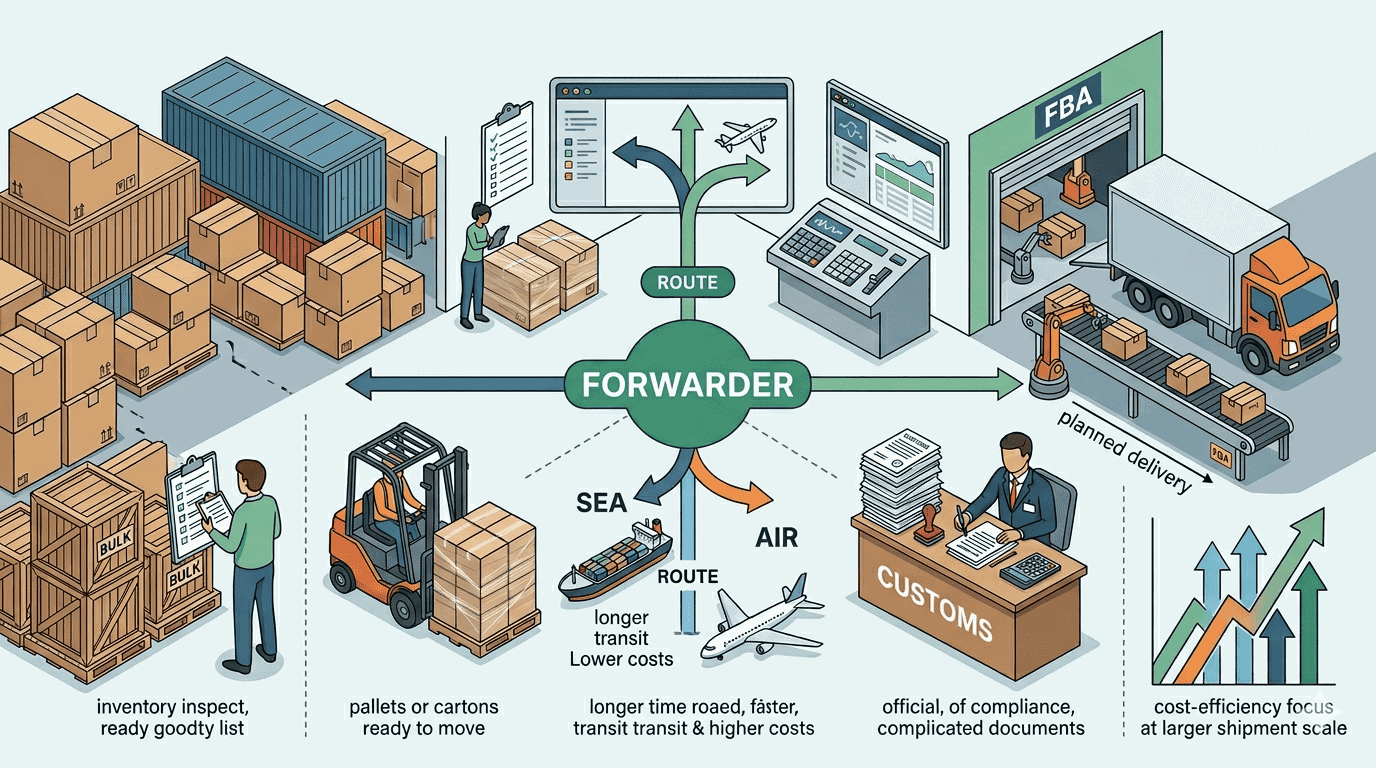
When You Need Both
You likely need both roles when China-side readiness and international transport need different specialists. They can work for one company or two. What matters is whether the handoff is written and visible to the buyer.
A simple sequence is:
- Buyer freezes product, packaging and destination requirements.
- Agent or supplier closes product/QC exceptions and issues the cargo-ready packet.
- Forwarder checks shipment data, quote scope, routing and pickup requirements.
- Buyer approves the final service scope and names the importer/broker path.
- Agent/warehouse releases the goods against the confirmed booking or pickup reference.
- Forwarder reports transport exceptions; product or quantity disputes return to the correct China-side owner.
The point is mundane but important: nobody should be able to say “the other side had the information” after the shipment has moved.
Questions to Put in Writing Before You Choose
- Which legal entity is my contracting party for product/fulfillment work?
- Which legal entity contracts or arranges the transport?
- Where does your scope start and end?
- Which services are included, optional or performed by a partner?
- Who approves samples, packaging and release?
- Who creates and signs off the commercial invoice and packing list data?
- Who provides the pickup/booking reference and loading evidence?
- Who is the importer, customs broker or filing contact?
- How are changed weights, dimensions, quantities or delivery instructions approved?
- Who owns an exception before pickup, in transit and after arrival?
FAQ
Do I need a dropshipping agent or a freight forwarder?
Choose by the unresolved problem. Product, supplier, packaging and order-level execution point toward an agent/operations partner. A cargo-ready international shipment points toward a forwarder. Multi-supplier or transition workflows often need both.
Can one company provide both services?
Yes, but confirm the scope rather than relying on the brand name. Ask which team or legal entity owns supplier work, warehouse work, freight, broker coordination and exceptions.
Can a freight forwarder inspect product quality?
Some forwarders or related warehouses offer inspection as an add-on. It is not implied by the freight quote. Define the inspection scope, sample/reference, evidence and decision owner separately.
Is a freight forwarder enough for Shopify or dropshipping orders?
Not when you also need supplier coordination, individual-order data, pick/pack, branded packaging or customer-level dispatch. A parcel carrier or forwarder may move the package, while a fulfillment operator controls the order before release.
Who is responsible for customs compliance?
That depends on destination law and the named parties. A broker may file or advise, and a forwarder may coordinate the handoff, but the importer can retain legal responsibilities. Verify the exact destination-country setup.
How Style Sourcing Can Help
Style Sourcing can support the China-side part of the handoff: supplier communication, quotation comparison, sample and specification follow-up, QC coordination, receiving/consolidation and preparation for the agreed first-leg logistics handoff. That is not a promise of customs clearance, delivery dates or a freight result.
If your order is moving from supplier follow-up into a repeatable shipping workflow, send the product links, supplier locations, order pattern, packaging requirements and destination. We can help separate the China-side tasks from the information your forwarder needs.
Related Guides
- How to Find a Reliable China Dropshipping Agent
- Is a China Dropshipping Agent Worth It for Independent Sellers?
- China Dropshipping Fulfillment Checklist Before the First Live Order
- Shopify Fulfillment from China Service
- China Dropshipping Agent Service
Sources and Boundaries
- FIATA: About Freight Forwarding — broad industry definition of freight-forwarding and logistics services. Actual provider scope and liability depend on contract and jurisdiction.
- U.S. CBP: Do I need a Customs Broker? — U.S.-specific broker/importer responsibility boundary; not universal destination-country advice.
This comparison is operational guidance, not legal, customs or tax advice. Confirm Incoterms, importer, broker, product and destination requirements for the actual transaction.


