
The short answer: to consolidate 1688 orders, route the planned supplier deliveries through a named China receiving point and manage them under one inbound manifest. Record each arrival, hold unresolved cartons, decide whether to wait or split, then release only the approved cargo to the freight forwarder.
Consolidation does not automatically mean one outbound shipment. It does not guarantee a lower freight bill, catch every defect or make incompatible cargo suitable for the same route. The value comes from having one decision record before international freight is booked.
This guide owns that multi-supplier control record. For the full purchase sequence, start with How to Buy from 1688 as a Foreigner. International transport choices belong in How to Ship from 1688 to Your Country.
Decide whether the orders belong in the same consolidation plan
Do this before any supplier dispatches. Products going to the same country are not automatically ready to travel together.
| Question | Why it matters | Evidence to collect |
|---|---|---|
| Are the final destination and delivery window compatible? | One late or urgent order may need a different release decision | Destination, required date and freight cutoff for each order |
| Can the products use the same transport route? | Batteries, liquids, magnets, food-contact items, branded goods and other controlled cargo may need separate review | Product descriptions and any relevant documents sent to the freight professional |
| Do cartons need counting, photos, inspection, labels or repacking? | A receiving address alone does not provide those services | Written warehouse scope and price for each task |
| Is any order still awaiting approval or correction? | Unresolved cargo should not be mixed into an approved outbound lot | Inspection or exception status by supplier and SKU |
| Have separate and combined plans been quoted on the same data? | A headline freight rate does not include every receiving, storage, handling or destination line | Actual carton data and written quote scope for both options |
Consolidate only the orders that fit the same approved plan. Others can remain on hold or move in a separate shipment.

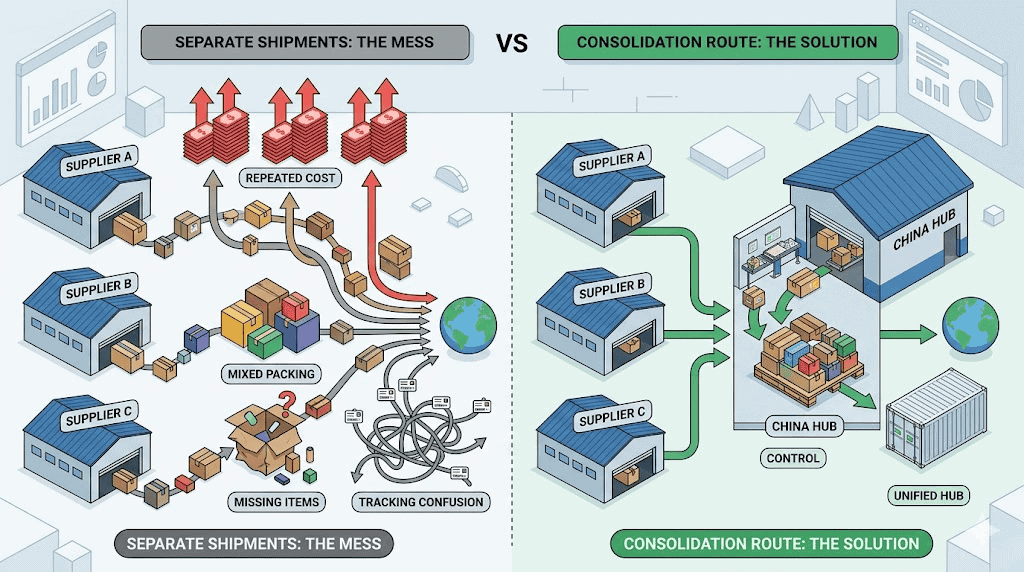
The illustration shows one possible outbound route. Your release may still be split if timing, cargo compatibility or an unresolved exception requires it.
Build the inbound manifest before suppliers ship
The manifest is the control sheet for the whole consolidation job. Give every supplier delivery a unique inbound reference and connect it to the purchase order or order record.
| Manifest field | What to enter |
|---|---|
| Inbound reference | A unique buyer reference for this supplier delivery |
| Supplier | Store/company name and contact |
| Order record | Purchase order, platform order or quote reference |
| Product identity | SKU, selected variant and short description |
| Expected quantity | Units, sets or packs ordered, with the unit defined |
| Expected cartons | Supplier’s current carton count; mark as provisional until dispatch |
| Expected carton data | Dimensions and gross weight supplied before dispatch, if available |
| Domestic tracking | Carrier and tracking number when dispatched |
| Receiving instruction | Count, photograph, inspect, hold, label or repack scope |
| Required evidence | Packing list, carton photos, labels or other agreed records |
| Arrival status | Expected, partial, received, exception or cancelled |
| Release status | Hold, accepted for consolidation, split or return/rework pending |
Do not merge a carton into a combined lot simply because it reached the same warehouse. The inbound reference must connect the physical carton to the correct supplier and order.
Send one receiving instruction to every supplier
Use the same field order for each supplier. The product details will change; the receiving logic should not.
China warehouse receiving instruction
- Buyer/inbound reference: [insert]
- Order or quote reference: [insert]
- Product/SKU and quantity: [insert]
- Receiving address and contact: [insert]
- Carton mark/reference required: [insert]
- Packing list required: [yes/no and format]
- Before dispatch, confirm: carton count, dimensions, gross weight and tracking
- Warehouse action on arrival: [receive only / count / photos / inspection / hold / other]
- Do not combine or release until: [named approval]
Ask the supplier to repeat the address, reference and planned carton count before dispatch. For the message-writing side, use How to Communicate with 1688 Suppliers rather than spreading the same details across unrelated chat messages.

A receiving point can perform only the work that was agreed. “Delivered to warehouse” is not evidence that quantities, products or packaging were checked.
Log each arrival before mixing cartons
The receiving record should preserve the condition of the inbound delivery and show whether it matches the manifest.
| Receiving field | Record |
|---|---|
| Arrival date and time | Warehouse receipt timestamp |
| Inbound reference | Reference shown on label or matched from tracking |
| Supplier and tracking | Supplier identity, carrier and tracking number |
| Cartons received | Actual count compared with expected count |
| External condition | Visible damage, wet carton, compression or missing marks |
| Weight and dimensions | Measured values if that service was requested |
| Photos | Unopened cartons, labels and visible exceptions |
| Quantity/product check | Result only if the warehouse was asked to open and check |
| Exception | Shortage, overage, wrong item, damage, unidentified parcel or none observed |
| Owner and next action | Person who must answer and whether the cargo remains on hold |
Do not infer the contents of an unopened carton. If the purchased service is receiving-only, the record should say that the inner quantity and product condition were not checked.
The broader workflow after an individual supplier dispatches is covered in What Happens After a 1688 Supplier Ships to a China Warehouse?. This article focuses on reconciling several such deliveries in one manifest.
Resolve exceptions before consolidation
An exception needs a disposition before the affected goods enter the outbound packing plan.
| Exception | Evidence to request | Possible disposition |
|---|---|---|
| Unidentified parcel | Label, tracking, supplier dispatch record | Hold until matched |
| Missing carton | Expected/received counts and carrier record | Ask supplier/carrier; hold or release partial order by buyer decision |
| Wrong SKU or variant | Order record, product and label photos | Hold; ask supplier for correction options |
| Visible carton damage | Unopened-carton photos and receiving note | Hold for opening/checking if authorized |
| Quantity mismatch | Count sheet and product photos | Recount or raise with supplier before release |
| Product/QC issue | Inspection record against buyer-defined criteria | Accept, rework, replace, return or reject according to buyer decision and supplier terms |
| Packaging/label issue | Approved packaging file and current photos | Hold for correction or accept as a documented deviation |
The warehouse should report observations. The buyer or named owner decides whether the evidence is sufficient and what action is authorized. Detailed inspection criteria belong in the 1688 Inspection Service guide.
Use a wait, split or release board
Suppliers do not need to finish on the same day for the manifest to work. Set a decision point for every order instead of leaving approved cargo on an open-ended hold.
| Order/reference | Current status | Required-by date | Storage/handling implication | Freight cutoff | Decision |
|---|---|---|---|---|---|
| Supplier/order A | Wait / split / release / cancel | ||||
| Supplier/order B | Wait / split / release / cancel | ||||
| Supplier/order C | Wait / split / release / cancel |
There is no universal waiting period. Use the buyer’s required date, the warehouse quote, cargo status and forwarder’s cutoff. A late order can be held for the next shipment while approved cargo moves, provided the buyer records that split.
Check cargo compatibility and packaging scope
Before cartons are physically combined or booked on one route, send the freight professional the actual product and carton data. Do not rely on broad labels such as “general goods.”
Check these points:
- product description, materials and intended use;
- batteries, liquids, powders, magnets or other route-sensitive features;
- brand/IP information where relevant;
- carton condition, dimensions and gross weight;
- fragile, crush-sensitive or contamination-sensitive products;
- unit labels, carton marks and destination handling requirements;
- any product or destination documents identified by the relevant professional.
Repacking is a separate scope. Ask what will be removed, retained, added or changed and request final carton data afterward. How to Improve Packaging Quality for 1688 Orders owns the detailed packaging workflow.

The inherited image text describes potential benefits. Whether the combined plan improves cost, carton use or control depends on the actual cargo, services and quotes.
Build the outbound release packet
The release packet is the final check that the warehouse, buyer and freight forwarder are working from the same cargo identity.
Include:
- the final list of accepted supplier orders and any excluded/held orders;
- final SKU and quantity totals mapped back to each order;
- final carton or pallet IDs;
- final carton count, dimensions, gross weight and volume;
- photos of the final packing and marks;
- inspection status and buyer disposition for each order;
- repacking, labelling or kitting work completed;
- unresolved exceptions, if any, and who owns them;
- the freight quote/version being approved;
- the named person and timestamp authorizing release.

Do not release cargo merely because every expected tracking number shows “delivered.” The manifest, exception log and final packing data must reconcile with the orders the buyer is approving.
Compare separate and consolidated plans
Use actual quotes and final carton data. This worksheet prevents a claimed freight saving from hiding extra handling or a timing trade-off.
| Cost or operational line | Separate plan | Consolidated plan | Source/assumption |
|---|---|---|---|
| China domestic delivery | |||
| Receiving / storage | |||
| Counting / photos / inspection | |||
| Repacking / labels / materials | |||
| International freight | |||
| Origin handling | |||
| Destination charges | |||
| Required delivery date | |||
| Delay exposure | |||
| Exception handling |
For a wider cost allocation framework, see the 1688 Test-Order Landed-Cost Handoff Matrix. Customs treatment and destination charges must be confirmed for the actual shipment with the appropriate freight or customs professional.
FAQ: consolidate 1688 orders
Can orders from different 1688 suppliers be consolidated? They can be routed to a common China receiving point when the suppliers can deliver there and the cargo fits the same approved handling and freight plan.
Does consolidation always mean one international shipment? No. A buyer may wait, split approved cargo, hold an exception or use different routes for incompatible products.
Does a consolidation warehouse inspect the goods automatically? No. Receiving, carton counting, opening, product inspection, photos, repacking and labels are separate tasks unless the provider’s written scope says otherwise.
Will consolidation always reduce shipping cost? No. Compare domestic delivery, receiving, storage, handling, repacking, international freight and destination lines using actual quotes and final carton data.
When should suppliers receive the warehouse address? Before domestic dispatch. Send the address, contact, inbound reference, carton-mark instruction and required dispatch data in one written message.
Should inspection happen before cartons are combined? Resolve the inspection scope and any observed exceptions before the affected goods are released into the outbound packing plan.
Sources and limits
- Alibaba Group: 1688 business overview — used only for 1688’s domestic wholesale marketplace context.
- 1688 official App Store listing — the app currently advertises global-buyer features, but route and feature availability still require case-specific confirmation.
This guide does not promise a cost saving, storage period, receiving or inspection scope, export route, customs result or single-shipment outcome. Use the current warehouse and freight quotes for the cargo in front of you.
If you have a supplier list and need the China-side receiving, exception and release steps coordinated, review the current scope of the Style Sourcing China sourcing service.


