
How to Compare China Sourcing Agents: Relationship vs Scale Claims
One sourcing agent says you will get personal attention. Another says its network, systems, and order volume make it the safer choice. Both claims sound useful, but neither tells you what will happen when a sample is wrong, a specification changes, or a shipment contains mixed SKUs.
To compare China sourcing agents well, translate every broad promise into an observable operating control. Ask who owns each stage, which record is created, how exceptions are escalated, and what the buyer receives before the next commercial decision. The best comparison is not relationship versus scale in the abstract. It is whether the proposed workflow gives your order enough visibility and control.
This guide gives you a practical framework. It does not rank sourcing companies or assume that a larger or smaller provider is automatically better. Your product, order complexity, sales channel, risk tolerance, and internal team determine which operating model fits.
Start With Your Buying Scenario, Not the Agent’s Pitch

Before speaking with agents, write a one-page buying scenario. Include product category, target market, expected SKU count, customization level, sample needs, packaging requirements, likely order rhythm, and the decisions your team must approve. Separate known requirements from assumptions.
This preparation prevents an attractive presentation from defining the comparison for you. A provider with a polished platform may still be a poor fit for a low-volume product that needs repeated design feedback. A relationship-led agent may communicate quickly but lack a clear record system for a growing multi-SKU program. The buying scenario turns those differences into testable questions.
Use the same scenario with every candidate. If one candidate receives a detailed brief and another receives a casual message, their responses are not comparable. Give each agent the same product information, the same open questions, and the same response deadline. Record what each one asks before offering a quotation. Good discovery questions often reveal more about the working method than a brochure does.
Relationship and Scale Are Not Opposites
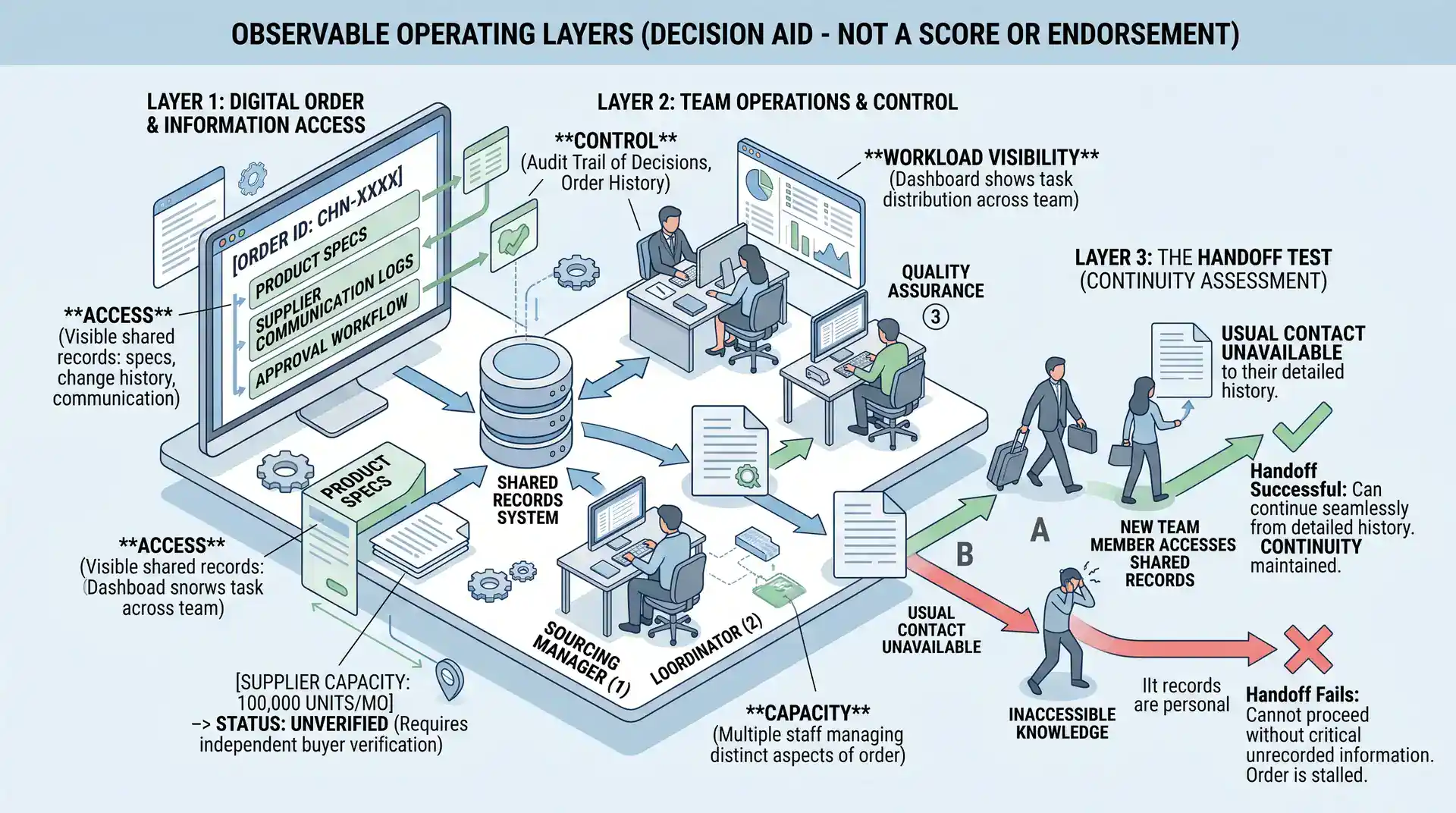
Small-agent marketing often emphasizes direct access, local knowledge, and flexible communication. Larger organizations may emphasize supplier coverage, standardized processes, specialist teams, and capacity. These are positioning themes, not verified outcomes.
A relationship-led model can still use strong systems. A scaled provider can still assign a responsive account owner. Likewise, direct messaging does not prove that changes reach the factory floor, and a large supplier database does not prove that a specific factory fits your order. Avoid turning company size into a shortcut for diligence.
Instead, compare four layers:
- Access: Who can you contact, and who can make decisions?
- Control: Which specifications, approvals, and checks are recorded?
- Capacity: How does the provider handle your expected SKU and order load?
- Continuity: Can another team member understand the order if the usual contact is unavailable?
The fourth layer is easy to miss. A close working relationship is valuable, but an order should not exist only inside one person’s chat history. A scaled team is useful, but multiple departments can create confusion if ownership is unclear. In both models, continuity depends on records and named responsibilities.
Use a Six-Part Comparison Scorecard

Create a scorecard before the sales calls. Use descriptive ratings such as clear, partly clear, and unverified instead of forcing false precision. Attach an evidence note to every rating.
| Comparison area | What to ask for | Useful evidence | Warning sign |
|---|---|---|---|
| Product discovery | How are candidate suppliers found and screened for this item? | Search criteria, shortlist fields, open-question log | A list of names with no item-specific reasoning |
| Specification control | How are revisions issued and accepted? | Versioned specification, approval owner, change log | Final requirements spread across chat messages |
| Sample management | How is the approved reference identified? | Sample ID, photos, measurements, approval note | “Sample approved” with no version or item code |
| Production follow-up | Which milestones are visible to the buyer? | Named checkpoints, dated updates, exception record | Status updates with no defined source |
| Quality control | Who defines checks and who reviews results? | Inspection scope, photo map, result categories | “QC included” without scope or acceptance owner |
| Shipping handoff | What passes to the forwarder or warehouse? | Packing data, carton IDs, document owner matrix | Responsibility becomes vague after production |
Do not score a feature simply because it exists. Ask how it would be used for your scenario. A dashboard is useful only if the data source, update owner, and exception path are clear. Direct access is useful only if decisions are recorded and transmitted to the right supplier contact.
Compare Supplier Search as a Documented Process
Many buyers ask, “How many suppliers do you know?” A stronger question is, “How will you create and narrow the shortlist for this product?”
Ask the agent to describe the search inputs. These may include product construction, material, process, certification questions for the assigned market, minimum commercial constraints, packaging, customization, and location. Then ask which fields appear in the shortlist and which claims remain unverified until the supplier responds or a sample is checked.
A useful shortlist distinguishes observed listing information, supplier-provided answers, agent observations, and buyer decisions. Those categories should not be blended. For a marketplace-led search, the 1688 buying guide and China sourcing service show why directory discovery and order execution are separate stages.
Test the process with one sample product. Give each candidate the same brief and ask for a limited demonstration of how they would structure the shortlist. You do not need a free full sourcing project. You need enough detail to see whether the method produces comparable evidence rather than a stream of links.
Examine Specification and Change Control
Product mistakes often begin before production. A material name is interpreted differently, a dimension changes without a version number, or packaging artwork is approved in one chat but not connected to the purchase instruction.
Ask each agent to show a blank or anonymized specification format. Look for item code, revision number, date, product details, tolerances where appropriate, packaging, labels, artwork references, sample identity, unresolved questions, and approval owner. Then ask how a change is made after a sample or quotation.
The key question is not whether the agent uses a spreadsheet, platform, or document. It is whether the current version is identifiable and whether superseded instructions can be separated from active ones. A relationship-led agent may manage this with a disciplined shared file. A scaled provider may manage it in software. Either can work when version control is real.
If your order includes custom packaging or branding, review the private label sourcing service as a prompt for the additional approval points that must be mapped. Do not let the packaging discussion sit outside the main product record.
Test Sample Control Before Discussing Bulk Confidence
An approved sample is not merely a positive impression. It should have an identity and a decision record. Ask how the agent labels samples, records observed differences, sends photos or measurements, and connects the accepted reference to the later order.
Use a sample exercise to compare responsiveness and evidence quality. Give the agent three deliberate questions: which features can be checked from photographs, which need physical measurement or function checks, and which remain buyer decisions? A careful answer should separate observation from judgment.
The sample checking and quality control service is a relevant service bridge when you need a local team to document a sample. It is still your responsibility to define what matters commercially and to approve or reject the reference.
Ask what happens if the sample differs from the written specification. Does the agent revise the specification, request a corrected sample, record an approved exception, or simply continue? The answer reveals whether the workflow treats the sample as controlled evidence or as a loose milestone.
Compare Quality Control by Scope and Decision Rights
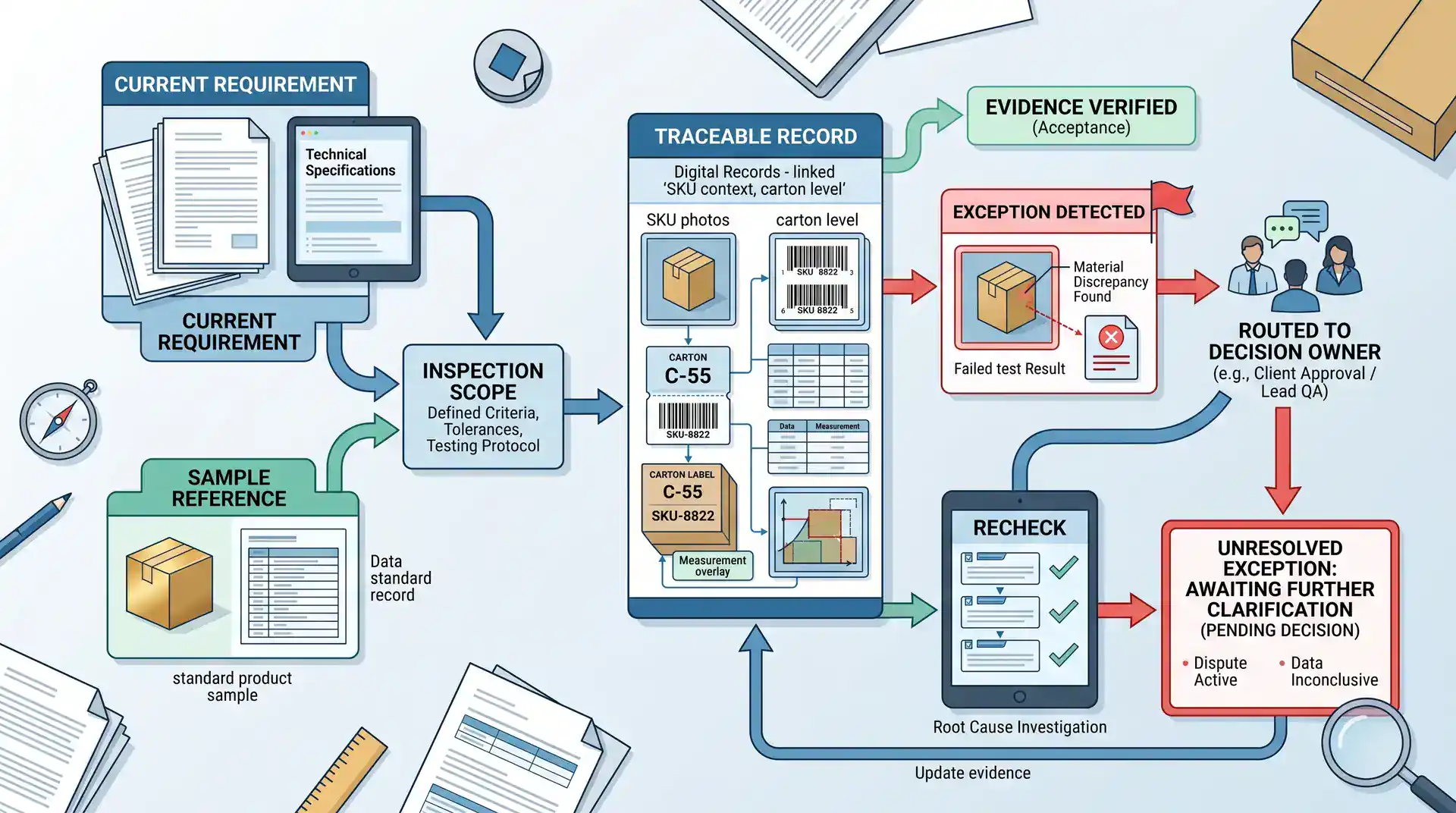
“We inspect every order” is incomplete. Compare the scope, timing, evidence format, sampling instruction, issue categories, and decision owner.
Ask who drafts the inspection checklist and what it references. A useful checklist points to the current product specification, approved sample, packaging files, quantity records, label requirements, and buyer-defined critical features. Ask when the check occurs and whether the buyer can review the evidence before a release decision.
Then separate three roles:
- The observer records what was checked and what was found.
- The coordinator obtains missing information and routes exceptions.
- The buyer or assigned authority decides whether to accept, rework, recheck, or hold.
An agent may perform more than one role, but the roles should still be visible. This prevents an observation such as “color differs from sample” from being silently converted into a commercial decision.
Ask for an anonymized inspection-report structure. Check whether photos have SKU or carton context, whether exceptions can be traced to the requirement, and whether a recheck preserves the original issue. Do not accept a photo folder as equivalent to a reviewable report unless the images are indexed.
Compare Communication Without Counting Messages
Fast replies feel reassuring, but message volume is a weak proxy for control. Compare communication by event and ownership.
Define the events that require updates: shortlist ready, quotation questions open, sample dispatched, sample reviewed, specification frozen, production checkpoint reached, inspection scheduled, exception raised, packing data confirmed, and shipping handoff completed. Ask who sends each update and what evidence accompanies it.
Also define escalation. If the account manager cannot resolve a factory discrepancy, who becomes involved? If the buyer is in another time zone, which decisions can wait and which require a hold? If the regular contact is unavailable, where can another team member find the active record?
A good test is to send a small revision with two related changes and ask the candidate to confirm the resulting current version. Evaluate whether the reply restates the exact item, fields changed, file version, and open questions. This is more informative than asking whether communication is “good.”
Evaluate Fees Through Scope, Not a Headline Percentage
Do not compare fees until the work units are visible. A low headline fee may exclude sample handling, inspection, consolidation, packaging coordination, or repeated supplier follow-up. A higher fee may include activities you do not need. The comparison must map charges to responsibilities and decision points.
Request a written scope with included work, excluded work, third-party charges, triggers for additional approval, and cancellation or change handling. Ask how supplier quotations and agent charges are presented. Do not assume a pricing model makes an agent independent or conflicted; ask how commercial relationships and payments are disclosed for your order.
Create a scenario comparison rather than predicting the final cost. For example, model one product with one sample, then a five-SKU order with custom packaging and a pre-shipment inspection. List which activities each proposal includes. Leave values marked unverified until the candidate confirms them in writing.
Run a Paid Pilot With a Clear Stop Point

A pilot should test the actual operating method without committing the full program. Choose an item that represents meaningful complexity but does not expose the business to an unacceptable loss. Define the pilot stages, outputs, approval rights, and stop point before it starts.
Useful pilot outputs include a supplier shortlist, question log, quotation comparison, versioned specification, sample evidence packet, and a closing handoff record. You may not need production or shipping to learn how the agent manages discovery and samples.
During the pilot, record exceptions rather than hiding them. A problem can be valuable evidence if the provider identifies it, communicates it clearly, preserves the record, and offers options within the agreed authority. A frictionless pilot may simply mean the test was too easy.
At the end, ask your own team four questions:
- Could we identify the current requirement without searching chats?
- Did every important claim have a source or an unverified label?
- Were decisions assigned to the correct owner?
- Could another team member continue the order from the saved records?
A Practical Decision Matrix
Use the following matrix after the pilot. Write evidence references in the final column.
| Decision factor | Relationship-led fit may be stronger when | Scaled-system fit may be stronger when | Evidence to retain |
|---|---|---|---|
| Product development | Frequent interpretation and iterative discussion are central | Requirements are mature and repeated across many items | Revision log and sample record |
| SKU volume | A small set needs close attention | Many items need standardized tracking | Item register and owner map |
| Buyer team | One buyer owns most decisions | Multiple functions need shared access | Approval matrix and access test |
| Exception handling | Direct senior involvement is important | Specialist routing and documented escalation are important | Exception case from pilot |
| Continuity | Personal context is a major advantage | Role redundancy is a major advantage | Handoff test result |
This is not a universal answer key. A hybrid may be best: one accountable relationship owner supported by documented systems and specialists. The point is to select observable controls, not a company-size story.
FAQ
Is a larger sourcing company safer than a small agent?
Not automatically. Size may provide capacity or specialist roles, while a smaller agent may provide direct access and context. Compare the controls used for your order, the evidence produced, and the continuity plan rather than treating size as proof of safety.
Should I choose the agent with the lowest service fee?
Only after comparing the included scope. Ask what happens during supplier search, sampling, specification changes, quality checks, consolidation, and shipping handoff. A headline number is not comparable when the responsibilities differ.
What documents should I request during an agent pilot?
Request the outputs relevant to the stages being tested: a shortlist with source labels, question log, quotation comparison, versioned specification, sample record, approval log, and closing handoff. Do not request irrelevant paperwork merely to create volume.
How can I verify an agent’s quality-control claim?
Ask for the proposed inspection scope, evidence structure, timing, observer role, decision owner, and anonymized format. Then test whether findings can be traced to the current requirement and sample. The format should preserve exceptions and rechecks.
When should I use a sourcing service instead of buying directly?
Consider support when local supplier communication, multi-supplier coordination, sample documentation, inspection evidence, packaging, consolidation, or handoff complexity exceeds your internal capacity. Direct buying may remain suitable when requirements and supplier controls are already mature.
Build the Comparison Around Evidence
To compare China sourcing agents, begin with your scenario, apply the same questions, test a limited workflow, and save evidence for each rating. Relationship and scale can both create value. Neither should replace product-specific controls.
For service context, review the China sourcing service, contact route, sample checking service, private label sourcing service, and Shopify fulfillment service. Use them to map the stages where local coordination may help, then request a written scope for your actual order.
Sources and Evidence Boundary
This local draft uses the 2026-W34 Style Sourcing knowledge base, same-day analytics context, and bounded review of public competitor headline positioning recorded in the weekly evidence package. Public positioning is used only to identify comparison themes. No named company is ranked, endorsed, or assigned a verified result. Buyers should verify current scope, fees, legal terms, supplier claims, and service capabilities directly before making a commercial decision.


