
Important boundary. This article does not state that any specific supplier, warehouse, or forwarder is who it claims to be. It does not state that any specific carton count is correct, that any specific carton is undamaged, that any consolidation is safe to release, that customs will accept the shipment, that payment is justified, or that any legal outcome follows from the matrix. The matrix is a buyer-side ownership and evidence-production reference. Customs, broker, payment, QC contractor, freight forwarder, and warehouse decisions remain with the responsible owner for the actual transaction.
Quick Answer: What Is a China Warehouse Handoff Responsibility Matrix?
A China warehouse handoff responsibility matrix is a one-page buyer-side reference that names, for each step in a China warehouse handoff, (a) who owns the step, (b) what evidence artifact the step produces, and (c) what the step does not prove. This article uses a six-stage model — receive, count, inspect, consolidate, pack, and release. A real warehouse contract may combine, rename, move, or omit a stage, so the owner and evidence fields must be adapted to the actual service scope.
The matrix is operational, not contractual. It does not replace a written service agreement with a warehouse or 3PL. It does not tell the warehouse what to do. It tells the buyer what evidence to ask for at each step and what that evidence cannot be stretched to mean.
For most small-batch buyers, the China warehouse handoff is the layer where three confusing things happen at once: cartons from one or more suppliers land in one facility, a third party looks at them, and a booking is opened with a forwarder. When something goes wrong downstream — wrong count, wrong SKU, hidden damage, missed consolidation — the buyer-side question is almost always “who owned that step and what artifact do I have?” The matrix below is the answer to that question, before any specific dispute opens.
Important boundary. A warehouse receipt — the printed slip that says “we got your cartons” — is not proof of correct carton count, proof of carton condition, proof of supplier identity, proof of quality, proof of consolidation, proof of compliance with destination rules, or proof that the forwarder will accept the goods. It is one artifact, at one step, and it does only one thing: it records that the warehouse physically took in cartons at a named time. The rest of the matrix exists because the receipt is not enough.
Who Owns Each Step, and What Each Step Actually Produces
The table below is the spine of this article. Each row is a step in a China warehouse handoff. The “Owner” column names the party the buyer should expect to do the work. The “Evidence artifact” column names the document, photo set, or file the buyer should expect to receive. The “Does not prove” column is the most important column for the buyer: it limits the meaning of the artifact.
| Step | Owner | Evidence artifact | Does not prove |
|---|---|---|---|
| 1. Receive | Warehouse (receiving bench) | Dated receiving list with carton count, supplier-supplied carton marks, photo set of carton exteriors before opening | That the carton count inside matches the supplier claim, that the cartons are undamaged, that the supplier is who they claim to be, that customs or the forwarder will accept the cartons |
| 2. Count | Warehouse (receiving bench) or buyer-arranged count | Per-carton SKU list with quantities, carton-level tally sheet, photo set of opened cartons | That the SKUs match the supplier invoice, that the SKUs meet the buyer’s specification, that the SKU labelling is correct, that the count is the only count the supplier will accept |
| 3. Inspect | Buyer-arranged QC contractor (or supplier-side QC if contracted) | Per-SKU inspection report with sample size, defect counts, photographs, and measurement table | That the unsampled SKUs are also good, that supplier-shipped defects are all captured, that destination customs will accept the goods, that quality is durable over the lot |
| 4. Consolidate | Warehouse (consolidation bench) or 3PL | Consolidation worksheet showing supplier SKUs mapped to a consolidated SKU, carton-level consolidated carton list, photo set of the consolidated carton stack | That the SKU mapping is approved by the buyer, that consolidation choices (carton size, dunnage, stacking order) are optimal for the route, that the forwarder will accept the consolidation |
| 5. Pack | Warehouse (packing bench) or 3PL | Packing list with per-consolidated-carton SKU list, dunnage and reinforcement photo set, sealed-carton photo set | That the consolidated SKU list matches the buyer’s purchase order, that the carton will survive the lane, that customs will accept the carton labelling |
| 6. Release | Warehouse (releasing bench) + buyer-side authorisation | Signed release note with carton count, weight, dimensions, sealed-photo set, and forwarder booking reference | That customs cleared the shipment, that the supplier invoice matches the packing list, that the forwarder confirmed pick-up, that the buyer should release payment |
The buyer should expect each agreed artifact to exist as a dated file — a PDF, a photo set, a worksheet, or a signed note — that can travel with the shipment record. If the responsible party cannot produce the agreed artifact, the buyer cannot verify that step from the current file. That is an evidence gap, not proof that the physical work never happened.
Important boundary. The owner column is descriptive, not prescriptive. A buyer who contracts a 3PL may move the owner of consolidation, packing, and release onto the 3PL; the artifacts are the same. A buyer who contracts the supplier for packing at the factory has effectively moved the pack step upstream and should expect the artifact to come from the supplier, not the warehouse.
Why This Matrix Is Different From a Generic Receiving Checklist
Most “receiving checklist” content on the open web treats the warehouse receipt as the end of the story. The receipt is a useful artifact, but it answers only one question: did the warehouse physically take in cartons? It does not answer whether the count inside is right, whether the SKUs match the buyer’s specification, whether consolidation was done the way the buyer approved, or whether the buyer should release the goods.
This matrix treats the receipt as step one of six and gives each of the other five steps its own owner and its own evidence artifact. Count, SKU, damage, consolidation, and seal questions arise after intake and need records beyond the receipt. A checklist that stops at step 1 cannot answer those later questions.
Important boundary. The matrix does not say that the buyer must run a separate inspection at step 3. If the buyer has contracted the supplier to do factory-side inspection, the artifact at step 3 is a supplier-issued report, and the warehouse’s role at step 3 is reduced to handling the carton to the QC contractor, not producing the report itself.
Where This Matrix Sits in the Buyer-Side Flow
The matrix sits between supplier-side production and the physical handoff to the forwarder or carrier. Freight booking may be opened earlier, so it is a reference input rather than a fixed endpoint. The matrix is one of three layers:
- Supplier-side layer — production, factory-side inspection, factory-side packing, and the supplier’s own evidence artifacts (factory-side inspection report, factory-side packing list).
- China warehouse handoff layer — the six steps above. This is the layer where the supplier’s cartons meet the buyer’s SKU and the forwarder’s booking.
- Forwarder-side layer — booking confirmation, container or air waybill, customs handoff at origin, and the forwarder’s evidence artifacts.
A buyer who only watches the supplier-side layer and the forwarder-side layer, but does not watch the China warehouse handoff layer, will see disputes open in the middle and will have no artifact to point to. The matrix exists to close that gap.
Important boundary. The matrix does not state that the buyer must engage an external QC contractor. It states that, when an inspection is run, the artifact at step 3 is a per-SKU report. The owner of the step may be the supplier, the buyer, or an external QC contractor; the artifact is the same.
Step 1 — Receive: What the Buyer Should Expect
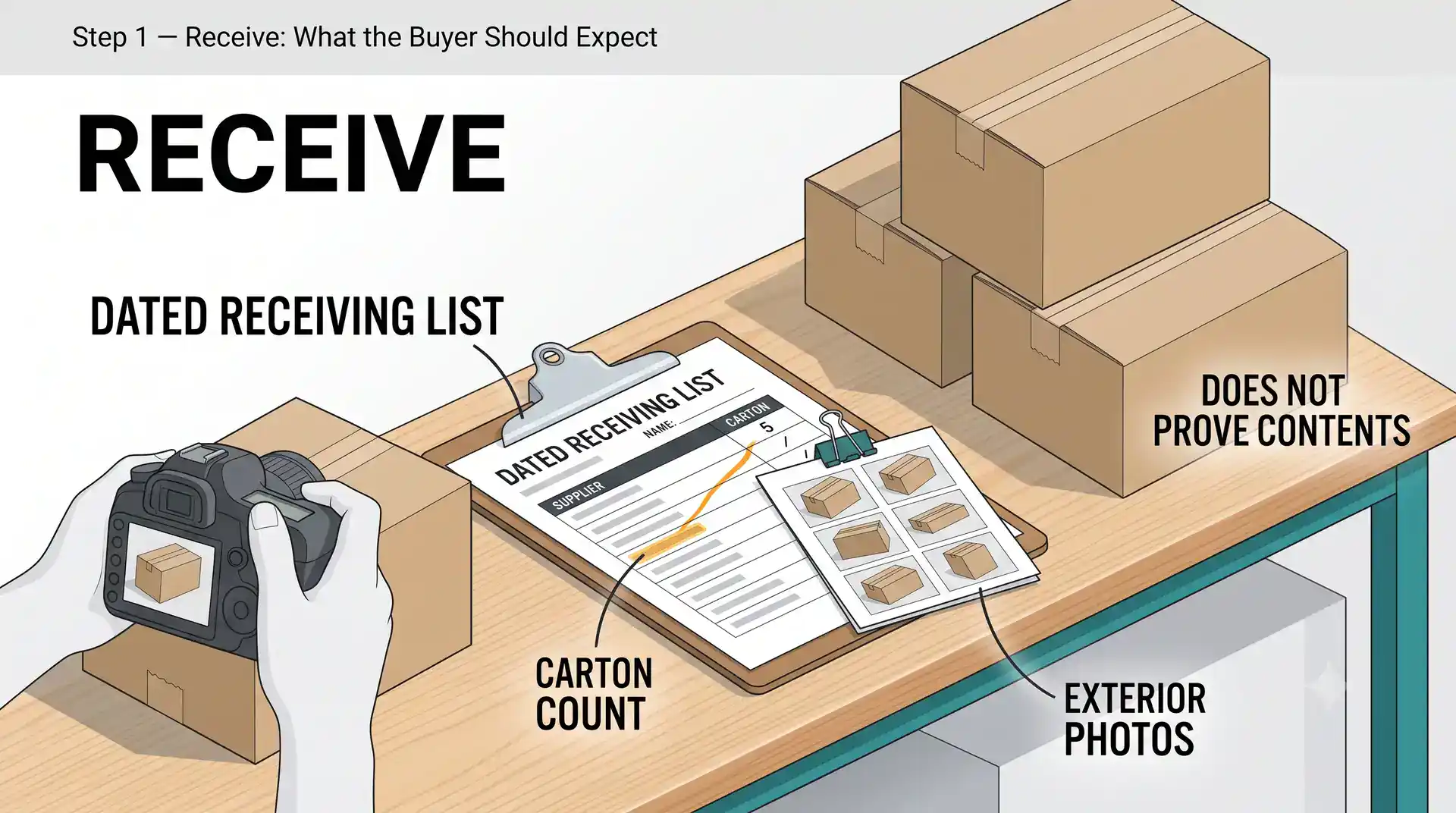
The receive step is the warehouse physically taking in cartons from a supplier or a courier. The owner is the warehouse receiving bench. The evidence artifact is a dated receiving list with the carton count, the supplier-supplied carton marks (if any), and a photo set of carton exteriors before opening.
The receiving list should record:
- The number of cartons received.
- The supplier-supplied carton marks (printed marks on the outside of the carton, if any).
- The physical condition of the cartons at intake — any visible damage, any opened cartons, any repackaged cartons.
- The date and time of intake.
The photo set should show:
- Each carton as it lands on the receiving bench, with the carton mark visible.
- Any damage visible on the outside of a carton, photographed before the carton is moved further.
What the receiving list does not prove:
- That the carton count inside matches the supplier claim.
- That the SKUs inside the cartons match the buyer-side purchase order.
- That the cartons are undamaged inside.
- That the supplier is who they claim to be.
- That the forwarder or customs will accept the cartons.
Important boundary. A carton photographed from the outside is evidence of carton exterior condition only. It is not evidence of inner condition, inner count, or inner SKU match.
Step 2 — Count: What the Buyer Should Expect

The count step is opening each carton and recording what is inside, at the SKU level. The owner is the warehouse receiving bench, or a buyer-arranged count contractor. The evidence artifact is a per-carton SKU list with quantities, a carton-level tally sheet, and a photo set of opened cartons.
The per-carton SKU list should record:
- Each SKU in the carton.
- The quantity of each SKU.
- Any visible damage to the SKU.
- Any mismatch between the supplier-side packing list and the count.
The carton-level tally sheet should record:
- The total count per SKU across all cartons from the same supplier.
- The carton that contained each SKU.
- Any missing or surplus SKUs against the supplier-side packing list.
The photo set should show:
- The opened carton with the SKUs visible.
- Any damaged SKU.
- Any mismatch between the supplier-side packing list and the count.
What the count does not prove:
- That the SKUs match the buyer’s specification (which is a quality question, not a count question).
- That the SKU labelling on the carton matches the SKUs inside the carton (which is a label-match question, not a count question).
- That the count is the only count the supplier will accept (which is a contractual question, not a count question).
- That the count will hold up under a later independent recount.
Important boundary. A count is a single-pass record. If the supplier disputes the count, the buyer’s evidence is the count artifact, not a guarantee that the count is final. A recount is always possible if both parties agree to it, and a recount artifact supersedes the original count artifact.
Step 3 — Inspect: What the Buyer Should Expect
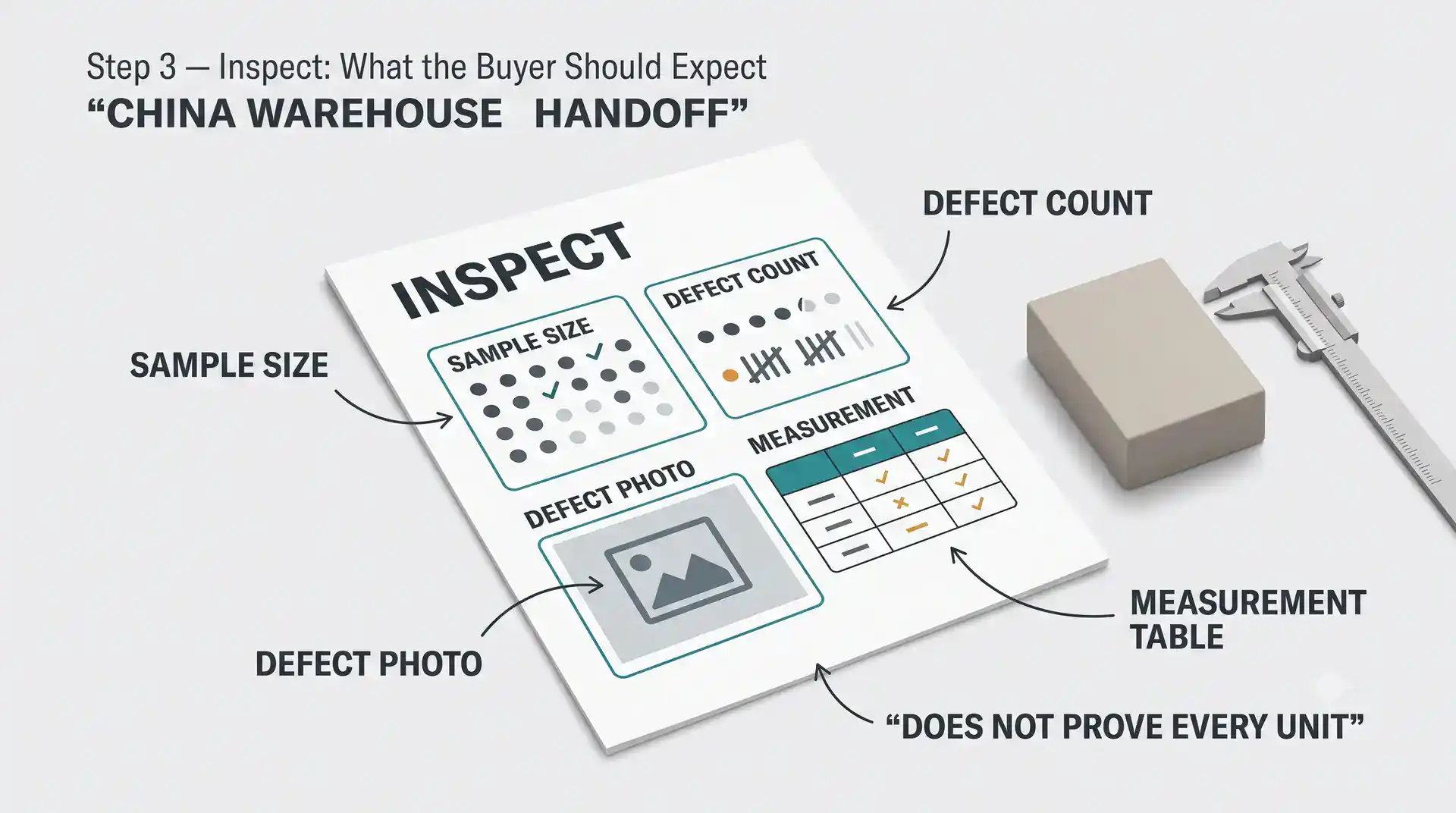
The inspect step is the per-SKU quality check. The owner is the buyer-arranged QC contractor, the supplier-side QC contractor (if contracted), or an internal buyer team. The evidence artifact is a per-SKU inspection report with sample size, defect counts, photographs, and a measurement table.
The per-SKU inspection report should record:
- The AQL or sampling standard used.
- The sample size per SKU.
- The number of defects found.
- The classification of each defect (critical / major / minor).
- Photographs of each defect.
- A measurement table for SKUs with measurable specs (size, weight, colour, fabric count, etc.).
What the inspection does not prove:
- That the unsampled SKUs are also good (which is a sampling question, not an inspection question).
- That supplier-shipped defects are all captured (which is a sampling-coverage question, not an inspection question).
- That destination customs will accept the goods (which is a compliance question, not an inspection question).
- That the quality is durable over the entire lot (which is a long-term quality question, not an inspection question).
Important boundary. When an agreed sampling plan is used, the inspection report records the sample, observations, defect classifications, and the result under that plan. It does not prove every unit is conforming. The buyer still applies the agreed acceptance criteria and makes the commercial release, hold, rework, or follow-up decision.
For context on how the inspect step differs from the supplier-side factory inspection and the pre-shipment inspection, see the Style Sourcing article on warehouse receiving vs QC vs pre-shipment inspection in China. That article scopes the three China-side checks; this matrix scopes the responsibility and evidence production at the China warehouse handoff.
Step 4 — Consolidate: What the Buyer Should Expect
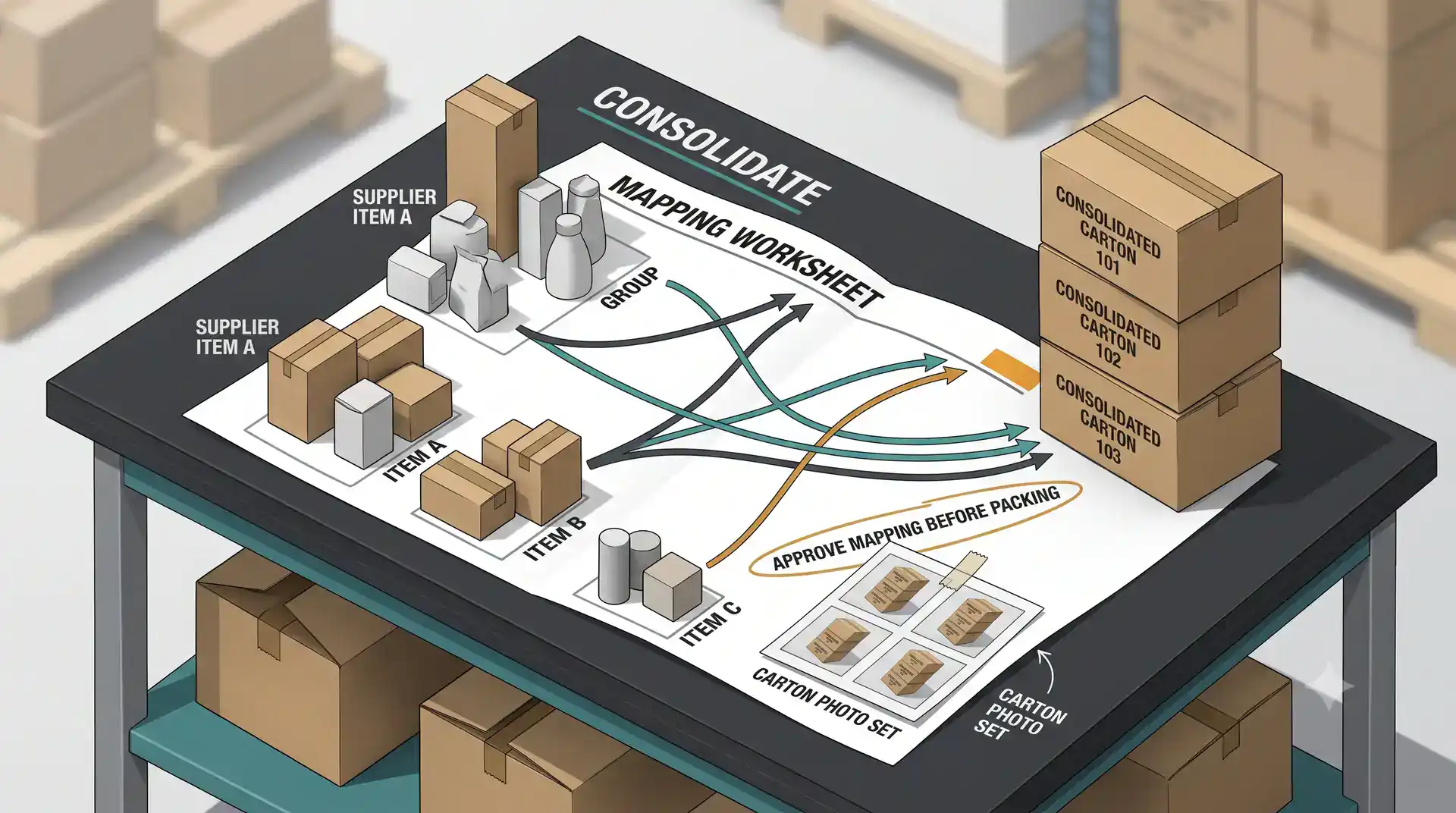
The consolidate step is mapping SKUs from one or more suppliers onto a consolidated carton list for the forwarder. The owner is the warehouse consolidation bench, the 3PL, or the buyer-arranged consolidator. The evidence artifact is a consolidation worksheet showing supplier SKUs mapped to a consolidated SKU, a carton-level consolidated carton list, and a photo set of the consolidated carton stack.
The consolidation worksheet should record:
- Each supplier SKU mapped to a consolidated SKU.
- The quantity of each supplier SKU in each consolidated carton.
- The carton count of the consolidated shipment.
- Any supplier SKUs that could not be consolidated and why.
What the consolidation worksheet does not prove:
- That the SKU mapping is approved by the buyer (which is an approval question, not a consolidation question).
- That consolidation choices (carton size, dunnage, stacking order) are optimal for the route (which is a freight-design question, not a consolidation question).
- That the forwarder will accept the consolidation (which is a forwarder-acceptance question, not a consolidation question).
Important boundary. The buyer should approve the SKU mapping before packing. If the buyer does not approve the mapping, the packing step at step 5 may produce a consolidated carton list the buyer did not sign off on.
For the carton-level traceability across multiple suppliers that feeds the consolidate step, see the Style Sourcing article on multi-supplier carton traceability in China consolidation. That article scopes the carton-level reconciliation across multiple suppliers; this matrix scopes the responsibility at the consolidate step.
Step 5 — Pack: What the Buyer Should Expect
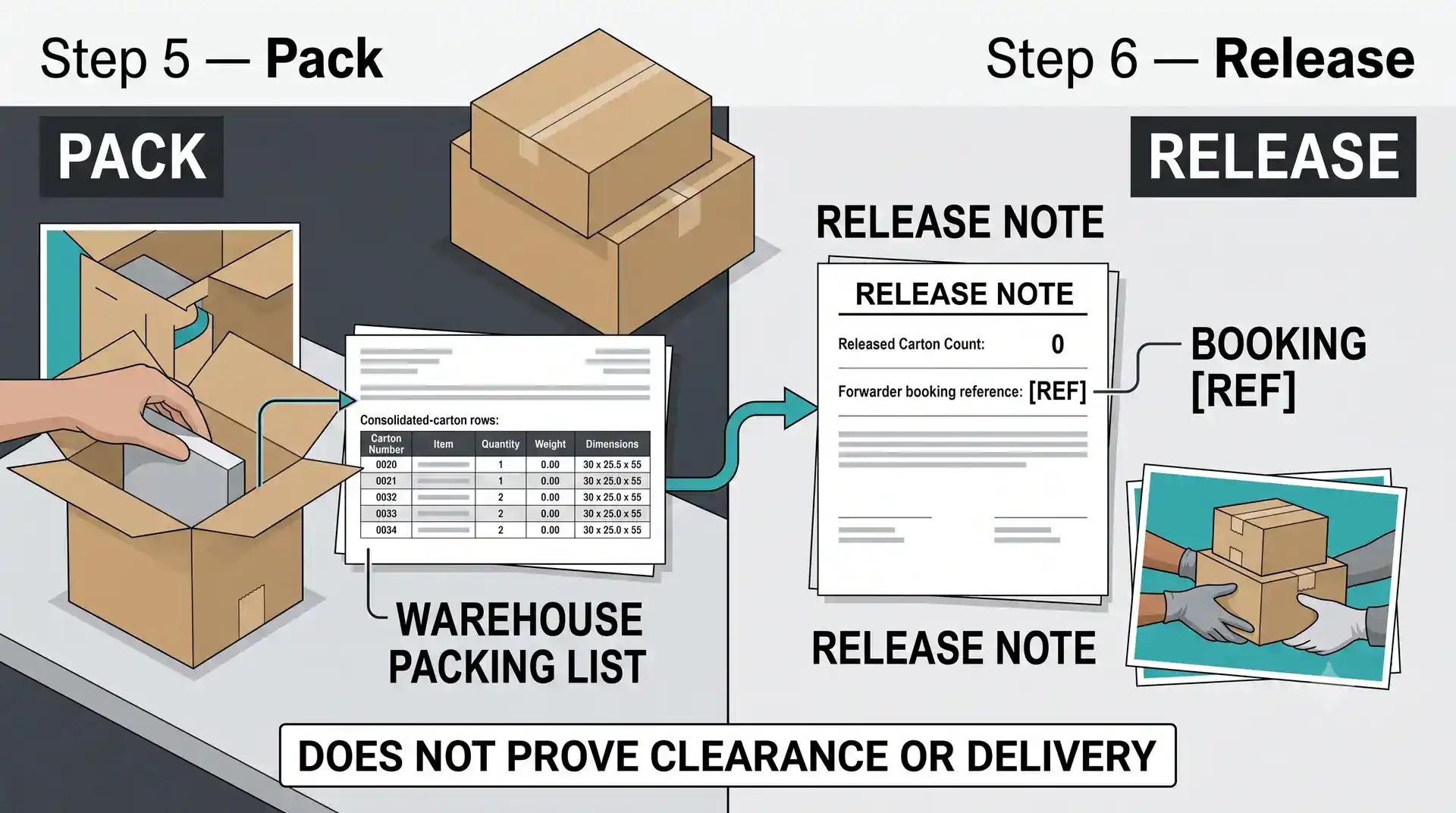
The pack step is sealing the consolidated cartons for the forwarder. The owner is the warehouse packing bench, the 3PL, or the supplier (if packing is moved upstream). The evidence artifact is a packing list with per-consolidated-carton SKU list, a dunnage and reinforcement photo set, and a sealed-carton photo set.
The packing list should record:
- Each consolidated carton number.
- The SKUs in each consolidated carton.
- The quantity of each SKU in each consolidated carton.
- The gross weight and dimensions of each consolidated carton.
- Any dunnage, reinforcement, or special-handling note.
What the packing list does not prove:
- That the consolidated SKU list matches the buyer’s purchase order (which is a SKU-match question, not a packing question).
- That the carton will survive the lane (which is a lane-condition question, not a packing question).
- That customs will accept the carton labelling (which is a labelling-compliance question, not a packing question).
Important boundary. A packing list from the China warehouse is not the same artifact as a packing list from the supplier. The warehouse-side packing list is the consolidated carton list. The supplier-side packing list is the per-supplier pre-consolidation list. Both should exist; both are evidence; both should travel with the shipment record.
For the contrast between the supplier-side packing list and the China-side packing list, and the role of the packing list in the pre-release and issued-document comparison, see the Style Sourcing article on shipment PDF authenticity cross-check. That article scopes the document-side comparison; this matrix scopes responsibility at the pack step.
Step 6 — Release: What the Buyer Should Expect
The release step is the handoff from the warehouse to the forwarder. The owner is the warehouse releasing bench, with the buyer’s authorisation. The evidence artifact is a signed release note with carton count, weight, dimensions, sealed-photo set, and forwarder booking reference.
The release note should record:
- The consolidated carton count released.
- The gross weight and dimensions of the released cartons.
- The forwarder booking reference.
- The date and time of release.
- The sealed-photo set of each released carton.
What the release note does not prove:
- That customs cleared the shipment (which is a customs-side event, not a release-side event).
- That the supplier invoice matches the packing list (which is a document-side cross-check, not a release-side event).
- That the forwarder confirmed pick-up (which is a forwarder-side event, not a release-side event).
- That the buyer should release payment (which is a payment-side decision, not a release-side event).
Important boundary. The release note is a handoff record. It is not a clearance record. Customs clearance happens at origin customs, not at the warehouse. The buyer should keep the release note with the booking reference, the document cross-check at release, and the customs clearance record as three separate artifacts.
For the document-side cross-check at release, see the Style Sourcing article on shipment PDF authenticity cross-check. For the role of the forwarder booking reference in the shipment record, see the Style Sourcing article on multi-supplier carton traceability.
Three Worked Examples: How the Matrix Plays Out
The three examples below are anonymised buyer-side scenarios. They are not records of any specific transaction, supplier, or warehouse.
Example 1 — Count Mismatch Between Supplier Packing List and Warehouse Count
A buyer receives 10 cartons from a supplier with a supplier-side packing list of 200 units across 5 SKUs. The warehouse count records 187 units across the same 5 SKUs, with 13 units missing from one SKU. The buyer pauses release and asks the supplier for a recount at the warehouse. The supplier’s recount confirms the warehouse count. The buyer’s evidence artifacts are: (a) the supplier-side packing list, (b) the warehouse count artifact, (c) the supplier’s recount artifact, and (d) a buyer-side note recording the discrepancy. The release step is paused until the supplier agrees to ship the missing 13 units or to revise the supplier invoice.
What the matrix says here: the count step (step 2) produced the record that surfaced the discrepancy. The release step (step 6) was paused. The supplier-side packing list and the warehouse count were conflicting evidence until the recount provided a third record.
Example 2 — Inspection Report Shows Defects, Buyer Requests Follow-Up
A buyer receives an inspection report at step 3. The sampled units contain defect observations that exceed the acceptance number in the buyer’s agreed sampling plan. The supplier argues that the sample is not representative. The buyer pauses release and requests a follow-up inspection under a separately agreed scope. The buyer’s evidence artifacts are: (a) the original inspection report and sampling plan, (b) the supplier’s response recorded as a buyer-side note, (c) the follow-up report, and (d) the buyer’s release or hold decision recorded as a buyer-side note. The example does not prescribe an AQL level, sample size, rework, refund, or contractual outcome.
What the matrix says here: the inspect step (step 3) produced the evidence. The release step (step 6) was paused. The inspection report was one input at the release decision, not the release decision itself.
Example 3 — Consolidation Mapping Approved by Buyer
A buyer receives a consolidation worksheet at step 4 that maps 12 supplier SKUs from 3 suppliers to 6 consolidated cartons. The buyer reviews the mapping and approves it in writing. The warehouse packs the consolidated cartons at step 5 and releases them at step 6 with the forwarder booking reference visible on the release note. The buyer’s evidence artifacts are: (a) the consolidation worksheet, (b) the buyer-side approval note, (c) the warehouse packing list, (d) the release note, and (e) the forwarder booking reference.
What the matrix says here: the buyer-side approval note at step 4 is the artifact that prevents a later dispute over what the buyer approved. The release note at step 6 is the artifact that records the handoff.
What This Matrix Does Not Replace
The matrix does not replace:
- A written service agreement with the warehouse or 3PL, which names the legal owner of each step and the contractual remedies.
- A quality agreement with the supplier, which names the supplier-side QC artifact.
- A freight contract with the forwarder, which names the booking reference and the freight terms.
- A payment instrument, which governs when the buyer releases payment.
The matrix is a buyer-side reference for the artifacts the buyer should expect to receive. It does not assign legal liability. It does not tell the warehouse what to do. It tells the buyer what to ask for.
Relationship to Adjacent Style Sourcing Articles
This matrix is one layer of a multi-layer buyer-side flow. The adjacent Style Sourcing articles cover the layers above and below it:
- For the supplier-side layer — factory-side inspection, supplier-side QC, supplier-side packing — see the Style Sourcing article on warehouse receiving vs QC vs pre-shipment inspection in China.
- For the China warehouse facility choice — supplier-owned, consolidator-owned, or 3PL — see the Style Sourcing article on China warehouse types and supplier consolidation vs 3PL.
- For the carton-level traceability across multiple suppliers that feeds the consolidate step — see the Style Sourcing article on multi-supplier carton traceability in China consolidation.
- For the document-side cross-check at release — issuer verification and cross-document discrepancy detection — see the Style Sourcing article on shipment PDF authenticity cross-check.
- For the jurisdiction allocation of importer of record vs customs broker — see the Style Sourcing article on importer of record vs customs broker.
- For what Incoterms do and do not cover — see the Style Sourcing article on what Incoterms do not cover.
- For the destination-side handoff to Amazon Brazil — see the Style Sourcing article on Brazil FBA inbound shipment documents.
The matrix above is the buyer-side ownership-and-evidence layer of a China warehouse handoff. The adjacent articles are the layers above, below, and to the side.
Handoff Exception Ledger — Keep the Hold, Evidence Gap, and Release Decision Together
When a handoff exception opens, keep one buyer-side ledger row that ties the exception number to the affected stage (receive, count, inspect, consolidate, pack, or release), the SKU, carton, or shipment involved, the named owner, and the missing evidence. Record the decision to hold or release, the date, and the written confirmation from the responsible party. This keeps an evidence gap from being mistaken for proof that the physical step failed, and it keeps a release decision from being inferred from a warehouse receipt alone.
FAQ
Is a warehouse receipt proof that the count is correct?
No. A warehouse receipt — the printed slip that says “we got your cartons” — records that the warehouse physically took in cartons at a named time. It does not record what was inside the cartons, the SKU match against the buyer’s purchase order, or the carton condition. The count step (step 2) is the artifact that records the inside-of-the-carton state. A warehouse receipt is evidence of intake, not of count.
Is a warehouse receipt proof of quality?
No. The warehouse receiving bench is not a quality station. The inspect step (step 3) is the artifact that records the quality state. If the buyer has not arranged an inspection at step 3, the buyer does not have a quality artifact at the China warehouse handoff, and the matrix is incomplete.
Is a warehouse receipt proof that customs will accept the goods?
No. Customs processes may occur at origin and destination, and neither is proven by a warehouse receipt. The release note (step 6) is a warehouse-to-forwarder handoff record, not a customs-clearance record. Keep the warehouse release evidence, freight/transport records, and any origin or destination customs records as separate artifacts.
Is a warehouse receipt proof of consolidation?
No. A warehouse receipt records the intake of supplier cartons. The consolidate step (step 4) is the artifact that records the mapping from supplier SKUs to consolidated SKUs. A warehouse receipt and a consolidation worksheet are two different artifacts at two different steps. The buyer should expect both.
What if the warehouse cannot produce the artifact at a step?
If the responsible party cannot produce the agreed artifact for a step, that step is unverified in the buyer’s file. The matrix gives the buyer a basis for asking “where is the record for this step?” Depending on the contract and risk, the buyer can pause the next handoff, request the missing record, or agree on a repeat check. Missing evidence does not by itself prove that the physical work was never performed.
Does this matrix tell the warehouse what to do?
No. The matrix is descriptive of buyer-side evidence production. It does not assign legal liability, name contractual remedies, or instruct the warehouse. The owner column names the party the buyer should expect to do the work; the artifact column names what the buyer should expect to receive. The matrix is a reference for the buyer, not a service agreement.
Does this matrix replace a written service agreement with the warehouse?
No. The matrix is a buyer-side reference for evidence production. A written service agreement with the warehouse or 3PL is the document that names the legal owner of each step, the contractual remedies, and the dispute pathway. The matrix and the service agreement are two different artifacts. A buyer should have both.
How does this matrix relate to the China-side three checks?
Receiving, QC, and pre-shipment inspection are three distinct China-side control stages, not three interchangeable quality checks. Receiving records intake, QC checks agreed product requirements, and a pre-shipment inspection applies its defined scope before shipment. In this matrix, receiving maps to step 1, counting can map to step 2, and a defined QC or inspection activity can map to step 3. For the distinction, see the Style Sourcing article on warehouse receiving vs QC vs pre-shipment inspection in China.
Sources and Evidence Boundaries
Bounded external surfaces used in this article.
The ICC Commercial Crime Services due-diligence guidance on forged trade and transport documents is used here only as the institutional surface for buyer-side cross-checks, not as a specific rule. The U.S. International Trade Administration export documents page is used here only as the institutional surface for the role of the commercial invoice and packing list at handoff, not as a specific rule.
External surfaces intentionally not used here.
This article does not cite a specific customs authority rule as a destination rule, a specific carrier rule as a transport-document rule, a specific letter-of-credit UCP rule as a payment-document rule, a specific court case, arbitration award, legal remedy, or quality-rate standard as a buy-side pass threshold. The three worked examples are anonymised buyer-side scenarios, not records of any specific transaction.
Local sources used.
The W31 daily marketing analyses for 2026-07-29, 2026-07-30, and 2026-07-31, and the matching three KB routing files. Existing Style Sourcing articles named in the W31 weekly opportunities manifest were used only for overlap positioning and internal-link wording.
What the article does not state.
This article does not state that any specific supplier, warehouse, or forwarder is who they claim to be. It does not state that any specific carton count is correct, that any specific carton is undamaged, that any specific consolidation is safe to release, that customs will accept the shipment, that payment is justified, or that any legal outcome follows from the matrix. The matrix is a buyer-side ownership and evidence-production reference.
Visual-layer boundary (for the paired image brief).
The paired image brief avoids any visual that depicts a fake warehouse software screen, a fake barcode or SKU label, a fake customs stamp, a fake carrier or courier logo (Maersk, MSC, COSCO, DHL, FedEx, UPS, SF Express, YTO, ZTO, Yunda, etc.), a fake tracking number, a fake release note, or any visual that implies a customs, title, legal, payment, or delivery outcome.
Yoast SEO green is not verified for this local draft. Local SEO metadata is prepared; WordPress and Yoast verification is the next step and is not part of this draft.
How Style Sourcing Supports This Step
Style Sourcing runs an in-China buying and warehouse handoff coordination role for brand-side buyers who already know what they want to source but need a single buyer-side party to keep the matrix above visible across the six steps. The engagement is descriptive, not a guarantee: Style Sourcing does not replace the warehouse, the QC contractor, the forwarder, or the customs broker. Style Sourcing helps the buyer keep the six artifacts visible, ask for them at the right step, and pause the release when one of them is missing.
If you are a brand-side sourcing operator or a small-batch importer who already buys from Chinese suppliers and needs a buyer-side party to keep the receive, count, inspect, consolidate, pack, and release steps visible, contact Style Sourcing for a scoping conversation. The conversation is descriptive of what Style Sourcing can do; it is not a sales pitch, a service promise, or a guarantee of customs, payment, or delivery outcome.


