
China Sourcing Approval Responsibility Matrix: Buyer, Agent, and Supplier Ownership
Who can approve a sample change after you have already signed off the specification? Who is allowed to release a factory to start bulk production? If the supplier sends a revised carton count to your sourcing agent, does that change require your approval, or can the agent handle it?
These questions sound simple until an order is moving between an overseas buyer, a China sourcing agent, a factory, a trading company, a QC contact, a warehouse, and a freight handoff. In Yiwu and other sourcing markets, the problem is rarely that nobody is working. More often, three people believe they are helping while nobody has a clearly recorded final approval.
A China sourcing approval responsibility matrix is a practical evidence sheet for fixing that gap. It records who prepares information, who checks it, who must approve a decision, and who is informed after the decision. It is an operating record, not a contract, legal allocation, warranty, or promise that a party can accept every task in every order.
This guide shows how an overseas buyer can assign ownership across specification, supplier verification, samples, substitutions, artwork, payment evidence, production release, QC exceptions, packaging, consolidation, and shipping documents.
What a China Sourcing Approval Responsibility Matrix Buyer Agent Supplier Covers
The exact focus keyword for this guide is china sourcing approval responsibility matrix buyer agent supplier. It frames an operational record that names the three parties — the overseas buyer, the China sourcing agent or coordinator, and the supplier or factory — and assigns each one preparation, approval, consultation, and notification rights across the eight named decisions below. It is not a contract, legal allocation, warranty, or service guarantee.
The Scope: One Order, Three Core Parties
The simplest useful version covers three parties:
| Party | Main operating role | What this party should make visible |
|---|---|---|
| Overseas buyer | Owns the commercial brief, customer-facing requirements, budget boundaries, and final decisions reserved to the buying team | Approved specification, brand assets, destination requirements, approval names, and decision records |
| China sourcing agent or coordinator | Translates, follows up, compares evidence, coordinates suppliers, and escalates exceptions | Supplier communication, revision history, sample status, open questions, photos, and a current action list |
| Supplier or factory | Confirms what can be produced and provides product, packing, and production evidence | Feasibility, sample version, material or artwork changes, production status, carton data, and shipment documents |
You can add other columns for a QC inspector, China warehouse, consolidator, freight forwarder, 3PL, or internal finance team. Start with the three core parties, though. If the matrix is too elaborate to use during a live order, it becomes another document that nobody updates.
The W32 opportunity framing is intentionally narrow: assign buyer, sourcing agent, and supplier ownership for specification, sample, substitution, artwork, production release, and exception decisions. It is distinct from a warehouse-stage responsibility matrix because the main decision point is before production and during order approval, not only when cartons arrive at a warehouse.
RACI Is a Starting Format, Not the Decision
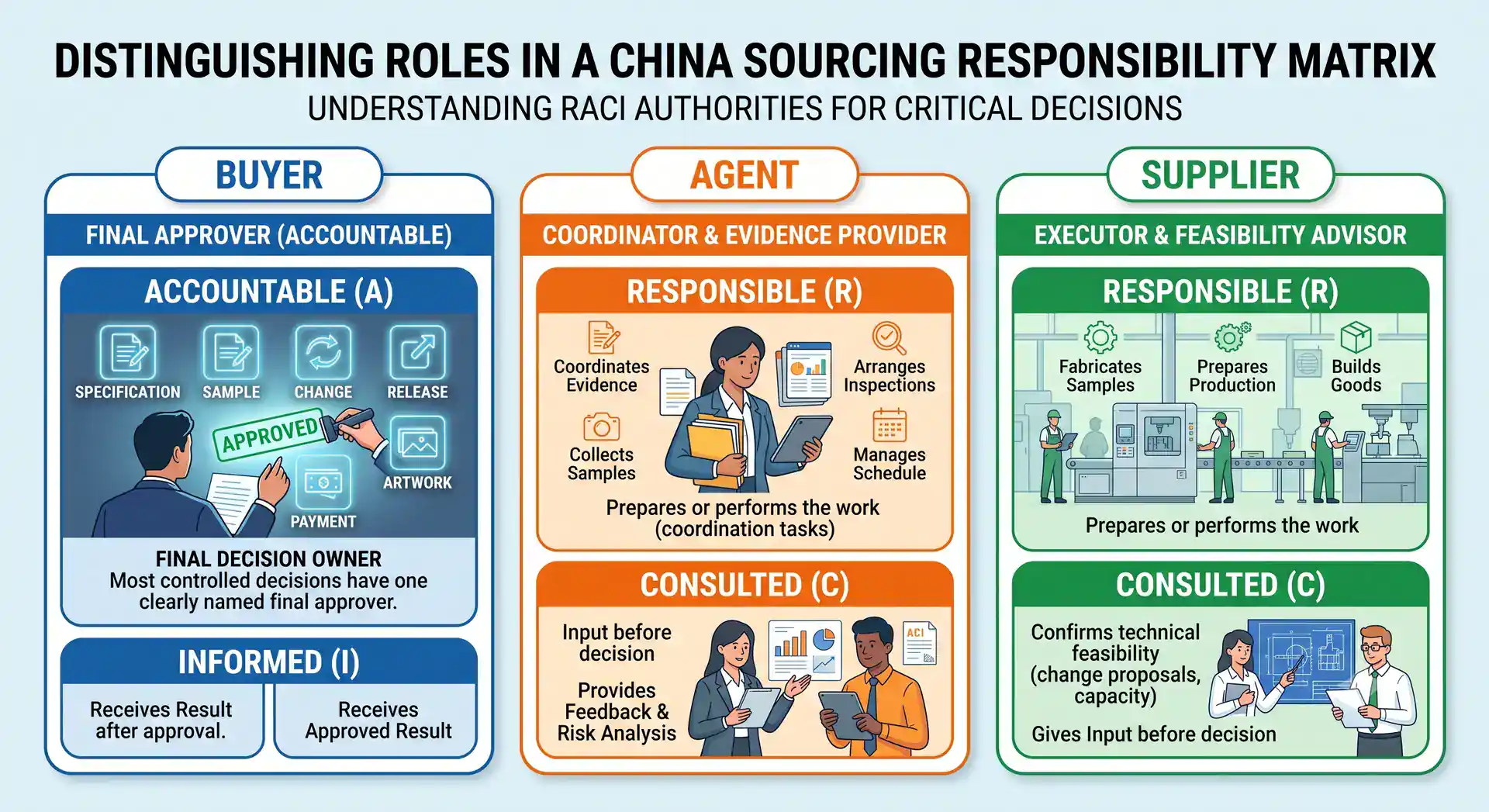
RACI is useful shorthand:
- R — Responsible: does the work or prepares the evidence.
- A — Accountable: owns the decision or final approval for that row.
- C — Consulted: gives input before the decision is made.
- I — Informed: receives the recorded result after the decision.
Do not put A in every column. That defeats the purpose of the matrix. For most order rows, there should be one clearly named final approver. There may be more than one person doing the preparation or consultation, but the approval record should not leave the final call ambiguous.
Also distinguish approval authority from execution authority. A sourcing agent may be authorized to negotiate a correction or ask a supplier for a new photo without being authorized to approve a change to the buyer’s product specification. A factory may be responsible for confirming feasibility without being authorized to replace an approved material. These are different permissions.
A China Sourcing Approval Responsibility Matrix
Use this as a working template. Replace the party labels with actual names or role names for the order, and record the document or message that supports each decision.
| Decision or handoff | Buyer | Agent / coordinator | Supplier / factory | Approval evidence to retain |
|---|---|---|---|---|
| Product brief and intended use | A | R, C | C | Dated brief and questions answered |
| Core specification and revision number | A | R, C | C | Approved spec sheet with version ID |
| Supplier feasibility confirmation | C | R | A | Written feasibility response and exclusions |
| Supplier identity and basic verification record | I, C | A, R | R, C | Supplier profile, business details supplied, and open checks |
| Sample request and sample version | A | R | R | Sample request, photos, sample code, and dispatch record |
| Sample review against the approved specification | A | R, C | C | Buyer comments, comparison notes, and decision date |
| Proposed material, component, or color substitution | A | R, C | R | Change request with reason, photo, and approval or rejection |
| Artwork, logo, label, or packaging copy | A | R, C | R | Annotated artwork proof and named approval |
| Price or order-quantity change | A | R, C | R | Revised quotation or order record and buyer approval |
| Payment request and payment evidence | A | R, C | R, I | Order record, invoice or payment instructions, and confirmation |
| Production start / production release | A | R | R | Release record tied to approved specification and sample |
| In-production change or exception | A | R, C | R | Exception log, revised evidence, and disposition |
| Pre-shipment QC evidence | A for acceptance decision | R, C | R | QC report, photos, result, and open exceptions |
| Carton count, marks, dimensions, and weight data | C or A if destination-sensitive | R, C | R | Supplier carton sheet and reconciliation record |
| Consolidation or warehouse handoff | I or A if reserved by buyer | R | R | Receiving, count, and handoff record |
| Commercial and shipping document cross-check | A for buyer data | R, C | R | Matched document set and discrepancy log |
| Final exception closure | A | R, C | R | Closure note with evidence and date |
This is deliberately conservative around substitutions, artwork, price, quantity, and production release. Those changes can alter what the buyer thinks is being ordered. The agent can keep the order moving, but the matrix should make clear when the agent must stop and obtain buyer approval.
The supplier remains responsible for describing what it will make and for flagging a change. It should not be treated as the final approver of the buyer’s intended specification simply because it is closest to production. Likewise, the buyer should not be asked to approve a vague sentence such as “same as last time” when the sample, artwork, material, or carton configuration has changed.
Build the Matrix Before You Need It
The best time to assign authority is before the sample is dispatched or the production release is requested. A short setup call or written kickoff can settle questions that become expensive to untangle later.
1. Name the order and the decision owner
Give the order a simple identifier, then write down the buyer’s final approver and the agent’s day-to-day coordinator. Do the same for the supplier contact. A role is better than a personal name when staff may change, but the live record should still show who performed each action.
Avoid a group approval such as “buyer team” unless one person is named for the final record. A group can review a file, but one person should sign or send the decision that moves the row from pending to approved.
2. Define what is inside the approval boundary
List the items that cannot change without buyer approval. Common examples include:
- product dimensions, material, color, components, and functional requirements;
- logo placement, label wording, care information, barcode content, and outer-carton marks;
- approved sample identity and the specification revision tied to it;
- order quantity, price, payment instructions, and production-release conditions;
- carton count, packaging configuration, and destination data supplied by the buyer;
- any exception that changes the approved product or the planned handoff.
Then list low-risk coordination actions the agent can perform without waiting for a new decision, such as requesting missing photos, asking a factory to repeat a measurement, translating a question, or arranging a sample dispatch. The exact boundary depends on the order. The point is to record it before a rushed message is interpreted as approval.
3. Give every controlled item a version
An approval is difficult to verify if the message says only “approved.” Use a version, date, and item identifier:
BAG-02 / Spec v3 / Sample S-02 / Artwork proof A-04 / approved by buyer / 2026-08-07
The format can be simpler. It just needs to distinguish the evidence that was approved from an earlier file or later revision. A supplier’s “we followed the sample” message is not enough when two samples are visible in the conversation.
4. Separate pending questions from approved decisions
Keep an open-action list next to the matrix. “Supplier to confirm zipper material” is an action, not an approval. “Buyer approved zipper material shown in photo P-18 against Spec v3” is a decision. Mixing them makes an order look more settled than it is.
Sample Matrix for a 2,000-Unit Order
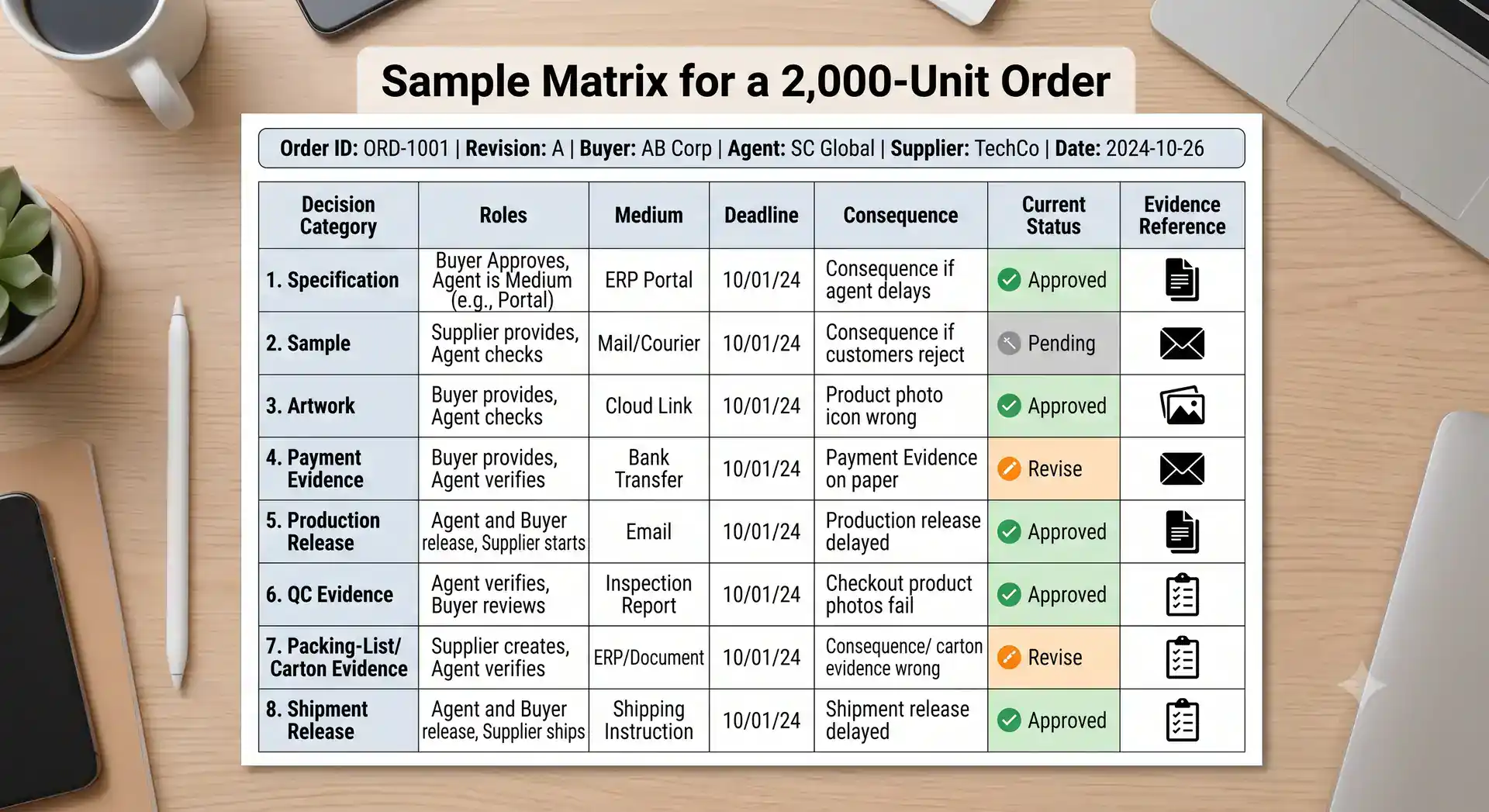
A worked example helps anchor the matrix to a real order. The 2,000-unit quantity below is a story-specific illustration; it is not a minimum order quantity or a service promise. It shows how the eight controlled decisions actually look once an overseas buyer, agent, and supplier sit down with a shared worksheet.
| Decision | Buyer | Agent | Supplier | Medium | Deadline | Consequence if skipped |
|---|---|---|---|---|---|---|
| Spec v3 + revision ID | A | R, C | C | Signed spec PDF | Before sample dispatch | Production runs against an unapproved baseline |
| Sample S-02 against Spec v3 | A | R, C | R | Sample photo + dispatch record | Before production release | Factory produces against a sample the buyer has not seen |
| Material / component substitution | A | R, C | R | Change request with photo | Within 24h of proposal | New material becomes the silent baseline |
| Artwork proof A-04 | A | R, C | R | Annotated artwork proof | Before artwork is sent to print | Carton or label carries the wrong copy |
| Quantity 2,000 + price | A | R, C | R | Revised quotation | Before payment | Buyer pays for a quantity that was not actually approved |
| Payment evidence | A | R, C | R, I | Order record + invoice | Before production release | Production may be released against an unverified payment |
| Production release | A | R | R | Release record tied to approved sample | Day of release | Factory cuts bulk fabric against an unapproved baseline |
| Packing list + shipment release | A | R, C | R | Packing list vs. purchase order | Before container leaves the warehouse | Wrong SKUs ship under a buyer’s name |
Each row links to one buyer-side evidence reference and one supplier-side record. The matrix is a single document the buyer, agent, and supplier can pull up during a Yiwu order, a factory visit, or a remote approval call.
Approval Records That Work in a Live Order
For each controlled decision, capture the same small set of fields:
| Field | What to record |
|---|---|
| Order ID | The order or project identifier |
| Decision ID | A short sequential ID, such as APR-014 |
| Item and version | SKU, sample, artwork, specification, or carton record plus revision |
| Proposal | What the supplier or agent is asking to approve |
| Reason | Why the change or decision is needed; use the supplier’s actual explanation |
| Evidence | Photo, measurement, file, quotation, message, or report reference |
| Decision | Approved, rejected, revise-and-resubmit, or pending |
| Approver | Named buyer or other authorized role |
| Date and channel | When and where the decision was issued |
| Downstream action | What the agent and supplier do next |
The record does not need to be a complex software workflow. A shared sheet plus an organized folder can work if the order team keeps the references stable. The important part is that a person can reconstruct the decision without scrolling through an entire chat history.
Use clear approval language
Ask the approver to write one of four outcomes:
- Approved as shown: identify the exact file, photo, sample, or revision.
- Rejected: state the reason and what must change.
- Revise and resubmit: describe the missing evidence or required correction.
- Pending: identify who owes the next answer and what is blocked.
“Looks good” is weak approval language. It does not say which version was reviewed or whether the comment applies to the product, artwork, packaging, or photograph. The agent should ask a short follow-up when the decision could be read two ways.
Escalation Workflow for Changes and Exceptions
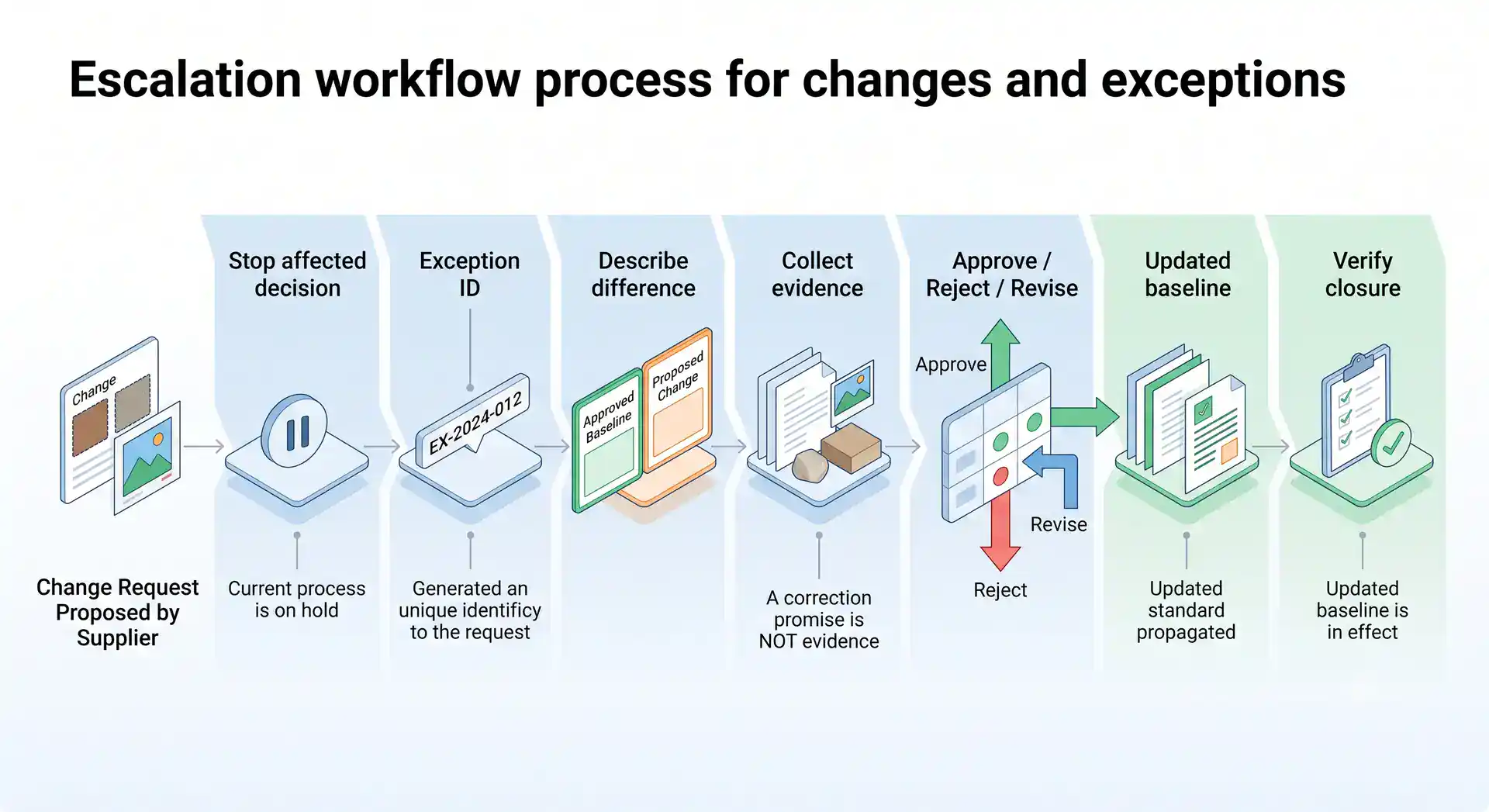
An exception is any result that does not match the currently approved record. It can be a different component, a changed print position, a revised carton count, a measurement question, a missing document, or a QC observation that needs a decision.
Use this sequence:
- Stop the affected decision. Do not let a pending substitution silently become the new baseline.
- Create an exception ID. Link it to the SKU, order, sample, specification revision, or carton record.
- Describe the difference. State the approved version, the observed version, and the exact point of difference.
- Collect focused evidence. Request a clear photo, measurement, marked-up file, supplier explanation, or report reference. Do not treat an unlabelled image as a complete record.
- Classify the decision owner. The agent coordinates; the supplier explains and corrects; the buyer approves, rejects, or requests a revision when the change affects the buyer’s boundary.
- Record the decision. Add the approver, date, evidence reference, and next action.
- Propagate the result. Update the active specification, sample reference, artwork, production note, packing record, and any handoff sheet affected by the decision.
- Close only when the new evidence is checked. A promise to correct something is not the same as evidence that the corrected item matches the approved record.
For a small substitution, this may take only a few messages. For a change that touches product function, branding, quantity, packaging, or destination data, keep the item open until the buyer’s named approver makes the decision. Do not bury a material change inside a general “production update.”
Checkpoints Across a China Sourcing Order
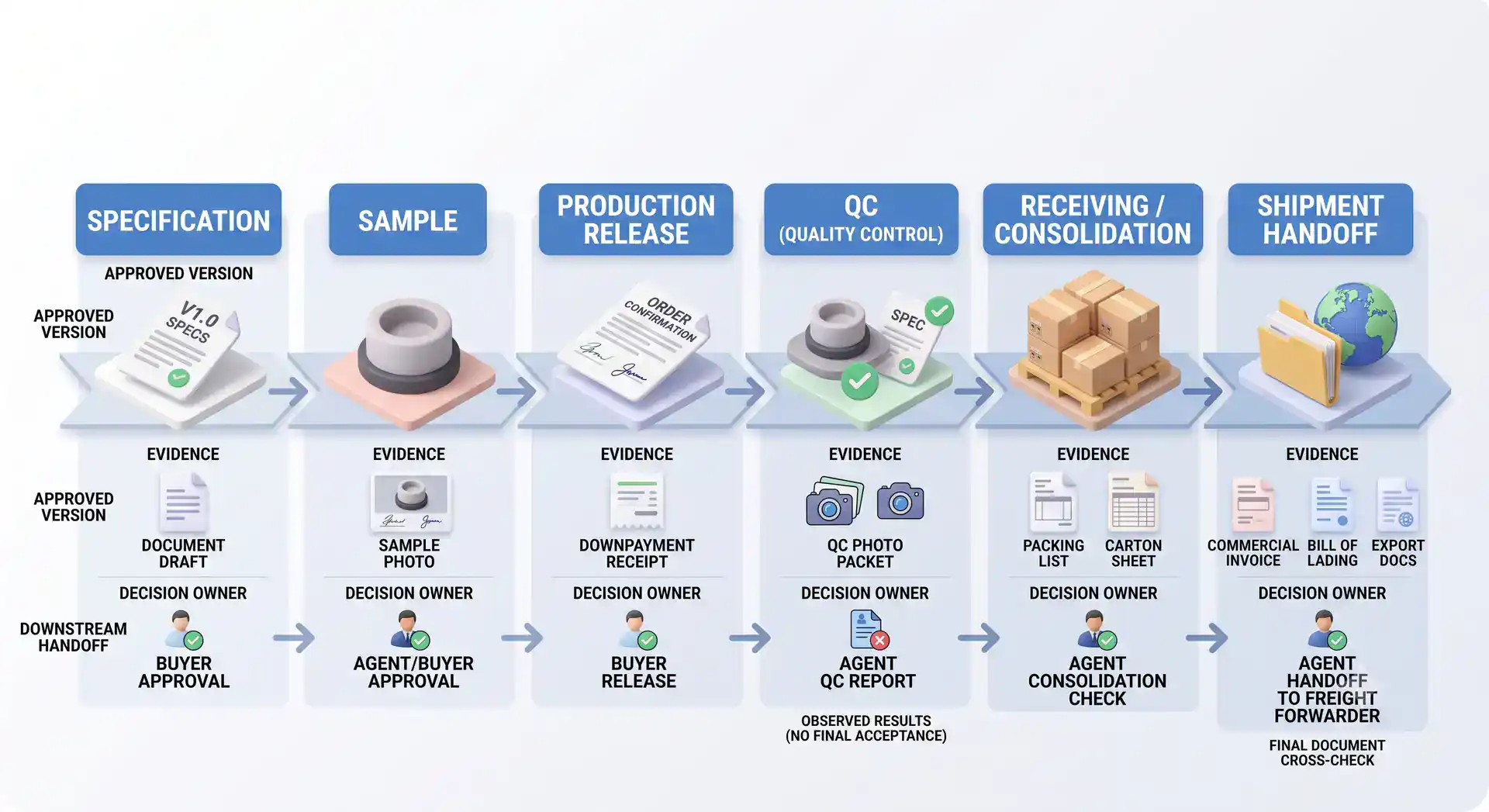
The matrix becomes more useful when it follows the order’s real movement.
Specification and supplier confirmation
The buyer supplies the commercial and product requirements. The agent converts unclear points into questions and confirms that the supplier has understood them. The supplier should identify feasibility limits, available options, and exclusions before the buyer treats the offer as a workable baseline.
Sample and artwork approval
Tie the physical sample and artwork proof to IDs. If a factory sends a second sample, record whether it is a correction, a new option, or a replacement baseline. Keep the buyer’s approval attached to the exact revision. This is especially important for private-label details that can look minor in a chat but matter once a production run begins.
Payment evidence and production release
The buyer controls the approval of the order and payment evidence that falls within its own process. The agent can check whether the visible order information matches the working specification and can ask the supplier to correct discrepancies. Production release should point back to the approved sample and specification, rather than relying on a verbal understanding.
For buyers using 1688 or another marketplace route, keep marketplace order evidence separate from the approval matrix. The matrix records who approved a sourcing decision; it does not replace platform terms, an invoice, a payment record, or a contract review.
QC, receiving, and shipment handoff
QC evidence should identify what was checked, which revision was used, what result was observed, and who owns an exception. A QC photo is useful only when someone can connect it to the item or checkpoint it represents. The buyer or authorized acceptance owner decides what to do with an exception; the agent coordinates the response; the supplier provides correction or explanation evidence.
At receiving or consolidation, reconcile the supplier’s carton information with the warehouse or handoff record. This is a later operational stage, so do not let a warehouse count retroactively approve a product or packaging change that still required buyer approval earlier. For related receiving and handoff planning, see the China warehouse handoff responsibility matrix and the multi-supplier carton traceability checklist.
Practical Checklist
Before production release, ask:
- Is there one current specification revision?
- Can the team identify the approved sample by code, photo, or date?
- Are material, color, component, logo, label, and packaging decisions recorded separately where needed?
- Does every controlled row have one named final approver?
- Does the supplier know which changes require a new approval?
- Does the agent know which coordination actions can proceed without buyer approval?
- Are price, quantity, and payment changes linked to a visible order record?
- Are open exceptions prevented from being treated as approval?
- Can the buyer find the evidence without searching every message?
- Is the production-release record tied to the approved revision?
Before shipment or consolidation, ask:
- Are QC results connected to the right SKU, sample, and specification revision?
- Are unresolved exceptions listed with an owner and next action?
- Are carton counts and marks reconciled against the supplier’s current record?
- Does the handoff record show who prepared, checked, approved, and received the information?
- Are commercial or transport documents cross-checked against the order information supplied by the buyer?
For a wider inspection workflow, the China pre-shipment inspection checklist and quality control service pages are useful internal references. They do not change the approval authority assigned in your matrix.
Where This Matrix Should Not Be Used as a Substitute
This record does not replace legal advice, a purchase contract, platform terms, customs advice, destination requirements, or a service agreement. It does not decide who is legally liable for a loss. It does not establish a warranty, guarantee a product result, or promise that a supplier will accept an exception.
It is also not a reason to give an agent unlimited authority. A well-run sourcing relationship depends on matching authority to evidence and to the buyer’s actual risk tolerance. A buyer may delegate routine coordination while retaining approval of specification changes, artwork, payment, production release, and material exceptions.
The matrix does not need to predict every possible problem. It needs to make the likely decision points visible and provide a route for anything unusual. If the order has special product, packaging, destination, or documentation requirements, write those requirements into the project record and obtain appropriate professional advice where needed.
FAQ
What is a China sourcing approval responsibility matrix?
It is a working table that assigns preparation, checking, approval, and notification responsibilities for decisions in a China sourcing order. It usually covers the overseas buyer, China sourcing agent or coordinator, and supplier or factory. It is an operational record, not legal advice.
The buyer or another role expressly authorized by the buyer should approve decisions that change the product brief, approved sample, specification, artwork, order quantity, price, payment evidence, or production-release baseline. The matrix should name one final approver for each row so a general group message does not become accidental approval.
Can a sourcing agent approve a supplier substitution?
Only if the buyer has expressly delegated that approval for the specific type of substitution and the matrix records the boundary. Otherwise, the agent should collect evidence, explain the difference, and request the buyer’s decision. Coordination authority and product-change approval are not the same thing.
Does supplier confirmation count as buyer approval?
No. Supplier confirmation can show feasibility, available options, or what the supplier intends to produce. It does not by itself show that the buyer approved the change or the final specification. Link both records when the supplier’s confirmation supports a buyer decision.
What should happen when a sample changes after approval?
Create a change or exception record, identify the old and new sample versions, describe the difference, collect focused evidence, and route the decision to the named approver. Keep production release tied to the version that was actually approved. If the evidence is unclear, mark the item pending or revise-and-resubmit rather than treating silence as approval.
Does RACI make the buyer legally responsible?
No. RACI is a project-operations format for clarifying who does what and who gives an internal decision. It is not a legal allocation of liability, a warranty, or a substitute for an agreement or professional advice.
Should QC approve the product?
QC can perform checks and report observed results. The person with acceptance authority decides how to treat an exception according to the buyer’s process. A QC report should therefore identify the checked revision and result, while the matrix records who makes the acceptance, rework, hold, or escalation decision.
What is the fastest useful version of the matrix?
Start with the order ID, the three party roles, ten to fifteen decision rows, one final approver per controlled row, the current revision, an evidence reference, and a pending-exception column. Expand it when the order includes multiple suppliers, packaging variants, destination data, or a warehouse handoff.
Work With a Clear Approval Trail
When an order is small, responsibility may feel obvious because everyone is in the same chat. As the order moves from a Yiwu market contact to a factory, an agent, QC, consolidation, and freight handoff, that assumption gets weaker. A short matrix keeps the team focused on the actual question: who prepares the evidence, who decides, and what exact version did they decide on?
If you need help organizing supplier communication, sample approval, quality checkpoints, or a China order handoff, start with the Yiwu order process and the 1688 supplier verification checklist. For a project-specific discussion, contact Style Sourcing with the product, suppliers involved, current approval stage, and the decisions that are still unclear. That gives the conversation a useful starting point without assuming that every order needs the same service arrangement.


