
Found three or four Chinese suppliers that look promising — but you only have one bulk-order budget?
Wondering how to actually compare their samples side by side without losing track of which one came from which supplier?
And whether you can ship those samples together in one small international parcel instead of paying four separate shipping fees?
That is a real problem for almost every first-time importer sourcing from China.
The mistake is not picking the wrong supplier. The mistake is picking a supplier without a clean way to compare samples at all.
This guide walks you through a practical China sample consolidation workflow — from receiving samples to making a bulk-order decision — so you can compare a manageable shortlist fairly, catch visible differences early, and decide whether a combined parcel makes sense.
Quick Answer: What Is China Sample Consolidation?
China sample consolidation is the process of:
- ordering samples from 2-4 (sometimes more) Chinese suppliers at the same time;
- receiving all the samples at one Chinese-side address;
- labelling each sample clearly with the supplier name, SKU, and date;
- comparing the samples side by side across material, finish, hardware, colour, packaging, and defects;
- documenting the comparison with photos;
- shipping all the samples together in one international parcel (or one consolidated shipment) to your overseas address.
The point is comparison and decision support, not just “get samples.”
Without this process, you usually end up:
- forgetting which sample came from which supplier;
- missing visible differences because the samples arrived at different times;
- paying 2-4 separate international shipping fees for tiny parcels;
- choosing a bulk supplier based on price, not based on actual side-by-side quality.
Why Sample Consolidation Matters Before You Place a Bulk Order
Most first-time importers underestimate how much the sample stage affects the bulk order.
Here is what usually goes wrong when samples are not consolidated properly.
1. You Cannot Compare Apples to Apples
If supplier A’s sample arrives this week and supplier B’s sample arrives next week, you are not comparing them under the same conditions.
- Humidity during shipping.
- The day you happen to open the parcel.
- The mood you were in when you looked at supplier A’s sample.
Side-by-side comparison — same day, same table, same lighting — gives you a more consistent basis for comparison.
2. You Miss Visible Differences That Should Have Killed the Deal
Suppliers send their best-looking sample. That is the job of a sample.
But sometimes the differences are still obvious once the samples are next to each other:
- one sample’s stitching is tighter than the others;
- one sample’s colour is slightly off from the listing photos;
- one sample’s hardware feels lighter or flimsier;
- one sample’s packaging is better protected than the others.
You usually only notice this when the samples are physically next to each other.
3. You Pay Too Much for Shipping Multiple Sample Parcels
A single Chinese sample to the US or Europe can cost almost as much as the sample itself.
If you order samples from several suppliers and ship them separately, you are paying for several international parcels.
If the samples are compatible and timing allows, consolidation can turn those parcels into one shipment. Compare the repacking, chargeable weight, handling, and destination requirements before assuming it will be cheaper.
4. You Make the Bulk Decision on Price Alone
Without a side-by-side comparison, it is very tempting to just pick the cheapest supplier.
But the cheapest supplier often has:
- thinner material,
- rougher finish,
- weaker hardware,
- worse packaging.
The bulk-order savings from the cheapest supplier can disappear quickly if material, workmanship, packaging, or defect performance is poor at destination.
The China Sample Consolidation Workflow: 7 Stages
Below is the practical workflow that works for most 2-4 supplier comparison situations. Adjust based on your product type and order size.
Stage 1: Decide Which Suppliers to Sample
Start with a manageable shortlist rather than an arbitrary universal number.
For a straightforward item, a small shortlist may be enough. A technically complex, high-risk, or highly customized product may justify a different number. The useful limit is the number you can compare against the same written specification without losing control of labels, evidence, cost, and timing.
Selection criteria before you sample:
- The supplier has a clear product category focus on 1688 or Alibaba.
- The supplier has responded clearly to your initial inquiry.
- The supplier can confirm the unit price, MOQ, sample fee, and lead time in writing.
- The supplier can ship to a Chinese warehouse (not only direct to overseas).
- The supplier’s response speed is acceptable.
If a supplier fails any of these, do not bother sampling from them. Sampling is not free.
Stage 2: Order Samples With Clear Specifications
Send each supplier the same written spec:
- Product name and SKU reference (your internal SKU, not the supplier’s listing code).
- Colour reference (Pantone if you have it, or a colour photo you send them).
- Size / dimensions / weight tolerance.
- Material preference.
- Hardware specifications (zipper type, button, lining, etc.).
- Logo / packaging requirements (if any).
- Quantity per sample.
- Where to ship the sample (Chinese warehouse address, not your overseas address).
Common mistake:
Asking 4 suppliers for “a sample of your product” and then trying to compare them. You will get 4 different versions of “the product.”
Stage 3: Receive Samples at a Chinese-Side Address
Each supplier ships their sample to one Chinese-side address — yours, your agent’s, or a 3PL warehouse.
What to record when each sample arrives:
- Supplier name.
- Date received.
- Number of pieces received vs ordered.
- Carton / packaging condition (photo).
- Supplier invoice or order sheet (keep with the sample).
Common mistake:
Letting each supplier ship direct to your overseas address. This kills the whole consolidation idea before it starts.
Stage 4: Label and Stage Each Sample
The single most important step in sample consolidation is labelling.
Each sample should be tagged with:
- Supplier name or code (e.g., S1, S2, S3, S4 if you want to keep it anonymous).
- Date received.
- SKU / variant.
- Any deviation from spec (note it here, even small ones).
Lay the labelled samples out on one table, in one lighting condition, with the same camera angle.
If you want to compare them blind (without seeing the supplier name), cover the labels with sticky notes.
Stage 5: Side-by-Side Comparison

[Image placement — Body image 1: S1–S4 comparison matrix for material, stitching, hardware, colour, packaging, and visible defects. Recommended alt: “side-by-side supplier sample comparison matrix for material stitching hardware colour packaging and defects”]
Use a fixed comparison matrix. Below is a reusable template:
| Item | S1 (Supplier 1) | S2 (Supplier 2) | S3 (Supplier 3) | S4 (Supplier 4) |
|---|---|---|---|---|
| Material (touch, weight, smell) | ||||
| Stitching (tightness, evenness, loose threads) | ||||
| Hardware (zipper, button, buckle, ring) | ||||
| Colour (vs reference photo / Pantone) | ||||
| Size (vs spec dimensions) | ||||
| Finish (rough edges, glue marks, paint chip) | ||||
| Inner packing (polybag, foam, divider) | ||||
| Outer packing (carton protection, label) | ||||
| Visible defects (any) | ||||
| Sample lead time (days from order to receive) | ||||
| Communication clarity during order |
Photograph each comparison:
- One wide shot of all samples.
- One close-up per category (material, stitching, hardware, colour).
- One photo of any visible defect.
This photo set is your evidence base for the bulk-order decision — and it is also useful when negotiating with the supplier you choose.
Stage 6: Raise Exceptions and Ask for Resamples

[Image placement — Body image 3: four generic red-flag sample details showing size mismatch, colour drift, hardware tarnish, and packaging dent. Recommended alt: “red flag supplier sample examples including size mismatch colour drift hardware tarnish and packaging damage”]
If the comparison reveals that one supplier’s sample is off-spec (wrong colour, wrong size, visible defect), raise it before paying for the bulk order.
What to do:
- Send the supplier your comparison photos.
- Quote your spec (with your original message and their original reply).
- Ask whether they can re-sample against the spec.
A reliable supplier will:
- acknowledge the deviation,
- explain whether it is a one-off or a production trend,
- offer a re-sample if needed.
A risky supplier will:
- blame the photo,
- blame the lighting,
- ask you to pay for another sample,
- or go silent.
The way a supplier handles a sample-stage exception is one of the best predictors of how they will handle bulk-order exceptions.
Stage 7: Ship All Samples in One Parcel
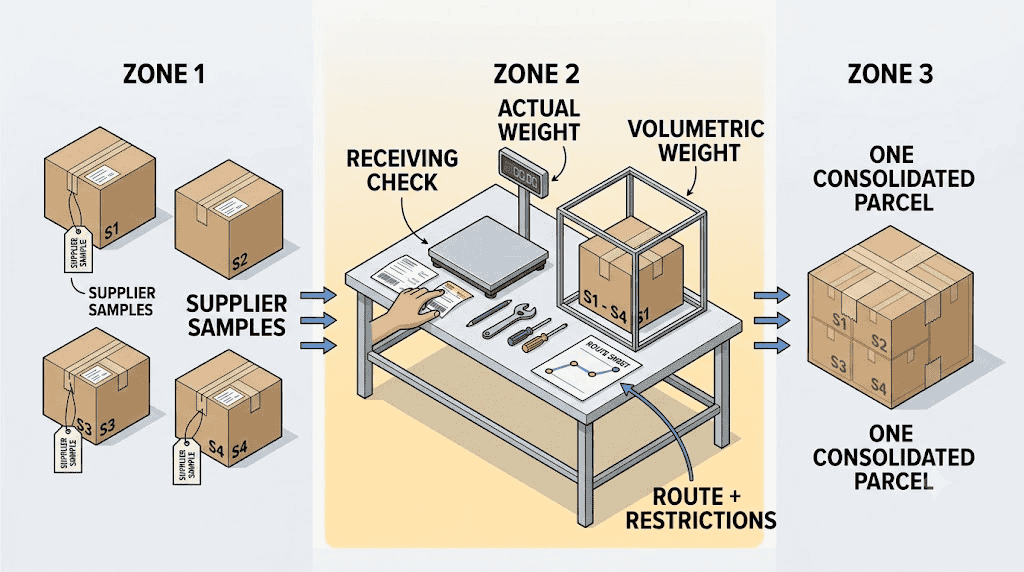
[Image placement — Body image 2: several labelled supplier sample parcels moving through one consolidation point into a combined international parcel. Recommended alt: “samples from multiple Chinese suppliers consolidated into one international parcel”]
After comparison and decision (or even before the decision if you want to keep the samples for later reference), ship all the labelled samples together in one consolidated international parcel.
Possible modes:
- international courier for compact or urgent sample shipments;
- air freight or another air service when courier chargeable weight is less suitable;
- a sea or consolidated freight option when samples are bulky, non-urgent, and accepted by the provider.
Ask the provider to compare actual weight, volumetric weight, minimum charges, transit route, product restrictions, customs documents, and destination handling.
Common mistake:
Accepting separate international dispatches without comparing them against a China-side consolidation option. Consolidation is useful only when the samples, timing, route, and handling requirements are compatible.
Sample Comparison Decision Record — Approve the Batch, Not Just the Sample
Before placing a bulk order, keep each supplier sample comparable in one decision record. The goal is not to collect attractive samples; it is to show why one sample is approved for production and what evidence still blocks the order.
| Comparison field | Record for every sample | Bulk-order decision |
|---|---|---|
| Identity and construction | Supplier code, material, construction method, dimensions, tolerance, hardware, and finish | Pass only when the sample matches the same product brief and the differences are understood |
| Commercial and delivery terms | Sample fee, quoted unit price, MOQ, lead time, packaging, and included revisions | Record whether the quote is comparable or requires a revised written offer before approval |
| Evidence and exceptions | Photo set, defect notes, measurement results, packaging proof, resample decision, and named approver | Release the bulk order only when open gaps have an owner, due date, and written disposition |
Keep the approved sample code, final specification, and supplier reply tied to the purchase order. If a material, dimension, finish, packaging, or supplier changes after approval, reopen the comparison instead of treating the old sample as automatic bulk-order approval. For the next handoff, keep the final sample and evidence trail together with the China Sourcing Evidence Trail.
Sample Consolidation vs Bulk-Order Consolidation
It is easy to confuse sample consolidation with bulk-order consolidation. They are different stages.
| Aspect | Sample consolidation | Bulk-order consolidation |
|---|---|---|
| When | Before bulk order | After bulk order is produced |
| Quantity | A few units per supplier | Cartons per supplier |
| Purpose | Compare suppliers side by side | Combine multiple supplier shipments into one export |
| Shipping cost weight | Smaller, but per-parcel cost is high | Larger, per-kg cost matters more |
| Failure mode | Picking the wrong supplier | Paying too much for fragmented international freight |
A full bulk-order consolidation guide is a separate article. Sample consolidation is the earlier, smaller-scale version of the same idea.
What a Good Chinese-Side Sample Consolidation Partner Does
If you do not have a Chinese-side address or warehouse, the practical way to do sample consolidation is to ask a sourcing agent or 3PL warehouse to receive the samples on your behalf.
A good partner for this stage will:
- Provide a Chinese warehouse address for samples to be sent to.
- Receive each supplier’s sample shipment and log it (supplier, date, piece count).
- Photograph external carton condition on arrival.
- Store samples in a clean, dry area until you give the next instruction.
- Open, label, and stage the samples on request.
- Take side-by-side comparison photos if you ask.
- Consolidate the samples into one international parcel and provide a packing list.
- Hand off to your chosen international courier or freight provider.
If you want help at this stage, send the supplier list (and what you are sampling for) to Style Sourcing, and we can walk through what makes sense for your specific case.
Common Mistakes Buyers Make at the Sample Stage
Below is a quick list of mistakes that compound if you do not consolidate samples properly.
- Sampling from more suppliers than you can compare properly. A larger shortlist adds work, cost, and labelling risk unless each sample tests a meaningful difference.
- Letting each supplier ship direct to your overseas address. You lose the ability to consolidate.
- Not labelling samples clearly. Within a week, you cannot remember which one was supplier A.
- Comparing samples that arrived weeks apart. Conditions and your mood have changed.
- Skipping the comparison matrix. You end up choosing on gut feel, not on data.
- Paying for resamples without negotiating. If a sample is off-spec, ask first whether the supplier will cover the cost.
- Picking the supplier with the lowest sample price. The sample price usually does not predict the bulk price accurately.
How Style Sourcing Can Support Sample Consolidation
If you want a Chinese-side team to handle parts of this, Style Sourcing can support the practical steps.
The kind of support that fits:
- Provide a Chinese warehouse address for samples.
- Receive samples from 2-4 suppliers and log them.
- Label each sample with supplier code, SKU, and date.
- Take side-by-side comparison photos.
- Flag visible deviations from your spec.
- Repack all samples into one international parcel.
- Hand off to your chosen international courier.
If this sounds useful, send the supplier list (or links) to Style Sourcing, and we can map the workflow for your specific order.
No fee, timeline, or outcome is guaranteed. The exact scope depends on the number of samples, product type, and destination.
FAQ
How many suppliers should I sample from one product?
Use the smallest shortlist that still gives you meaningful alternatives. The right number depends on product complexity, customization, supplier differences, budget, and how many samples you can compare under one specification.
How long does the sample stage usually take?
There is no universal timeline. It depends on whether the sample is stock or customized, the suppliers’ dispatch dates, domestic delivery, comparison or resampling work, consolidation instructions, international transport, and destination clearance. Ask each party for the current milestone rather than relying on a generic promise.
Can I keep the supplier names anonymous when comparing samples?
Yes. Many buyers label samples as S1, S2, S3, S4 and only reveal the supplier name after the comparison. This reduces bias when comparing.
What if one supplier refuses to ship to a Chinese warehouse?
Ask for the reason and the applicable sales or delivery terms. It may reflect channel rules, payment protection, product restrictions, or the supplier’s own process. Treat an unexplained refusal as a comparison factor, but do not assume it proves misconduct.
Is sample consolidation worth it for low-value products?
It depends on parcel count, size, chargeable weight, handling, timing, and the value of a side-by-side comparison. Compare the total separate-shipment cost with the consolidation and repacking quote before deciding.
What if I decide not to bulk order from any of them?
That is a valid outcome. Sample consolidation is supposed to save you from a bad bulk order, not push you into one. If none of the samples meet your spec, walk away and re-sample.
Suggested Next Steps
- If you have not yet picked suppliers, narrow to 2-4 candidates with clear specs.
- If you have already placed sample orders, prepare a Chinese-side receiving address.
- If you want a Chinese-side team to handle receiving, labelling, comparison, and combined shipment, send the supplier list to Style Sourcing.
Service Bridge
This workflow helps you compare supplier samples before placing a bulk order; it does not verify suppliers or guarantee product quality, shipping costs, or delivery times.


