
Answer first. A Bao66 bag order has three operational levers an overseas buyer can document: the usable MOQ and specification for the exact version, the payment evidence tied to the quote, and the China-side receiving-to-export handoff for the goods. Put each one in writing before money moves so everyone has the same reference. If one remains unclear, record the uncertainty and decide whether to proceed before it affects the next handoff. This article is the order-execution lane for those three levers on Bao66 — it is not a full buying guide, not a platform-safety review, not an agent-decision page, and not a customs or freight guide.
This page stays inside the MOQ, payment, and shipping lane for Bao66. Use How to Buy from Bao66 as a Foreigner for the complete purchase sequence, Is Bao66 Safe? for supplier verification, and Do You Need a Bao66 Sourcing Agent? for the partner-versus-self-run decision. The 1688 equivalents are linked later. Keeping those tasks separate lets this article concentrate on the three order terms that need a clean handoff.
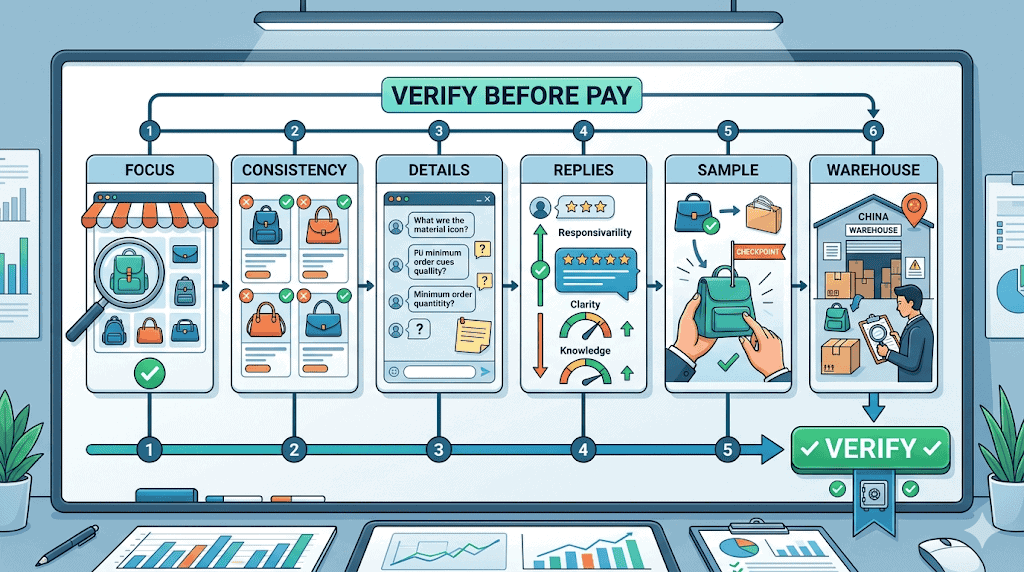
The three operational levers, in the order a buyer should think about them
The three levers are not the same shape, and they do not unlock at the same point in the order. Each lever has its own section below; this block is the map.
- Usable MOQ and specification — the version, the quantity, the packaging, and the customization that actually trigger the supplier’s bulk production. Covered in Usable MOQ and specification.
- Documented-payment evidence — the written quote, the agreed terms, and the payment path that produces a receipt. Covered in Documented-payment evidence checklist.
- China-side receiving to export handoff — where the goods are sent inside China, how they are checked and consolidated, and how they reach the freight forwarder. Covered in China-side receiving to export handoff.
Each lever feeds the next. An unclear MOQ discussion produces an unclear quote, and a quote that is not tied to the payment record is harder to reconcile if the receiving handoff finds an off-spec carton.
Usable MOQ and specification: what a buyer should pin down before placing a paid bulk order
The MOQ shown next to a listing may not cover the exact version you want to buy. Ask the supplier to quote one defined configuration: material, quantity, color mix, packaging, customization and China delivery point. That written reply—not an assumption about the listing—is the usable MOQ for the order you are evaluating.
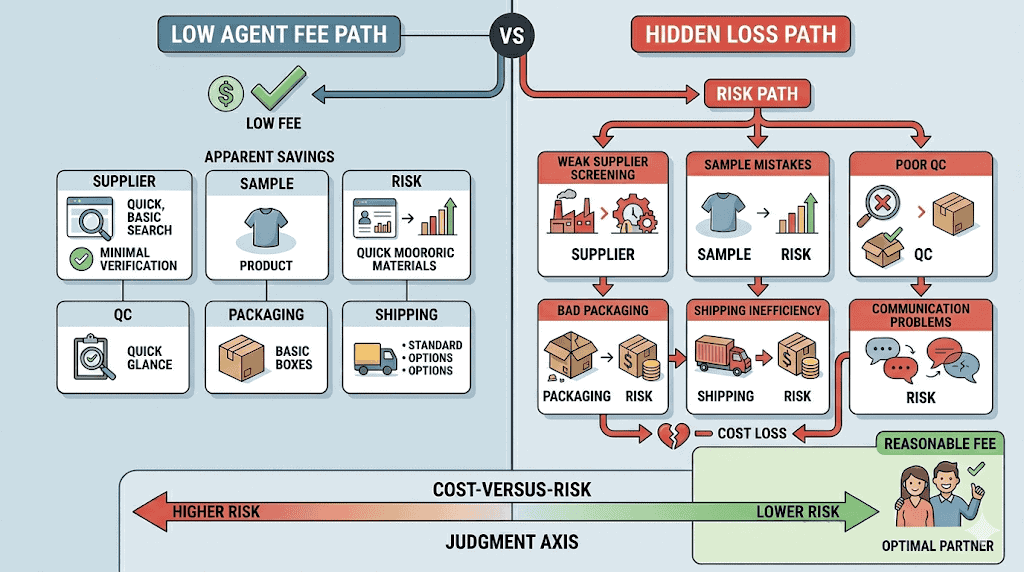
The table below is what to pin down before paying a bulk deposit. The right-hand column is the limit of what pinning each item down actually achieves — the table does not pretend that pinning the MOQ solves the supplier’s willingness to hold to the spec under production pressure.
| Pin-down item | What the buyer is locking in | What it does not solve |
|---|---|---|
| Version (material, color, hardware, lining) | The exact SKU and reference, not just a category | Whether the bulk run matches the sample without follow-up |
| Quantity tier | The number of pieces that triggers the quoted price | Whether mixed sizes or mixed colors inside the tier are charged at the same rate |
| Packaging (inner packing, polybag, carton) | Whether each piece has its own polybag, how many pieces per inner pack, pieces per export carton | Whether the export carton will actually protect the goods on the truck to the warehouse |
| Customization (logo, label, hangtag) | The customization method (printed plate, embossed plate, sewn label), the file format, the color count | Whether the customization will hold to the same reference across the bulk run |
| Mixed colors / mixed sizes | Whether the supplier will produce the colorway split at the same unit price | Whether the supplier can keep the color run consistent across cartons |
| Lead time stated in working days | A starting production window from deposit to “ready to dispatch from supplier” | Whether the goods actually leave the supplier on the agreed day, or get queued |
| Sample-to-bulk consistency note | The buyer’s written observation that the sample is the reference | Whether the supplier will hold to that reference without a recheck |
None of these are universal numbers. They are the items a buyer should pin in writing per product, per store, per version. A supplier may change the quoted MOQ when the version, packaging, customization or timing changes. Confirm those variables in writing rather than treating the listing number as final.
Documented-payment evidence checklist
For this order, treat payment as an evidence chain—quote, terms, payment path and receipt—rather than assuming one method or percentage split applies to every supplier. The checklist below is a practical evidence set to review before a deposit or balance moves. It does not promise a universal split, a universal method, or a universal currency path; those decisions are between the buyer, the supplier, and the China-side partner the buyer works through.
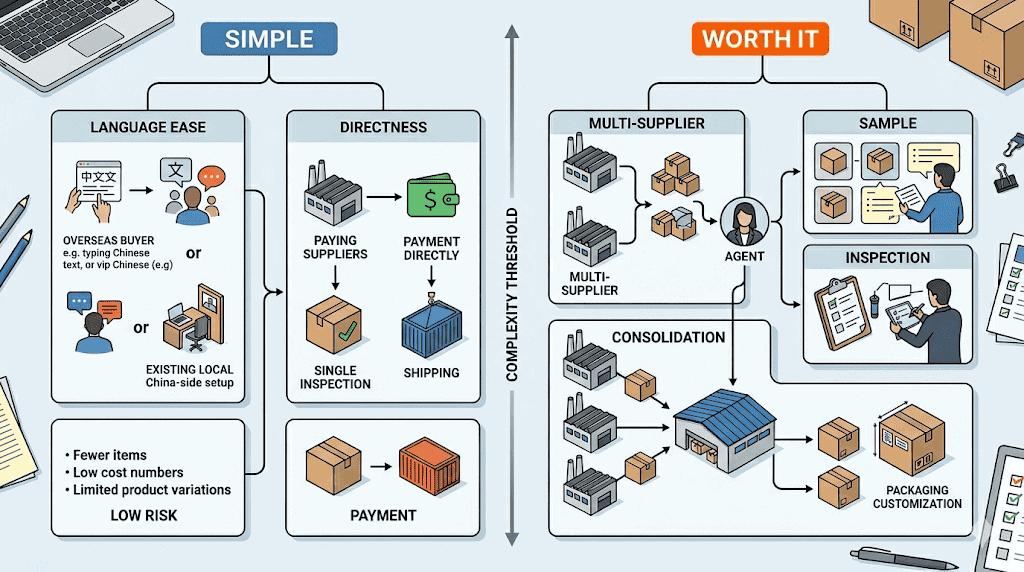
- Written quote tied to the agreed version, quantity, packaging, and customization, with a clear expiry. A verbal quote is difficult to verify later; if a written quote has expired, ask the supplier to reconfirm it before paying.
- Agreed terms in the same document as the quote — what the deposit covers, what triggers the balance, what happens if the bulk run misses the agreed spec, and what happens if the goods are delayed past the stated lead time.
- Payment path that produces a receipt — a bank statement line, a card statement line, a payment-platform transaction record, or a domestic payment-platform receipt, depending on the path used. “I sent it” is not the same evidence as a dated receipt with a counterparty reference.
- Counterparty reference that matches the supplier’s business name — the name on the receipt should match the registered company name on the supplier’s business license, or match the documented payment-counterparty name the supplier has confirmed in writing. Mismatches are not necessarily a problem; unrecorded mismatches are.
- Currency path recorded in writing — whether the buyer paid in the buyer’s currency and the supplier received in RMB, or whether a domestic payment-platform handled the conversion, and at what conversion cost the buyer agreed in advance. The conversion number is case-specific and not part of this article.
- Balance release linked to a defined event — sample approval, pre-shipment inspection, photo proof, or goods-at-warehouse confirmation. If “on dispatch” is the trigger, define what evidence confirms dispatch and keep it with the order record.
- A copy of the agreed specification kept with the receipt — the same document the supplier’s bulk run is checked against later, kept on the buyer’s side before the balance moves.
A workable payment record ties the agreed quote and terms to a dated receipt. Do not assume that a payment split, method or currency applies platform-wide; confirm the actual counterparty, release event and payment path for this supplier and order.
China-side receiving to export handoff: who handles what, where things tend to slip
The third lever is the China-side receiving-to-export handoff. If your order uses a Yiwu warehouse, sourcing office or forwarder receiving point, write that address and its receiving instructions into the supplier handoff before dispatch.
The matrix below names each handoff step, what is checked or produced there, and what still needs confirmation. It uses plain domestic-delivery wording. Ask the supplier what its quote covers, then ask the freight or customs professional where the international handoff and destination-document responsibilities begin.

China-side receiving to export handoff matrix
| Handoff step | What is checked or produced | Where it tends to slip |
|---|---|---|
| Supplier dispatches to the China-side address | A dispatch note with carton count, weight, and tracking | Carton count on the dispatch note differs from the actual count on arrival |
| Receiving warehouse logs cartons in | A warehouse receipt with carton count, weight, dimensions, and any visible damage | Visible damage is noted by the warehouse but not photographed before the carton is opened |
| Buyer or China-side partner opens sample cartons | A pre-inspection read against the locked specification — material, color run, hardware, stitching, lining, polybag, inner pack, export carton | Sample cartons look fine but the bulk cartons inside have not been spot-checked |
| Pre-shipment inspection | A documented inspection record with photo evidence, observed defects, and a decision against the buyer-defined accept/reject criteria | Inspection is skipped because “the supplier is trusted” or because the timing window is tight |
| Consolidation with other orders, if any | A consolidated carton list, total weight, total volume, and a packing plan for the export carton | Mixed orders are shipped as separate parcels to the same destination instead of consolidated |
| Repacking for export (if needed) | Export-carton dimensions, inner packing, marking, and label per the destination country’s import rules | Repacking is skipped and the original domestic cartons ship out, which can complicate the destination side |
| Export document handoff | Commercial invoice, packing list, and any destination-required documents handed to the freight forwarder | Document data does not match the confirmed product or consignee details; the freight or customs professional must verify destination-required entries |
| Freight booking and dispatch | A booked freight slot with the freight forwarder, an ETD, and a tracking reference | Freight is booked before the inspection record is reviewed, so a rejected lot still leaves China |
A China-side receiving point gives the buyer an opportunity to count and inspect before export. Without a named receiving address, a defined inspection step or a consolidation record, discrepancies may remain unnoticed until a later handoff.
Questions to send a Bao66 supplier about MOQ, payment, and shipping
A short list of questions to send a Bao66 supplier about the three operational levers can be sent in one message and pinned in writing before the deposit moves. Each question ties back to a section in this article.
- What is the usable MOQ for the version we agreed on, including packaging, logo, and mixed-color split? (See Usable MOQ and specification.)
- What is the bulk lead time in working days from deposit to “ready to dispatch from your warehouse”? (See Usable MOQ and specification.)
- What is the written quote for that MOQ, including the packaging breakdown and the customization charge if any? When does the quote expire?
- What is the payment path you can receive on, in what currency, and what is the agreed conversion path if I pay in my currency? (See Documented-payment evidence checklist.)
- At what defined event is the balance released — sample approval, pre-shipment inspection, photo proof, or goods-at-warehouse?
- What is the receiving address you will dispatch to, and what is your usual dispatch note format (carton count, weight, tracking)? (See China-side receiving to export handoff.)
- Can you share a photo of an export carton for a previous similar order, including pieces per carton and carton dimensions?
- Is your business license name the same as the storefront name, or different? (Mismatch is not necessarily a problem; unrecorded mismatch is.)
Use these questions as a starting set and adapt them to the product. The important point is to keep the supplier’s MOQ, payment and delivery answers in the order record.
Red flags worth slowing down for
The red flags below are operator-side observations about the three operational levers. A single signal is not a verdict. A pattern of unresolved answers after a written follow-up is a reason to pause and decide whether this supplier can support the exact version.
- The supplier cannot state the usable MOQ in writing for the version, packaging, and customization a buyer intends to order. If the reply only repeats the displayed MOQ, the exact configuration is still unconfirmed.
- The written quote expires faster than the buyer’s decision window, or the supplier refuses to put a version-specific quote in writing at all.
- The payment path requires a method the buyer cannot produce a receipt for — a transfer to an unrelated name, a third-party wallet not on the supplier’s business license, or a path that produces no dated counterparty reference. The path itself is not the issue; the receipt is.
- The balance release event is undefined, or is defined only as “on dispatch” with no inspection or photo gate.
- The supplier will not commit to a China-side dispatch address in writing, or only commits to a vague “to your forwarder” without naming a city or a warehouse.
- The supplier resists a pre-shipment inspection as a documented step in the order, or proposes to skip the sample carton opening on arrival.
- Communication slows or shifts the moment MOQ numbers, payment receipts, or dispatch addresses come up. The shift itself is a signal, not a verdict.
- The supplier cannot describe the dispatch record it will provide for the named China receiving address.
A red flag here is a reason to slow down, ask again, or ask a different person at the supplier. It is not a reason to walk away from a domestic platform on its own.
When this lane hands off to a partner or to a sibling guide
Three adjacent lanes already exist on this site, and each owns a question this article deliberately does not.
- The purchase-execution lane at How to Buy from Bao66 as a Foreigner (Post 12849) owns the full order sequence from product brief to export. This article assumes the buyer is already past the brief and shortlist and is now placing a paid bulk order.
- The supplier-verification lane at Is Bao66 Safe? How to Verify Bag Suppliers on Bao66 (Post 12854) owns the pre-payment check on the supplier itself. This article assumes the supplier has been read at least at the basic level and the buyer’s question is now about the three operational levers.
- The agent decision lane at Do You Need a Sourcing Agent to Buy from Bao66? (Post 12858) owns the question of whether to run the China-side receiving and inspection step alone or with a partner. This article stays neutral on that decision; it works either way.
- The 1688-specific lanes at 1688 MOQ Explained (Post 12753), How to Pay 1688 Suppliers from Overseas (Post 12738), How to Ship from 1688 to Your Country (Post 12740), and How to Consolidate Orders from Multiple 1688 Suppliers (Post 12812) cover similar operational questions for that platform. Confirm the relevant listing, supplier and order terms there rather than transferring assumptions from Bao66.
If the buyer’s question starts with “is Bao66 safe”, “how do I place the order”, “do I need an agent”, or “how do MOQ, payment, and shipping work on 1688 instead”, the right lane is one of those pages. This page is the lane in between: the supplier has been shortlisted, the buyer is about to place a paid bulk order, and the three operational levers are the next conversation.
FAQ: Bao66 MOQ, payment, and shipping
What is the real MOQ on Bao66? The usable MOQ is the supplier’s written quantity for the version a buyer intends to order, including any packaging, logo and color split. The listing figure may not cover those variables, so confirm them before paying. Pin the usable MOQ in writing before the deposit moves. See the Usable MOQ and specification section.
How should an overseas buyer pay a Bao66 supplier? On whatever payment path the buyer, the supplier, and the China-side partner have agreed, in writing, and that produces a receipt with a counterparty reference. Do not assume a platform-wide payment split, method or currency. Confirm the terms and counterparty for the specific supplier and order. The Documented-payment evidence checklist lists the evidence the buyer should hold.
Can Bao66 ship directly overseas? Ask whether the supplier can arrange overseas dispatch and what that quote includes. If you use a China-side receiving point, define its inspection, consolidation and freight handoff before the supplier ships. The China-side receiving to export handoff section walks through it.
Do I need a sourcing agent to handle MOQ, payment, and shipping on Bao66? Whether to run the China-side receiving, inspection, and consolidation step alone or with a partner is a separate decision. The three operational levers work either way; what changes is who holds the receiving address, who opens the cartons, who negotiates the quote, and who books the freight. The decision is covered in the agent-decision lane (Post 12858). This article stays neutral on it.
Does this advice apply to 1688? The same three questions also matter on 1688, but use the 1688-specific guides for that platform and confirm every supplier-specific term rather than transferring assumptions from Bao66. The 1688-specific lanes are linked in the When this lane hands off section.
If the buyer is already past the supplier shortlist and wants a Yiwu-based team to take on the China-side receiving, the inspection step, or the consolidation-and-export handoff for a Bao66 bag order, start at the Bao66 Bag Sourcing Service for Overseas Buyers page and tell the team which of the three levers you would like help with.


