
Amazon FBA Prep and Labeling 2026: Supplier-to-3PL Responsibility Checklist
Your supplier says the cartons are “Amazon ready.” The 3PL says it will check the labels. Your shipment plan is open, but nobody has written down who owns the final unit prep, who verifies the label-to-SKU match, or what happens when an exception appears. Who is actually signing off before the inventory moves?
That handoff became more important on January 1, 2026. Amazon’s official SP-API changelog says prep and item-labeling services for FBA shipments are no longer available in the US marketplace. The change covers inventory sent directly to FBA and inventory moving through Amazon Warehousing and Distribution, Amazon Global Logistics, Amazon SEND, or the Supply Chain Portal.
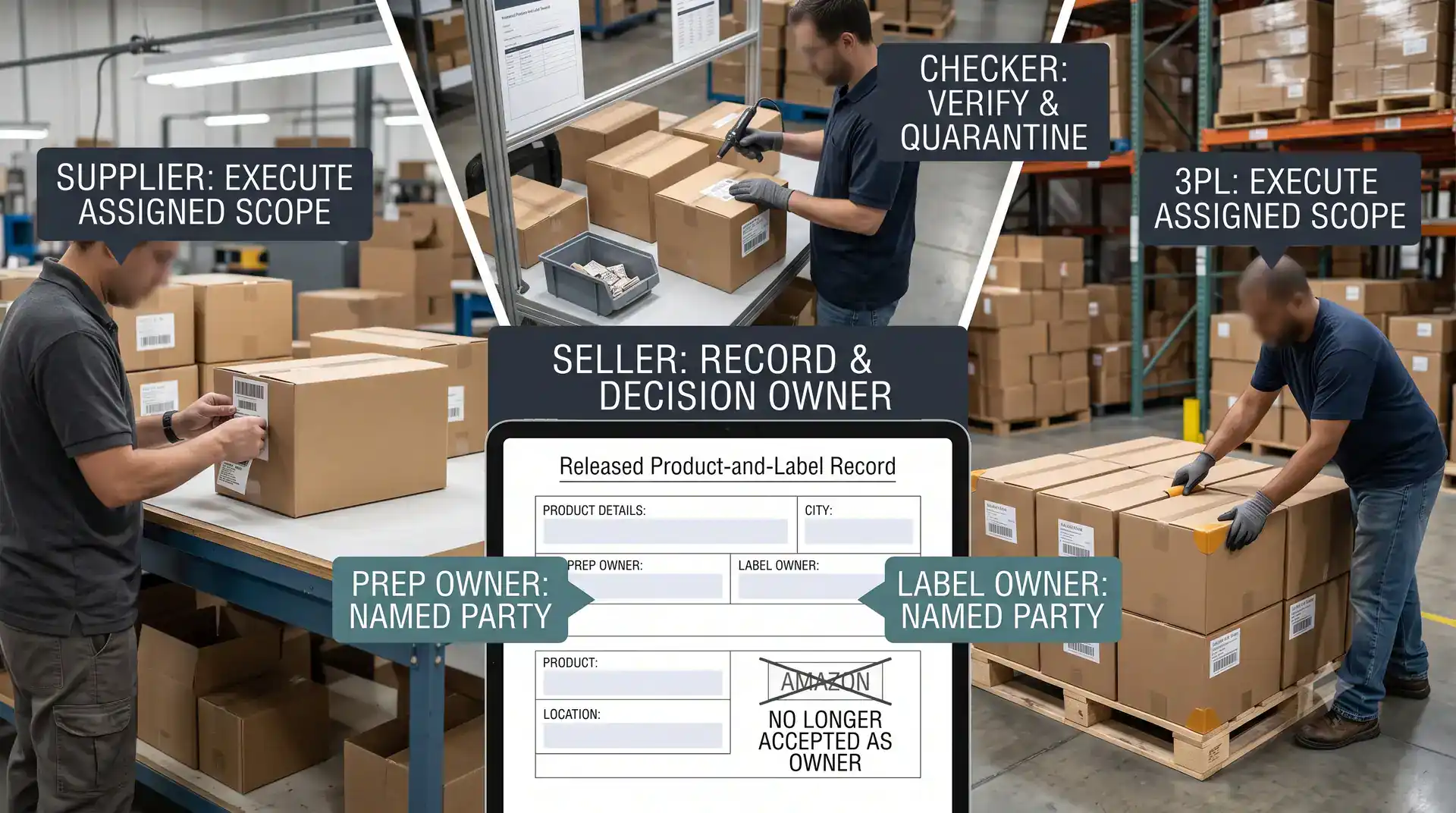
The practical response is not to replace one vague promise with another. It is to create a named prep owner, a named label owner, a verification checkpoint, and an evidence file for every shipment.
Quick Answer: Who Owns Amazon FBA Prep and Labeling in 2026?
Amazon no longer performs US FBA prep and item labeling as a selectable owner under the cited change. Your operating team must assign those jobs before shipment. The seller remains responsible for making sure the inbound plan, product record, labels, packaging instructions, and service-provider handoffs are consistent, even when a supplier or 3PL performs the physical work.
| Control | Supplier in China | China-side checker or warehouse | 3PL / prep center | Seller account team |
|---|---|---|---|---|
| Product and packaging specification | Produces to the approved record | Checks the received goods against it | Uses it for final prep | Owns the approved version |
| Unit prep | Performs only the assigned steps | Verifies or completes assigned steps | Performs final steps if contracted | Assigns the prep owner |
| Item label application | Prints or applies only from controlled files | Checks SKU-to-label match | Applies or replaces if contracted | Exports and controls label files |
| Shipment-plan data | Not the source of truth | Uses the seller’s released packet | Uses the seller’s released packet | Creates and releases it |
| Exception decision | Stops and reports | Quarantines and reports | Quarantines and reports | Approves rework, relabeling, or hold |
| Evidence | Production and packing proof | Receiving and check proof | Final-prep and dispatch proof | Keeps the shipment record |
This matrix is a starting point, not an Amazon eligibility decision. The exact prep rules vary by product, packaging type, program, and current Seller Central instructions.
Amazon FBA Prep and Labeling 2026
Amazon’s changelog makes three points that should anchor the workflow:
- Date: US FBA prep and item-labeling services ended on January 1, 2026.
- Scope: The change applies to inventory sent directly to US FBA and inventory that passes through AWD, AGL, Amazon SEND, or the Supply Chain Portal.
- System boundary:
AMAZONis no longer an accepted value forprepOwnerorlabelOwneracross Fulfillment Inbound API operations in the US marketplace.
The changelog tells developers to remove any code that statically identifies Amazon as the prep or label owner. Operationally, that is a useful warning for sellers too: do not leave those responsibilities implied. Put a real party and a real checkpoint behind each task.
The changelog does not publish a universal prep price, 3PL fee, acceptance time, reimbursement result, or correction outcome. It also does not say that a supplier or 3PL automatically becomes the legal or platform-responsible party merely because it performs the work.
Start With One Released Prep Packet Per SKU

The most common failure is not a worker forgetting to place a sticker. It is two locations using two different versions of the instruction.
Create one released prep packet for each SKU or product configuration. At minimum, include:
- seller SKU and product identifier used in the inbound workflow;
- clear product description and variation name;
- approved product photos from several angles;
- unit dimensions and weight as measured or confirmed for the shipment record;
- unit-packaging method and material;
- barcode or item-label file released by the seller account team;
- exact label placement photo or diagram;
- any set, multipack, bundle, or suffocation-warning instruction that the seller has verified for the product;
- carton quantity and carton-marking instruction;
- inspection sample size or check scope, if a check has been ordered;
- version number, release date, and name of the person who approved the packet;
- stop conditions for an unclear label, mixed variation, damaged unit, changed packaging, or inconsistent quantity.
Do not ask a factory worker to infer Amazon prep from a product link. Do not let the supplier download a label from an old chat thread. Do not let the 3PL “fix whatever looks wrong” without recording what it changed.
For product specification control before samples or bulk production, connect this packet to the separate factory-ready specification workflow. Prep instructions do not replace a product specification.
Separate Prep Ownership From Label Ownership
Prep and labeling are related, but they are not the same control.
Prep ownership covers the assigned physical work needed to present the product in the condition required for the inbound shipment. Depending on the verified product rule, that may involve bagging, sealing, bundling, protective material, set marking, or another product-specific step.
Label ownership covers the controlled link between a released label file and the correct sellable unit. It includes file control, print quality, placement, coverage of conflicting barcodes when required by the applicable instruction, and verification that the label belongs to the right SKU and variation.
A supplier can own unit prep while a 3PL owns final labeling. A supplier can apply both while a China-side checker verifies the work. A 3PL can perform both after receiving unprepped goods. Any of those arrangements can be workable if the responsibilities and evidence are explicit.
The risky arrangement is: “supplier prepares it, 3PL checks it, seller uploads it.” That sentence does not say which version of the file is used, how many units are checked, who can authorize relabeling, or where rejected units wait.
Build a Controlled Label Handoff
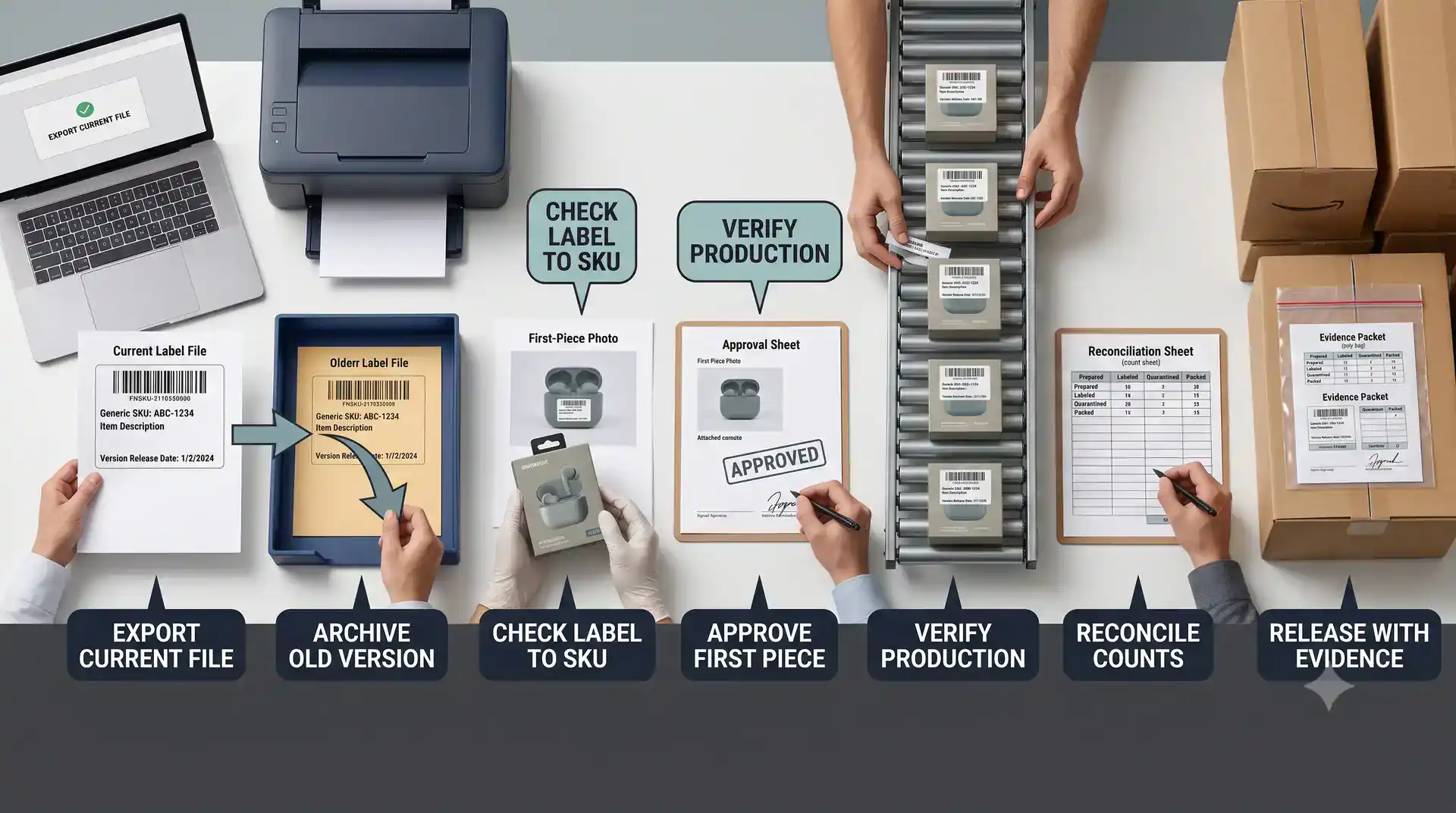
Use this sequence whenever a seller-account label file moves to a supplier, warehouse, or 3PL.
- Export from the current shipment workflow. The seller account team names the file with SKU, variation, shipment or batch reference, and release date.
- Lock the released version. Put obsolete label files in an archive that production staff cannot use by accident.
- Send a visual placement standard. Show the correct unit, label position, orientation, and any barcode that must remain visible or be covered under the current verified instruction.
- Run a first-piece check. The physical prep location sends a clear photo of the first prepared and labeled unit beside the product reference.
- Approve or reject in writing. Silence is not approval. Record the decision and the packet version.
- Check production output. Use the agreed check scope and record the units or cartons sampled. This is not a guarantee that every unit is correct.
- Reconcile counts. Prepared units, labeled units, quarantined units, and packed units must add up.
- Release cartons only after evidence is complete. Save the final photos, count sheet, carton records, and dispatch reference in one shipment folder.
This is the same version-control principle used in a strong packaging approval checklist: one approved standard, one dated release, and a visible exception path.
Responsibility Matrix for Supplier, China Checker, 3PL, and Seller
Seller account team
The seller account team controls the inbound plan and releases the current product and label records. It confirms which party is assigned to prep and labeling, checks that the service agreement matches the operating plan, and decides what happens to exceptions. It should not expect a supplier or 3PL to interpret an account screen it cannot access.
Supplier
The supplier performs only the prep and labeling steps included in the released purchase-order or work instruction. It reports material, dimensions, packaging, quantity, and production changes before applying labels to the full batch. If the supplier is not the final verification point, it hands the goods and its evidence to the checker or 3PL without calling the shipment complete.
China-side checker or consolidation warehouse
The checker verifies the received SKU, visible product and package condition, count, label-to-SKU match, label placement, and carton traceability within the assigned scope. It quarantines mismatches instead of making an undocumented correction. Receiving is not automatically a full quality inspection; keep those scopes separate with a warehouse receiving versus QC checklist.
Third-party prep center
The 3PL performs the contracted final prep or labeling work, records changes, and confirms the dispatch-ready count. Its service agreement should name the source file, verification scope, rework authority, evidence supplied, storage or hold process, and escalation contact. A listing in a service-provider directory does not itself promise a specific result.
Evidence Pack Before the Shipment Moves to FBA
Keep a shipment-level folder rather than scattered chat screenshots. Include:
- released prep packet and version history;
- label files and a record of who received them;
- first-piece approval photo;
- supplier packing list and production count;
- receiving count at the checker or 3PL;
- photos showing correct and incorrect examples;
- check record with date, location, scope, and checker;
- quarantine and rework log;
- final unit and carton count reconciliation;
- final carton exterior and label photos;
- dispatch reference and handoff confirmation;
- current Seller Central help-page references used for the product;
- service agreements or purchase-order clauses that define responsibility between seller and provider.
The file helps reconstruct what happened. It does not guarantee Amazon acceptance, reimbursement, claim success, fee reversal, or recovery from a service provider.
For mixed suppliers or a consolidation warehouse, use a separate carton traceability checklist so every unit and carton remains tied to a supplier and released SKU record.
Failure Scenarios and Bounded Responses
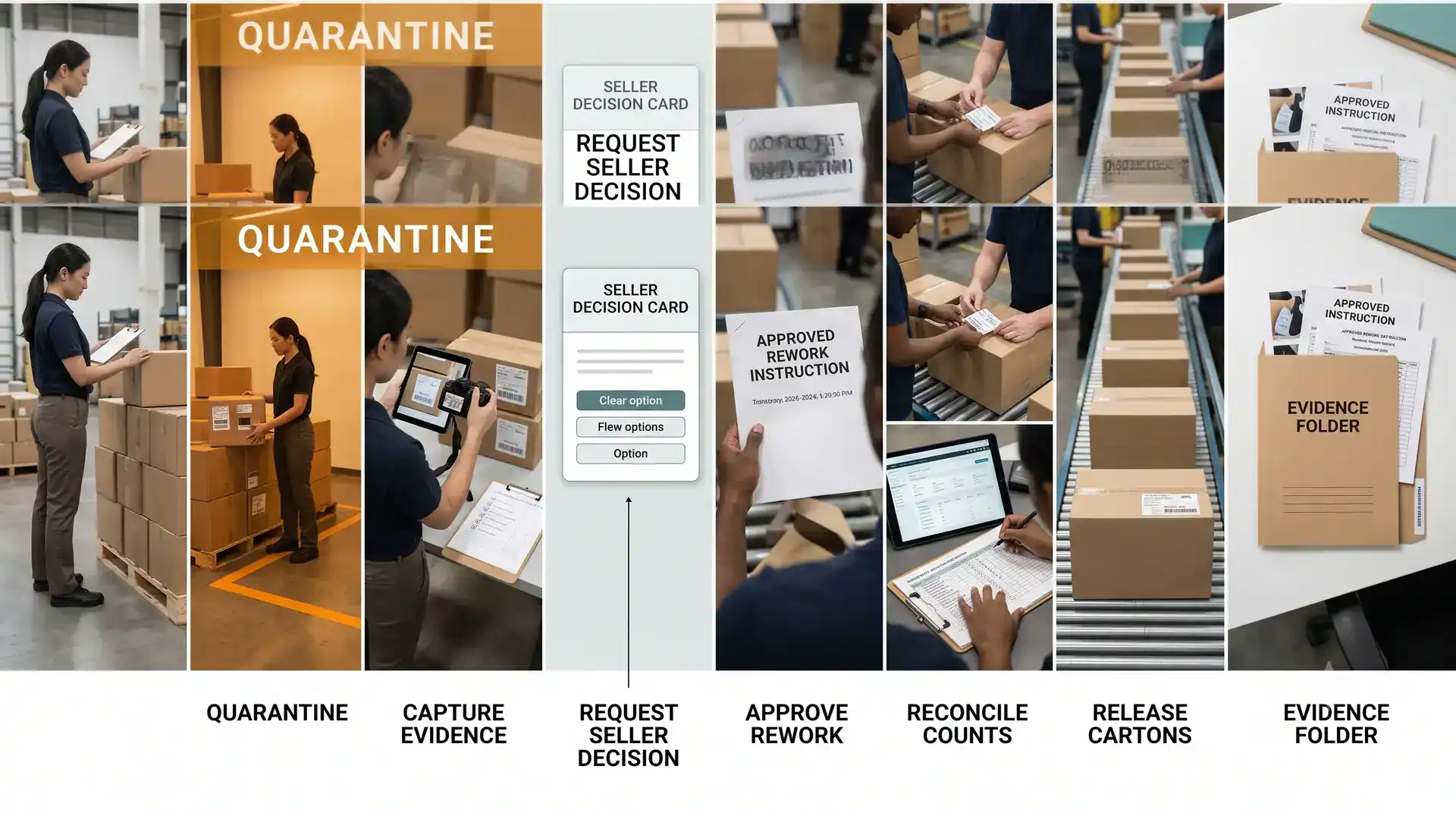
The supplier used an old label file
Stop the affected batch. Identify the last correctly released file, quarantine units prepared from the old file, and record the quantity. Ask the seller account team to approve the rework instruction. Do not layer a new label over an old one unless the current product instruction permits the exact method.
The 3PL received mixed variations
Do not ask the 3PL to identify a variation from memory. Reconcile supplier SKU, product photo, variation attribute, unit label, and carton reference. If the evidence is insufficient, keep the units on hold and request a seller decision.
Label placement looks correct, but the SKU does not match
Treat this as a data mismatch, not a cosmetic defect. Check the released label file, product record, and shipment-plan reference. A cleanly printed wrong label is still wrong.
The provider made an error
A dated Amazon Seller Forums thread records this exact buyer concern. An Amazon representative replied that service-provider contracts and transactions are managed between the seller and the provider. That response supports a practical control: define responsibility and evidence in the provider agreement before work starts. It does not establish a universal reimbursement or liability result for every order.
Amazon identifies a prep or label problem
In the same dated thread, the representative said missing or improper prep or labels may be surfaced as defects in the Inbound Performance Dashboard and that Amazon may apply the missing prep or label. The representative also discussed possible receiving delays, damage, poor customer experience, or returns. Treat that reply as a bounded platform explanation from that thread, not a promise that Amazon will correct every unit or that a particular reimbursement, fee, delay, or account outcome will follow. Check the current Seller Central pages for the affected shipment.
Eight-Step Supplier-to-3PL Workflow
- Verify the current product rule. The seller account team checks the applicable Seller Central prep and labeling instructions for the actual product and shipment.
- Release the prep packet. Give the supplier and provider one version-controlled SKU record.
- Assign prep owner and label owner. Name the parties in the purchase order, work order, and internal shipment record.
- Approve a first prepared unit. Review the product, packaging, label file, placement, and visible identifiers before full-batch work.
- Receive and reconcile. The checker or 3PL records what arrived and separates unexpected products, quantities, damage, and label conditions.
- Perform the assigned check. Record the scope, sample, findings, and exceptions. A check is evidence, not a zero-defect guarantee.
- Approve rework and final release. Only the named decision owner authorizes relabeling, repacking, disposal, return, or hold.
- Archive the shipment packet. Keep the released files, approvals, evidence, final counts, and dispatch record together.
How Style Sourcing Can Support the China-Side Handoff
Style Sourcing can support the China-side operating layer when the scope and supplier access are confirmed. That may include preparing a supplier instruction packet, collecting first-piece prep and label photos, coordinating receiving at a Yiwu-side warehouse, checking visible SKU-to-label matches within an agreed scope, recording carton traceability, and organizing the evidence for the seller or its US 3PL.
This is not Seller Central account management, FBA eligibility advice, legal advice, a guarantee of product or label compliance, or a promise of Amazon acceptance, reimbursement, fee treatment, receiving time, inventory availability, account health, or recovery from a supplier or 3PL.
Frequently Asked Questions
Did Amazon end all FBA prep and item-labeling services in the US?
Amazon’s official changelog says prep and item-labeling services for inventory sent to the US FBA service ended on January 1, 2026. It lists direct FBA, AWD, AGL, Amazon SEND, and the Supply Chain Portal within the change. Check current Seller Central help for product-specific instructions and any later platform update.
Can I still use a supplier or 3PL for FBA prep?
The changelog removes AMAZON as an accepted prep or label owner in the cited US inbound API operations; it does not prohibit using a supplier or third-party provider. Your agreement and workflow should state exactly which party performs, verifies, and records each task.
Does a 3PL mistake become Amazon’s responsibility?
Do not assume that. In the dated Seller Forums response, an Amazon representative said contracts and transactions with service providers are managed between the seller and provider. Review the current platform terms and your provider agreement for the actual case.
Will Amazon fix missing prep or labels?
The forum representative described Amazon flagging certain missing or improper prep or label cases and applying prep or labels. That is not a universal service promise. The official changelog says Amazon’s prep and item-labeling services ended, so build the shipment to be correct before arrival and check current Seller Central guidance for any exception.
Do prep defects affect Account Health Rating?
In the dated thread, the Amazon representative wrote that prep defects shown in the Inbound Performance Dashboard do not affect the overall Account Health Rating, while also noting other possible operational effects. Treat that as a dated response, not a permanent guarantee; verify the current account-health and inbound policies.
What should the supplier receive from the seller?
At minimum: the released SKU record, verified product-specific prep instruction, seller-controlled label file, placement example, packaging instruction, carton plan, first-piece approval requirement, and stop conditions. Do not ask the supplier to infer the current Amazon rule from a product listing.
Is a receiving check the same as a pre-shipment inspection?
No. Receiving can confirm count, visible condition, SKU, labels, and packaging within a defined scope. A pre-shipment inspection has a separate product-quality scope and sampling plan. Keep both assignments explicit.
Can this checklist guarantee FBA acceptance?
No. It creates responsibility, version control, and evidence. Amazon acceptance and any later correction, fee, claim, reimbursement, receiving, or account outcome depend on the current platform rules and the facts of the shipment.


