Found the same product on Alibaba, then heard it was cheaper on 1688 and wondered what you would be giving up? Or trying to decide whether lower domestic pricing is really worth the extra work around language, payment, and shipping?
A lot of 1688 vs Alibaba articles reduce the choice to price alone. That is too shallow.
For overseas buyers, the better platform depends on how much sourcing complexity you can really handle, not just which site shows the lower unit price.
Alibaba is usually easier to work with. 1688 is often cheaper. The right choice depends on order type, experience level, communication needs, and whether you have China-side support.
In this guide, I’ll break down 1688 vs Alibaba the way real buyers should evaluate it: price, MOQ, language, payment, shipping, supplier access, and when using 1688 makes sense only with China-side help.
Quick Verdict: 1688 vs Alibaba
If you want the blunt answer, here it is.
1688 is usually better when:
- you want lower domestic-market pricing
- you have a sourcing agent or China-side support
- you are buying commodity products or Yiwu-style goods
- you can handle more sourcing complexity in exchange for better margins
Alibaba is usually better when:
- you want an easier English-speaking buying process
- you are new to sourcing from China
- you need export-ready communication from the start
- you do not yet have a China warehouse or local support team
So which one is better?
For most first-time overseas buyers, Alibaba is easier.
For buyers with China-side support, 1688 can be more cost-effective.
That is the real answer.

What 1688 and Alibaba Are Actually Built For
This is the biggest difference.
1688 is built for China’s domestic market
That means suppliers often expect:
- Chinese-language communication
- domestic payment methods
- RMB settlement
- delivery to a China address
- buyers who already understand local sourcing norms
Alibaba is built for international buyers
That means suppliers are more used to:
- overseas inquiries
- English communication
- export questions
- international payment handling
- shipping discussions to foreign destinations
In short:
- 1688 is a domestic procurement platform
- Alibaba is an export-facing sourcing platform
That one difference explains most of what buyers experience later.

1688 vs Alibaba on Price: Listing Price Is Not the Full Story
A 1688 listing may show a lower unit price than an Alibaba quote. That does not establish a platform-wide savings rate. The gap depends on the exact SKU, material or grade, specification, quantity tier, color mix, labeling, packaging, and supplier.
Compare like with like. Send both suppliers the same product brief, then separate each quote into:
- the product and basic packaging
- China domestic delivery and warehouse receiving
- payment handling and sample costs
- inspection and any corrective work
- consolidation, repacking, and export documents
- international freight and destination charges
Only then ask: “Which route gives this order the lower verified landed cost, and which tasks or charges still sit outside the supplier’s quote?”
Why 1688 is often cheaper
- it serves the domestic Chinese market
- suppliers face more local competition
- many listings are closer to factory or wholesale pricing
- suppliers are not building as much export support into the sale
Why Alibaba often looks more expensive
- suppliers expect more back-and-forth with overseas buyers
- export service is part of the selling process
- communication and support take more time
- shipping and payment conversations are built into the workflow
The trap many buyers fall into
A lower screen price is easy to mistake for a lower sourcing cost. The gap can shrink—or reverse—when one quote excludes work the other supplier has included.
Before choosing, mark who owns each handoff:
- translation and specification confirmation
- sample production and remake decisions
- China domestic delivery and warehouse receiving
- inspection, corrective action, and re-inspection
- export packing, labeling, consolidation, and repacking
- international freight, customs handoff, and destination charges
If the product configuration and quote scope are not the same, the prices are not comparable.

MOQ and Customization: Which Platform Is Easier?
MOQ depends on the supplier, not just the platform.
But the buying environment still matters.
On 1688
Many suppliers show domestic wholesale pricing tied to quantity breaks.
That means the price looks attractive, but the real buying conditions may be stricter than they appear.
Typical surprises include:
- logo printing starts at a higher MOQ
- custom packaging has a separate MOQ
- mixed colors are not accepted at low quantity
- the listed price only applies to a very basic version
On Alibaba
Suppliers are generally more used to discussing:
- sample orders
- small trial orders
- custom packaging questions
- export-ready product details
- negotiation with overseas buyers
That does not mean MOQ is always lower.
It usually means MOQ is easier to understand and discuss.
Practical takeaway
If you want the easiest conversation around MOQ and customization, Alibaba is usually smoother.
If you want the lowest local-market price and you can handle the negotiation, 1688 may be better.
Communication: Alibaba Is Easier for Most Foreign Buyers
This is one of the biggest differences in real life.
Alibaba usually wins on communication
Most Alibaba suppliers who work with export buyers already have some English communication process.
Perfect? Not always.
Good enough to move an order forward? Usually yes.
1688 is much harder without Chinese support
On 1688, product pages are in Chinese.
Supplier chats are usually in Chinese.
Important details like material specs, packaging notes, and production conditions are often buried in domestic phrasing.
Browser translation helps, but it misses too much when accuracy matters.
This is exactly why many buyers can browse 1688 but still cannot use it confidently.
Payment: Alibaba Is Easier, 1688 Is More Local
Alibaba payment is more foreign-buyer friendly
Depending on the supplier, buyers can usually work through:
- international transfer
- export payment workflows
- Alibaba Trade Assurance-style processes
- payment terms already familiar to international trade buyers
1688 payment is more domestic
Many 1688 suppliers prefer:
- Alipay
- WeChat Pay
- Chinese bank transfer
- RMB settlement
That is one of the biggest barriers for foreign buyers.
If you do not have a clean China-side payment path, 1688 becomes harder very quickly.
What many buyers do in real life
They still use 1688 pricing, but they buy through:
- a sourcing agent
- a Yiwu-based team
- a China-side company
- a local payment and consolidation partner
That is often the bridge between “cheap in theory” and “actually workable.”
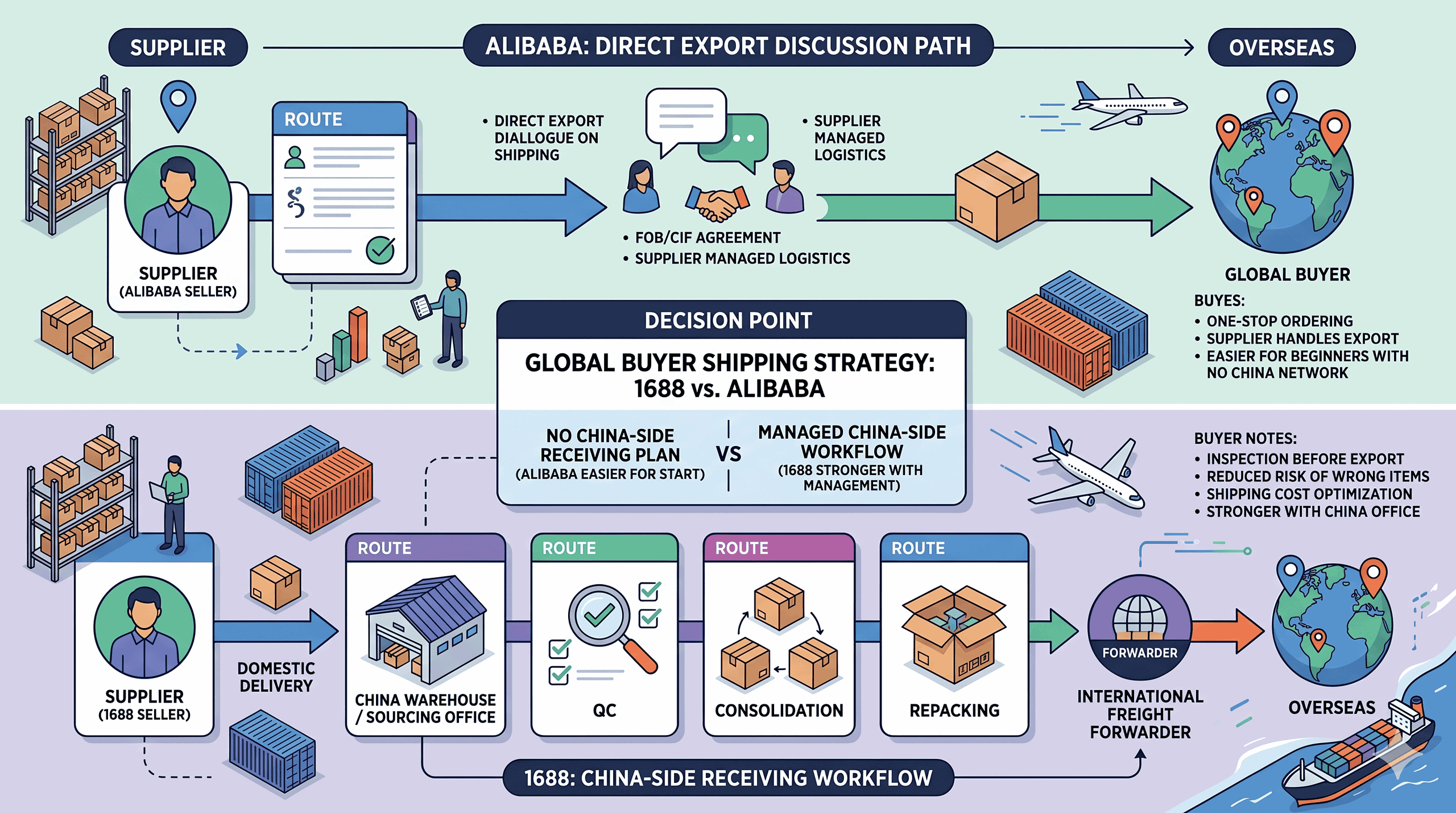
Shipping: Alibaba Is Easier to Start, 1688 Works Better with a China-Side Workflow
Alibaba is easier if you want direct export discussion
Alibaba suppliers are more used to talking about:
- shipping methods
- trade terms
- export lead times
- overseas delivery expectations
1688 usually works better if you ship to China first
This is the more practical workflow.
Instead of asking every supplier to export directly, many buyers let 1688 suppliers ship first to:
- a Yiwu warehouse
- a sourcing office
- a forwarder’s warehouse
- a consolidation point in China
Then they inspect, combine, repack, and export.
That workflow is often much smoother than trying to force every supplier into direct overseas service.
Practical takeaway
If you do not have any China-side receiving plan, Alibaba is easier.
If you do have one, 1688 becomes much more powerful.
Supplier Quality and Risk: Neither Platform Is Automatically Safe
This is where people get too simplistic.
You can find excellent suppliers on both platforms.
You can also find weak suppliers on both.
Alibaba’s advantage
Alibaba suppliers are often more familiar with export expectations.
That helps with:
- packaging standards
- export communication
- lead-time discussions
- buyer confidence for overseas orders
1688’s advantage
1688 can expose you to deeper local-market pricing and a larger domestic supplier pool.
That is valuable.
1688’s risk for foreign buyers
If you do not speak Chinese or understand supplier screening, it is easier to misunderstand:
- whether a supplier is a factory or trader
- whether the listed price is really usable
- whether the sample matches the listing quality
- whether the supplier can actually support your order properly
The real answer
The safer platform is not always Alibaba.
The safer process is the one where you actually:
- compare multiple suppliers
- review samples
- confirm specifications clearly
- inspect before shipping
Which Products Make More Sense on 1688?
1688 is especially strong for:
- jewelry
- fashion accessories
- stationery
- packaging materials
- small home goods
- pet accessories
- promotional items
- lightweight Yiwu-style commodity products
These are the categories where domestic wholesale pricing can make a big difference.
If you source around Yiwu, 1688 is often a very useful benchmark.
Which Products Are Often Easier on Alibaba?
Alibaba is often easier when:
- the product is more technical
- the product has compliance requirements
- the product needs more export-ready documentation
- you need direct international shipping discussion
- you are still learning the China sourcing process
It is not always cheaper.
But it is often easier to manage.
Who Should Use 1688?
1688 is usually the better choice if:
- you already know what product you want
- you want domestic-market pricing
- you have support in China
- you can handle or outsource Chinese communication
- you want to go deeper into local supplier comparison
Best fit for:
- experienced importers
- buyers working with a sourcing agent
- Yiwu-based sourcing workflows
- buyers focused on margin improvement
Who Should Use Alibaba?
Alibaba is usually the better choice if:
- you are new to buying from China
- you want English communication
- you need an easier payment and export process
- you do not yet have a China receiving address
- you want a simpler starting point
Best fit for:
- first-time overseas buyers
- smaller brands still learning sourcing
- buyers who prioritize ease over absolute lowest cost
A Simple Decision Rule for Global Buyers
If you want the simplest rule possible, use this:
Choose Alibaba if:
- you need speed
- you need easier communication
- you are still learning
- you do not have China-side support yet
Choose 1688 if:
- you already understand the product
- you care more about margin
- you can manage more complexity
- you have a sourcing agent or local team in China
What many smart buyers do
A very common path looks like this:
- start on Alibaba to understand the market
- compare suppliers and learn product specs
- move to 1688 when ready to lower costs
- use a Yiwu-based team to manage payment, QC, consolidation, and shipping
That is often the smarter move.

FAQ: 1688 vs Alibaba
Is 1688 cheaper than Alibaba?
Often yes, especially for commodity products and local-market goods.
But the real comparison is final landed cost, not just the listing price.
Can I use 1688 without a sourcing agent?
Yes, but it is much easier if you already speak Chinese, can pay locally, and have a China receiving address.
Is Alibaba safer than 1688?
Not automatically.
Alibaba is usually easier for overseas buyers, but supplier screening, samples, and inspection still matter on both platforms.
Should I start with Alibaba and move to 1688 later?
For many buyers, yes.
That is a very practical path because it reduces confusion early on and improves margins later.
Final Advice
If you are comparing 1688 vs Alibaba, do not ask only which platform is cheaper.
Ask which one fits your current stage, your order type, and your real sourcing ability.
For new buyers, Alibaba is usually easier.
For more advanced buyers — or buyers working with a sourcing team in China — 1688 can be much more cost-effective.
In short:
- Alibaba is easier
- 1688 is often cheaper
- the best choice depends on whether you can handle the extra complexity
Need Help Comparing 1688 and Alibaba Suppliers?
If you want help comparing suppliers, checking samples, handling payment, or arranging shipping from China, our Yiwu-based team can help.
At Style Sourcing, we help overseas buyers reduce sourcing risk while still getting better pricing and better supplier control.
If you already know you want 1688 pricing but do not want to handle every China-side step alone, you can also see our 1688 buying support page for a simpler overview of the workflow.
Our China Sourcing Service can help you compare suppliers, check samples, and plan the right buying route before you place an order. Need help deciding whether 1688 or Alibaba is the better route for your product? Talk to our team here.


