Ever found a supplier on 1688 that looked promising, but then stopped and thought: how do I actually know this company is reliable before I send money? Or maybe the store looked decent, the price looked attractive, and the replies seemed okay — but you still were not sure whether you were looking at a real long-term supplier or just another risky listing?
That is a smart concern.
Because on 1688, the biggest losses usually do not happen because buyers cannot find products.
They happen because buyers move too quickly before verifying the supplier properly.
In this guide, I’ll give you a practical 1688 supplier verification checklist you can use before placing an order, so you can reduce supplier risk, ask better questions, and avoid paying the wrong company in China.
Quick Answer: How Do You Verify a 1688 Supplier?
You verify a 1688 supplier by checking more than just the listing price.
A useful verification process usually includes:
- checking whether the store is focused
- comparing several suppliers side by side
- confirming product details clearly
- reviewing sample quality
- evaluating communication quality
- confirming whether the supplier can support China-side delivery, inspection, and follow-up
In short:
Do not verify a supplier by how cheap they look. Verify them by how workable they are.

Why Supplier Verification Matters So Much on 1688
1688 is a domestic Chinese wholesale platform.
That means there are plenty of real suppliers there.
But it also means foreign buyers often have less context than local buyers.
You may not know:
- whether the supplier is a factory or a trader
- whether the listing price is realistic for your order
- whether the product photos reflect real quality
- whether the supplier communicates clearly enough to trust with a bulk order
That is why supplier verification matters more than most new buyers expect.
The 1688 Supplier Verification Checklist
Here is the practical checklist.
You do not need perfection on every point.
But you do need enough good signals before you pay.
1. Check whether the store is focused
A focused store is usually easier to trust than a completely random one.
For example, a supplier that mainly sells:
- jewelry boxes
- packaging products
- pet accessories
- one narrow product category
usually feels stronger than a store selling random unrelated categories.
This does not guarantee quality.
But store focus often reflects stronger product familiarity and more stable sourcing logic.
2. Check whether the product photos feel original
Photos do not prove everything.
But they reveal a lot.
Better signs
- consistent shooting style
- clear detail photos
- packaging photos
- workshop or real stock photos
- multiple angles of the same product
Warning signs
- obvious copy-paste photos
- mixed image style from many different sources
- low-quality screenshots
- no real detail photos at all
If the store looks like it does not really know the product, slow down.

3. Compare 3 to 5 suppliers, not one
This is one of the strongest verification methods.
Never judge a supplier in isolation.
When you compare multiple suppliers, you can quickly spot:
- who is unrealistically cheap
- who is vague
- who explains material properly
- who understands packaging and MOQ clearly
- who looks more stable overall
This is how “normal” becomes easier to recognize.
4. Ask specific questions and judge the quality of the reply
A reliable supplier usually gives clearer answers.
Ask things like:
- What is the exact material?
- What is the sample cost?
- What is the MOQ for the plain version?
- What is the MOQ for custom logo?
- Can you support custom packaging?
- What is the lead time?
- Can you ship to a Yiwu warehouse?
You are not only collecting information.
You are also evaluating the supplier’s response quality.
5. Confirm whether the pricing logic makes sense
A low number is not verification.
It is just a number.
You need to check:
- whether the price matches the real material
- whether the quantity bracket is realistic
- whether packaging is included
- whether the price applies to your order structure
If one supplier is much cheaper than all others and cannot explain why, that is a warning sign.
6. Check whether MOQ is stable and clearly explained
A trustworthy supplier should be able to explain:
- plain product MOQ
- logo MOQ
- packaging MOQ
- color or variant MOQ
If MOQ keeps changing randomly, that does not feel stable.
The number itself may still be reasonable.
But the explanation should make sense.

7. Order a sample before bulk payment
A sample is one of the strongest verification tools you have.
It helps you verify:
- product quality
- finishing
- packaging quality
- whether the supplier follows instructions
- whether the product really matches the listing
A supplier who handles the sample well is easier to trust than one who becomes messy even at this early stage.
8. Check whether they can support China-side delivery properly
This matters a lot on 1688.
A workable supplier should usually be able to ship to:
- a Yiwu warehouse
- a sourcing office
- a China consolidation point
- a forwarder warehouse
If the supplier cannot handle normal domestic China delivery clearly, that makes the process riskier.
9. Watch whether communication stays clear after money is mentioned
This is important.
Some suppliers seem responsive at first, then become vague the moment the conversation turns serious.
That is not a good sign.
You want consistency in communication, not just a good first impression.
10. Check whether they are honest about limits
One underrated trust signal is honesty.
A supplier who clearly says:
- this MOQ is not possible
- this packaging option needs higher quantity
- this lead time is not realistic
can actually be safer than a supplier who says yes to everything too fast.
Overpromising is not the same as being capable.

Red Flags That Should Make You Slow Down
Here are the warning signs I would take seriously.
1. The price is dramatically below everyone else
2. Replies are vague or inconsistent
3. Product photos look copied from everywhere
4. MOQ keeps shifting without clear explanation
5. They push hard for quick payment
6. They avoid sample questions
7. They cannot clearly handle China-side delivery
8. Packaging questions get ignored
One red flag is not always enough to walk away.
But several together should definitely slow you down.
Factory or Trader: Should You Care?
Yes — but not in a simplistic way.
A trader is not automatically bad.
A factory is not automatically safe.
What matters more is whether the supplier is:
- transparent
- consistent
- responsive
- capable of handling your order properly
If factory status matters to your cost or lead time, verify it.
But do not treat “factory” as automatic proof of reliability.
How a Sourcing Agent Helps with Supplier Verification
For foreign buyers, a sourcing agent can help because supplier verification is not just translation.
It also involves:
- asking the right questions
- comparing multiple suppliers properly
- spotting vague replies
- checking samples
- confirming packaging and delivery details
That is why a local Yiwu-based team often helps reduce risk earlier in the process.
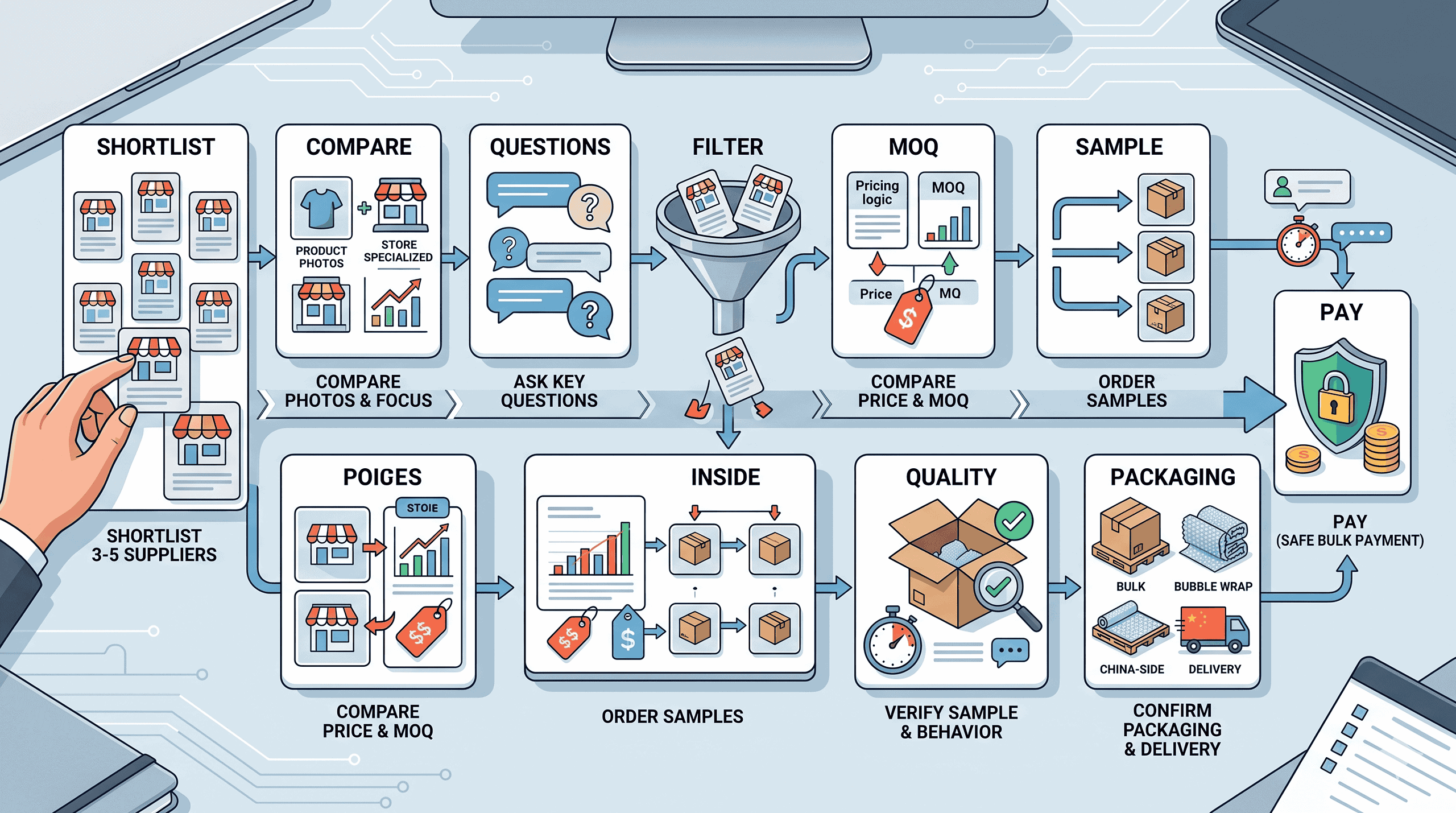
A Simple Verification Workflow That Works
If you want a repeatable process, use this flow:
- shortlist 3 to 5 suppliers
- compare product photos and category focus
- ask the same key questions to each supplier
- remove vague suppliers
- compare pricing logic and MOQ logic
- order samples from the strongest options
- verify sample quality and supplier behavior
- confirm packaging and China-side delivery before bulk payment
That is a much safer workflow than “find one supplier and hope for the best.”
FAQ: 1688 Supplier Verification Checklist
Can I verify a supplier using the store page alone?
No. The store page can help, but you still need to ask practical questions and review samples.
Is the cheapest supplier always risky?
Not always, but very low pricing without clear logic should make you cautious.
Should I verify even if I only place a small order?
Yes, especially if the product quality or packaging matters to your business.
Is a good sample enough to trust the supplier completely?
Not completely. A good sample is strong evidence, but bulk inspection still matters when the order value is meaningful.
Final Advice
If you want to use a real 1688 supplier verification checklist, remember this:
You are not trying to find a “perfect-looking” store.
You are trying to find a supplier who can actually handle your order clearly, consistently, and with fewer surprises.
That means you verify the supplier through:
- better questions
- better comparison
- better sample review
- better process discipline
That is how you reduce risk before payment instead of managing regret after payment.
Need Help Verifying 1688 Suppliers?
If you want help screening suppliers, checking samples, comparing quotes, or confirming packaging and shipping details before you order, our Yiwu-based team can help.
At Style Sourcing, we help overseas buyers verify 1688 suppliers more carefully before they commit to payment.
Need help checking a 1688 supplier before you order? Talk to our team here.


