
Before you compare a 1688 sourcing agent fee, freeze the job you want the agent to perform. A percentage, flat fee or bundled price is not meaningful until you know whether it covers supplier communication, payment handling, receiving, inspection, packaging coordination, consolidation or freight handoff.
The practical way to compare two quotes is to give both providers the same order brief, map every line to a real task, separate the agent’s fee from third-party costs, and keep a written approval record before the first invoice is authorised. This avoids treating a headline number as if it were a complete cost.
There is no universal 1688 fee that applies to every buyer or order. The fee depends on the scope written into the quote. Your goal is not to find a magic percentage. It is to make two offers comparable and record what happens if the order changes.
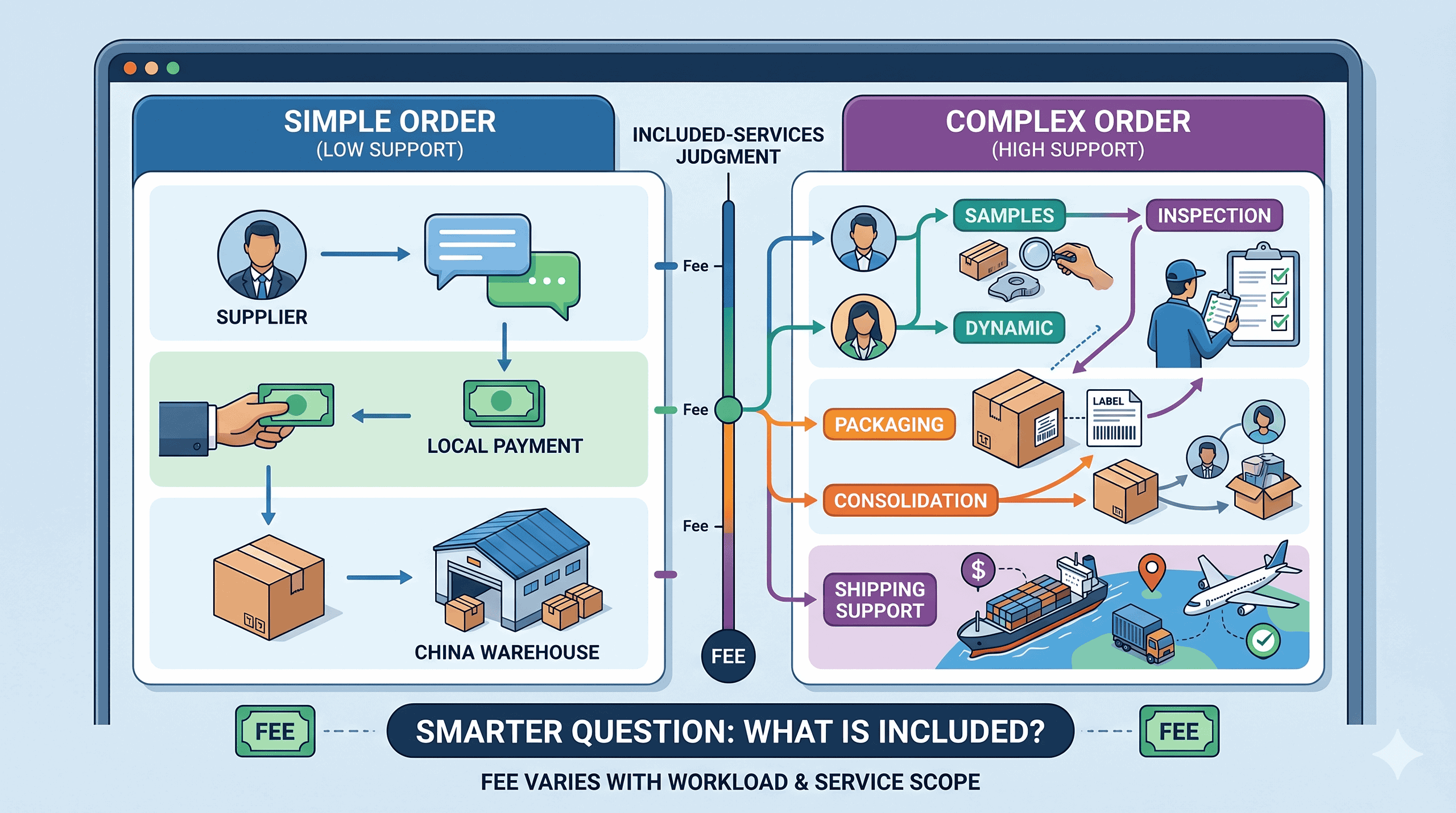
Compare two quotes against the same order brief
Do not send one provider a simple product request and another provider a full-service brief. Their prices may look different because they are pricing different work.
Prepare one short order brief containing the product identity, variants, target quantity, sample requirement, packaging expectations, destination and the point at which you want the goods handed to the freight provider. Then ask each agent to answer the same table:
| Work line | Quote A | Quote B | Evidence to keep |
|---|---|---|---|
| Product and supplier search | Scope, limits and revision rule | Scope, limits and revision rule | Search brief and supplier shortlist |
| Supplier communication | Messages, translation and follow-up included? | Messages, translation and follow-up included? | Written service description |
| Payment handling | Who pays, when and under whose account? | Who pays, when and under whose account? | Payment terms and receipts |
| China receiving | Address only, or count, photos and other work? | Address only, or count, photos and other work? | Warehouse or receiving scope |
| Samples and inspection | Included task, optional task or third-party cost? | Included task, optional task or third-party cost? | Sample and inspection instructions |
| Packaging coordination | Review, rework coordination or material purchase? | Review, rework coordination or material purchase? | Packaging brief and exclusions |
| Consolidation | Included handoff or separate operation? | Included handoff or separate operation? | Carton and release scope |
| Freight coordination | Quote collection, booking support or freight itself? | Quote collection, booking support or freight itself? | Freight quote and responsibility line |
A blank cell is not a zero price. It is an unanswered question. Ask the provider to state whether the line is included, excluded, optional or priced by a separate third party.
For the broader decision about whether local support fits your order, see Do You Need a 1688 Sourcing Agent?. This page starts after that decision: it helps you approve a fee scope without confusing it with the whole buying process.
Read the fee basis before comparing the number
A quote can use a percentage model, a fixed task fee, a mixed model or a minimum charge. None is automatically better. The important question is what the model is calculated on and when the amount can change.
Ask the provider to state these fields in writing:
- the base used for any percentage, such as product value or another defined amount;
- whether domestic delivery, samples, packaging material, inspection and freight are inside or outside that base;
- the exact tasks covered by a flat fee;
- any minimum fee, currency conversion method or payment minimum;
- when the fee is due and whether later stages require a new approval;
- what happens if the supplier list, product specification or shipment plan changes;
- whether third-party charges are paid directly by the buyer or passed through the agent;
- which parts of the quote are estimates and which are confirmed charges.
Public service pages show why fee models should not be treated as a market-wide standard. A competitor page describes more than one service model, while an adjacent 1688 buyer guide gives a commission example. Those are bounded descriptions of named pages, not a Style Sourcing rate and not proof of what every agent charges. Your comparison should rely on the two written quotes for your own order.

Separate included work from extra costs
The phrase “full service” is not a cost breakdown. Turn it into a line-by-line record. A provider may include one part of a stage while excluding the third-party charge connected to that stage.
| Stage | May be included in an agent scope | May remain a separate cost or approval |
|---|---|---|
| Sourcing | Searching, comparing and presenting supplier options | Samples, supplier-side tooling or product charges |
| Communication | Chinese-language messages and follow-up | Extra rounds after a changed brief or a new supplier search |
| Payment | Payment coordination or local payment handling | Product value, platform charges, bank charges or currency conversion |
| Receiving | Delivery address and basic arrival notice | Counting, photos, storage, inspection or handling work |
| Inspection | Coordination of an inspection request | Third-party inspection fee, testing or rework |
| Packaging | Confirming a packaging brief or requesting photos | Packaging materials, redesign, printing, repacking or relabelling |
| Consolidation | Handoff information for multiple cartons | Warehouse handling, carton work and the international shipment |
| Freight | Collecting or comparing shipping options | Freight, customs, duties, destination charges and carrier changes |
Use “may” because the quote controls. Do not assume that a China receiving address includes inspection or repacking. Do not assume that a shipping-support line includes freight itself. If a line is important to your margin or delivery plan, leave it open until the responsible party and cost basis are written down.
For the operational details of one downstream stage, see 1688 Inspection Service: How to Check Quality Before Shipping and How to Consolidate Orders from Multiple 1688 Suppliers. Those pages own execution workflows; this page only explains how to map their possible cost lines into an agent quote.

Questions to ask before approving a 1688 sourcing agent fee
Send the same questions to each provider and keep the answers beside the quote. A short written answer is more useful than a broad promise that “everything is handled.”
- What exact order or product brief does this quote cover?
- What is the fee basis, and what amount is used if the fee is percentage-based?
- Which work is included at the first stage, and which work needs separate approval?
- Are samples, inspection, packaging material, repacking and consolidation priced separately?
- Who pays each third-party cost, and will the buyer see the underlying quote or receipt?
- What happens if a supplier cannot meet the specification or changes the packaging?
- When can the scope or fee be re-quoted, and who approves that change?
- What currency, payment timing and minimum charge apply to the quoted work?
- What written record will the buyer receive after supplier, sample or inspection decisions?
If the answer is “it depends,” ask the provider to name the dependency. For example, the fee may depend on the number of suppliers, the type of inspection or the amount of packaging coordination. The record should say what happens at each branch instead of leaving the buyer to interpret it after payment.
For message structure and supplier follow-up, see How to Communicate with 1688 Suppliers If You Don’t Speak Chinese. For the payment rail itself, use How to Pay 1688 Suppliers from Overseas; this article does not replace payment-safety guidance.
Keep one approval record before the first invoice
The approval record is the document that turns a conversation into an agreed scope. It can be a signed quote, a dated email confirmation or a shared order sheet, provided the final version is identifiable.
Record these fields:
- counterparty name, contact and order reference;
- product, variant, supplier and destination scope;
- tasks included in the agent fee;
- fee model, calculation base, minimum, currency and payment timing;
- every known third-party cost and whether it is estimated, quoted or excluded;
- responsibility for samples, inspection, packaging, receiving, consolidation and freight handoff;
- the evidence required before each release decision;
- what happens when a supplier answer, sample or inspection result is unclear;
- the rule for a changed brief, additional supplier or changed shipment plan;
- date, version and the person who approved the scope.
The record does not need to predict every future charge. It does need to show when a new charge requires a new approval. That distinction protects both sides from treating a changed order as if it were covered by the original quote.
A low headline fee is not evidence of a low total cost, and a higher fee is not evidence of better execution. The useful comparison is the clarity of the scope, the evidence requested at each stage and the way exceptions are handled.

When an agent fee may fit the order—and when it may not
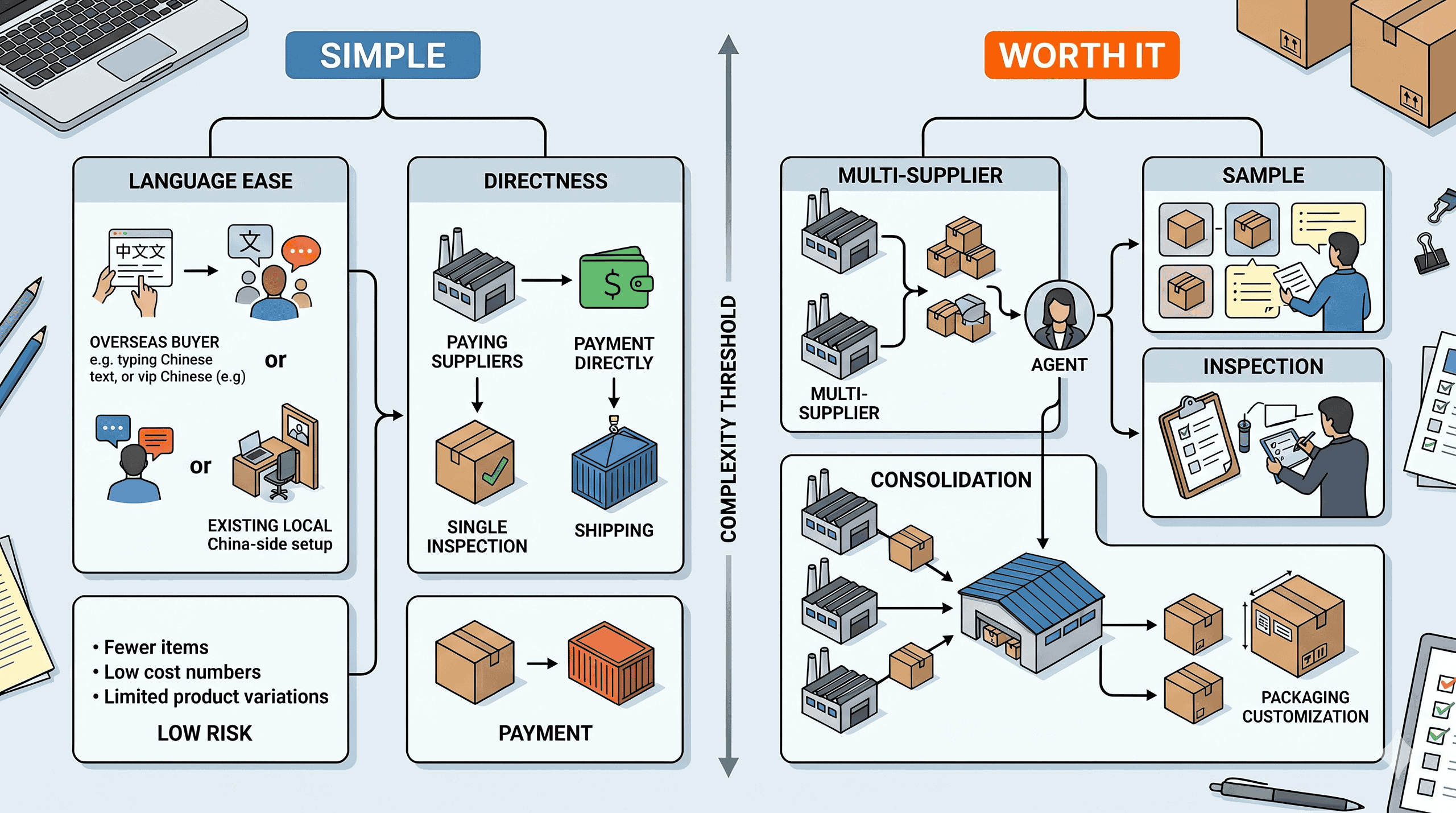
A fee may be easier to justify when the order involves several suppliers, Chinese-language communication, custom packaging, sample comparison, an inspection before export or a consolidation handoff. These are signals that the buyer is paying for coordination work rather than a single message.
A smaller scope may be enough when the buyer already has a China-side operation, can communicate and pay directly, has a defined supplier relationship, or only needs one limited task. The decision depends on the actual gaps in the order, not on a universal rule about who should use an agent.
If you are still deciding whether an agent is appropriate, return to the evaluation guide rather than using this fee article as a pros-and-cons page. If you have already decided to use one, compare the written scope before approving the first invoice.
FAQ: 1688 sourcing agent fee
Is there a standard 1688 sourcing agent fee?
No single fee applies to every order. The quote should identify the work, calculation basis, exclusions and change rules for the order being discussed.
What should a written quote include?
It should identify the product and supplier scope, included tasks, fee basis, third-party costs, payment timing, evidence requirements and the rule for extra work or a changed order.
Are inspection and freight included?
Sometimes they are included as coordination tasks; sometimes the underlying inspection or freight cost is separate. Ask the provider to separate coordination from third-party charges.
How do I compare two agent quotes fairly?
Give both providers the same order brief, use the same line-item table, ask the same questions and keep the final approval record with the quote version that was accepted.
Can a low fee result in a higher total cost?
It can if the scope is vague, third-party charges are hidden or changes are handled without a new approval. The answer is not a universal warning about cheap agents; it is a reason to compare the record behind the number.
Is a percentage fee safer than a flat fee?
Neither model is inherently safer. A clear basis, defined scope and written exception rule matter more than the label used for the fee.
Need help comparing the scope behind an agent quote?
If you want a second set of eyes on a supplier brief or a China-side quote breakdown, contact Style Sourcing with the order scope and the questions that remain open. The useful next step is a written comparison, not a promise of a universal fee.
Sources and limits
- Alibaba Group: 1688 business overview — background framing for 1688 as a domestic wholesale marketplace.
- JingSourcing: 1688 agent service — competitor structure and fee-model examples, captured in a dated local snapshot; not a Style Sourcing rate.
- WorldFirst: buying from 1688 outside China — adjacent buyer-guide context and a competitor commission example; not a universal market rate.
These sources help explain why quotes can use different models. They do not establish a standard fee, guarantee savings, prove a service outcome or replace the written quote for a particular order. Payment methods, inspection execution, consolidation and international shipping each have their own operating details and should be checked in the linked guides.


