
1688 Buyer-Protection Badge Explained for Overseas Buyers: What the Merchant-Side Agreement Can and Cannot Tell You
Short answer: the 1688 buyer-protection badge is a merchant-side participation and remedy framework, not a buyer-side refund button. Before you pay a deposit, read the agreement behind the badge and match it to the exact sub-order you are considering.
The v20240912 Buyer Protection Service Agreement sets out basic services, merchant deposit mechanics, defined breach handling, value-added service labels and a fulfilment-guarantee insurance route. It does not replace your product specification, supplier checks, payment record, inspection plan, freight evidence or destination responsibilities.
This article uses the agreement text captured on 2026-07-24. It explains what the framework can help you evaluate, what it cannot prove, and which records you should preserve before a dispute starts. It does not promise a refund, payout, claim success, timing or after-sales result.
This guide walks through the v20240912 agreement text as captured on 2026-07-24, separates the merchant-side framework (basic services, deposit mechanics, breach-triggered payout authority, value-added lines, and the 履约保证险 alternative) from the buyer-side operating questions (does this badge apply to my sub-order, what evidence do I still need to gather, and where does the badge stop helping me). It does not rate 1688 as safe or unsafe, does not rank suppliers, and does not promise a payout, refund timing, claim success, or after-sales outcome.

Quick Answer: Read the Badge Against the Agreement, Not the Icon
| Question the buyer asks | What the v20240912 1688 Buyer-Protection Service Agreement actually does | What stays outside the agreement |
|---|---|---|
| Is the badge a buyer-side refund guarantee? | No. The agreement creates a merchant-side basic service framework, deposit mechanics, breach-triggered payout authority, and value-added lines tied to sub-order conditions. | Product quality, supplier reliability, production capacity, factory capability, every sub-order being eligible, and a universal payout outcome are all outside the agreement. |
| Who are the parties to the agreement? | The agreement binds the merchant (商家) and the relevant Alibaba entities. Buyers are addressed as beneficiaries of the basic services and value-added services where conditions are met. | The agreement does not turn the buyer into a contract party with a private refund right, and it does not assign bank, legal, tax, or customs obligations. |
| What does the basic service framework include? | 如实描述 (truthful description), 三包 (statutory after-sales guarantees required by Chinese consumer-style rules), 售后服务要求 (after-sales service requirements), and a deposit (保证金) structure. | Specific quality acceptance criteria, AQL levels, defect definitions, sample-approval mechanisms, payment-milestone triggers, freight terms, and destination-document packets are not part of the basic service clause set. |
| How does the deposit work? | It is composed of a 基础额度 (base amount) and a 风险额度 (risk amount). When the deposit falls below the required level, the agreement references an Alipay auto-top-up mechanic and a 14-day 补缴 (top-up) window. Payout authority is triggered by defined breaches. | The deposit mechanic is merchant-side. It is not your escrow, your refund pot, or a guarantee that you will be paid back. |
| What triggers a payout? | Defined breaches of the basic services — for example, failure to comply with 如实描述, 三包, or 售后服务要求 — trigger the platform’s payout authority using deposit and Alipay balance. | Buyer disappointment, slow shipping, late production, freight damage, inspection findings, dispute rhetoric, or after-sales dissatisfaction are not automatically a payout trigger. |
| Are there value-added lines? | Yes. Captured value-added services include 晚发必赔 (late-shipment compensation) currently framed at 5% of a single sub-order value with a capped amount (max 3000元 in the agreement capture from 2026-07-24). | The cap, the percentage, and the triggers are agreement-defined. Whether a specific sub-order, route, or product category triggers the value-added service is a sub-order-level question, not a universal badge promise. |
| Is there an alternative to the cash deposit? | Yes. The agreement describes 履约保证险 (fulfilment guarantee insurance) as an alternative mechanism with a third-party insurer. The merchant’s participation in insurance is a merchant choice under the agreement. | Insurance availability, eligibility, payout mechanics, claim timing, and dispute outcome are between the merchant, the insurer, and the platform — not a buyer-side guarantee. |
| When can the merchant recover the deposit? | When the agreement’s deposit-refund conditions are met, including no open trades, no open complaints, no open after-sales records, no collection notices, and no outstanding payable balances under the platform’s checks. | Open orders, open complaints, after-sales tickets, or unpaid platform balances keep the deposit locked — which is why a buyer who has a live after-sales case cannot assume a merchant deposit is freely refundable in parallel. |
| Does the badge help me as an overseas buyer? | It tells you a defined framework is in place. It does not replace a sub-order evidence file, product specification, payment record, inspection plan, freight handoff, or destination document packet. | Cross-border payment corridors, foreign-exchange controls, destination customs, importer-of-record responsibilities, and product-specific licenses or certifications are entirely outside the badge. |
The badge is most useful when you treat it as a prompt to ask better questions, not as a safety net that catches everything you did not write down.
What the v20240912 Agreement Actually Lets You Check
The 2026-07-24 daily market watch recorded that the official route for the v20240912 agreement returned HTTP 200 after several days of HTTP 403 / AccessDenied responses (2026-07-21 → 2026-07-23). The Style Sourcing 1688 knowledge page promotes that recovery to a bounded primary evidence layer for one cycle.
The captured agreement is useful because it gives you a defined reference point instead of a badge interpretation based on screenshots or sales language. It also sets the limits of what this article can claim:
- Sections that exist in the captured agreement text (parties, definitions, basic services, deposit structure, breach payout, value-added lines, deposit refund conditions, 履约保证险 alternative) are described from that text. No clause is paraphrased as a buyer-side promise.
- Linked rule pages on
rule.1688.comand sub-order legal portals remain account/login shells and are not cited as clause-level evidence. - Any clause not present in the captured agreement text is excluded from this article.
That is why every claim below ties back to a named agreement section rather than to a generic “1688 protects buyers” line.
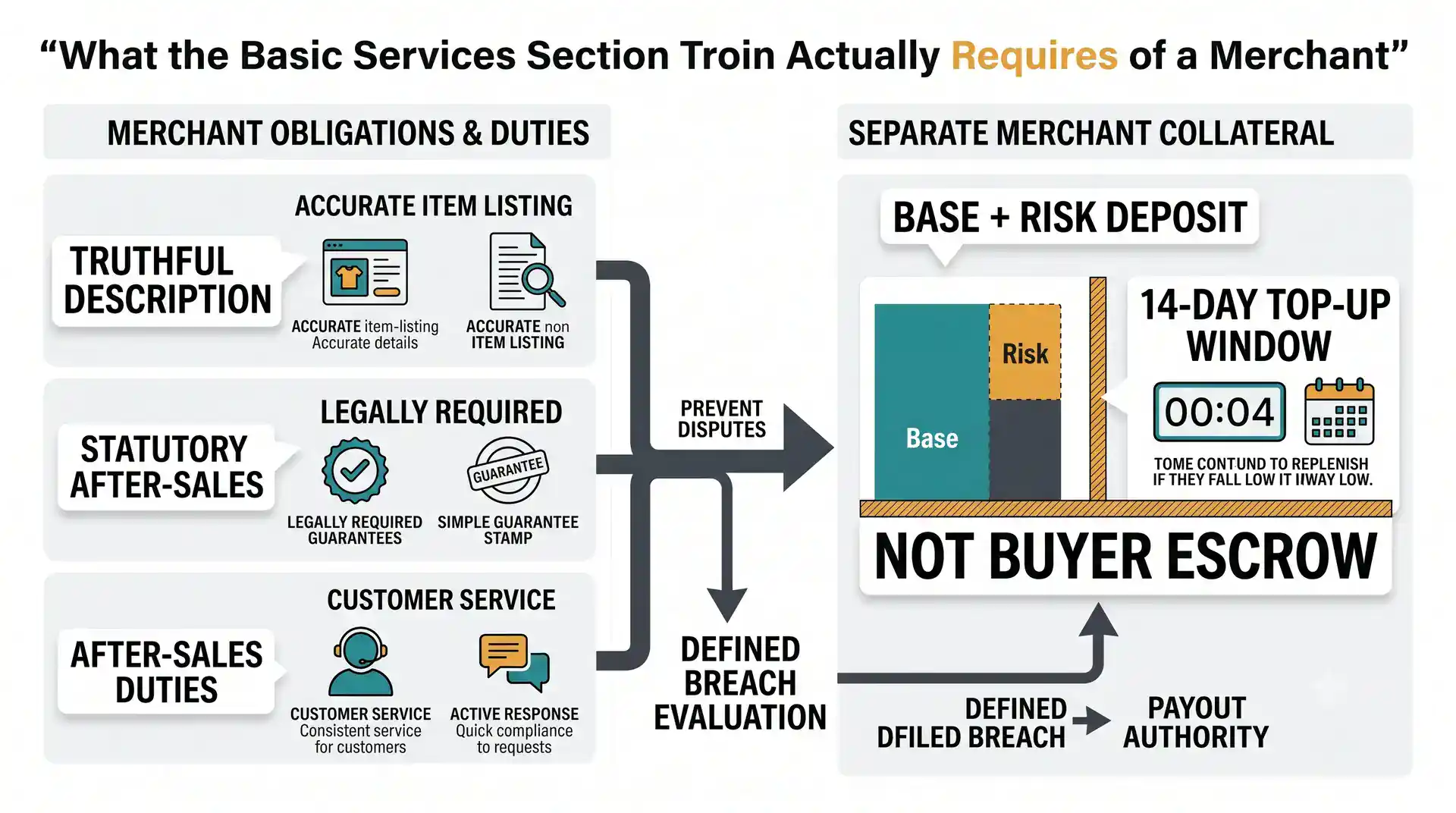
What the Basic Services Section Actually Requires of a Merchant
The agreement’s basic services section describes what a participating merchant must do at the platform level. Those obligations are not the same as a buyer-side refund.
如实描述 (Truthful description)
The merchant is required to accurately describe products and order terms. This obligation lives at the platform layer and binds the merchant under the agreement. It does not give a buyer a refund for any description they later disagree with — it gives the platform a defined trigger to evaluate a merchant-side claim when the description is materially different from what was delivered.
三包 (Statutory after-sales guarantees)
The captured text references 三包 obligations at the platform level. 三包 is shorthand for a Chinese after-sales framework (typically repair, replacement, and refund for qualifying consumer goods). How 三包 applies to a specific product, category, platform route, or sub-order is a sub-order-level question. Outside the agreement, an overseas buyer also has to deal with the practical reality that after-sales obligations designed for domestic consumer orders do not always travel cleanly through cross-border freight, customs, or return logistics.
售后服务要求 (After-sales service requirements)
The agreement requires merchants to maintain a defined after-sales service posture. The exact scope, response window, and platform-managed process are governed by the agreement and linked rules. Buyer-side keep-everything depends on the merchant’s actual after-sales posture plus the buyer’s evidence record.
What the basic services section does not do
- It does not define your product specification, AQL, defect criterion, or acceptance criteria.
- It does not establish a private refund right at the buyer level.
- It does not lift your responsibility to inspect at sample, pre-shipment, or warehouse-receiving stages.
- It does not substitute for the destination importer-of-record, customs, tax, or licensing obligations.
If you treat the basic services section as your safety net, you will write the wrong order.
How the Deposit (保证金) Actually Works
The agreement describes a deposit structure composed of two parts: a 基础额度 (base amount) and a 风险额度 (risk amount). This is merchant-side collateral, not buyer escrow.
基础额度 + 风险额度 (base + risk)
The merchant commits a base amount plus a risk-based top-up determined by the platform. The base and risk amounts are agreement-driven and platform-managed. A buyer does not choose them and does not benefit from them in the same way they would benefit from escrow.
Alipay auto-top-up and 14-day 补缴
When the merchant’s deposit falls below the platform’s required level, the agreement references an Alipay auto-top-up mechanic and a 14-day window for the merchant to make up the difference (补缴). This is a merchant-side cash management rule. It keeps the framework funded; it does not entitle a buyer to a payout before a breach is established.
When a defined breach occurs, the platform can authorize a payout using the merchant’s deposit and, where applicable, the merchant’s Alipay balance. The trigger is a defined breach event, not a buyer complaint, a slow shipment, or an after-sales conversation. That distinction shapes what evidence matters when you want the framework to work for you.
Why “more deposit” is not “more safety for me”
A merchant with a larger deposit is not a merchant who will refund you more easily. The deposit is a defined pool that the platform can draw on when an eligible breach is established, within the agreement’s rules. A complete sub-order evidence file gives the platform something concrete to evaluate. A badge viewed without that file is only a visual signal.
The Value-Added Lines: 晚发必赔 and What Else Lives There
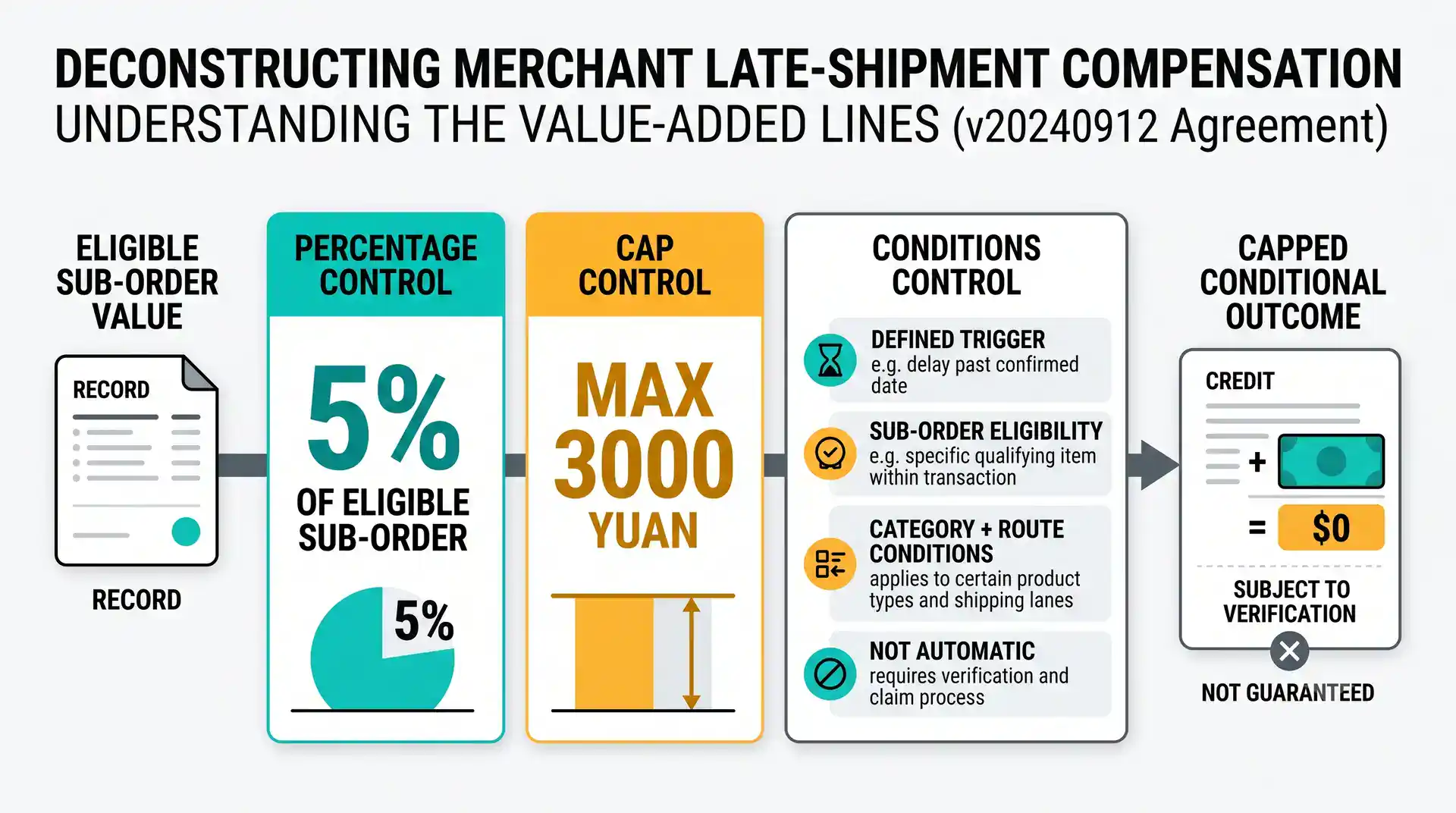
The agreement includes value-added services layered on top of the basic services. The captured text on 2026-07-24 includes 晚发必赔 — late-shipment compensation — currently framed at 5% of a single sub-order value, capped at max 3000元.
Read the cap and the trigger separately
- The percentage (5%) is agreement-defined. It is not a discount you set.
- The cap (max 3000元) is agreement-defined. A larger sub-order does not produce a larger percentage line; the cap is built in.
- The trigger is agreement-defined. Late shipment qualifies only when the agreement’s conditions are met — sub-order, route, timing, and category all matter.
Other value-added lines you might encounter
Merchants and platform pages sometimes advertise additional value-added services (for example, 7天无理由退货-style lines for certain product categories). Whether a specific line applies to your sub-order depends on the agreement version, the sub-order terms, and any linked rule pages. Because linked rule pages remain account/login shells in this cycle, those specifics are not asserted in this article.
What the value-added lines do not promise
- They do not promise that every late shipment triggers compensation automatically.
- They do not promise that overseas buyers enjoy the same refund window as domestic consumers.
- They do not promise that compensation covers freight, customs, FX, or downstream losses.
- They do not make the merchant personally liable beyond the agreement’s framework.
履约保证险 (Fulfilment Guarantee Insurance): The Alternative to Cash Deposit
The captured v20240912 agreement describes 履约保证险 as an alternative path. A merchant can satisfy part of the agreement’s collateral requirements through a fulfilment-guarantee insurance product from a third-party insurer instead of holding cash in the platform deposit.
Why this matters to a buyer
- The merchant may appear on the badge even when their “collateral” is an insurance policy rather than cash on the platform.
- Insurance mechanics, claims handling, and policy wording belong to the insurer and the merchant, not to you.
- A merchant who actively maintains both cash deposit and insurance is not automatically safer than one who uses only one path. Each path has its own rules.
What stays outside the insurance path
- You cannot file a claim directly with the insurer as a buyer unless the policy wording allows it.
- Payout mechanics and timing are different from deposit-breach payouts.
- Coverage scope, exclusions, and dispute resolution are governed by the policy and the platform’s framework, not by your order record alone.
If the platform page is showing insurance-backed participation, treat it the same way you would treat a cash-deposit merchant: read the badge against your own sub-order evidence, not against the merchant’s collateral source.
When a Payout Actually Gets Triggered
A payout is the agreement’s defined remedy at the platform layer. It is not a buyer refund triggered by an unhappy email.
A defined breach must be established
The platform evaluates defined breaches of the basic services — for example, failure to comply with truthful description, after-sales, or 三包 obligations. The buyer’s evidence file matters here. Without it, the platform has very little to evaluate against the agreement.
The merchant’s deposit or insurer funds the payout
Even when a breach is established, the payout source is the merchant’s deposit or the merchant’s insurer. The platform draws on what is available. A merchant with a thin deposit or an inactive policy is a different risk from a merchant who has consistently maintained a meaningful deposit and after-sales footprint.
The agreement’s deposit-refund conditions matter to you too
The captured text lists deposit-refund conditions including: no open trades, no open complaints, no open after-sales records, no collection notices, and no outstanding payable balances. Open buyer-side tickets and open sub-orders keep the merchant’s deposit locked. That can feel frustrating when you want a fast outcome, but it also explains why filing sloppy complaint chains can dilute rather than concentrate your position.
What “payout” is not
- A payout is not the same as a buyer-side private refund.
- A payout is not the same as a credit-card chargeback.
- A payout is not a guarantee of recovery of every dollar you spent on freight, customs, inspection, or downstream losses.
A Buyer-Side Evidence Plan Around the Badge
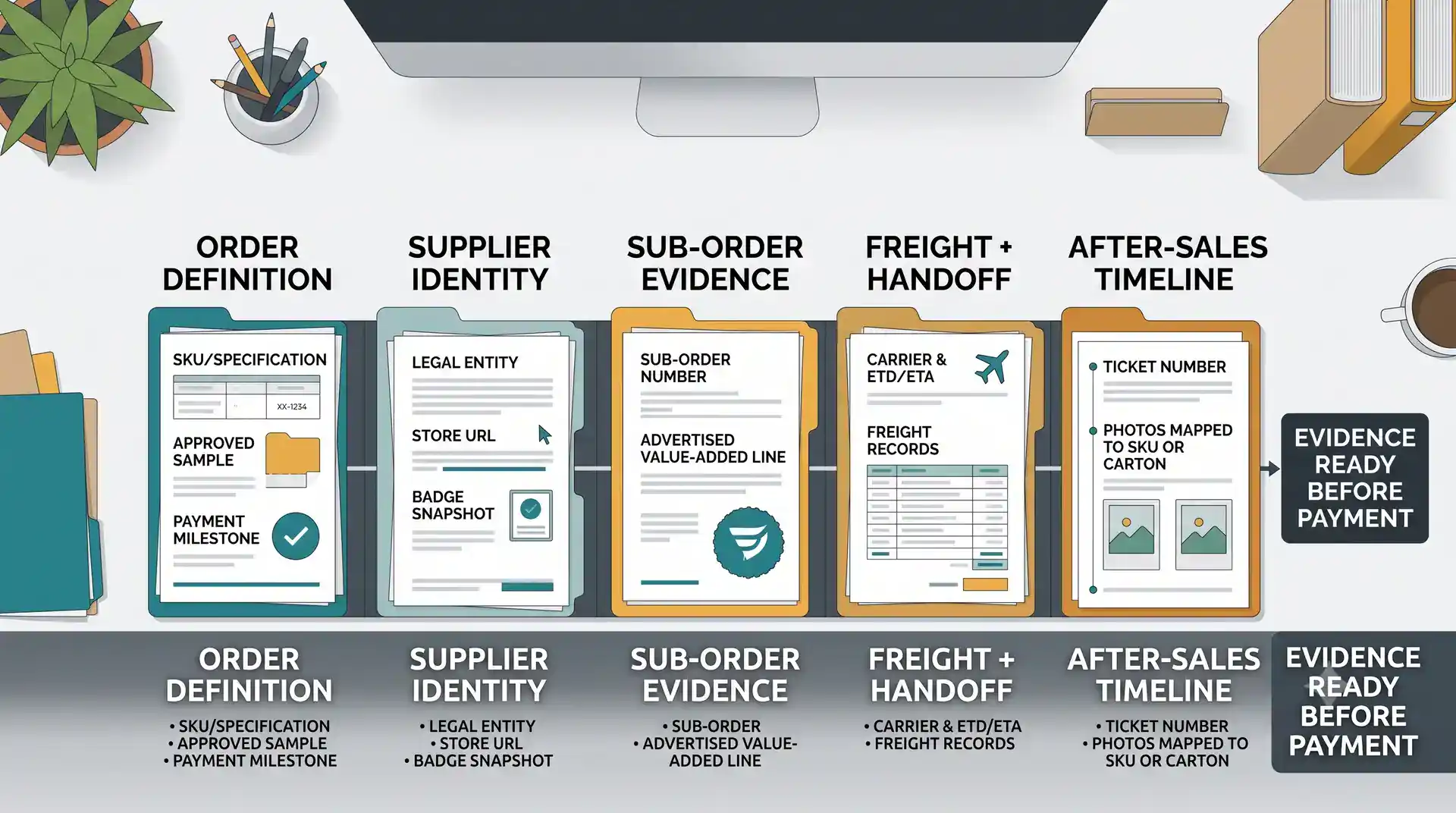
The badge will be most useful to you when your evidence file is already in shape. Build the file before the deposit, not after the dispute.
Order definition evidence
Keep a clean record of the agreed product, SKU, material, finish, packaging, carton marks, sample-approval version, payment milestones, and freight terms. If the order is on 1688, attach as much of that record as the platform’s order page allows. Anything you keep only in WeChat, WhatsApp, or phone calls is harder to evaluate against the agreement later.
Supplier-identity evidence
Confirm the legal entity on the agreement, the store owner, and any sub-account that messages you. A buyer who wires to an account whose name does not match the agreement has weakened their position for any framework-based remedy.
Sub-order evidence
- Sub-order number, agreement version in effect at order time, badge status at order time, value-added lines advertised, and platform page snapshots.
- Pre-payment inspection record or sample-approval record, even if it is informal.
- Freight booking record (carrier, route, ETA) and the agreed Incoterm or freight basis.
After-sales evidence
Keep messages, photos, packing-list scans, and platform-after-sales tickets version-controlled. The agreement’s after-sales framework expects the buyer to participate in the platform’s process, not bypass it.
Where the badge helps you — and where it does not
| Buyer-side need | Badge framework contribution | Buyer-side evidence still required |
|---|---|---|
| Merchant not responding after deposit | Provides defined breach evaluation path through the agreement’s after-sales and dispute routes | Order proof, deposit confirmation, message history, identity verification, version-controlled timeline |
| Goods significantly differ from listing | Triggers 如实描述 evaluation | Product specification, approved sample record, independent comparison photos, platform-after-sales ticket |
| Late shipment with 晚发必赔 line | Triggers a defined value-added compensation line, subject to the agreement’s conditions | Sub-order record, agreed-ship-date vs actual-ship-date evidence, freight booking proof |
| Quality defect at receiving | Does not, by itself, equal a payout | Inspection record, defect photos mapped to cartons/SKUs, after-sales ticket, freight evidence |
| Cross-border freight damage or loss | Outside the badge | Carrier claim process, marine cargo insurance or carrier liability, destination evidence |
How the Badge Compares to Alibaba Trade Assurance
The 1688 badge and Alibaba.com Trade Assurance are different platform frameworks for different sites. Some buyers assume one substitutes for the other — it does not.
| Aspect | 1688 Buyer-Protection Service Agreement (v20240912) | Alibaba.com Trade Assurance |
|---|---|---|
| Site scope | 1688.com (domestic Chinese B2B marketplace) | Eligible Alibaba.com orders under current T&Cs |
| Trigger | Defined merchant-side breach of basic services or eligible value-added service condition | Order terms not met, as published on the Trade Assurance landing page and Terms |
| Payout source | Merchant deposit and/or 履约保证险 | Platform-managed escrow under current T&Cs |
| Buyer-side flow | Sub-order, platform-after-sales, agreement-defined remedy process | Pay through platform, escrow, platform assistance flow |
| Geographic framing | Anchored to 1688 platform rules; overseas buyer application is bounded | Anchored to Alibaba.com platform rules; overseas buyer application is bounded |
| Article use | This article is bounded to v20240912 captured text | See the Style Sourcing Trade Assurance article for the Alibaba.com flow |
If your order is on 1688, do not move the money to Alibaba.com hoping to gain Trade Assurance. If your order is on Alibaba.com, do not assume 1688’s badge applies. Each platform’s framework follows its own path.
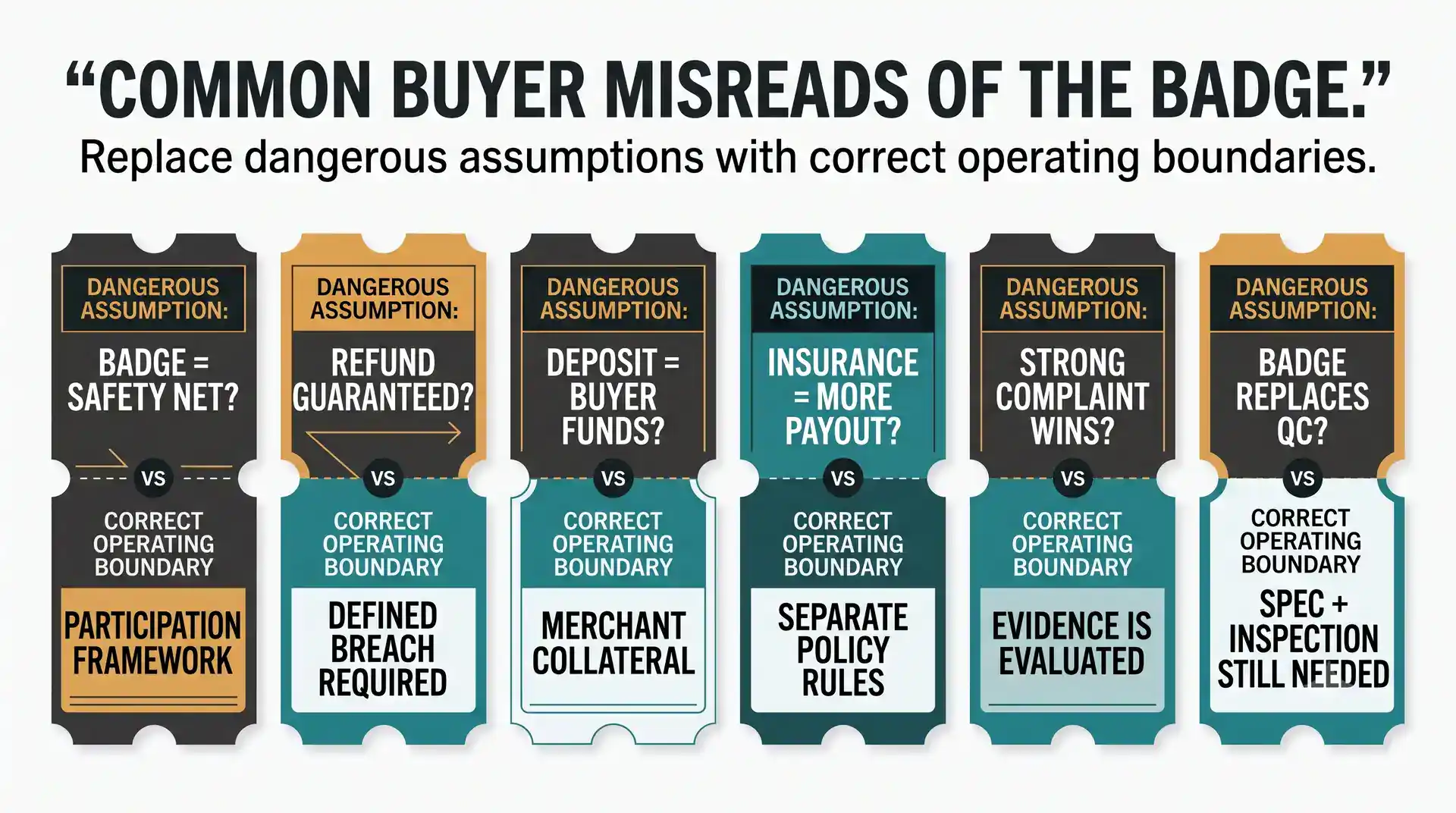
Common Buyer Misreads of the Badge
Some misreads are common enough that they deserve their own section.
“If the supplier has the badge, the order is safe”
No. The badge is a participation marker, not a per-order safety net. Your evidence file is the order’s safety net.
“If anything goes wrong, I will be paid back”
No. Payouts are tied to defined breaches of the agreement’s basic services or the conditions of a value-added line, evaluated against the platform’s evidence.
“The deposit is the merchant’s promise to refund me”
No. The deposit is merchant-side collateral that the platform can draw on. It is not a buyer escrow pool.
“Insurance-backed participation means more payout”
Not automatically. Insurance scope, exclusions, and payout mechanics are governed by the policy and the agreement, not by the icon.
“If I just write a strong complaint, the platform will compensate me”
The platform evaluates complaint evidence against the agreement. Emotion and rhetoric are not substitutes for an evidence file.
“The badge replaces my need to inspect”
The badge does not run inspection. It does not replace a sample-approval step, a pre-shipment inspection, or a warehouse-receiving record. Physical conformity and documentation conformity are separate questions.
A Practical Pre-Order Checklist Around the Badge
Use this checklist before wiring a deposit on a 1688 sub-order. It is not a contract or a legal document. It is a working set of questions to put yourself in a position where the agreement’s framework, if it ever applies to your sub-order, has enough evidence to evaluate.
Order and product
- [ ] Product identity, SKU, color, size, material, finish, packaging, and carton marks are recorded.
- [ ] Approved sample or reference record exists with a date.
- [ ] Specification version is attached to the sub-order or visible in the platform chat thread.
Merchant and agreement
- [ ] The merchant’s legal entity name is captured at the platform layer.
- [ ] The merchant’s deposit status or insurance-backed status is visible on the store page at order time.
- [ ] The buyer has read the badge section of the platform page on the day of ordering.
Sub-order and payment
- [ ] Sub-order number, value, currency basis, and payment milestones are written down.
- [ ] Bank-account name is cross-checked against the merchant’s legal entity name before the deposit is sent.
- [ ] Payment proof (screenshot, transfer reference, platform payment ID) is stored outside the chat thread.
Freight and handoff
- [ ] Freight basis (Incoterm, named place, carrier responsibility) is recorded.
- [ ] Warehouse or freight-forwarder receiving scope is defined if the goods go to a China consolidation point first.
- [ ] Carrier, booking reference, and ETD/ETA are recorded before shipment.
After-sales and timeline
- [ ] The buyer knows how to open a platform-after-sales ticket and has the sub-order number ready.
- [ ] A version-controlled timeline (date, party, what was said, what was sent) is kept by the buyer, not just in the platform chat.
- [ ] Defect photos are mapped to carton/SKU when goods arrive.
A Practical Post-Order Workflow if Something Goes Wrong
When something goes wrong on a 1688 sub-order, the order of operations matters.
Step 1 — Freeze exposure
Pause further deposits, balance payments, or additional sub-orders with the same merchant until the situation is mapped. Continuing to flow money into the same merchant during an active issue is one of the most expensive mistakes a buyer can make.
Step 2 — Open a platform-after-sales ticket early
The agreement’s framework evaluates against the platform’s record. A buyer who waits weeks before opening a ticket has weakened their position for any framework-based remedy. The ticket should reference the sub-order number, the agreement version, and the value-added line (if relevant).
Step 3 — Consolidate evidence by version
Version your evidence: each message, photo, packing-list scan, and freight document gets a date and a version number. If the same document is updated, keep the older version too. A platform evaluating defined breaches looks at the timeline as much as the latest message.
Step 4 — Match the evidence against the trigger
- Was the issue a truthful-description problem? Match against the listing, the sub-order chat, and the goods delivered.
- Was the issue a 三包 or after-sales response? Match against the merchant’s response timeline and your ticket trail.
- Was the issue a late shipment covered by 晚发必赔? Match the agreed-ship date, the actual-ship date, and the sub-order value against the agreement’s 5% / max 3000元 line.
- Was the issue an insurance-backed merchant’s coverage scope? Match against the policy’s conditions, with the merchant in the lead on policy communication.
Step 5 — Escalate through the agreement’s defined path
The platform evaluates defined breaches. Work the platform’s defined escalation path before broadening to off-platform remedies. Off-platform remedies such as bank processes, chargeback claims, or third-party arbitration may exist, but they are separate flows with separate evidence standards. Do not run them in parallel without keeping the platform ticket current.
Step 6 — Close the loop with a version-controlled record
Whichever path the issue takes, close the loop with a final, dated, version-controlled record. The same merchant, the same product category, or the same freight route may come up again, and your archive is what makes the second issue easier to evaluate than the first.
Related 1688 Buying Guides
The badge is only one control in a China order. Use the guide that matches the next decision you need to make:
- 1688 supplier verification checklist — identity and capacity checks before you order.
- 1688 refunds and disputes — what to document when an order goes wrong.
- Is 1688 safe? — a broader risk-screening checklist for overseas buyers.
- Alibaba Trade Assurance before payment — a separate Alibaba.com framework, not the 1688 badge.
- 1688 inspection service — physical quality checks that the badge does not perform.
How Style Sourcing Can Support the Handoff Around the Badge
If you are placing a 1688 sub-order or reviewing one that has gone sideways, Style Sourcing can help with the operational layer the badge framework does not cover, subject to the assignment and available supplier information. Depending on the assignment and verified supplier access, support can include aligning the buyer’s specification, sample-approval record, and sub-order milestones against the agreement’s basic-services framing; collecting and version-controlling after-sales evidence; cross-checking the merchant’s deposit or insurance-backed status at order time; coordinating inspection scope and receiving evidence; and preparing the freight- and destination-side packet so the platform-after-sales process has something to evaluate alongside the buyer’s own file.
That support is conditional and operational. It is not legal advice, platform representation, after-sales advocacy on the buyer’s behalf, a refund guarantee, a payout promise, an outcome forecast, or a substitute for the agreement’s defined processes. To scope it, share the product specification, the platform page screenshots at order time, the sub-order number, the value-added lines advertised, the supplier’s store URL, the freight basis, and the after-sales or defect evidence already on file.
Frequently Asked Questions
Does the 1688 buyer-protection badge mean I will get a refund if something goes wrong?
No. The badge sits on top of a merchant-side agreement (basic services, deposit, breach payout, value-added lines). A buyer-side refund is not guaranteed. Whether any remedy applies depends on the agreement’s defined conditions, the merchant’s participation, and the evidence on file.
Is 1688 buyer protection the same as Alibaba Trade Assurance?
No. 1688 buyer protection is governed by the v20240912 1688 Buyer Protection Service Agreement for 1688.com orders. Alibaba Trade Assurance is a separate platform flow for eligible Alibaba.com orders. Each platform’s framework follows its own path.
What does the deposit (保证金) actually do?
The deposit is merchant-side collateral with a base amount and a risk amount. When the platform establishes a defined breach, payout authority can be exercised against the merchant’s deposit and (where applicable) Alipay balance. It is not a buyer escrow pool.
What is 晚发必赔 in this version of the agreement?
The captured v20240912 text frames 晚发必赔 (late-shipment compensation) at 5% of a single sub-order value, with a capped amount of max 3000元. The trigger, scope, and category conditions are agreement-defined. Whether a specific sub-order qualifies is a sub-order-level question.
What is 履约保证险 (fulfilment guarantee insurance)?
It is the agreement’s alternative to a cash deposit. A participating merchant can fund part of the agreement’s collateral through a third-party insurer’s policy. The merchant’s choice does not change your evidence responsibilities, and the policy’s payout mechanics sit with the merchant, the insurer, and the platform.
Can a platform-after-sales ticket help on a 1688 sub-order?
The agreement’s framework expects a platform-recorded ticket to anchor after-sales evaluation. A buyer who keeps the ticket current, attaches evidence versions, and references the sub-order number has a stronger footing than a buyer who works only off-platform.
Does the badge cover freight damage, customs issues, or import duty?
No. Cross-border freight damage, customs clearance, and destination import-duty questions are outside the 1688 Buyer-Protection Service Agreement. They belong to carrier liability, destination broker, destination importer-of-record, and applicable customs and tax rules.
Should I still do my own supplier verification if the supplier has the badge?
Yes. The badge is a participation marker. Your supplier-identity, capacity, sub-order evidence, and inspection work still belong to you. See the relevant Style Sourcing guide for the verification layer.
Does the badge protect me from product-quality defects?
The badge framework evaluates defined breaches of basic services (such as truthful description and after-sales). It does not run inspection, define your acceptance criteria, or compensate automatically for every defect. Quality decisions belong to your specification, sample approval, inspection plan, and receiving evidence.
Can overseas buyers use the platform-after-sales process in English?
The agreement and linked rules are managed on the 1688 platform in Chinese. A buyer who can read Chinese, or who works with a sourcing partner who can, has an easier time working the platform’s defined path. Off-platform escalation paths are independent of the agreement’s language.
Will the agreement version I see on 1688 always be v20240912?
No. The agreement version can be updated by the platform. This article is bounded to the v20240912 text captured on 2026-07-24. If you see a different version reference at order time, use the current version’s text as your source.
Does the badge guarantee that 5% / max 3000元 晚发必赔 will pay out automatically on late shipment?
No. The line is agreement-defined, capped, and conditional. Whether it applies to a specific sub-order, route, product category, and timing is evaluated under the agreement’s rules, against the sub-order record.
Sources and Editorial Boundaries
https://terms.alicdn.com/legal-agreement/terms/suit_bu1_b2b/suit_bu1_b2b202002162159_27770.html— the v20240912 1688 买家保障服务协议 (Buyer Protection Service Agreement) full text. The route returned HTTP 200 during the 2026-07-24 Style Sourcing daily market watch after several days of HTTP 403 / AccessDenied responses (2026-07-21 → 2026-07-23). Captured sections: parties (商家 and Alibaba entities); linked rules; definitions (买家保障服务, 子订单, 关联公司, 支付宝公司); basic services (如实描述, 三包, 售后服务要求); deposit (基础额度 + 风险额度) with Alipay auto-top-up and 14-day 补缴; breach-triggered payout authority; deposit-refund conditions including no open trades / complaints / after-sales / collection notices / outstanding payable balance; 履约保证险 alternative; value-added services including 晚发必赔 = 5% of single sub-order value, max 3000元. Linkedrule.1688.compages remain account/login shells and are not used as clause-level evidence.- the dated working evidence record — daily watch artefact documenting the route recovery (403 → 200) and the captured agreement sections listed above.
- the dated working evidence record — promotion of the badge explainer to a bounded Friday slot with an explicit “no buyer-side refund, success rate, or claim-timing promise” boundary.
- the dated working evidence record — Lane 2 (1688 / China domestic platforms) evidence ledger and Lane 5 (buyer risk / QC / payment / shipping) carry-forward support.
- the dated working evidence record — durable interpretation that the visible framework is merchant-side basic services, deposit/insurance arrangements, breach-triggered payout authority and conditional value-added services, and that it does not constitute product quality, supplier reliability, buyer eligibility, claim success, refund timing or universal compensation.
- the dated working evidence record — separation of pre-payment verification, post-payment supplier silence, warehouse/QC evidence, and disputes; prohibits recovery promises and legal conclusions.
This article is operational and educational. It is not legal advice, platform representation, after-sales advocacy, an outcome forecast, an arbitration service, a tax opinion, a customs ruling, a chargeback strategy, an escrow analysis, or a contract interpretation. Where the agreement uses Chinese terms (如实描述, 三包, 售后服务要求, 买家保障服务, 子订单, 基础额度, 风险额度, 补缴, 晚发必赔, 履约保证险), this article uses those terms alongside English working equivalents; in case of any conflict, the current agreement text controls. The Style Sourcing stance remains: organise evidence, evaluate against the agreement’s defined conditions, and rely on qualified advisers — not on the icon alone.


